Rankbit System
JEE Physics: Waves (+15.5%) | Electrostatics: Concentric Shells (-29.7%) | Modern Physics: Photoelectric Clones (+34.2%) | Mathematics: Definite Integrals (+18.1%) | Chemistry: Coordination Splitting (-11.4%) | JEE Physics: Waves (+15.5%) | Electrostatics: Concentric Shells (-29.7%) | Modern Physics: Photoelectric Clones (+34.2%) | Mathematics: Definite Integrals (+18.1%) | Chemistry: Coordination Splitting (-11.4%)

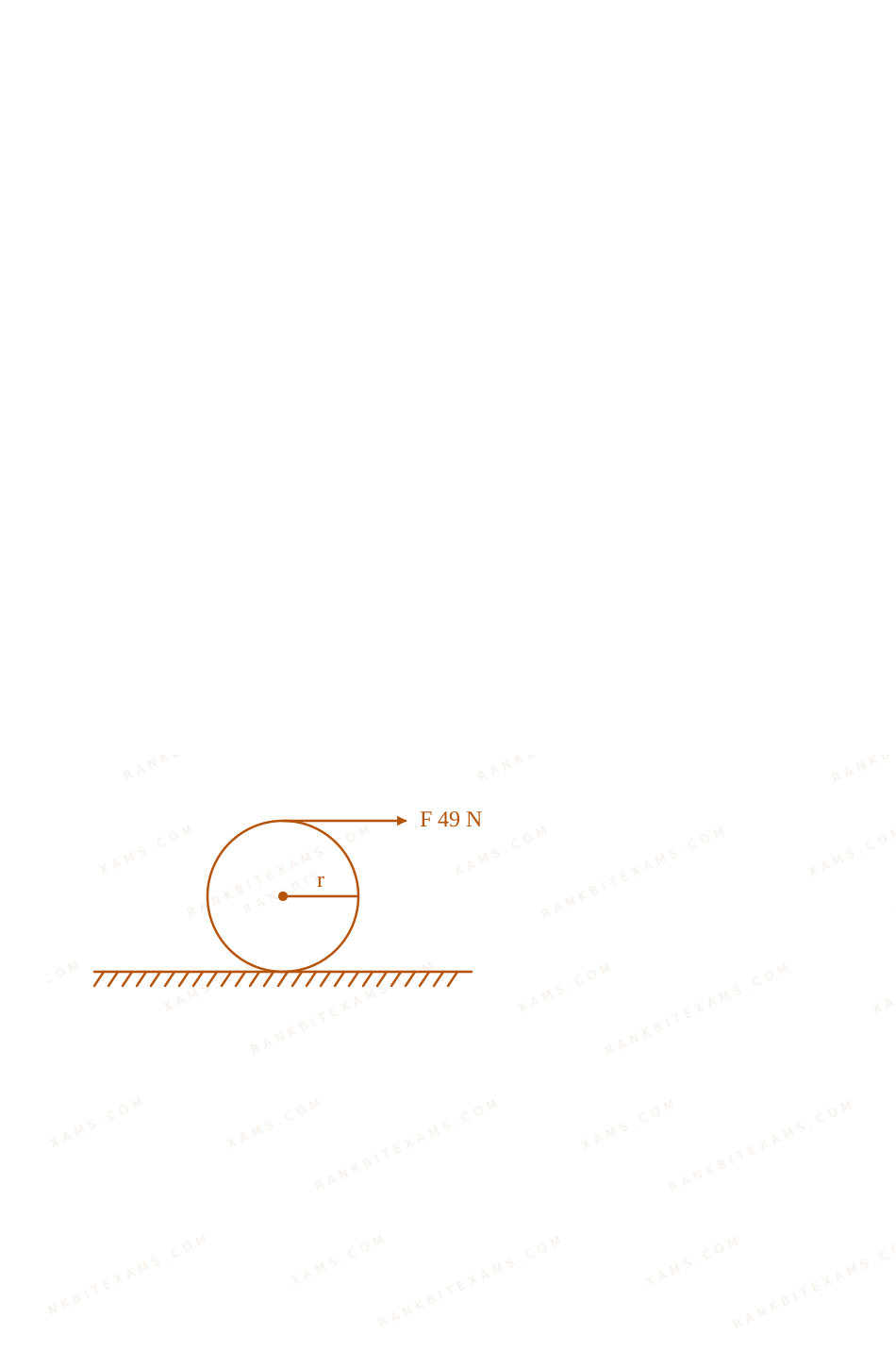
A body of mass 5text kg moving with a uniform speed 3sqrt2text ms^-1 in X–Y plane along the line y = x + 4. The angular momentum of the particle about the origin will be ______ textkg m^2texts^-1.

Numerical Answer Type:
Enter a numerical value Answer: 60 to 60 +4 marks

Solution & Explanation

### Related Formula The magnitude of the angular momentum L of a particle of mass m moving with velocity v is: L = m v d where: * d is the perpendicular distance from the axis of rotation (origin) to the line of motion of the particle. ### Core Logic Given parameters: * Mass, m = 5text kg * Velocity, v = 3sqrt2text ms^-1 * Line of motion: y = x + 4 implies x - y + 4 = 0 ### Step 1: Calculate Perpendicular Distance The perpendicular distance d from the origin (0,0) to the line Ax + By + C = 0 is: d = frac|A(0) + B(0) + C|sqrtA^2 + B^2 For the line x - y + 4 = 0: d = frac|4|sqrt1^2 + (-1)^2 = frac4sqrt2 = 2sqrt2text m ### Step 2: Calculate Angular Momentum Substitute the values into the angular momentum formula: L = m v d L = 5text kg times (3sqrt2text ms^-1) times (2sqrt2text m) L = 5 times 3 times 4 = 60text kg m^2texts^-1 Thus, the angular momentum of the particle about the origin is 60text kg m^2texts^-1. ### Pattern Recognition Instead of complicated vector cross products, find the perpendicular distance of the straight line from the origin using standard coordinate geometry. L = mvd is extremely fast and reliable. ### Evaluation Rubric / Model Answer null ### Chapter Mix Class 11 Physics: System of Particles and Rotational Motion

More System of Particles and Rotational Motion Previous-Year Questions — Page 7

Q54 jee_main_2024_29_jan_morning Rolling Motion
A cylinder is rolling down on an inclined plane of inclination 60^circ. It's acceleration during rolling down will be fracxsqrt3 mathrm~m / s^2, where x = ________ (use g = 10 mathrm~m/s^2).
Numerical Answer. Answer: 10 to 10

Solution

### Related Formula The linear acceleration (a) of a symmetric body performing pure rolling down an inclined plane of angle theta is given by: a = fracg sin theta1 + fracI_textcmM R^2 ### Core Logic For a solid cylinder, the moment of inertia about its central longitudinal axis is: I_textcm = frac12 M R^2 implies fracI_textcmM R^2 = frac12 Given inclination angle, theta = 60^circ, and g = 10 mathrm~m/s^2.
Free body diagram of a rolling cylinder on an incline for Q54
### Step 1: Calculate Linear Acceleration Substituting the values into the acceleration template: a = frac10 times sin 60^circ1 + frac12 = frac10 times fracsqrt32frac32 a = frac10 sqrt33 = frac10sqrt3 mathrm~m/s^2 ### Step 2: Solve for x Comparing this evaluated value with the expression \frac{x}{\sqrt{3}}: frac10sqrt3 = fracxsqrt3 implies x = 10 Therefore, the value of x is 10. ### Pattern Recognition Pure rolling problems reduce down to tracking the shape factor fraction \beta = 1 + \frac{I}{MR^2}. For solid cylinders it is 1.5, for solid spheres it is 1.4, and for hoops it is 2.0$. This value acts as an effective inertial scaling factor for gravity. ### Evaluation Rubric / Model Answer null ### Chapter Mix Class 11 Physics: System of Particles and Rotational Motion
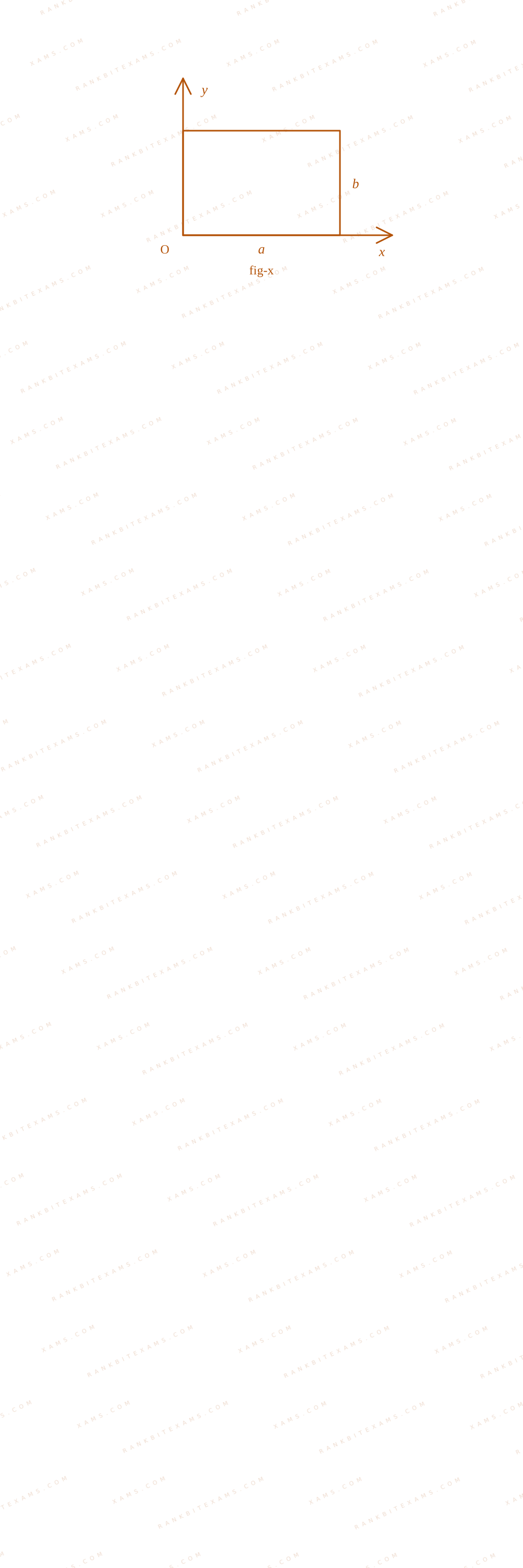
Q53 jee_main_2024_30_january_evening Loss in Kinetic Energy on Coupling
Two discs of moment of inertia mathrmI_1 = 4 mathrm~kg mathrm~m^2 and mathrmI_2 = 2 mathrm~kg mathrm~m^2 about their central axes & normal to their planes, rotating with angular speeds 10 mathrm~rad/s & 4 mathrm~rad/s respectively are brought into contact face to face with their axe of rotation coincident. The loss in kinetic energy of the system in the process is ________ mathrmJ.
Numerical Answer. Answer: 24 to 24

Solution

### Related Formula textC.O.A.M: I_1 omega_1 + I_2 omega_2 = (I_1 + I_2) omega_textfinal Delta K.E. = frac12 fracI_1 I_2I_1 + I_2 (omega_1 - omega_2)^2 ### Core Logic When two rotating discs are brought into contact, they exert friction on each other until they reach a common angular velocity. Angular momentum is conserved about the central axis. We can use the conservation of angular momentum to find the final angular velocity, or use the direct formula for loss in kinetic energy. ### Step 1: Calculate Final Angular Velocity (Alternative Method) I_1 omega_1 + I_2 omega_2 = (I_1 + I_2)omega_0 4(10) + 2(4) = (4 + 2)omega_0 40 + 8 = 6omega_0 implies omega_0 = 8 mathrm~rad/s ### Step 2: Calculate Kinetic Energy Loss Initial Energy mathrmE_1 = frac12 I_1 omega_1^2 + frac12 I_2 omega_2^2 mathrmE_1 = frac12(4)(100) + frac12(2)(16) = 200 + 16 = 216 mathrm~J Final Energy mathrmE_2 = frac12 (I_1 + I_2) omega_0^2 mathrmE_2 = frac12 (6) (8^2) = 3 times 64 = 192 mathrm~J Loss Delta E = mathrmE_1 - mathrmE_2 = 216 - 192 = 24 mathrm~J ### Pattern Recognition The loss formula \Delta K = \frac{1}{2} \frac{I_1 I_2}{I_1 + I_2} (\omega_1 - \omega_2)^2 is incredibly fast: \frac{1}{2} \times \frac{4 \times 2}{6} \times (10 - 4)^2 = \frac{1}{2} \times \frac{8}{6} \times 36 = \frac{4}{6} \times 36 = 24 \mathrm{~J}$. ### Evaluation Rubric / Model Answer null ### Chapter Mix Class 11 Physics: System of Particles and Rotational Motion
Q47 jee_main_2024_30_jan_morning Impulse and Momentum
A spherical body of mass 100 mathrm~g is dropped from a height of 10 mathrm~m from the ground. After hitting the ground, the body rebounds to a height of 5 mathrm~m. The impulse of force imparted by the ground to the body is given by: (given g = 9.8 mathrm~m / s^2)
  • A. 4.32 mathrm~kg\,ms^-1
  • B. 43.2 mathrm~kg\,ms^-1
  • C. 23.9 mathrm~kg\,ms^-1
  • D. 2.39 mathrm~kg\,ms^-1

Solution

### Related Formula v = sqrt2gh vecI = Delta vecP = m(vecv_f - vecv_i) ### Core Logic Impulse delivered by the ground equals the total change in momentum of the body during the collision. We must compute the velocity immediately before impact and immediately after rebound, respecting their opposite vector directions. ### Step 1: Calculate Velocities Velocity just before hitting the ground (v_i): v_i = sqrt2 times 9.8 times 10 = sqrt196 = -14 mathrm~m/s quad (textdownwards) Velocity just after rebounding (v_f): v_f = sqrt2 times 9.8 times 5 = sqrt98 = +7sqrt2 mathrm~m/s quad (textupwards) ### Step 2: Calculate Impulse Mass M = 100 mathrm~g = 0.1 mathrm~kg vecI = Delta P = m(v_f - v_i) vecI = 0.1 times [7sqrt2 - (-14)] vecI = 0.1(14 + 7sqrt2) Since sqrt2 approx 1.414: vecI = 0.1(14 + 7(1.414)) = 0.1(14 + 9.898) = 0.1(23.898) vecI approx 2.39 mathrm~kg\,ms^-1 ### Pattern Recognition When dealing with rebounds, Delta v is the sum of magnitudes |v_1| + |v_2| because the direction reverses. A common trap is to subtract the magnitudes instead of adding. ### Evaluation Rubric / Model Answer null ### Chapter Mix Class 11 Physics: System of Particles and Rotational Motion Class 11 Physics: Kinematics
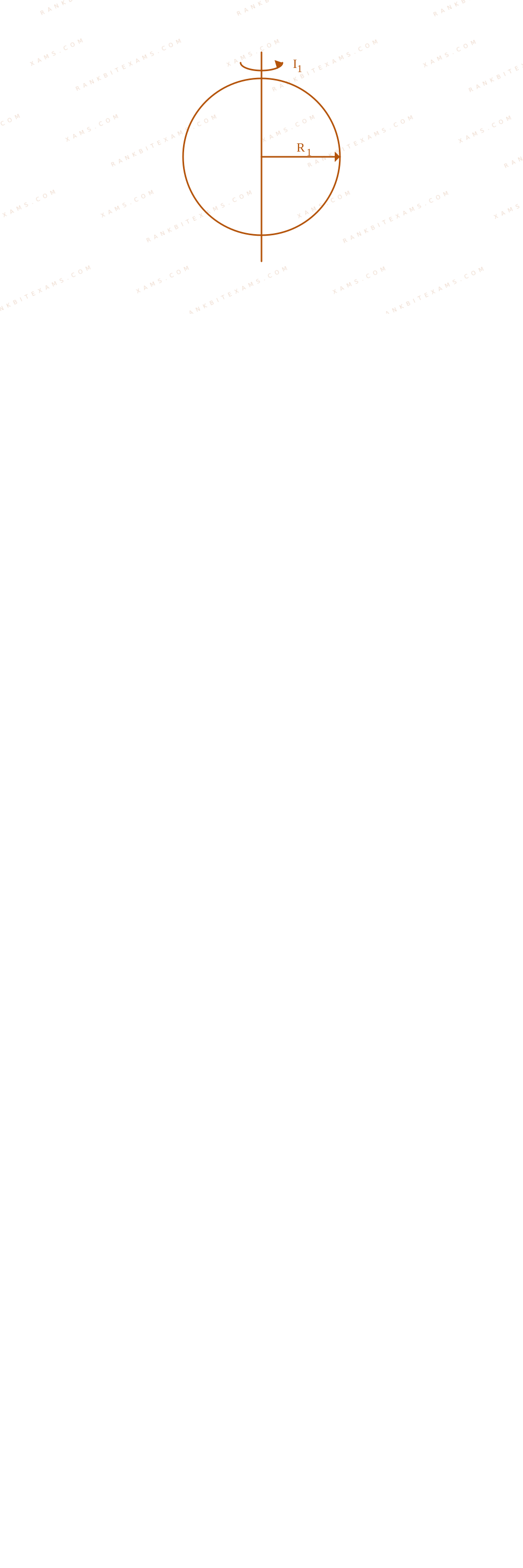
Q48 jee_main_2024_30_jan_morning Angular Momentum of a Projectile
A particle of mass m projected with a velocity 'u' making an angle of 30^circ with the horizontal. The magnitude of angular momentum of the projectile about the point of projection when the particle is at its maximum height h is :
  • A. fracsqrt316 fracmu^3g
  • B. fracsqrt32 fracmu^2g
  • C. fracmu^3sqrt2g
  • D. textzero

Solution

### Related Formula L = m v_perp r_perp = m (u cos theta) H H_max = fracu^2 sin^2 theta2g ### Core Logic At maximum height, the vertical component of velocity is zero, so the only velocity is horizontal (u cos theta). The perpendicular distance from the line of action of this velocity to the origin is exactly the maximum height H. ### Step 1: Calculate Angular Momentum L = m cdot (u cos theta) cdot H Substitute H = fracu^2 sin^2 theta2g: L = m u cos theta left( fracu^2 sin^2 theta2g right) ### Step 2: Plug in Angles For theta = 30^circ: L = fracm u^32g cos(30^circ) sin^2(30^circ) L = fracm u^32g times fracsqrt32 times left(frac12right)^2 L = fracsqrt3 m u^316g ### Pattern Recognition Angular momentum of a projectile at apex about the launch point strictly uses the horizontal velocity component coupled with the maximum height as the lever arm: L = mv_x H. ### Evaluation Rubric / Model Answer null ### Chapter Mix Class 11 Physics: System of Particles and Rotational Motion Class 11 Physics: Kinematics
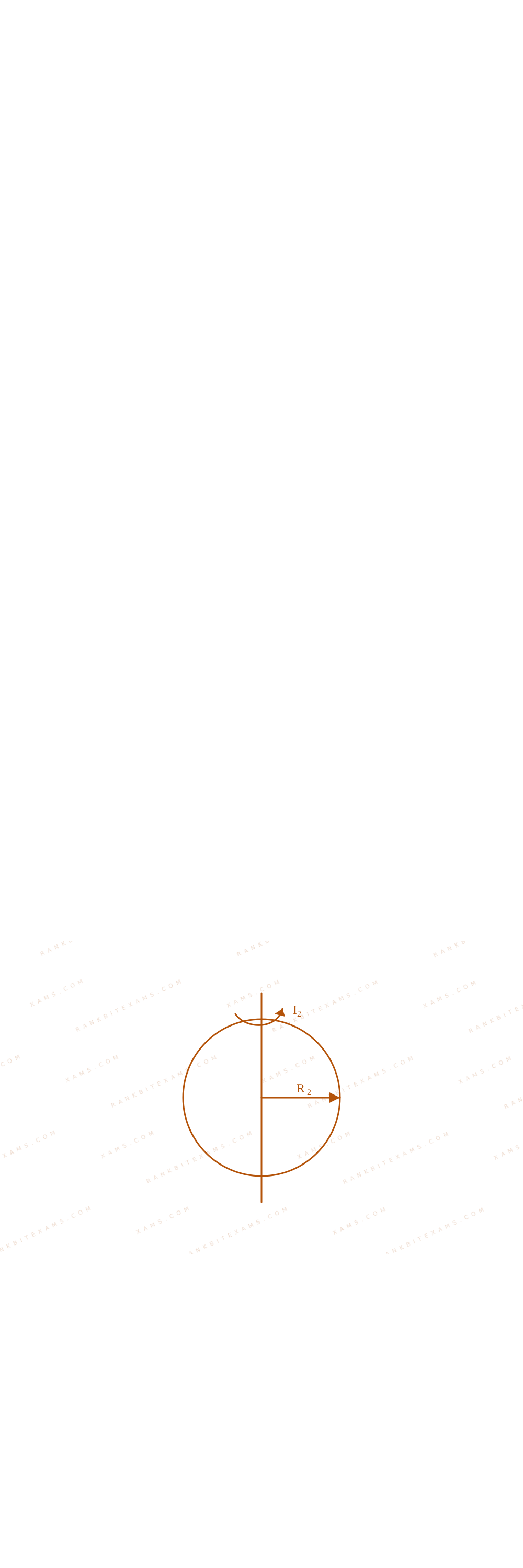
Q58 jee_main_2024_30_jan_morning Conservation of Angular Momentum
Consider a Disc of mass 5 mathrm~kg, radius 2 mathrm~m, rotating with angular velocity of 10 mathrm~rad/s about an axis perpendicular to the plane of rotation. An identical disc is kept gently over the rotating disc along the same axis. The energy dissipated so that both the discs continue to rotate together without slipping is ________ J.
Conservation of Angular Momentum diagram for Q58 - JEE Main 2024 Morning
A 5kg disc spinning at 10 rad/s before a second identical disc is added.
Numerical Answer. Answer: 250 to 250

Solution

### Related Formula I = fracMR^22 quad (textfor a solid disc) L = I omega E = frac12 I omega^2 ### Core Logic Since no external torque acts on the system along the axis of rotation, the angular momentum of the system is conserved. After coupling, the total moment of inertia doubles, slowing the common angular velocity. The kinetic energy lost goes into frictional heat between the discs. ### Step 1: Calculate Initial State Moment of inertia of one disc: I = fracMR^22 = frac5 times 2^22 = 10 mathrm~kg\,m^2 Initial angular momentum: L_i = I omega_i = 10 times 10 = 100 mathrm~kg\,m^2/s Initial kinetic energy: E_i = frac12 I omega_i^2 = frac12(10)(10)^2 = 500 mathrm~J ### Step 2: Conservation of Angular Momentum vecL_i = vecL_f 100 = 2I omega_f = 2(10) omega_f 100 = 20 omega_f Rightarrow omega_f = 5 mathrm~rad/s ### Step 3: Calculate Final Energy and Loss Final kinetic energy (for both discs): E_f = frac12 (2I) omega_f^2 = frac12 (20) (5)^2 = 10 times 25 = 250 mathrm~J Energy dissipated: Delta E = E_i - E_f = 500 - 250 = 250 mathrm~J ### Pattern Recognition When an identical object drops onto a spinning object (I_f = 2I_i), conservation of L dictates omega_f = omega_i / 2. Rotational KE (L^2 / 2I) is inversely proportional to I. Thus, doubling I halves the KE. The loss is exactly half the initial energy. ### Evaluation Rubric / Model Answer null ### Chapter Mix Class 11 Physics: System of Particles and Rotational Motion

More System of Particles and Rotational Motion Questions — jee_main_2024_29_january_evening
Practice all System of Particles and Rotational Motion previous-year questions →
YOUR FIRST PREP STEP STARTS HERE

We Map Every Repeating Question in Competitive Exams.

Say goodbye to generic mock test fatigue. RankBit uses smart analysis to group past exam questions into their foundational Repeating Question Types. Find chapter weightage, track repeating questions, and score higher with targeted practice.

Select Your Target Exam

Choose an exam track below to find formulas per chapter and patterns.

Syncing Exam Intelligence

Mapping formulas and patterns across all tracks…

PATH A — FULL LENGTH PRACTICE

Full Mock Test Hub

Simulate real NTA exam conditions with fully tracked mocks. Time yourself against past papers.

Under Development
PATH B — TARGETED PRACTICE

Topic-wise Practice Hub

Practice past-year questions one chapter at a time. Pick an exam → subject → chapter and get every PYQ for that topic — pulled together from all past papers — with the chapter's key formulas alongside.

Loading Questions... Browse Topics
Latest from the Blog
View all →

Loading articles...