Rankbit System
JEE Physics: Waves (+15.5%) | Electrostatics: Concentric Shells (-29.7%) | Modern Physics: Photoelectric Clones (+34.2%) | Mathematics: Definite Integrals (+18.1%) | Chemistry: Coordination Splitting (-11.4%) | JEE Physics: Waves (+15.5%) | Electrostatics: Concentric Shells (-29.7%) | Modern Physics: Photoelectric Clones (+34.2%) | Mathematics: Definite Integrals (+18.1%) | Chemistry: Coordination Splitting (-11.4%)

A particle of mass m projected with a velocity 'u' making an angle of 30^circ with the horizontal. The magnitude of angular momentum of the projectile about the point of projection when the particle is at its maximum height h is :

Solution & Explanation

### Related Formula L = m v_perp r_perp = m (u cos theta) H H_max = fracu^2 sin^2 theta2g ### Core Logic At maximum height, the vertical component of velocity is zero, so the only velocity is horizontal (u cos theta). The perpendicular distance from the line of action of this velocity to the origin is exactly the maximum height H. ### Step 1: Calculate Angular Momentum L = m cdot (u cos theta) cdot H Substitute H = fracu^2 sin^2 theta2g: L = m u cos theta left( fracu^2 sin^2 theta2g right) ### Step 2: Plug in Angles For theta = 30^circ: L = fracm u^32g cos(30^circ) sin^2(30^circ) L = fracm u^32g times fracsqrt32 times left(frac12right)^2 L = fracsqrt3 m u^316g ### Pattern Recognition Angular momentum of a projectile at apex about the launch point strictly uses the horizontal velocity component coupled with the maximum height as the lever arm: L = mv_x H. ### Evaluation Rubric / Model Answer null ### Chapter Mix Class 11 Physics: System of Particles and Rotational Motion Class 11 Physics: Kinematics
More System of Particles and Rotational Motion Previous-Year Questions

Q jee_main_2025_02_april_evening Torque and Moment of Inertia
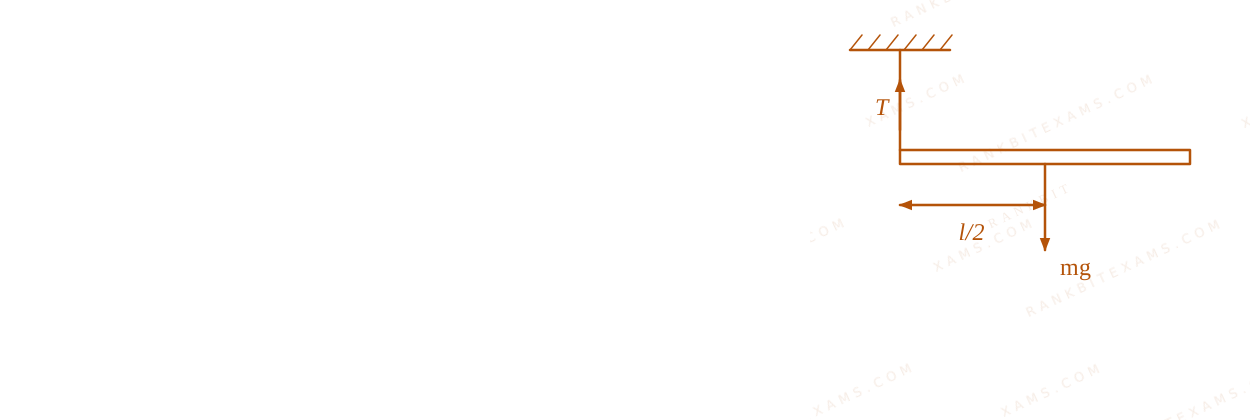
A wheel of radius 0.2 mathrm~m rotates freely about its center when a string that is wrapped over its rim is pulled by force of 10 mathrm~N as shown in figure. The established torque produces an angular acceleration of 2 mathrmrad / mathrms^2 . Moment of inertia of the wheel is ________ kg m^2 . (Acceleration due to gravity = 10mathrmm / mathrms^2)
Circular wheel being pulled by a tangential force string
The diagram displays a circular wheel rotating about its center under a tangential pulling force of 10 N.
Numerical Answer. Answer: 1 to 1

Solution

### Related Formula 1. Torque (tau) produced by a tangential pulling force: tau = F cdot R 2. Newton's second law for rotation: tau = I cdot alpha ### Core Logic We are given: - Radius of the wheel R = 0.2 \ mathrmm - Applied force F = 10 \ mathrmN - Angular acceleration alpha = 2 \ mathrmrad/s^2 ### Step 1: Calculate torque and moment of inertia First, find the torque tau: tau = F cdot R = 10 \ mathrmN times 0.2 \ mathrmm = 2 \ mathrmN cdot m Next, calculate the moment of inertia I using tau = Ialpha: I = fractaualpha = frac2 \ mathrmN cdot m2 \ mathrmrad/s^2 = 1 \ mathrmkg cdot m^2 Thus, the moment of inertia is 1 mathrm~kgcdot m^2. ### Pattern Recognition Sees: Pulley/wheel torque with basic rotational dynamics. Trap: Attempting to integrate gravity (g = 10text m/s^2) into mass equations. Gravity is a redundant distractor here because the pulling tension force is explicitly defined! Shortcut: Directly compute torque as tau = F R and divide by the angular acceleration alpha. ### Evaluation Rubric / Model Answer null ### Chapter Mix Class 11 Physics: System of Particles and Rotational Motion
Q3 jee_main_2025_02_april_evening Moment of Inertia of Ring
The moment of inertia of a circular ring of mass M and diameter r about a tangential axis lying in the plane of the ring is:
  • A. frac12 M r^2
  • B. frac38 M r^2
  • C. frac32 M r^2
  • D. 2 M r^2

Solution

### Related Formula 1. Moment of inertia of a circular ring of mass M and radius R about a diametrical axis in its plane: I_textdia = frac12 M R^2 2. Parallel Axis Theorem: I = I_textcm + M d^2 where d is the perpendicular distance between the center of mass axis and the parallel axis. ### Core Logic The axis of rotation is tangential and lies in the plane of the ring. Thus, the distance from the center of mass axis (which is also diametrical and in-plane) is equal to the radius R. Using the parallel axis theorem: I_texttangent = I_textdia + M R^2 = frac12 M R^2 + M R^2 = frac32 M R^2 ### Step 1: Express in terms of diameter r The question specifies the diameter of the ring is r. Therefore, the radius R is: R = fracr2 Substitute R = fracr2 into the moment of inertia formula: I_texttangent = frac32 M left(fracr2right)^2 = frac38 M r^2 Thus, the moment of inertia is frac38 M r^2. ### Pattern Recognition Sees: Circular ring tangential axis in-plane. Trap: Directly using radius r instead of diameter r. Read variables carefully: often r is radius, but here it is explicitly given as diameter! Shortcut: Standard in-plane tangent is frac32MR^2. Substitute R = fracr2 to get frac38Mr^2. ### Evaluation Rubric / Model Answer null ### Chapter Mix Class 11 Physics: System of Particles and Rotational Motion

Q3 jee_main_2025_02_april_morning Moment of Inertia and Torque
A cord of negligible mass is wound around the rim of a wheel supported by spokes with negligible mass. The mass of wheel is 10mathrm~kg and radius is 10mathrm~cm and it can freely rotate without any friction. Initially the wheel is at rest. If a steady pull of 20mathrm~N is applied on the cord, the angular velocity of the wheel, after the cord is unwound by 1mathrm~m, would be:
Wheel diagram for Q3 - JEE Main 2025 Morning
A wheel rotating with a pull force of 20 N acting on the cord.
  • A. 20mathrm~rad/s
  • B. 30mathrm~rad/s
  • C. 10mathrm~rad/s
  • D. 0mathrm~rad/s

Solution

### Related Formula W_F = F cdot s K_R = frac12 I omega^2 I = M R^2 quad text(Moment of inertia of a ring/rim) ### Core Logic The work done by the constant pulling force F = 20mathrm~N through distance s = 1mathrm~m is completely converted into the rotational kinetic energy of the wheel. Work done by force: W_F = F cdot s = 20 times 1 = 20mathrm~J Since the spokes are of negligible mass, all mass M = 10mathrm~kg is distributed on the outer rim of radius R = 10mathrm~cm = 0.1mathrm~m. The wheel acts as a thin ring: I = M R^2 = 10 times (0.1)^2 = 0.1mathrm~kgcdot m^2 Using the work-energy theorem: W_F = Delta K_R = frac12 I omega^2 20 = frac12 times 0.1 times omega^2 40 = 0.1 omega^2 implies omega^2 = 400 implies omega = 20mathrm~rad/s ### Step 1: Final Conclusion The angular velocity of the wheel after the cord is unwound by 1mathrm~m is 20mathrm~rad/s. ### Pattern Recognition Work done in unwinding a string is F cdot s. Under pure rotation with zero friction, this is exactly frac12 I omega^2. Always identify the mass distribution (here, rim with massless spokes acts as a thin cylinder/ring I = MR^2). ### Evaluation Rubric / Model Answer null ### Chapter Mix Class 11 Physics: Rotational Motion Class 11 Physics: Work, Energy and Power
Q13 jee_main_2025_02_april_morning Moment of Inertia and Torque
A square Lamina OABC of length 10mathrm~cm is pivoted at 'O'. Forces act on the Lamina as shown in the figure. If the Lamina remains stationary, then the magnitude of F is:
Square lamina pivoted at O diagram for Q13
A square lamina OABC with multiple force vectors acting on its vertices, pivoted at O.
  • A. 20mathrm~N
  • B. 0 (zero)
  • C. 10mathrm~N
  • D. 10sqrt2mathrm~N

Solution

### Related Formula tau_O = F cdot r_perp sum tau_O = 0 quad text(for rotational equilibrium) ### Core Logic Let the side length of the square lamina be l = 10mathrm~cm. The lamina is pivoted at point O(0,0) and remains stationary under rotational equilibrium. Therefore, the net torque about O must be zero. Evaluating torque contributions about point O: - Forces acting directly at pivot O produce zero torque. - Forces whose lines of action pass through O produce zero torque. - The 10mathrm~N force perpendicular to side OA produces torque: tau_1 = 10 times l quad text(Counter-Clockwise) - The unknown force F acting perpendicular to side OC produces torque: tau_2 = F times l quad text(Clockwise) Setting sum tau_O = 0: 10 cdot l - F cdot l = 0 implies F = 10mathrm~N ### Step 1: Final Conclusion The magnitude of the force F is 10\mathrm{~N}$. ### Pattern Recognition In pivoted laminas, focus on the pivot and disregard any force vector whose line of action passes through the pivot. For symmetric placements, equate Clockwise torque = Counter-Clockwise torque directly. ### Evaluation Rubric / Model Answer null ### Chapter Mix Class 11 Physics: Rotational Motion
Q16 jee_main_2025_02_april_morning Moment of Inertia and Torque
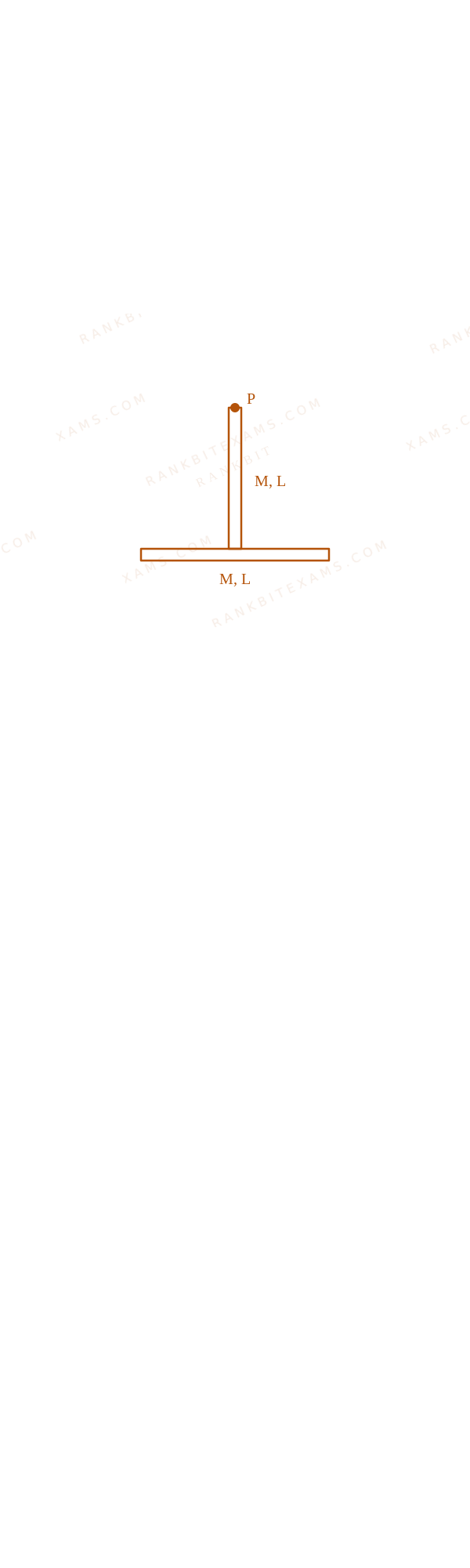
Moment of inertia of a rod of mass 'M' and length 'L' about an axis passing through its center and normal to its length is 'α'. Now the rod is cut into two equal parts and these parts are joined symmetrically to form a cross shape. Moment of inertia of cross about an axis passing through its center and normal to plane containing cross is:
  • A. alpha
  • B. alpha / 4
  • C. alpha / 8
  • D. alpha / 2

Solution

### Related Formula I = frac112 M L^2 ### Core Logic Initially, the moment of inertia is: alpha = fracM L^212 When cut into two equal parts, each smaller rod has: - Mass, m = fracM2 - Length, l = fracL2 When joined symmetrically as a cross, the target axis passes through their joint intersection perpendicular to their plane. For each rod, this axis passes through its individual center of mass and is perpendicular to its length. Thus, the total moment of inertia of the cross is the sum of the moments of inertia of the two rods: I_textcross = I_1 + I_2 = 2 times left(frac112 m l^2right) = frac16 m l^2 Substituting m = fracM2 and l = fracL2: I_textcross = frac16 times left(fracM2right) times left(fracL2right)^2 = frac16 times fracM2 times fracL^24 = fracM L^248 Comparing with alpha: I_textcross = frac14 left(fracM L^212right) = fracalpha4 ### Step 1: Final Conclusion The moment of inertia of the cross is \alpha / 4. ### Pattern Recognition Since mass scales linearly (M \propto L), cutting a rod into n equal segments scales the length by 1/n and mass by 1/n. The moment of inertia of each segment scales as 1/n^3. Reassembling n segments linearly sums their contributions, so the final moment of inertia scales as n \times \frac{1}{n^3} = \frac{1}{n^2}$. ### Evaluation Rubric / Model Answer null ### Chapter Mix Class 11 Physics: Rotational Motion

More System of Particles and Rotational Motion Questions — jee_main_2024_30_jan_morning

Practice all System of Particles and Rotational Motion previous-year questions →

YOUR FIRST PREP STEP STARTS HERE

We Map Every Repeating Question in Competitive Exams.

Say goodbye to generic mock test fatigue. RankBit uses smart analysis to group past exam questions into their foundational Repeating Question Types. Find chapter weightage, track repeating questions, and score higher with targeted practice.

Select Your Target Exam

Choose an exam track below to find formulas per chapter and patterns.

Syncing Exam Intelligence

Mapping formulas and patterns across all tracks…

PATH A — FULL LENGTH PRACTICE

Full Mock Test Hub

Simulate real NTA exam conditions with fully tracked mocks. Time yourself against past papers.

Under Development
PATH B — TARGETED PRACTICE

Topic-wise Practice Hub

Practice past-year questions one chapter at a time. Pick an exam → subject → chapter and get every PYQ for that topic — pulled together from all past papers — with the chapter's key formulas alongside.

Loading Questions... Browse Topics
Latest from the Blog
View all →

Loading articles...