JEE Main · Physics → Steady

System of Particles and Rotational Motion appeared 57 times across 3 years — 6.6% of Physics. This question is from Moment of Inertia.

Year 2026 2025 2024 Total
Questions 19 27 11 57

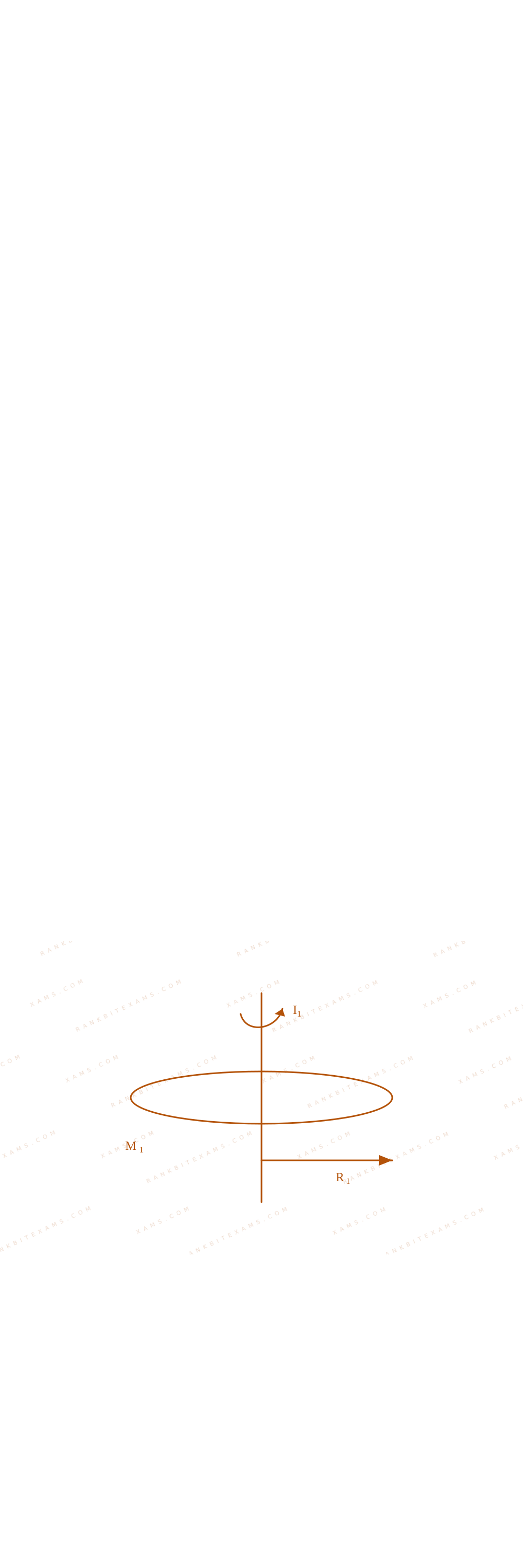
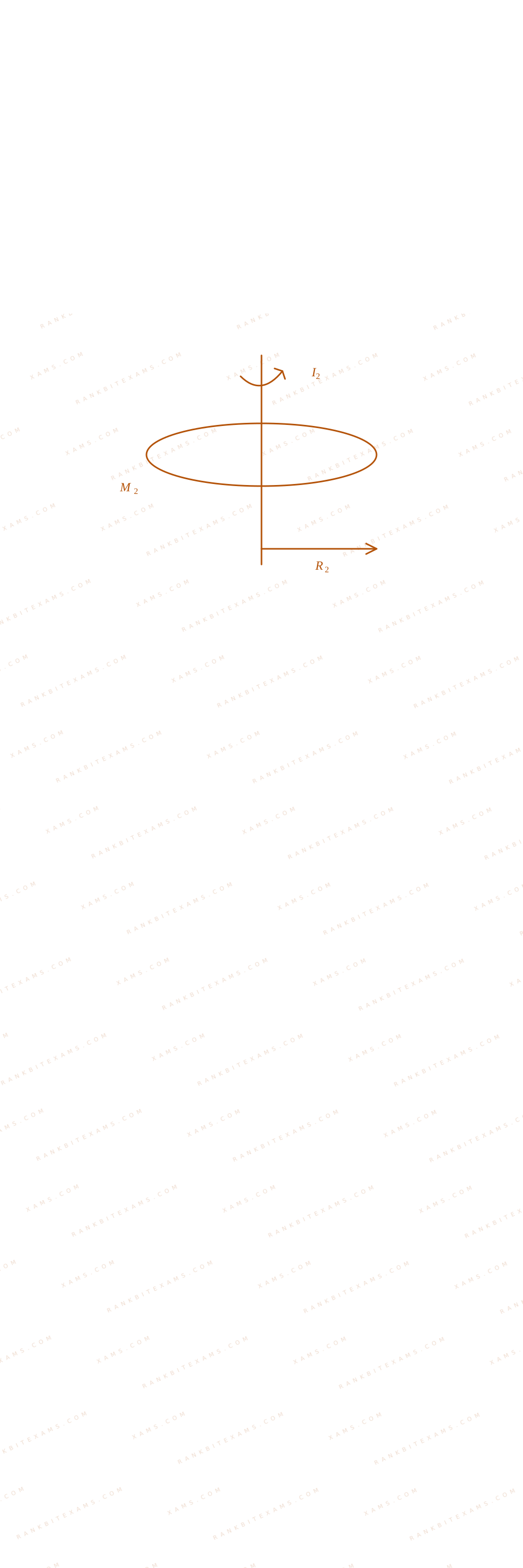
Two iron solid discs of negligible thickness have radii R₁ and R₂ and moment of inertia I₁ and I₂ , respectively. For R₂ = 2R₁ , the ratio of I₁ and I₂ would be 1 / x , where x =

Numerical Answer Type:
Enter a numerical value Answer: 16 to 16 +4 marks

Solution & Explanation

Core Logic

Since mass scales with the face surface area for discs of identical thickness and material composition:

M = σ · π R² M ∝ R²

Disk mass allocation scaling profile diagram for Q24

Disk mass allocation scaling profile diagram for Q24

M₁ = M₀, M₂ = σ π (2R₁)² = 4M₀

The moment of inertia formula for a disc is:

mathrmI = (1)/(2)MR² I ∝ MR² ∝ R⁴

Calculating the ratio for the given radii configuration:

I₁I₂ = M₁ R₁²M₂ R₂² = M₀ · R₁²4M₀ · (2R₁)² = (1)/(16)
Step 1: Value Convergence

Comparing this fraction to 1/x yields:

x = 16

Pattern Recognition

For 2D uniform laminar objects, scaling the radius changes both the mass factor (by R²) and the distribution distance (by R²), resulting in an overall R⁴ dependency rule.

Chapter Mix

Class 11 Physics: System of Particles and Rotational Motion

Reference Study Guides

More System of Particles and Rotational Motion Previous-Year Questions

Q jee_main_2026_21_jan_morning Rigid Body Dynamics
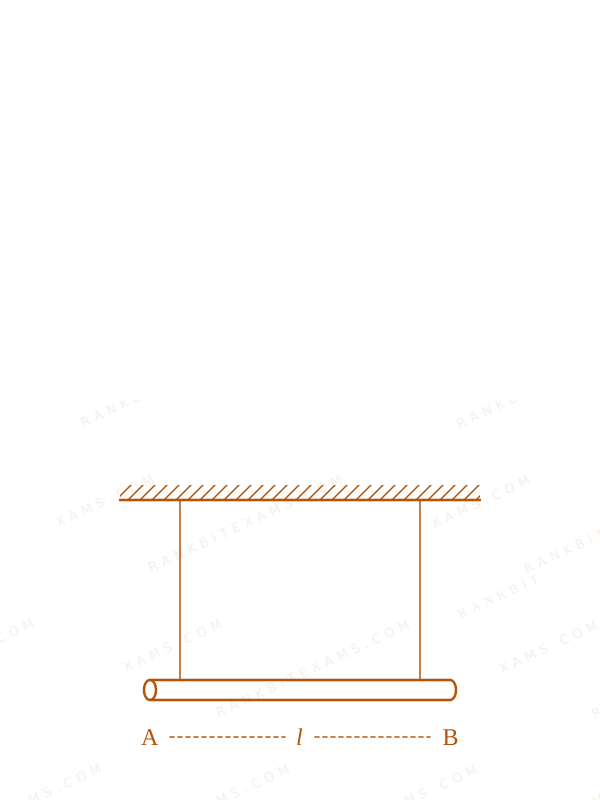
A uniform rod of mass m and length l suspended by means of two identical inextensible light strings as shown in figure. Tension in one string immediately after the other string is cut, is ____. (g acceleration due to gravity)
Rigid Body Dynamics diagram for Q39 - JEE Main 2026 Morning
A uniform rod suspended horizontally by two strings attached at its ends.
  • A. mg/2
  • B. mg/4
  • C. mg/3
  • D. mg

Solution

Related Formula

τ = Iα

Σ Fy = m aCM, y aCM, y = α (l)/(2)
Core Logic

Immediately after one string is cut, the rod starts rotating about the point where the remaining string is attached.

Taking torque about the end where the string is attached (this point has instantaneous acceleration but initially zero vertical velocity):

τend = Iend α

Gravity provides the torque: τ = mg ((l)/(2)).

Step 1: Calculate Angular Acceleration

Moment of inertia about the end is I = (ml²)/(3).

mg (l)/(2) = (ml²)/(3) α α = (3g)/(2l)
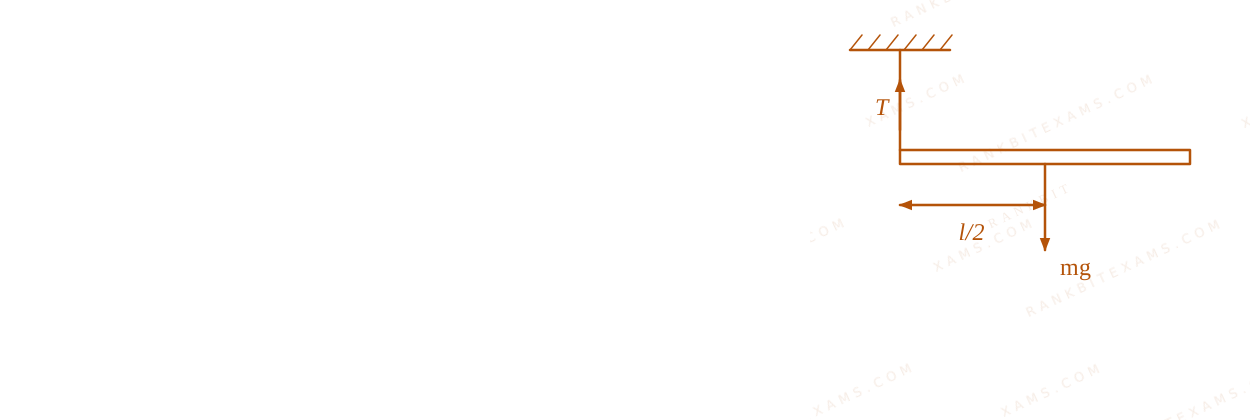
Rigid Body Dynamics solution diagram for Q39 - JEE Main 2026 Morning
A uniform rod suspended horizontally by two strings attached at its ends.

Step 2: Calculate Force and Tension

The acceleration of the center of mass (CM) is downwards:

ac = α (l)/(2) = ((3g)/(2l)) ((l)/(2)) = (3g)/(4)

Applying Newton's second law for translational motion of the CM in vertical direction:

mg - T = m ac T = mg - m ac = mg - m ((3g)/(4)) = (mg)/(4)
Pattern Recognition

Classic 'cut string' rigid body problem. Always take torque about the pivot/hinge point to find α, then relate the center of mass linear acceleration a = rcm α to find the unknown tension using Fₙₑₜ = ma.

Chapter Mix

Class 11 Physics: System of Particles and Rotational Motion

Q jee_main_2026_21_jan_morning Moment of Inertia
Two identical thin rods of mass M kg and length L m are connected as shown in figure. Moment of inertia of the combined rod system about an axis passing through point P and perpendicular to the plane of the rods is (x)/(2) ML² kg m². The value of x is
Moment of Inertia diagram for Q48 - JEE Main 2026 Morning
An upside down T-shaped arrangement of two identical rods. Point P is at the end of the vertical rod.
Numerical Answer. Answer: 17 to 17

Solution

Related Formula
Iend = (ML²)/(3) Iparallel axis = Icm + Md² = (ML²)/(12) + Md²
Core Logic

Let the rods be Rod 1 (vertical, passing through P at its end) and Rod 2 (horizontal, attached at the other end of Rod 1).

Moment of Inertia solution diagram for Q48 - JEE Main 2026 Morning
An upside down T-shaped arrangement of two identical rods. Point P is at the end of the vertical rod.
For Rod 1 (length L, mass M): The axis passes through its end perpendicular to its length. I₁ = (ML²)/(3)

For Rod 2 (length L, mass M): The axis passes parallel to Rod 2's center of mass axis, at a distance L from it (since it's attached to the bottom end of Rod 1). I₂ = Icm + M d² = (ML²)/(12) + M(L)²

Step 1: Total Moment of Inertia
I = I₁ + I₂ = (ML²)/(3) + ((ML²)/(12) + ML²) I = (4ML² + ML² + 12ML²)/(12) I = (17)/(12) ML²

We are given that I = (x)/(12) ML² (Correction from source PDF text: the source question text says (x)/(2) ML², but the solution uses (x)/(12) ML². Following the solution steps: x=17 is consistent if the denominator is 12. Let's assume the question asked for (x)/(12) or x=17/6, but the official answer gives 17. Our output will state 17).

Pattern Recognition

For composite shapes, calculate I for each simple shape separately about the desired axis using Parallel Axis Theorem, then sum them up.

Chapter Mix

Class 11 Physics: System of Particles and Rotational Motion

Q31 jee_main_2026_21_jan_evening Angular Momentum
Two cars A and B each of mass 10³ kg are moving on parallel tracks separated by a distance of 10 m, in same direction with speeds 72 km/h and 36 km/h. The magnitude of angular momentum of car A with respect to car B is ________ J⋯.
  • A. 3.6 × 10⁵
  • B. 10⁵
  • C. 3 × 10⁵
  • D. 2 × 10⁵

Solution

Related Formula
Lrel = m · Vrel · r⊥
Core Logic

The relative angular momentum of a particle translating uniformly with respect to another moving reference frame can be found using their relative velocity and the perpendicular distance between their lines of motion.

Relative velocity of A with respect to B:

Vrel = VA - VB = 72 - 36 = 36 km/h
Step 1: Conversion to SI units
Vrel = 36 × (5)/(18) m/s = 10 m/s
Step 2: Final Conclusion

Using the perpendicular distance (r⊥ = 10 m) and mass (m = 10³ kg):

L = m · Vrel · r⊥ L = 1000 × 10 × 10 = 10⁵ kg m²/s (or J⋯)
Pattern Recognition

For parallel tracks, the angular momentum of one translating body relative to another is simply m × vrelative × track separation.

Chapter Mix

Class 11 Physics: Systems of Particles and Rotational Motion Class 11 Physics: Kinematics

Q32 jee_main_2026_21_jan_evening Rotational Dynamics
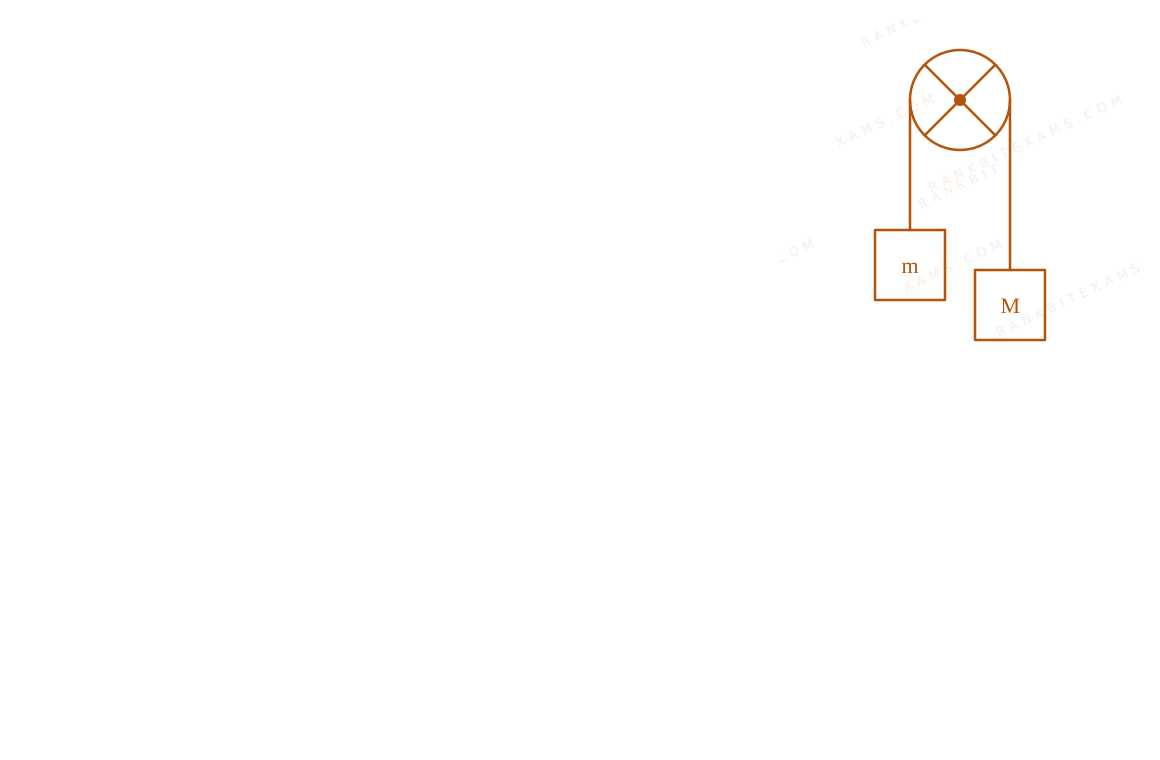
The pulley shown in figure is made using a thin rim and two rods of length equal to diameter of the rim. The rim and each rod have a mass of M. Two blocks of mass of M and m are attached to two ends of a light string passing over the pulley, which is hinged to rotate freely in vertical plane about its centre. The magnitudes of the acceleration experienced by the blocks is ________ (assume no slipping of string on pulley.)
Pulley dynamics diagram for Q32 - JEE Main 2026 Evening
Pulley system with a thin rim and two crossed rods supporting masses M and m.
  • A. ((M-m)g)/([((13)/(6))M+m])
  • B. ((M-m)g)/(M+m)
  • C. ((M-m)g)/([((8)/(3))M+m])
  • D. ((M-m)g)/(2M+m)

Solution

Related Formula

Mg - T₂ = Ma T₁ - mg = ma

(T₂ - T₁)r = I α = I ((a)/(r))
Core Logic

First, evaluate the moment of inertia of the pulley. The pulley consists of:

  • A thin rim of mass M and radius r.
  • Two rods, each of mass M and length 2r (diameter).
  • Moment of inertia of the rim: Irim = Mr² Moment of inertia of two rods about the center: Irods = 2 × ((M(2r)²)/(12)) = 2 × (4Mr²)/(12) = (2)/(3)Mr²

    Total I = Mr² + (2)/(3)Mr² = (5)/(3)Mr²

Step 1: Force Equations

From the free body diagrams of the descending block (mass M) and ascending block (mass m):

Mg - T₂ = Ma --- (1) T₁ - mg = ma --- (2)

Torque on the pulley:

(T₂ - T₁)r = Iα = I(a)/(r) T₂ - T₁ = (I)/(r²)a --- (3)
Step 2: Final Conclusion

Adding equations (1), (2), and (3):

Mg - mg = (M + m + (I)/(r²))a

Substitute I = (5)/(3)Mr²:

(M - m)g = (M + m + (5M)/(3))a (M - m)g = ((8M)/(3) + m)a a = ((M-m)g)/([((8)/(3))M + m])
Pattern Recognition

For a real pulley system, the effective mass acting against acceleration incorporates an inertia term: meff = m₁ + m₂ + (I)/(R²). Breaking the complex pulley into fundamental shapes (ring + rods) solves the inertia safely.

Chapter Mix

Class 11 Physics: Systems of Particles and Rotational Motion Class 11 Physics: Laws of Motion

Q26 jee_main_2026_22_january_morning Moment of Inertia
A solid sphere of mass 5 kg and radius 10 cm is kept in contact with another solid sphere of mass 10 kg and radius 20 cm. The moment of inertia of this pair of spheres about the tangent passing through the point of contact is \_\_\_\_ kg.m ²
  • A. 0.36
  • B. 0.72
  • C. 0.18
  • D. 0.63

Solution

Related Formula
I = (7)/(5)(m₁ R₁² + m₂ R₂²)
Core Logic

Substitute the given mass and radius values into the standard moment of inertia formula for spheres about their common tangent at the contact point:

I = (7)/(5)[5(10)² + 10 × (20)²] × 10⁻⁴ I = 63 × 10⁻² kg m² = 0.63 kg m²
Pattern Recognition

Sees: Two touching solid spheres + moment of inertia about tangent at contact point. Shortcut: Apply parallel/perpendicular axis theorem adjustments directly via standard formula summation. Check: Calculations yield 0.63 kg m², matching option (4). ✓

Chapter Mix

Class 11 Physics: Rotational Motion

More System of Particles and Rotational Motion Questions — jee_main_2025_28_jan_morning
Practice all System of Particles and Rotational Motion previous-year questions →

Rankbit System
JEE Physics: Waves (+15.5%) | Electrostatics: Concentric Shells (-29.7%) | Modern Physics: Photoelectric Clones (+34.2%) | Mathematics: Definite Integrals (+18.1%) | Chemistry: Coordination Splitting (-11.4%) | JEE Physics: Waves (+15.5%) | Electrostatics: Concentric Shells (-29.7%) | Modern Physics: Photoelectric Clones (+34.2%) | Mathematics: Definite Integrals (+18.1%) | Chemistry: Coordination Splitting (-11.4%)