A body of mass 5 kg$5\text{ kg}$ moving with a uniform speed 3√(2) ms⁻¹$3\sqrt{2}\text{ ms}^{-1}$ in X–Y plane along the line y = x + 4$y = x + 4$. The angular momentum of the particle about the origin will be ______ kg m²s⁻¹$\text{kg m}^2\text{s}^{-1}$.
Numerical Answer Type:
Enter a numerical valueAnswer: 60 to 60+4 marks
Solution & Explanation
Related Formula
The magnitude of the angular momentum L$L$ of a particle of mass m$m$ moving with velocity v$v$ is:
L = m v d$L = m v d$
where:
d$d$ is the perpendicular distance from the axis of rotation (origin) to the line of motion of the particle.
Core Logic
Given parameters:
Mass, m = 5 kg$m = 5\text{ kg}$
Velocity, v = 3√(2) ms⁻¹$v = 3\sqrt{2}\text{ ms}^{-1}$
Line of motion: y = x + 4 x - y + 4 = 0$y = x + 4 \implies x - y + 4 = 0$
Step 1: Calculate Perpendicular Distance
The perpendicular distance d$d$ from the origin (0,0)$(0,0)$ to the line Ax + By + C = 0$Ax + By + C = 0$ is:
Instead of complicated vector cross products, find the perpendicular distance of the straight line from the origin using standard coordinate geometry. L = mvd$L = mvd$ is extremely fast and reliable.
Chapter Mix
Class 11 Physics: System of Particles and Rotational Motion
Keywords:#angular momentum of the particle about the origin#JEE Main 2024 Evening Q60#Rotational Motion JEE Main 2024#Angular Momentum of straight line JEE Main 2024
More System of Particles and Rotational Motion Previous-Year Questions — Page 6
Q6jee_main_2025_07_april_morningCentre of Mass
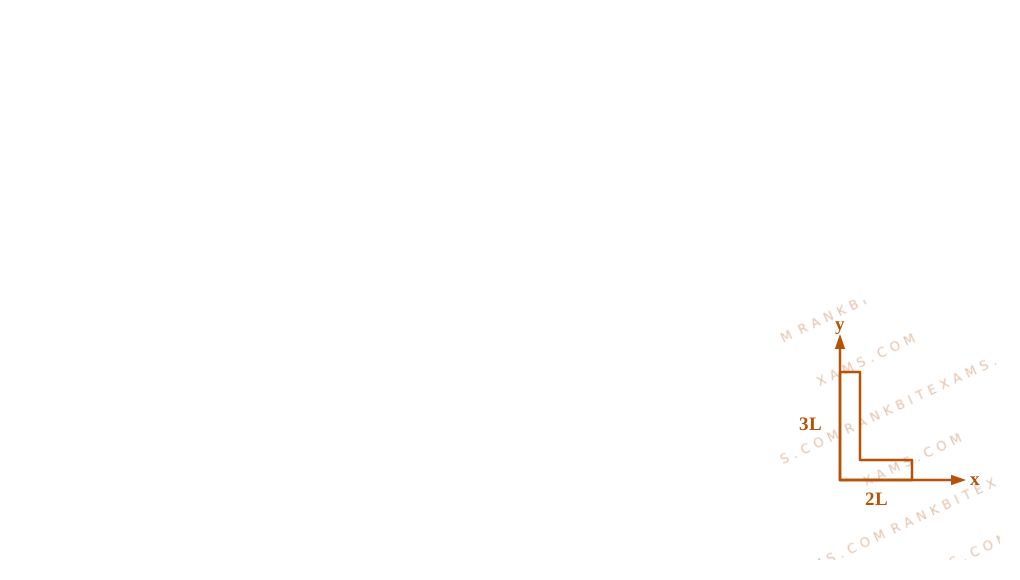
A rod of length 5 ~L$5 \mathrm{~L}$ is bent right angle keeping one side length as 2 ~L$2 \mathrm{~L}$ . Diagram of an L-shaped rod aligned with the x and y axes, with lengths 2L and 3L respectively. The position of the centre of mass of the system : (Consider L = 10cm$\mathrm{L} = 10\mathrm{cm}$ )
A.2 i + 3 j$2\hat{\mathbf{i}} + 3\hat{\mathbf{j}}$
B.3 i + 7 j$3\hat{\mathbf{i}} + 7\hat{\mathbf{j}}$
C.5 i + 8 j$5\hat{\mathbf{i}} + 8\hat{\mathbf{j}}$
D.4 i + 9 j$4\hat{\mathbf{i}} + 9\hat{\mathbf{j}}$
Solution
Related Formula
For a continuous system modeled as discrete point masses located at their respective centers of mass:
Sees: L-shaped rod formed by bending a total length Ltotal$L_{\text{total}}$.
Shortcut: Treat each arm as a point mass at its geometric midpoint. For segments of ratio 2:3$2:3$, the COM divides the distance between their midpoints in the inverse ratio 3:2$3:2$ closer to the heavier segment on the y-axis.
Chapter Mix
Class 11 Physics: System of Particles and Rotational Motion
Q21jee_main_2025_07_april_morningMoment of Inertia
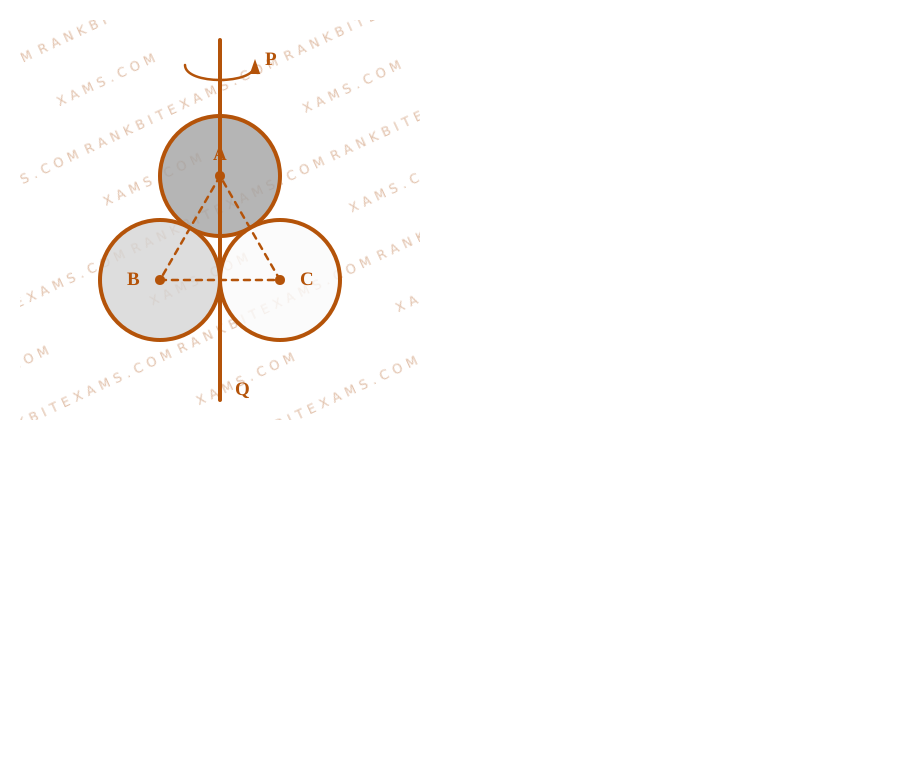
A, B and C are disc, solid sphere and spherical shell respectively with same radii and masses. These masses are placed as shown in figure. A symmetric system consisting of a disc (top), solid sphere (bottom-left), and spherical shell (bottom-right) arranged with vertical axis PQ. The moment of inertia of the given system about PQ is x15I,$\frac{\mathrm{x}}{15}\mathrm{I},$ where I is the moment of inertia of the disc about its diameter. The value of x is
Numerical Answer.Answer: 199 to 199
Solution
Related Formula
Parallel Axis Theorem:
Iₐₓᵢₛ = Icom + M R²$$I_{\text{axis}} = I_{\text{com}} + M R^2$$
Standard Moments of Inertia about center of mass:
Disc about diameter: Idisc,dia = (MR²)/(4)$I_{\text{disc,dia}} = \frac{MR^2}{4}$
Comparing with IPQ = (x)/(15) I$I_{\text{PQ}} = \frac{x}{15} I$ yields x = 199$x = 199$.
Pattern Recognition
Sees: Composite body consisting of three standard symmetric shapes about a tangent/offset axis.
Shortcut: Sum the central inertia terms and the offset terms separately. Offset masses are only B and C, so the offset sum is 2MR²$2MR^2$. The central sum is (1/4 + 2/5 + 2/3)MR²$(1/4 + 2/5 + 2/3)MR^2$. Adding these directly yields the combined fractional factor of 199/60$199/60$.
Chapter Mix
Class 11 Physics: System of Particles and Rotational Motion
Q2jee_main_2025_08_april_eveningMoment of Inertia
A rod of linear mass density λ$\lambda^{\prime}$ and length L$L$ is bent to form a ring of radius R$R$. Moment of inertia of ring about any of its diameter is:
A.λ L³16π²$\frac{\lambda L^{3}}{16\pi^{2}}$
B.λ L³12$\frac{\lambda L^{3}}{12}$
C.λ L³4π²$\frac{\lambda L^{3}}{4\pi^{2}}$
D.λ L³8π²$\frac{\lambda L^{3}}{8\pi^{2}}$
Solution
Related Formula
Idia = (1)/(2) M R²$$I_{\text{dia}} = \frac{1}{2} M R^2$$
where,
Idia$I_{\text{dia}}$ = moment of inertia of a ring about its diameter
M$M$ = total mass of the ring
R$R$ = radius of the ring
Core Logic
Since the linear mass density is λ$\lambda^{\prime}$ (or λ$\lambda$ as per the options), the total mass M$M$ of the rod of length L$L$ is:
M = λ L$M = \lambda L$
When this rod is bent into a ring of radius R$R$, its circumference equals the length of the rod:
2π R = L R = (L)/(2π)$$2\pi R = L \implies R = \frac{L}{2\pi}$$
Substituting M$M$ and R$R$ into the formula for the moment of inertia about the diameter:
Sees: "Rod of length L$L$ bent to form a ring" → R = (L)/(2π)$R = \frac{L}{2\pi}$.
Trap: Moment of inertia about the central axis perpendicular to the plane is MR²$MR^2$, but about its diameter, it is half, i.e., (1)/(2)MR²$\frac{1}{2}MR^2$.
Shortcut: I = (1)/(2) (λ L) ((L)/(2π))² = (λ L³)/(8π²)$I = \frac{1}{2} (\lambda L) \left(\frac{L}{2\pi}\right)^2 = \frac{\lambda L^3}{8\pi^2}$. ✓
Chapter Mix
Class 11 Physics: Rotational Motion
Q24jee_main_2025_08_april_eveningAngular Acceleration and Torque
A thin solid disk of 1~kg$1\mathrm{~kg}$ is rotating along its diameter axis at the speed of 1800~rpm$1800\mathrm{~rpm}$. By applying an external torque of 25π~N· m$25\pi\mathrm{~N\cdot m}$ for 40~s$40\mathrm{~s}$, the speed increases to 2100~rpm$2100\mathrm{~rpm}$. The diameter of the disk is ________ ~m$\mathrm{~m}$.
Idia = (1)/(4) m R²$$I_{\text{dia}} = \frac{1}{4} m R^2$$
where,
N$N$ = rotational speed in rpm
α$\alpha$ = angular acceleration
τ$\tau$ = torque applied
Idia$I_{\text{dia}}$ = moment of inertia of a solid disk about its diameter axis
Sees: Torque acting on a rotating disk increasing its speed.
Trap: The axis of rotation is the diameter axis, not the normal geometric center axis. This means the moment of inertia is I = (1)/(4) m R²$I = \frac{1}{4} m R^2$, not (1)/(2) m R²$\frac{1}{2} m R^2$! Check this detail carefully. ✓
Chapter Mix
Class 11 Physics: Rotational Motion
Q25jee_main_2025_08_april_eveningTorque and Equilibrium
A cube having a side of 10~cm$10\mathrm{~cm}$ with unknown mass and 200~gm$200\mathrm{~gm}$ mass were hung at two ends of an uniform rigid rod of 27~cm$27\mathrm{~cm}$ long. The rod along with masses was placed on a wedge keeping the distance between wedge point and 200~gm$200\mathrm{~gm}$ weight as 25~cm$25\mathrm{~cm}$. Initially the masses were not at balance. A beaker is placed beneath the unknown mass and water is added slowly to it. At given point the masses were in balance and half volume of the unknown mass was inside the water.
(Take the density of unknown mass is more than that of the water, the mass did not absorb water and water density is 1~g/cm³$1\mathrm{~g/cm}^{3}$.)
The unknown mass is ________ kg$\mathrm{kg}$.
Numerical Answer.Answer: 3 to 3
Solution
Related Formula
Σ τ = 0 (Rotational Equilibrium)$$\sum \tau = 0 \quad \text{(Rotational Equilibrium)}$$Fₙₑₜ = m g - FB$$F_{\text{net}} = m g - F_B$$FB = ρwater Vsubmerged g$$F_B = \rho_{\text{water}} V_{\text{submerged}} g$$
where,
τ$\tau$ = torque about the wedge point
FB$F_B$ = buoyancy force
Core Logic
Let's list the geometric parameters from the setup:
Length of uniform rigid rod, L = 27~cm$L = 27\mathrm{~cm}$.
Wedge is positioned such that the distance to the 200~g$200\mathrm{~g}$ (0.2~kg$0.2\mathrm{~kg}$) weight is d₁ = 25~cm$d_1 = 25\mathrm{~cm}$.
Therefore, the distance to the unknown mass M$M$ at the other end is d₂ = 27 - 25 = 2~cm$d_2 = 27 - 25 = 2\mathrm{~cm}$.
Calculate the volume of the cube:
Side of the cube, a = 10~cm = 0.1~m$a = 10\mathrm{~cm} = 0.1\mathrm{~m}$.
FB = ρw Vsub g = 1000~kg/m³ × (5 × 10⁻⁴~m³) × g = 0.5 g~N$$F_B = \rho_w V_{\text{sub}} g = 1000\mathrm{~kg/m}^3 \times \left(5 \times 10^{-4}\mathrm{~m}^3\right) \times g = 0.5 g\mathrm{~N}$$
Step 1: Torque Balance Equation
For rotational equilibrium, balance the torques about the wedge point O$O$:
Torque on the left (unknown mass branch): τleft = (M g - FB) × d₂ = (M g - 0.5 g) × 2$\tau_{\text{left}} = \left(M g - F_B\right) \times d_2 = (M g - 0.5 g) \times 2$
Torque on the right (200~g$200\mathrm{~g}$ mass branch): τright = 0.2 g × d₁ = 0.2 g × 25$\tau_{\text{right}} = 0.2 g \times d_1 = 0.2 g \times 25$
τleft = τright$$\tau_{\text{left}} = \tau_{\text{right}}$$(M g - 0.5 g) × 2 = 0.2 g × 25$$(M g - 0.5 g) \times 2 = 0.2 g \times 25$$
2 (M - 0.5) = 5$2 (M - 0.5) = 5$
M - 0.5 = 2.5 M = 3~kg$$M - 0.5 = 2.5 \implies M = 3\mathrm{~kg}$$
Thus, the unknown mass is 3~kg$3\mathrm{~kg}$.
Pattern Recognition
Sees: Rod torque balance + buoyancy force on one end.
Trap: Ensure you measure the distances from the pivot point (the wedge). The unknown mass is at 27 - 25 = 2~cm$27 - 25 = 2\mathrm{~cm}$ from the wedge.
Shortcut: Since g$g$ appears in both gravity and buoyancy terms, it cancels out immediately. Balancing torque simplifies directly to resolving mass differences: 2(M - 0.5) = 0.2 × 25 = 5$2(M - 0.5) = 0.2 \times 25 = 5$. This yields M = 3$M = 3$ instantly! ✓
Chapter Mix
Class 11 Physics: Rotational Motion
Class 11 Physics: Mechanical Properties of Fluids
More System of Particles and Rotational Motion Questions — jee_main_2024_29_january_evening
Practice past-year questions one chapter at a time. Pick an exam → subject → chapter and get every PYQ for that topic — pulled together from all past papers — with the chapter's key formulas alongside.