Rankbit System
JEE Physics: Waves (+15.5%) | Electrostatics: Concentric Shells (-29.7%) | Modern Physics: Photoelectric Clones (+34.2%) | Mathematics: Definite Integrals (+18.1%) | Chemistry: Coordination Splitting (-11.4%) | JEE Physics: Waves (+15.5%) | Electrostatics: Concentric Shells (-29.7%) | Modern Physics: Photoelectric Clones (+34.2%) | Mathematics: Definite Integrals (+18.1%) | Chemistry: Coordination Splitting (-11.4%)

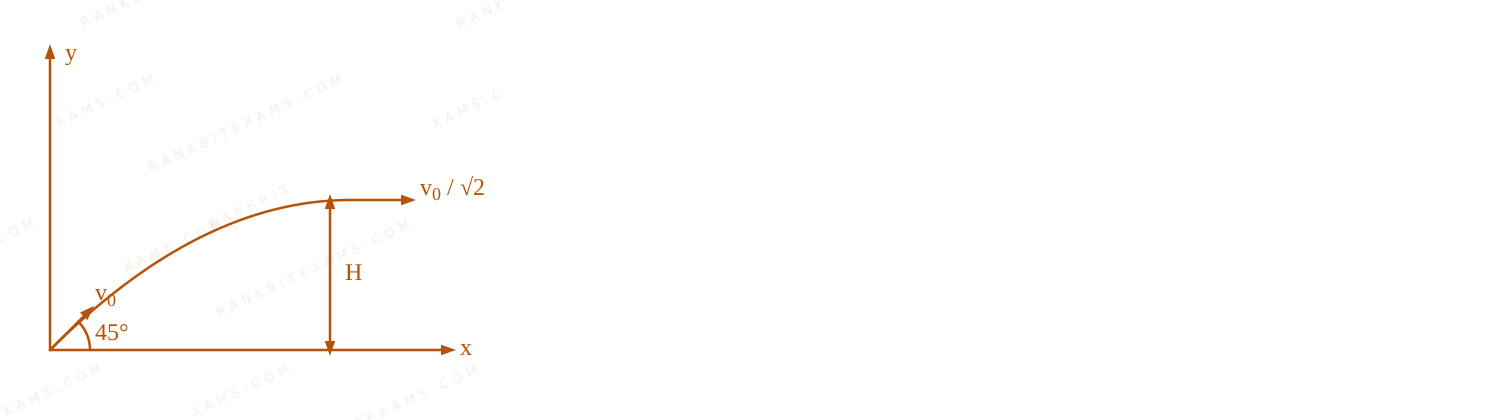
An object of mass 'm' is projected from origin in a vertical xy plane at an angle 45^circ with the x-axis with an initial velocity v_0 The magnitude and direction of the angular momentum of the object with respect to origin, when it reaches at the maximum height, will be [g is acceleration due to gravity]

Solution & Explanation

### Related Formula The definition of angular momentum vector vecL relative to the origin is: vecL = vecr times vecp = m(vecr times vecv) In scalar form for a horizontal speed component at a maximum altitude H: L = m v_x H ### Core Logic At maximum height, the vertical speed component drops to zero, and the projectile travels entirely horizontally along the curve profile as shown in
Angular Momentum diagram for Q8 - JEE Main 2025 Morning
: v_x = v_0 cos 45^circ = fracv_0sqrt2 H = fracv_0^2 sin^2 45^circ2g = fracv_0^24g ### Step 1: Calculating Magnitude and Vector Direction Evaluate the horizontal vector cross components: L = m left(fracv_0sqrt2 ight) left(fracv_0^24g ight) = fracmv_0^34sqrt2g Using the right-hand rule, vecr points into quadrant-1 while velocity points towards +hati. Therefore, vecr times vecv tracks clockwise, yielding a negative hatk orientation (along the negative z-axis). ### Pattern Recognition At peak height, always map vecL using m cdot v_textpeak cdot y_textmax. This scalar form simplifies the calculation significantly. ### Evaluation Rubric / Model Answer null ### Chapter Mix Class 11 Physics: System of Particles and Rotational Motion

More System of Particles and Rotational Motion Previous-Year Questions

Q 2025 Torque and Moment of Inertia
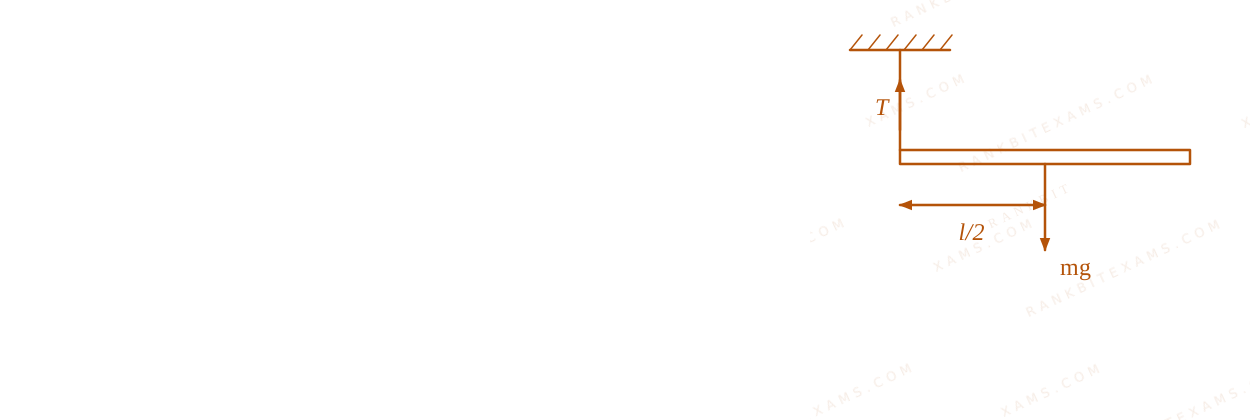
A wheel of radius 0.2 mathrm~m rotates freely about its center when a string that is wrapped over its rim is pulled by force of 10 mathrm~N as shown in figure. The established torque produces an angular acceleration of 2 mathrmrad / mathrms^2 . Moment of inertia of the wheel is ________ kg m^2 . (Acceleration due to gravity = 10mathrmm / mathrms^2)
Circular wheel being pulled by a tangential force string
The diagram displays a circular wheel rotating about its center under a tangential pulling force of 10 N.
Numerical Answer. Answer: 1 to 1

Solution

### Related Formula 1. Torque (tau) produced by a tangential pulling force: tau = F cdot R 2. Newton's second law for rotation: tau = I cdot alpha ### Core Logic We are given: - Radius of the wheel R = 0.2 \ mathrmm - Applied force F = 10 \ mathrmN - Angular acceleration alpha = 2 \ mathrmrad/s^2 ### Step 1: Calculate torque and moment of inertia First, find the torque tau: tau = F cdot R = 10 \ mathrmN times 0.2 \ mathrmm = 2 \ mathrmN cdot m Next, calculate the moment of inertia I using tau = Ialpha: I = fractaualpha = frac2 \ mathrmN cdot m2 \ mathrmrad/s^2 = 1 \ mathrmkg cdot m^2 Thus, the moment of inertia is 1 mathrm~kgcdot m^2. ### Pattern Recognition Sees: Pulley/wheel torque with basic rotational dynamics. Trap: Attempting to integrate gravity (g = 10text m/s^2) into mass equations. Gravity is a redundant distractor here because the pulling tension force is explicitly defined! Shortcut: Directly compute torque as tau = F R and divide by the angular acceleration alpha. ### Evaluation Rubric / Model Answer null ### Chapter Mix Class 11 Physics: System of Particles and Rotational Motion
Q3 2025 Moment of Inertia of Ring
The moment of inertia of a circular ring of mass M and diameter r about a tangential axis lying in the plane of the ring is:
  • A. frac12 M r^2
  • B. frac38 M r^2
  • C. frac32 M r^2
  • D. 2 M r^2

Solution

### Related Formula 1. Moment of inertia of a circular ring of mass M and radius R about a diametrical axis in its plane: I_textdia = frac12 M R^2 2. Parallel Axis Theorem: I = I_textcm + M d^2 where d is the perpendicular distance between the center of mass axis and the parallel axis. ### Core Logic The axis of rotation is tangential and lies in the plane of the ring. Thus, the distance from the center of mass axis (which is also diametrical and in-plane) is equal to the radius R. Using the parallel axis theorem: I_texttangent = I_textdia + M R^2 = frac12 M R^2 + M R^2 = frac32 M R^2 ### Step 1: Express in terms of diameter r The question specifies the diameter of the ring is r. Therefore, the radius R is: R = fracr2 Substitute R = fracr2 into the moment of inertia formula: I_texttangent = frac32 M left(fracr2right)^2 = frac38 M r^2 Thus, the moment of inertia is frac38 M r^2. ### Pattern Recognition Sees: Circular ring tangential axis in-plane. Trap: Directly using radius r instead of diameter r. Read variables carefully: often r is radius, but here it is explicitly given as diameter! Shortcut: Standard in-plane tangent is frac32MR^2. Substitute R = fracr2 to get frac38Mr^2. ### Evaluation Rubric / Model Answer null ### Chapter Mix Class 11 Physics: System of Particles and Rotational Motion

Q6 2025 Centre of Mass
A rod of length 5 mathrm~L is bent right angle keeping one side length as 2 mathrm~L .
L-shaped bent rod geometry for Q6 - JEE Main 2025 Morning
Diagram of an L-shaped rod aligned with the x and y axes, with lengths 2L and 3L respectively.
The position of the centre of mass of the system : (Consider mathrmL = 10mathrmcm )
  • A. 2hatmathbfi + 3hatmathbfj
  • B. 3hatmathbfi + 7hatmathbfj
  • C. 5hatmathbfi + 8hatmathbfj
  • D. 4hatmathbfi + 9hatmathbfj

Solution

### Related Formula For a continuous system modeled as discrete point masses located at their respective centers of mass: x_textcom = fracm_1x_1 + m_2x_2m_1 + m_2 y_textcom = fracm_1y_1 + m_2y_2m_1 + m_2 ### Core Logic Let the uniform linear mass density of the rod be lambda. - Total length is 5L. - One segment of length 2L lies on the x-axis. Its mass is 2m = lambda(2L) and its center of mass is at (L, 0). - The remaining segment of length 3L lies on the y-axis. Its mass is 3m = lambda(3L) and its center of mass is at (0, 1.5L). ### Step 1: Calculate COM Coordinates Find the coordinates of the system's center of mass: x_textcom = frac2m(L) + 3m(0)2m + 3m = frac2L5 = 0.4L y_textcom = frac2m(0) + 3m(1.5L)2m + 3m = frac4.5L5 = 0.9L Given L = 10 mathrm~cm: x_textcom = 0.4 times 10 = 4 mathrm~cm y_textcom = 0.9 times 10 = 9 mathrm~cm ### Step 2: Vector Form Expressing in vector notation: vecr_textcom = 4hatmathbfi + 9hatmathbfj ### Pattern Recognition Sees: L-shaped rod formed by bending a total length L_texttotal. Shortcut: Treat each arm as a point mass at its geometric midpoint. For segments of ratio 2:3, the COM divides the distance between their midpoints in the inverse ratio 3:2 closer to the heavier segment on the y-axis. ### Evaluation Rubric / Model Answer null ### Chapter Mix Class 11 Physics: System of Particles and Rotational Motion
Q21 2025 Moment of Inertia
A, B and C are disc, solid sphere and spherical shell respectively with same radii and masses. These masses are placed as shown in figure.
Rotational geometry of sphere, disc, and shell for Q21 - JEE Main 2025 Morning
A symmetric system consisting of a disc (top), solid sphere (bottom-left), and spherical shell (bottom-right) arranged with vertical axis PQ.
The moment of inertia of the given system about PQ is fracmathrmx15mathrmI, where I is the moment of inertia of the disc about its diameter. The value of x is
Numerical Answer. Answer: 199 to 199

Solution

### Related Formula Parallel Axis Theorem: I_textaxis = I_textcom + M R^2 Standard Moments of Inertia about center of mass: - Disc about diameter: I_textdisc,dia = fracMR^24 - Solid sphere: I_textsphere = frac25MR^2 - Spherical shell: I_textshell = frac23MR^2 ### Core Logic The axis of rotation PQ passes through the center of the top disc (A) along its diameter. - Top disc (A): I_A = fracMR^24 - Bottom-left solid sphere (B): Center lies at distance R from the axis PQ. I_B = I_textcom + M R^2 = frac25MR^2 + MR^2 = frac75MR^2 - Bottom-right spherical shell (C): Center lies at distance R from the axis PQ. I_C = I_textcom + M R^2 = frac23MR^2 + MR^2 = frac53MR^2 ### Step 1: Calculate Total System Moment of Inertia Sum the contributions: I_textPQ = I_A + I_B + I_C I_textPQ = fracMR^24 + frac75MR^2 + frac53MR^2 To add the fractions, find a common denominator (60): I_textPQ = left( frac15 + 84 + 10060 right) MR^2 = frac19960 MR^2 ### Step 2: Express in terms of standard Disc Moment We are given I = fracMR^24 implies MR^2 = 4I. Substitute this in the expression: I_textPQ = frac19960 (4I) = frac19915 I Comparing with I_textPQ = fracx15 I yields x = 199. ### Pattern Recognition Sees: Composite body consisting of three standard symmetric shapes about a tangent/offset axis. Shortcut: Sum the central inertia terms and the offset terms separately. Offset masses are only B and C, so the offset sum is 2MR^2. The central sum is (1/4 + 2/5 + 2/3)MR^2. Adding these directly yields the combined fractional factor of 199/60. ### Evaluation Rubric / Model Answer null ### Chapter Mix Class 11 Physics: System of Particles and Rotational Motion
Q15 2025 Angular Momentum of a System of Particles
Three equal masses m are kept at vertices (A, B, C) of an equilateral triangle of side a in free space. At t = 0 , they are given an initial velocity vecV_mathrmA = V_0overrightarrowmathrmAC , vecV_mathrmB = V_0overrightarrowmathrmBA and vecV_mathrmC = V_0overrightarrowmathrmCB . Here, overrightarrowmathrmAC, overrightarrowmathrmCB and overrightarrowmathrmBA are unit vectors along the edges of the triangle. If the three masses interact gravitationally, then the magnitude of the net angular momentum of the system at the point of collision is:
Angular Momentum of a System of Particles diagram for Q15 - JEE Main 2025 Evening
The graphic exhibits three mass particles at the vertices of an equilateral triangle with velocity vectors pointed along the cyclic boundary directions.
  • A. frac12 mathrm~a mathrm~mV_0
  • B. 3mathrmamV_0
  • C. fracsqrt32 mathrm~a mathrm~mV_0
  • D. frac32 mathrm~a mathrm~mV_0

Solution

### Related Formula vecL = sum left(vecr_i times m vecv_iright) vectau_textext = fracdvecLdt ### Core Logic Since the three masses interact purely through mutual internal gravitational forces, the net external torque acting on the system about any central reference point is zero: vectau_textext = 0 implies vecL_textinitial = vecL_textfinal Let us compute the total angular momentum about the centroid of the equilateral triangle:
Angular Momentum Calculation Geometry diagram for Q15 - JEE Main 2025 Evening
The graphic exhibits three mass particles at the vertices of an equilateral triangle with velocity vectors pointed along the cyclic boundary directions.
From trigonometry, the perpendicular distance from the centroid to the velocity vector along any edge is: r_perp = fraca2sqrt3 The initial angular momentum for one mass about the centroid is L_1 = m V_0 r_perp. Since all three particles move cyclically in the same direction, their angular momenta reinforce cleanly: L_textnet = 3 cdot left(m V_0 fraca2sqrt3right) = frac32sqrt3 m V_0 a = fracsqrt32 a m V_0 By conservation of angular momentum, this configuration value remains unchanged up to the point of collision. ### Pattern Recognition Mutual internal central forces can never alter the angular momentum of a system. Hence, the solution completely reduces to measuring the static configuration values at t=0 about the center of mass symmetry. ### Evaluation Rubric / Model Answer null ### Chapter Mix Class 11 Physics: System of Particles and Rotational Motion Class 11 Physics: Gravitation

More System of Particles and Rotational Motion Questions — jee_main_2025_24_jan_morning

Practice all System of Particles and Rotational Motion previous-year questions →

YOUR FIRST PREP STEP STARTS HERE

We Map Every Repeating Question in Competitive Exams.

Say goodbye to generic mock test fatigue. RankBit uses smart analysis to group past exam questions into their foundational Repeating Question Types. Find chapter weightage, track repeating questions, and score higher with targeted practice.

Select Your Target Exam

Choose an exam track below to find formulas per chapter and patterns.

Syncing Exam Intelligence

Mapping formulas and patterns across all tracks…

PATH A — FULL LENGTH PRACTICE

Full Mock Test Hub

Simulate real NTA exam conditions with fully tracked mocks. Time yourself against past papers.

Under Development
PATH B — TARGETED PRACTICE

Topic-wise Practice Hub

Practice past-year questions one chapter at a time. Pick an exam → subject → chapter and get every PYQ for that topic — pulled together from all past papers — with the chapter's key formulas alongside.

Loading Questions... Browse Topics
Latest from the Blog
View all →

Loading articles...