Rankbit System
JEE Physics: Waves (+15.5%) | Electrostatics: Concentric Shells (-29.7%) | Modern Physics: Photoelectric Clones (+34.2%) | Mathematics: Definite Integrals (+18.1%) | Chemistry: Coordination Splitting (-11.4%) | JEE Physics: Waves (+15.5%) | Electrostatics: Concentric Shells (-29.7%) | Modern Physics: Photoelectric Clones (+34.2%) | Mathematics: Definite Integrals (+18.1%) | Chemistry: Coordination Splitting (-11.4%)

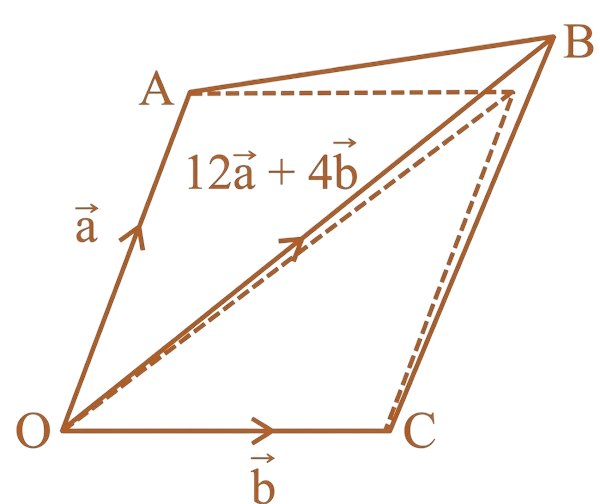
Let overrightarrowOA = veca, overrightarrowOB = 12veca + 4vecb and overrightarrowOC = vecb, where O is the origin. If S is the parallelogram with adjacent sides OA and OC, then the ratio of the area of the quadrilateral OABC to the area of S is equal to

Solution & Explanation

### Related Formula textArea of Parallelogram S = |veca times vecb| textArea of Quadrilateral OABC = textArea(Delta OAB) + textArea(Delta OBC) ### Core Logic Let us compute the component areas using vector cross products: textArea(Delta OAB) = frac12 |overrightarrowOA times overrightarrowOB| = frac12 |veca times (12veca + 4vecb)| = frac12 |4(veca times vecb)| = 2|veca times vecb| textArea(Delta OBC) = frac12 |overrightarrowOB times overrightarrowOC| = frac12 |(12veca + 4vecb) times vecb| = frac12 |12(veca times vecb)| = 6|veca times vecb| ### Step 1: Finding Total Ratio Adding both triangles to find the total area of the quadrilateral OABC: textArea(OABC) = 2|veca times vecb| + 6|veca times vecb| = 8|veca times vecb|
Area of Quadrilateral and Parallelogram diagram for Q8 - JEE Main 2024 Evening
Dividing this total by the area of the baseline parallelogram S = |veca times vecb|: textRatio = frac8|veca times vecb||veca times vecb| = 8 ### Pattern Recognition Since veca times veca = 0 and vecb times vecb = 0, cross product distributions yield terms with purely veca times vecb, ensuring absolute scalability independent of vectors chosen. ### Evaluation Rubric / Model Answer null ### Chapter Mix Class 12 Mathematics: Vector Algebra
Reference Study Guides

More Vector Algebra Previous-Year Questions — Page 5

Q17 jee_main_2024_27_jan_morning Scalar Triple Product
Let veca=hati+2hatj+hatk, vecb=3(hati-hatj+hatk). Let vecc be the vector such that vecatimesvecc=vecb and vecacdotvecc=3 Then vecacdot((vecctimesvecb)-vecb-vecc) equal to:
  • A. 32
  • B. 24
  • C. 20
  • D. 36

Solution

### Related Formula vecx cdot (vecy times vecz) = [vecx \ vecy \ vecz] = (vecx times vecy) cdot vecz ### Core Logic The expression to evaluate is: E = veca cdot ((vecc times vecb) - vecb - vecc) Distributing the dot product over the terms gives: E = veca cdot (vecc times vecb) - veca cdot vecb - veca cdot vecc ### Step 1: Evaluating the Scalar Triple Product The first term is a scalar triple product: veca cdot (vecc times vecb) = (veca times vecc) cdot vecb We are given that veca times vecc = vecb. Substitute this in: (vecb) cdot vecb = |vecb|^2 Given vecb = 3hati - 3hatj + 3hatk, its magnitude squared is: |vecb|^2 = 3^2 + (-3)^2 + 3^2 = 9 + 9 + 9 = 27 ### Step 2: Evaluating the remaining Dot Products For the second term, calculate veca cdot vecb: veca = 1hati + 2hatj + 1hatk vecb = 3hati - 3hatj + 3hatk veca cdot vecb = (1)(3) + (2)(-3) + (1)(3) = 3 - 6 + 3 = 0 For the third term, we are explicitly given: veca cdot vecc = 3 ### Step 3: Final Output Calculation Substitute all individual values back into the expanded expression: E = 27 - 0 - 3 = 24 ### Pattern Recognition When asked to evaluate complex vector expressions containing veca cdot (dots times dots), immediately distribute and convert them into Scalar Triple Products [veca \ vecb \ vecc]. Cyclic permutations and given cross-product relationships will rapidly collapse the expression into simple magnitudes. ### Evaluation Rubric / Model Answer null ### Chapter Mix Class 12 Maths: Vector Algebra
Q21 jee_main_2024_27_jan_morning Dot Product
The least positive integral value of alpha, for which the angle between the vectors alphahati-2hatj+2hatk and alphahati+2alphahatj-2hatk is acute, is:
Numerical Answer. Answer: 5 to 5

Solution

### Related Formula cos theta = fracveca cdot vecb|veca||vecb| For an acute angle, cos theta > 0, which strictly means veca cdot vecb > 0. ### Core Logic Given vectors vecA = alphahati - 2hatj + 2hatk and vecB = alphahati + 2alphahatj - 2hatk. For the angle to be acute, their dot product must be strictly positive: vecA cdot vecB > 0 (alpha)(alpha) + (-2)(2alpha) + (2)(-2) > 0 alpha^2 - 4alpha - 4 > 0 ### Step 1: Solving the Inequality Complete the square to find critical points: alpha^2 - 4alpha + 4 > 8 (alpha - 2)^2 > 8 Extracting roots gives: alpha - 2 > 2sqrt2 quad textor quad alpha - 2 < -2sqrt2 alpha > 2 + 2sqrt2 quad textor quad alpha < 2 - 2sqrt2 ### Step 2: Finding Least Positive Integer Approximate the boundary values. Since sqrt2 approx 1.414: 2 + 2(1.414) = 4.828 The ranges are alpha in (-infty, -0.828) cup (4.828, infty). We need the *least positive integral value* of alpha. Looking at the interval (4.828, infty), the smallest integer present is 5. ### Pattern Recognition Acute angle translates directly to a positive dot product. Set up the quadratic inequality, compute numerical bounds of irrational roots, and select the immediate next integer. ### Evaluation Rubric / Model Answer null ### Chapter Mix Class 12 Maths: Vector Algebra Class 11 Maths: Linear Inequalities
Q8 jee_main_2024_29_jan_morning Collinear Vectors
Let veca, vecb and vecc be three non-zero vectors such that vecb and vecc are non-collinear. If veca+5vecb is collinear with vecc, vecb+6vecc is collinear with veca and veca+alphavecb+betavecc=0, then alpha+beta is equal to
  • A. 35
  • B. 30
  • C. -30
  • D. -25

Solution

### Related Formula textIf vecX text and vecY text are collinear, then vecX = lambda vecY text for some scalar lambda. Linear Independence: If vecu and vecv are non-collinear, then xvecu + yvecv = 0 implies x = 0 text and y = 0. ### Core Logic Based on the problem statement: 1) veca + 5vecb is collinear with vecc: * quad veca + 5vecb = lambdavecc quad dots(1) 2) vecb + 6vecc is collinear with veca: * quad vecb + 6vecc = muveca quad dots(2) ### Step 1: Eliminate Vector a From equation (1), isolate veca: veca = lambdavecc - 5vecb Substitute this into equation (2): vecb + 6vecc = mu(lambdavecc - 5vecb) vecb + 6vecc = mulambdavecc - 5muvecb Rearrange to group coefficients for vecb and vecc: (1 + 5mu)vecb + (6 - mulambda)vecc = 0 ### Step 2: Determine Scalars Since vectors vecb and vecc are given as non-collinear, their linear combination resolving to zero dictates that their scalar coefficients must both individually be zero. 1 + 5mu = 0 Rightarrow mu = -frac15 6 - mulambda = 0 Rightarrow 6 - left(-frac15right)lambda = 0 Rightarrow 6 + fraclambda5 = 0 fraclambda5 = -6 Rightarrow lambda = -30 ### Step 3: Match the Final Equation Substitute lambda = -30 back into equation (1): veca + 5vecb = -30vecc veca + 5vecb + 30vecc = 0 The problem provides the structure veca + alphavecb + betavecc = 0. Comparing the two yields: alpha = 5, quad beta = 30 Thus: alpha + beta = 5 + 30 = 35 ### Pattern Recognition Double-collinearity equations should always be mapped out by eliminating the "third" vector (veca in this case) and funneling everything into the two known non-collinear vectors. The resulting zero-equation perfectly exposes the scalar unknowns. ### Evaluation Rubric / Model Answer null ### Chapter Mix Class 12 Mathematics: Vector Algebra

Q13 jee_main_2024_29_jan_morning Vector Angle Bisector
Let O be the origin and the position vector of A and B be 2hati+2hatj+hatk and 2hati+4hatj+4hatk respectively. If the internal bisector of angle AOB meets the line AB at C, then the length of OC is
  • A. frac23sqrt31
  • B. frac23sqrt34
  • C. frac34sqrt34
  • D. frac32sqrt31

Solution

### Related Formula textInternal Angle Bisector Theorem: fracACCB = frac|vecOA||vecOB| textSection Formula: vecOC = fracmvecOB + nvecOAm+n ### Core Logic Find the magnitudes of the position vectors vecOA and vecOB: |vecOA| = sqrt2^2 + 2^2 + 1^2 = sqrt4+4+1 = sqrt9 = 3 |vecOB| = sqrt2^2 + 4^2 + 4^2 = sqrt4+16+16 = sqrt36 = 6 According to the internal angle bisector theorem in Delta AOB, the point C divides the segment AB in the ratio of the adjacent sides: fracACCB = frac|vecOA||vecOB| = frac36 = frac12
Vector Angle Bisector
### Step 1: Apply Section Formula Using the section formula to find the position vector of C, dividing AB internally in ratio m:n = 1:2: vecOC = frac1(vecOB) + 2(vecOA)1 + 2 vecOC = frac1(2hati+4hatj+4hatk) + 2(2hati+2hatj+hatk)3 vecOC = frac(2+4)hati + (4+4)hatj + (4+2)hatk3 vecOC = frac6hati + 8hatj + 6hatk3 = 2hati + frac83hatj + 2hatk ### Step 2: Compute Length of OC Now, find the magnitude (length) of the vector vecOC: |vecOC| = sqrt2^2 + left(frac83right)^2 + 2^2 = sqrt4 + frac649 + 4 = sqrt8 + frac649 = sqrtfrac72 + 649 = sqrtfrac1369 = fracsqrt4 times 343 = frac2sqrt343 ### Pattern Recognition Vector angle bisector questions invariably test the geometric property that the bisector divides the opposite side in the ratio of the side lengths. Combine this directly with the 3D coordinate section formula. ### Evaluation Rubric / Model Answer null ### Chapter Mix Class 12 Mathematics: Vector Algebra
Q4 jee_main_2024_30_january_evening Cross Product
Let veca = hati +alpha hatj +beta hatk,alpha ,beta in mathbbR .Let a vector vecb be such that the angle between veca and vecb is fracpi4 and |vecb |^2 = 6 If vecacdotvecb = 3sqrt2 , then the value of (alpha^2 + beta^2)|vecatimes vecb |^2 is equal to
  • A. 90
  • B. 75
  • C. 95
  • D. 85

Solution

### Related Formula vecacdotvecb = |veca||vecb| cos theta |veca times vecb|^2 = |veca|^2 |vecb|^2 sin^2 theta |veca|^2 = a_x^2 + a_y^2 + a_z^2 ### Core Logic Given |vecb|^2 = 6, angle theta = fracpi4, and vecacdotvecb = 3sqrt2. |veca||vecb| cos theta = 3sqrt2 Squaring both sides: |veca|^2 |vecb|^2 cos^2 theta = 18 |veca|^2 (6) left(frac1sqrt2right)^2 = 18 |veca|^2 (6) left(frac12right) = 18 Rightarrow 3|veca|^2 = 18 Rightarrow |veca|^2 = 6 ### Step 1: Finding alpha and beta relation We have veca = hati + alpha hatj + beta hatk. |veca|^2 = 1^2 + alpha^2 + beta^2 1 + alpha^2 + beta^2 = 6 Rightarrow alpha^2 + beta^2 = 5 ### Step 2: Evaluating the Target Expression We need to find the value of (alpha^2 + beta^2)|veca times vecb|^2. |veca times vecb|^2 = |veca|^2 |vecb|^2 sin^2 theta |veca times vecb|^2 = (6) (6) sin^2left(fracpi4right) = 36 left(frac12right) = 18 Thus, the required value is: (alpha^2 + beta^2)|veca times vecb|^2 = (5)(18) = 90 ### Pattern Recognition Vector magnitude and dot product give direct length values. |vecatimesvecb|^2 + (vecacdotvecb)^2 = |veca|^2|vecb|^2 (Lagrange's Identity) skips sin^2theta calculations completely. ### Evaluation Rubric / Model Answer null ### Chapter Mix Class 12 Maths: Vector Algebra

More Vector Algebra Questions — jee_main_2024_29_january_evening

Practice all Vector Algebra previous-year questions →

YOUR FIRST PREP STEP STARTS HERE

We Map Every Repeating Question in Competitive Exams.

Say goodbye to generic mock test fatigue. RankBit uses smart analysis to group past exam questions into their foundational Repeating Question Types. Find chapter weightage, track repeating questions, and score higher with targeted practice.

Select Your Target Exam

Choose an exam track below to find formulas per chapter and patterns.

Syncing Exam Intelligence

Mapping formulas and patterns across all tracks…

PATH A — FULL LENGTH PRACTICE

Full Mock Test Hub

Simulate real NTA exam conditions with fully tracked mocks. Time yourself against past papers.

Under Development
PATH B — TARGETED PRACTICE

Topic-wise Practice Hub

Practice past-year questions one chapter at a time. Pick an exam → subject → chapter and get every PYQ for that topic — pulled together from all past papers — with the chapter's key formulas alongside.

Loading Questions... Browse Topics
Latest from the Blog
View all →

Loading articles...