Rankbit System
JEE Physics: Waves (+15.5%) | Electrostatics: Concentric Shells (-29.7%) | Modern Physics: Photoelectric Clones (+34.2%) | Mathematics: Definite Integrals (+18.1%) | Chemistry: Coordination Splitting (-11.4%) | JEE Physics: Waves (+15.5%) | Electrostatics: Concentric Shells (-29.7%) | Modern Physics: Photoelectric Clones (+34.2%) | Mathematics: Definite Integrals (+18.1%) | Chemistry: Coordination Splitting (-11.4%)

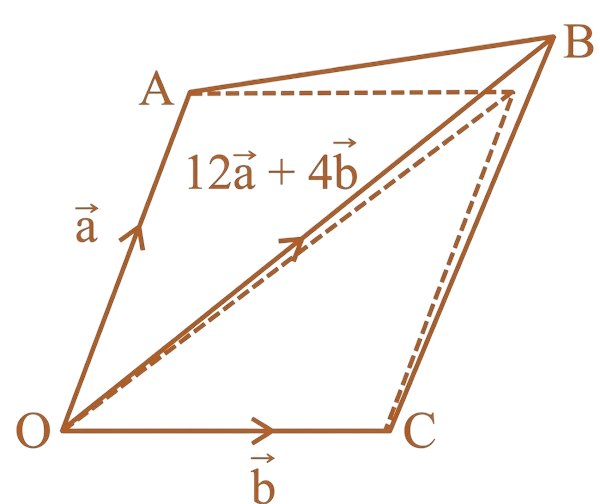
Let overrightarrowOA = veca, overrightarrowOB = 12veca + 4vecb and overrightarrowOC = vecb, where O is the origin. If S is the parallelogram with adjacent sides OA and OC, then the ratio of the area of the quadrilateral OABC to the area of S is equal to

Solution & Explanation

### Related Formula textArea of Parallelogram S = |veca times vecb| textArea of Quadrilateral OABC = textArea(Delta OAB) + textArea(Delta OBC) ### Core Logic Let us compute the component areas using vector cross products: textArea(Delta OAB) = frac12 |overrightarrowOA times overrightarrowOB| = frac12 |veca times (12veca + 4vecb)| = frac12 |4(veca times vecb)| = 2|veca times vecb| textArea(Delta OBC) = frac12 |overrightarrowOB times overrightarrowOC| = frac12 |(12veca + 4vecb) times vecb| = frac12 |12(veca times vecb)| = 6|veca times vecb| ### Step 1: Finding Total Ratio Adding both triangles to find the total area of the quadrilateral OABC: textArea(OABC) = 2|veca times vecb| + 6|veca times vecb| = 8|veca times vecb|
Area of Quadrilateral and Parallelogram diagram for Q8 - JEE Main 2024 Evening
Dividing this total by the area of the baseline parallelogram S = |veca times vecb|: textRatio = frac8|veca times vecb||veca times vecb| = 8 ### Pattern Recognition Since veca times veca = 0 and vecb times vecb = 0, cross product distributions yield terms with purely veca times vecb, ensuring absolute scalability independent of vectors chosen. ### Evaluation Rubric / Model Answer null ### Chapter Mix Class 12 Mathematics: Vector Algebra

Reference Study Guides

More Vector Algebra Previous-Year Questions — Page 4

Q53 jee_main_2025_28_jan_evening Components of Vectors
If the components of veca=alphahati+betahatj+gammahatk along and perpendicular to vecb=3hati+hatj-hatk respectively, are frac1611(3hati+hatj-hatk) and frac111(-4hati-5hatj-17hatk), then alpha^2+beta^2+gamma^2 is equal to:
  • A. 23
  • B. 18
  • C. 16
  • D. 26

Solution

### Related Formula Any vector veca can be written as the sum of its component parallel to vecb (along vecb) and its component perpendicular to vecb: veca = veca_parallel + veca_perp Magnitude squared: |veca|^2 = alpha^2 + beta^2 + gamma^2 ### Core Logic Given: veca_parallel = frac1611(3hati+hatj-hatk) veca_perp = frac111(-4hati-5hatj-17hatk) ### Step 1: Reconstruct Vector a Add both components to find veca: veca = frac1611(3hati+hatj-hatk) + frac111(-4hati-5hatj-17hatk) veca = frac111 left[ (48 - 4)hati + (16 - 5)hatj + (-16 - 17)hatk right] veca = frac111 left[ 44hati + 11hatj - 33hatk right] = 4hati + hatj - 3hatk Therefore, alpha = 4, beta = 1, gamma = -3. ### Step 2: Calculate Sum of Squares alpha^2 + beta^2 + gamma^2 = 4^2 + 1^2 + (-3)^2 = 16 + 1 + 9 = 26 ### Pattern Recognition Since parallel and perpendicular components are orthogonal vectors, you can also use directly |veca|^2 = |veca_parallel|^2 + |veca_perp|^2 to save algebra step: |veca_parallel|^2 = frac16^211^2(9+1+1) = frac25611, |veca_perp|^2 = frac111^2(16+25+289) = frac330121 = frac3011. Total = frac28611 = 26. ### Evaluation Rubric / Model Answer null ### Chapter Mix Class 12 Mathematics: Vector Algebra
Q55 jee_main_2025_29_jan_morning Vector Cross Product and Dot Product
Let veca = 2hati - hatj + 3hatk , vecb = 3hati - 5hatj + hatk and vecc be a vector such that veca times vecc = vecc times vecb and left(vecmathbfa + vecmathbfcright) . left(vecmathbfb + vecmathbfcright) = 168. Then the maximum value of |vecmathbfc|^2 is:
  • A. 77
  • B. 462
  • C. 308
  • D. 154

Solution

### Related Formula vecu times vecv = -vecv times vecu textIf vecu times vecv = 0 implies vecu parallel vecv implies vecu = lambda vecv ### Core Logic Given veca times vecc = vecc times vecb implies veca times vecc + vecb times vecc = 0 (veca + vecb) times vecc = 0 implies vecc = lambda(veca + vecb) ### Step 1: Compute a + b veca + vecb = (2+3)hati + (-1-5)hatj + (3+1)hatk = 5hati - 6hatj + 4hatk vecc = lambda(5hati - 6hatj + 4hatk) |vecc|^2 = lambda^2(25 + 36 + 16) = 77lambda^2 ### Step 2: Expand the Dot Product Condition (veca + vecc) cdot (vecb + vecc) = 168 veca cdot vecb + vecc cdot (veca + vecb) + |vecc|^2 = 168 Evaluate veca cdot vecb = (2)(3) + (-1)(-5) + (3)(1) = 6 + 5 + 3 = 14. Substitute vecc cdot (veca + vecb) = lambda |veca + vecb|^2 = 77lambda: 14 + 77lambda + 77lambda^2 = 168 implies 77lambda^2 + 77lambda - 154 = 0 lambda^2 + lambda - 2 = 0 implies lambda = 1 text or lambda = -2 ### Step 3: Maximize |vecc|^2 Maximum value occurs when lambda = -2: |vecc|^2 = 77(-2)^2 = 77 times 4 = 308 ### Pattern Recognition Recognize the cross-product rule inversion immediately: vecx times vecy = vecy times vecz implies (vecx+vecz) parallel vecy. This linear reduction circumvents solving complex linear systems. ### Evaluation Rubric / Model Answer null ### Chapter Mix Class 12 Mathematics: Vector Algebra
Q8 jee_main_2024_01_february_morning Vector Triple Product
Let veca=-5hati+hatj-3hatk, vecb=hati+2hatj-4hatk and vecc=(((vecatimesvecb)timeshati)timeshati)timeshati. Then vecccdot(-hati+hatj+hatk) is equal to:
  • A. -12
  • B. -10
  • C. -13
  • D. -15

Solution

### Related Formula Vector Triple Product Identity: (vecu times vecv) times vecw = (vecu cdot vecw)vecv - (vecv cdot vecw)veca ### Core Logic Given vectors veca and vecb: First, let's find the inner vector triple product (veca times vecb) times hati: (veca times vecb) times hati = (veca cdot hati)vecb - (vecb cdot hati)veca From the given components: - veca cdot hati = -5 - vecb cdot hati = 1 (veca times vecb) times hati = -5vecb - veca ### Step 1: Substitute Vector Coordinates Substitute coordinates of veca and vecb into the expression: -5vecb - veca = -5(hati + 2hatj - 4hatk) - (-5hati + hatj - 3hatk) = -5hati - 10hatj + 20hatk + 5hati - hatj + 3hatk = -11hatj + 23hatk Now, perform successive cross products with hati: textNext Step = (-11hatj + 23hatk) times hati = -11(hatj times hati) + 23(hatk times hati) = 11hatk + 23hatj textFinal Vector vecc = (23hatj + 11hatk) times hati = 23(hatj times hati) + 11(hatk times hati) = -23hatk + 11hatj ### Step 2: Calculate Dot Product Now evaluate vecc cdot (-hati + hatj + hatk): vecc = 11hatj - 23hatk vecc cdot (-hati + hatj + hatk) = (0)( -1) + (11)(1) + (-23)(1) = 11 - 23 = -12 ### Pattern Recognition Sees: Repeated vector cross products with standard unit vectors. Shortcut: Observe that crossing a vector in the y-z plane with hati rotates its components by 90^circ in that plane. Doing it twice returns it to the original plane with flipped coefficients and signs (vecv times hati times hati = -vecv). ### Evaluation Rubric / Model Answer null ### Chapter Mix Class 12 Mathematics: Vector Algebra
Q20 jee_main_2024_29_january_evening Vector Operations and Angles
Let a unit vector hatmathbfu = xhatmathbfi + yhatmathbfj + zhatmathbfk make angles fracpi2, fracpi3 and frac2pi3 with the vectors frac1sqrt2hatmathbfi + frac1sqrt2hatmathbfk, frac1sqrt2hatmathrmj + frac1sqrt2hatmathrmk and frac1sqrt2hatmathbfi + frac1sqrt2hatmathrmj respectively. If \vec{\mathrm{v}} = \frac{1}{\sqrt{2}}\hat{\mathrm{i}} +\frac{1}{\sqrt{2}}\hat{\mathrm{j}} +\frac{1}{\sqrt{2}}\hat{\mathrm{k}}, then |\hat{\mathbf{u}} -\bar{\mathbf{v}} |^2 is equal to
  • A. \frac{11}{2}
  • B. \frac{5}{2}
  • C. 9
  • D. 7

Solution

### Related Formula vecA cdot vecB = |vecA| |vecB| cos phi ### Core Logic Let the given baseline vectors be vecp_1, vecp_2, vecp_3. Note that |vecp_1| = |vecp_2| = |vecp_3| = 1. 1. Angle with vecp_1 is fracpi2: hatu cdot vecp_1 = 0 implies fracxsqrt2 + fraczsqrt2 = 0 implies x + z = 0 quad dots (i) 2. Angle with vecp_2 is fracpi3: hatu cdot vecp_2 = cosfracpi3 implies fracysqrt2 + fraczsqrt2 = frac12 implies y + z = frac1sqrt2 quad dots (ii) 3. Angle with vecp_3 is frac2pi3: hatu cdot vecp_3 = cosfrac2pi3 implies fracxsqrt2 + fracysqrt2 = -frac12 implies x + y = -frac1sqrt2 quad dots (iii) ### Step 1: Finding Vector Coordinates Subtracting (ii) from (iii): (x + y) - (y + z) = -frac1sqrt2 - frac1sqrt2 implies x - z = -sqrt2 quad dots (iv) Solving (i) and (iv): 2x = -sqrt2 implies x = -frac1sqrt2 z = frac1sqrt2 From (ii): y = frac1sqrt2 - frac1sqrt2 = 0. So, hatu = -frac1sqrt2hati + 0hatj + frac1sqrt2hatk. ### Step 2: Evaluating the Norm Difference Given vecv = frac1sqrt2hati + frac1sqrt2hatj + frac1sqrt2hatk: hatu - vecv = left(-frac1sqrt2 - frac1sqrt2right)hati + left(0 - frac1sqrt2right)hatj + left(frac1sqrt2 - frac1sqrt2right)hatk hatu - vecv = -sqrt2hati - frac1sqrt2hatj + 0hatk Evaluating the squared magnitude: |hatu - vecv|^2 = (-sqrt2)^2 + left(-frac1sqrt2right)^2 = 2 + frac12 = frac52 ### Pattern Recognition Setting up dot products systematically transforms descriptive geometric angles into solvable sets of linear equations. ### Evaluation Rubric / Model Answer null ### Chapter Mix Class 12 Mathematics: Vector Algebra

More Vector Algebra Questions — jee_main_2024_29_january_evening

Practice all Vector Algebra previous-year questions →

YOUR FIRST PREP STEP STARTS HERE

We Map Every Repeating Question in Competitive Exams.

Say goodbye to generic mock test fatigue. RankBit uses smart analysis to group past exam questions into their foundational Repeating Question Types. Find chapter weightage, track repeating questions, and score higher with targeted practice.

Select Your Target Exam

Choose an exam track below to find formulas per chapter and patterns.

Syncing Exam Intelligence

Mapping formulas and patterns across all tracks…

PATH A — FULL LENGTH PRACTICE

Full Mock Test Hub

Simulate real NTA exam conditions with fully tracked mocks. Time yourself against past papers.

Under Development
PATH B — TARGETED PRACTICE

Topic-wise Practice Hub

Practice past-year questions one chapter at a time. Pick an exam → subject → chapter and get every PYQ for that topic — pulled together from all past papers — with the chapter's key formulas alongside.

Loading Questions... Browse Topics
Latest from the Blog
View all →

Loading articles...