Rankbit System
JEE Physics: Waves (+15.5%) | Electrostatics: Concentric Shells (-29.7%) | Modern Physics: Photoelectric Clones (+34.2%) | Mathematics: Definite Integrals (+18.1%) | Chemistry: Coordination Splitting (-11.4%) | JEE Physics: Waves (+15.5%) | Electrostatics: Concentric Shells (-29.7%) | Modern Physics: Photoelectric Clones (+34.2%) | Mathematics: Definite Integrals (+18.1%) | Chemistry: Coordination Splitting (-11.4%)

Let P(alpha, beta) be a point on the parabola y^2 = 4x. If P also lies on the chord of the parabola x^2 = 8y whose mid point is left(1, frac54right), then (alpha - 28)(beta - 8) is equal to

Numerical Answer Type:
Enter a numerical value Answer: 192 to 192 +4 marks

Solution & Explanation

### Related Formula Equation of chord with given midpoint (x_1, y_1) is T = S_1. ### Core Logic For the parabola x^2 = 8y, the equation of the chord with midpoint left(1, frac54right) is: x(1) - 4left(y + frac54right) = 1^2 - 8left(frac54right) x - 4y - 5 = 1 - 10 = -9 x - 4y + 4 = 0 quad dots (i) ### Step 1: Point Intersection with Paraboloid Curve Since P(alpha, beta) lies on this chord and also on y^2 = 4x: 1) alpha - 4beta + 4 = 0 implies alpha = 4beta - 4 2) beta^2 = 4alpha Substituting alpha into the equation: beta^2 = 4(4beta - 4) implies beta^2 - 16beta + 16 = 0 ### Step 2: Calculating the Target Value We need to find the value of (alpha - 28)(beta - 8). Substitute alpha = 4beta - 4 into this targeted expression: textValue = (4beta - 4 - 28)(beta - 8) = (4beta - 32)(beta - 8) = 4(beta - 8)(beta - 8) = 4(beta^2 - 16beta + 64) From the quadratic step, we know beta^2 - 16beta = -16. Substituting this: textValue = 4(-16 + 64) = 4(48) = 192 ### Pattern Recognition Do not solve for ugly root combinations explicitly if the target expression can be algebraically mapped back to the defining quadratic equations. This prevents unnecessary fractional math steps. ### Evaluation Rubric / Model Answer null ### Chapter Mix Class 11 Mathematics: Conic Sections

Reference Study Guides

More Conic Sections Previous-Year Questions — Page 11

Q23 jee_main_2024_30_jan_morning Hyperbola
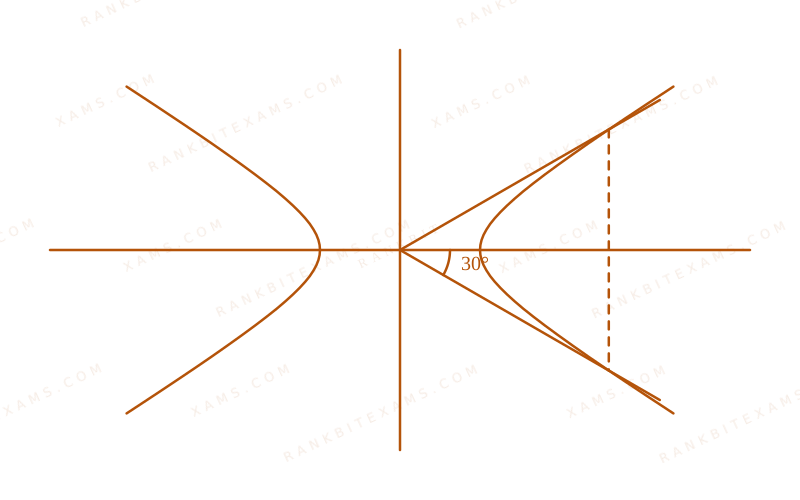
Let the latus rectum of the hyperbola fracx^29 - fracy^2b^2 = 1 subtend an angle of fracpi3 at the centre of the hyperbola. If b^2 is equal to fraclm(1 + sqrtn), where l and m are co-prime numbers, then l^2 + m^2 + n^2 is equal to
Numerical Answer. Answer: 182 to 182

Solution

### Related Formula Latus Rectum = frac2b^2a e^2 = 1 + fracb^2a^2 ### Core Logic
Hyperbola diagram for Q23 - JEE Main 2024 Morning
The endpoints of the latus rectum are (ae, fracb^2a) and (ae, -fracb^2a). It subtends 60^circ at the center (0,0). By symmetry, the line connecting the center to (ae, fracb^2a) makes an angle of 30^circ with the x-axis. tan 30^circ = fracfracb^2aae = fracb^2a^2e = frac1sqrt3 ### Step 1: Expressing e in terms of b Given a^2 = 9, so a = 3. fracb^29e = frac1sqrt3 Rightarrow e = fracsqrt3b^29 ### Step 2: Applying eccentricity relation We know e^2 = 1 + fracb^29. Substitute e: left(fracsqrt3b^29right)^2 = 1 + fracb^29 frac3b^481 = 1 + fracb^29 fracb^427 = frac9 + b^29 b^4 = 3(9 + b^2) = 27 + 3b^2 b^4 - 3b^2 - 27 = 0 ### Step 3: Solving for b^2 Using the quadratic formula for b^2: b^2 = frac3 pm sqrt9 - 4(1)(-27)2 = frac3 pm sqrt9 + 1082 = frac3 pm sqrt1172 Since b^2 > 0: b^2 = frac3 + 3sqrt132 = frac32(1 + sqrt13) Comparing this to fraclm(1 + sqrtn): l = 3, m = 2, n = 13. ### Step 4: Final calculation Target: l^2 + m^2 + n^2 = 3^2 + 2^2 + 13^2 = 9 + 4 + 169 = 182 ### Pattern Recognition Whenever an angle is subtended at the origin symmetrically, use half the angle mapping to the tangent of the coordinate ratio (y/x). ### Evaluation Rubric / Model Answer null ### Chapter Mix Class 11 Maths: Conic Sections
Q7 jee_main_2024_31_jan_evening Parabola and Ellipse intersection
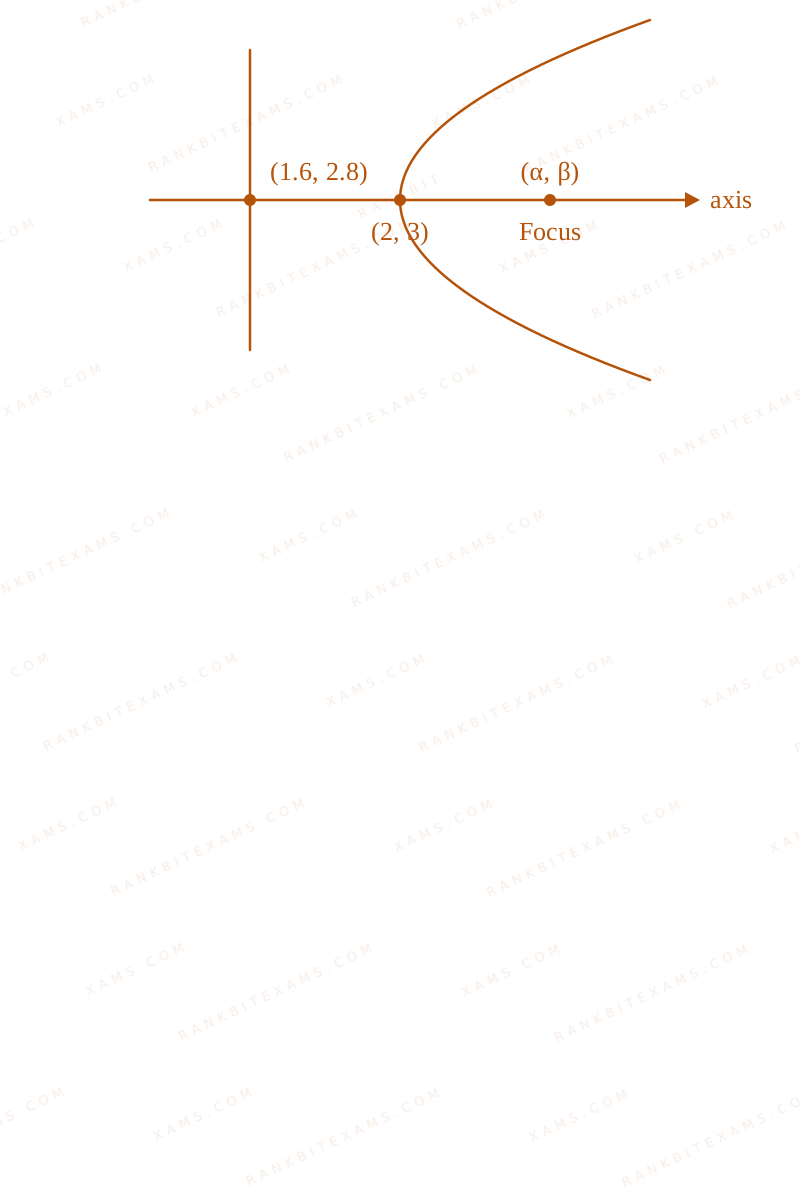
Let P be a parabola with vertex (2, 3) and directrix 2x + y = 6. Let an ellipse E:fracx^2a^2 +fracy^2b^2 = 1,a > b of eccentricity frac1sqrt2 pass through the focus of the parabola P. Then the square of the length of the latus rectum of E, is
  • A. frac3858
  • B. frac3478
  • C. frac51225
  • D. frac65625

Solution

### Related Formula textLength of Latus Rectum of Ellipse = frac2b^2a e = sqrt1 - fracb^2a^2 ### Core Logic
Parabola and Ellipse intersection diagram for Q7 - JEE Main 2024 Evening
Directrix of parabola is 2x + y - 6 = 0. Axis is perpendicular to directrix and passes through vertex V(2,3). Slope of axis = 1/2. Equation of axis: y - 3 = frac12(x - 2) implies x - 2y + 4 = 0. Intersection of axis and directrix is K: 2x + y = 6 x - 2y = -4 Solving, K = (8/5, 14/5) = (1.6, 2.8). Vertex V(2,3) is the midpoint of focus S(alpha, beta) and K(1.6, 2.8): fracalpha + 1.62 = 2 implies alpha = 2.4 fracbeta + 2.82 = 3 implies beta = 3.2 So, focus S = (2.4, 3.2). Ellipse passes through S(2.4, 3.2): frac(2.4)^2a^2 + frac(3.2)^2b^2 = 1 Eccentricity e = frac1sqrt2 implies 1 - fracb^2a^2 = frac12 implies a^2 = 2b^2. Substitute a^2 = 2b^2: frac5.762b^2 + frac10.24b^2 = 1 implies frac2.88 + 10.24b^2 = 1 implies b^2 = 13.12 = frac32825 Square of Latus Rectum: L^2 = left(frac2b^2aright)^2 = frac4b^4a^2 = frac4b^42b^2 = 2b^2 = 2 times frac32825 = frac65625 ### Pattern Recognition Leverage geometry of parabola (Vertex is exactly midway between focus and directrix intersection on the axis) to find coordinate points before substituting into ellipse equation. ### Evaluation Rubric / Model Answer null ### Chapter Mix Class 11 Maths: Conic Sections
Q3 jee_main_2024_31_jan_morning Hyperbola and Ellipse Properties
If the foci of a hyperbola are same as that of the ellipse fracx^29 + fracy^225 = 1 and the eccentricity of the hyperbola is frac158 times the eccentricity of the ellipse, then the smaller focal distance of the point left(sqrt2, frac143sqrtfrac25right) on the hyperbola, is equal to
  • A. 7sqrtfrac25 - frac83
  • B. 14sqrtfrac25 - frac43
  • C. 14sqrtfrac25 - frac163
  • D. 7sqrtfrac25 + frac83

Solution

### Related Formula e = sqrt1 - fraca^2b^2 text (for vertical ellipse) textFocal distance of P(x_1, y_1) text on hyperbola = e_H |y_1 pm fracBe_H| ### Core Logic For the ellipse fracx^29 + fracy^225 = 1: a = 3, b = 5. Since b > a, the major axis is along the y-axis. e = sqrt1 - frac925 = frac45 Foci = (0, pm be) = (0, pm 4). ### Step 1: Hyperbola Properties Eccentricity of hyperbola e_H = frac45 times frac158 = frac32. Let the hyperbola be fracx^2A^2 - fracy^2B^2 = -1 since its foci (0, pm 4) are on the y-axis. Foci B e_H = 4 implies B = frac83. A^2 = B^2(e_H^2 - 1) = frac649left(frac94 - 1right) = frac809. Equation: fracx^280/9 - fracy^264/9 = -1. ### Step 2: Focal Distance Calculation Directrix of hyperbola: y = pm fracBe_H = pm frac169. Smaller focal distance PS = e_H cdot PM, where PM is the distance to the nearer directrix. PS = frac32 left| frac143sqrtfrac25 - frac169 right| = 7sqrtfrac25 - frac83 ### Pattern Recognition Smaller focal distance of a point (x_1, y_1) on a vertical hyperbola is given by e|y_1 - fracbe| where y_1 > 0 and we use the positive directrix. ### Evaluation Rubric / Model Answer null ### Chapter Mix Class 11 Maths: Conic Sections

Q27 jee_main_2024_31_jan_morning Ellipse and Hyperbola Properties
Let the foci and length of the latus rectum of an ellipse fracx^2a^2 + fracy^2b^2 = 1, a > b be (pm 5, 0) and sqrt50, respectively. Then, the square of the eccentricity of the hyperbola fracx^2b^2 - fracy^2a^2 b^2 = 1 equals
Numerical Answer. Answer: 51 to 51

Solution

### Core Logic For the ellipse, foci are at (pm 5, 0) implies ae = 5. Latus rectum = frac2b^2a = sqrt50 = 5sqrt2 implies b^2 = frac5sqrt2a2. ### Step 1: Solve for a and b Using b^2 = a^2(1 - e^2): a^2 - (ae)^2 = b^2 implies a^2 - 25 = frac5sqrt2a2 2a^2 - 5sqrt2a - 50 = 0 2a^2 - 10sqrt2a + 5sqrt2a - 50 = 0 2a(a - 5sqrt2) + 5sqrt2(a - 5sqrt2) = 0 a = 5sqrt2 (since a > 0). Now, b^2 = frac5sqrt2(5sqrt2)2 = 25 implies b = 5. ### Step 2: Hyperbola Eccentricity The hyperbola is fracx^2b^2 - fracy^2a^2b^2 = 1. Here, semi-major axis A = b and semi-minor axis B = ab. Using eccentricity formula for hyperbola e_H^2 = 1 + fracB^2A^2: e_H^2 = 1 + fraca^2 b^2b^2 = 1 + a^2 Since a = 5sqrt2, a^2 = 50. e_H^2 = 1 + 50 = 51 ### Evaluation Rubric / Model Answer null ### Chapter Mix Class 11 Maths: Conic Sections

More Conic Sections Questions — jee_main_2024_29_january_evening

Practice all Conic Sections previous-year questions →

YOUR FIRST PREP STEP STARTS HERE

We Map Every Repeating Question in Competitive Exams.

Say goodbye to generic mock test fatigue. RankBit uses smart analysis to group past exam questions into their foundational Repeating Question Types. Find chapter weightage, track repeating questions, and score higher with targeted practice.

Select Your Target Exam

Choose an exam track below to find formulas per chapter and patterns.

Syncing Exam Intelligence

Mapping formulas and patterns across all tracks…

PATH A — FULL LENGTH PRACTICE

Full Mock Test Hub

Simulate real NTA exam conditions with fully tracked mocks. Time yourself against past papers.

Under Development
PATH B — TARGETED PRACTICE

Topic-wise Practice Hub

Practice past-year questions one chapter at a time. Pick an exam → subject → chapter and get every PYQ for that topic — pulled together from all past papers — with the chapter's key formulas alongside.

Loading Questions... Browse Topics
Latest from the Blog
View all →

Loading articles...