JEE Main · Physics ↓ Falling

Mechanical Properties of Fluids appeared 32 times across 3 years — 3.7% of Physics. This question is from Surface Tension and Capillarity.

Year 2026 2025 2024 Total
Questions 9 15 8 32

Given below are two statements: Statement I: If a capillary tube is immersed first in cold water and then in hot water, the height of capillary rise will be smaller in hot water. Statement II: If a capillary tube is immersed first in cold water and then in hot water, the height of capillary rise will be smaller in cold water. In the light of the above statements, choose the most appropriate from the options given below:

Solution & Explanation

Related Formula

The height of capillary rise (h) is given by:

h = (2T θ)/(ρ g r)

where, T = surface tension of the liquid θ = angle of contact ρ = density of the liquid r = radius of the capillary tube

Core Logic

As the temperature of water increases, its intermolecular cohesive forces decrease. This leads to a decrease in surface tension (T).

Since h ∝ T (assuming ρ and θ remain relatively constant), height of capillary rise decreases with increase in temperature.

Step 1: Evaluate Statement I and II

Because Thot lt Tcold, it follows that hhot lt hcold.

Pattern Recognition

Remember the key physical dependence: Temperature Up Surface Tension Down Capillary Rise Down. This basic trend of cohesive/adhesive properties versus thermal energy frequently appears in competitive conceptual physical chemistry/fluid physics questions.

Chapter Mix

Class 11 Physics: Mechanical Properties of Fluids

Reference Study Guides

More Mechanical Properties of Fluids Previous-Year Questions — Page 7

Q47 jee_main_2024_31_jan_evening Viscosity and Terminal Velocity
A small spherical ball of radius r, falling through a viscous medium of negligible density has terminal velocity 'v'. Another ball of the same mass but of radius 2r, falling through the same viscous medium will have terminal velocity:
  • A. (v)/(2)
  • B. (v)/(4)
  • C. 4v
  • D. 2v

Solution

Related Formula

At terminal velocity, downward force equals upward drag (assuming negligible buoyancy):

Mg = 6π η r v v = (Mg)/(6π η r)
Core Logic

Since the density of the medium is negligible, we ignore buoyant forces. The mass M of the ball is specified to remain the same in both cases, despite the change in radius (implying the material density of the second ball is lower).

Step 1: Setup Proportionality

Since M, g, and η are all constants:

v ∝ (1)/(r)
Step 2: Evaluating the Ratio

For the second ball, r' = 2r. Therefore, the new terminal velocity v' is:

v' = v × ((r)/(r')) = v × ((r)/(2r)) = (v)/(2)
Pattern Recognition

Read the constraints carefully. Usually, questions keep material density uniform (v ∝ r²). However, this specifically says "same mass". This shifts the formula dependency from v ∝ r² entirely to v ∝ 1/r because M acts as a constant numerator.

Chapter Mix

Class 11 Physics: Mechanical Properties of Fluids
Q jee_main_2024_31_jan_morning Viscosity And Terminal Velocity
A small steel ball is dropped into a long cylinder containing glycerine. Which one of the following is the correct representation of the velocity time graph for the transit of the ball?
  • A.
  • B.
  • C.
  • D.

Solution

Related Formula
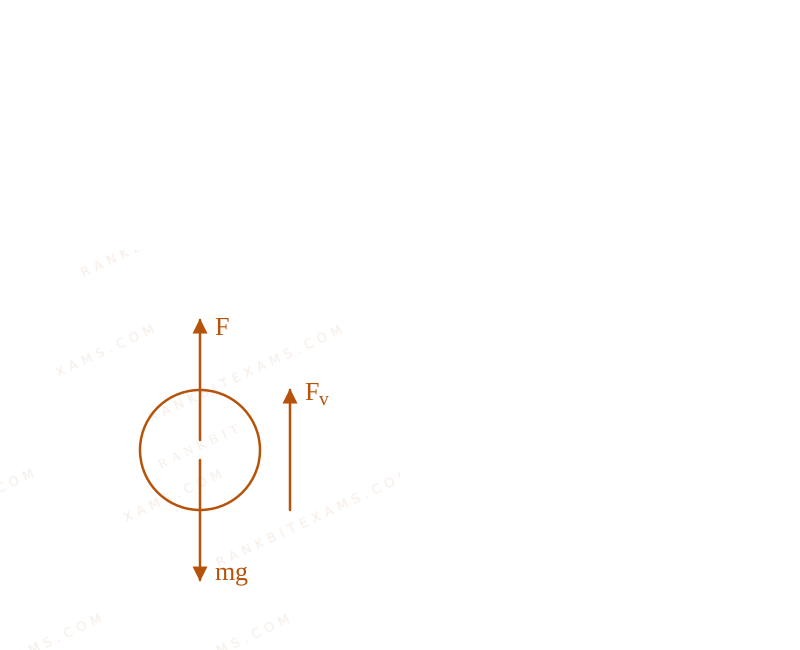
mg - FB - Fv = ma Fv = 6πη r v
Core Logic

Viscosity And Terminal Velocity diagram for Q46 - JEE Main 2024 Morning

When dropped, three forces act on the ball: Gravity downwards, Buoyant force upwards, and Viscous drag upwards.

mg - FB - Fv = m (dv)/(dt) (ρ (4)/(3)π r³)g - (ρL (4)/(3)π r³)g - 6πη rv = m (dv)/(dt)

Let (4π r³ g(ρ - ρL))/(3m) = K₁ and (6πη r)/(m) = K₂.

(dv)/(dt) = K₁ - K₂ v

Integrating from t=0, v=0:

∫₀^v (dv)/(K₁ - K₂ v) = ∫₀^t dt -(1)/(K₂) ln ((K₁ - K₂ v)/(K₁)) = t v = (K₁)/(K₂) ( 1 - e-K₂ t )

This is an exponential curve starting from the origin and asymptotically approaching the terminal velocity VT = K₁ / K₂.

Chapter Mix

Class 11 Physics: Mechanical Properties Of Fluids

More Mechanical Properties of Fluids Questions — jee_main_2024_29_jan_morning

Practice all Mechanical Properties of Fluids previous-year questions →

Rankbit System
JEE Physics: Waves (+15.5%) | Electrostatics: Concentric Shells (-29.7%) | Modern Physics: Photoelectric Clones (+34.2%) | Mathematics: Definite Integrals (+18.1%) | Chemistry: Coordination Splitting (-11.4%) | JEE Physics: Waves (+15.5%) | Electrostatics: Concentric Shells (-29.7%) | Modern Physics: Photoelectric Clones (+34.2%) | Mathematics: Definite Integrals (+18.1%) | Chemistry: Coordination Splitting (-11.4%)
