Equation of two diameters of a circle are 2x-3y=5$2x-3y=5$ and 3x-4y=7$3x-4y=7$. The line joining the points (-(22)/(7),-4)$(-\frac{22}{7},-4)$ and (-(1)/(7),3)$(-\frac{1}{7},3)$intersects the circle at only one pointP(α,β)$P(\alpha,\beta)$. Then 17β-α$17\beta-\alpha$ is equal to
Numerical Answer Type:
Enter a numerical valueAnswer: 2 to 2+4 marks
Solution & Explanation
Related Formula
The intersection of any two non-parallel diameters yields the center of the circle.
A line that intersects a circle at exactly one point is a tangent line.
The tangent at the point of contact P$P$ is always perpendicular to the radius CP$CP$, thus mtangent × mradius = -1$m_{\text{tangent}} \times m_{\text{radius}} = -1$.
Core Logic
Find the center C$C$ by solving the two diameter equations:
Multiply (1) by 3 and (2) by 2:
6x - 9y = 15$6x - 9y = 15$6x - 8y = 14$6x - 8y = 14$
Subtracting the equations gives -y = 1 ⇒ y = -1$-y = 1 \Rightarrow y = -1$.
Substitute y = -1$y = -1$ into (1): 2x + 3 = 5 ⇒ 2x = 2 ⇒ x = 1$2x + 3 = 5 \Rightarrow 2x = 2 \Rightarrow x = 1$.
Center C$C$ is (1, -1)$(1, -1)$.
Find the equation of the line joining A(-(22)/(7), -4)$A(-\frac{22}{7}, -4)$ and B(-(1)/(7), 3)$B(-\frac{1}{7}, 3)$.
Slope of AB$AB$: mAB = (3 - (-4))/(-1/7 - (-22/7)) = (7)/(21/7) = (7)/(3)$m_{AB} = \frac{3 - (-4)}{-1/7 - (-22/7)} = \frac{7}{21/7} = \frac{7}{3}$.
Equation of line AB$AB$:
Since line AB$AB$intersects the circle at only one pointP(α, β)$P(\alpha, \beta)$, line AB$AB$ is a tangent to the circle, and P$P$ is the point of tangency.
The radius line CP$CP$ is perpendicular to tangent AB$AB$.
Slope of CP$CP$ (mCP$m_{CP}$) must be -(3)/(7)$-\frac{3}{7}$.
Equation of the line passing through center C(1, -1)$C(1, -1)$ with slope -(3)/(7)$-\frac{3}{7}$:
When a line "intersects a circle at exactly one point", it's a coded cue to stop thinking about quadratics and discriminants, and immediately build a perpendicular geometric radius from the center to find the exact tangency coordinate.
Chapter Mix
Class 11 Mathematics: Circles
Class 11 Mathematics: Straight Lines
Keywords:#intersects the circle at only one point#JEE Main 2024 Morning Q21#Circles JEE Main 2024#Tangents and Normal JEE Main 2024
More Circles Previous-Year Questions — Page 9
Qjee_main_2025_07_april_morningTangent and Normal to a Circle
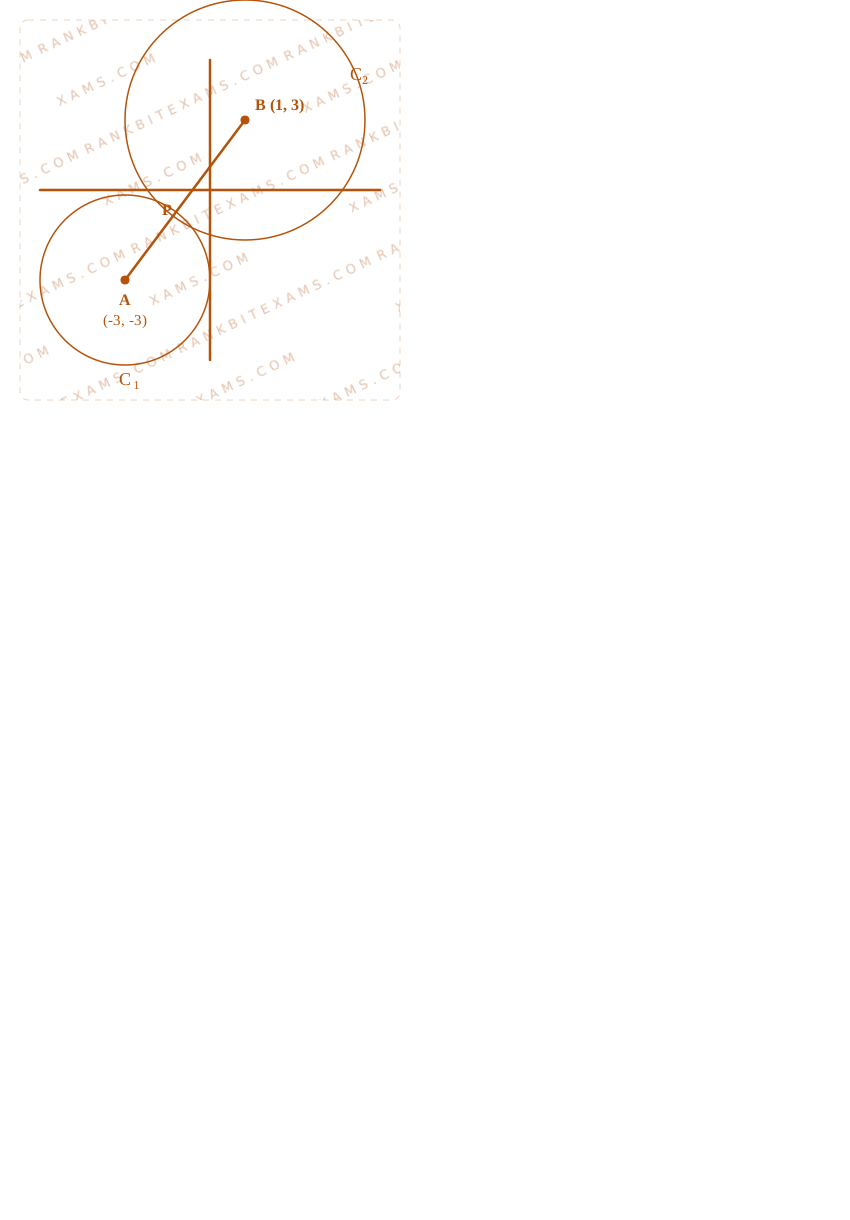
Let C₁$C_1$ be the circle in the third quadrant of radius 3, that touches both coordinate axes. Let C₂$C_2$ be the circle with centre (1, 3) that touches C₁$C_1$ externally at the point (α, β)$(\alpha, \beta)$. If (β - α)² = (m)/(n)$(\beta - \alpha)^2 = \frac{m}{n}$, (m, n) = 1$\gcd(m, n) = 1$, then m + n$m + n$ is equal to:
A.9$9$
B.13$13$
C.22$22$
D.31$31$
Solution
Related Formula
For a circle in the third quadrant touching both coordinate axes, the center layout is (-r, -r)$(-r, -r)$ and equation looks like:
For external contact between circles C₁$C_1$ and C₂$C_2$, the distance between centers equals the sum of their radii:
C₁C₂ = r₁ + r₂$$C_1C_2 = r_1 + r_2$$
Core Logic
Circle C₁$C_1$ has radius r₁ = 3$r_1 = 3$ and touches both axes in the third quadrant, so its center is A(-3, -3)$A(-3, -3)$.
Circle C₂$C_2$ has center B(1, 3)$B(1, 3)$.
Step 2: Locate the Contact Point via Section Formula
The point of contact P(α, β)$P(\alpha, \beta)$ divides the line segment joining centers A(-3, -3)$A(-3, -3)$ and B(1, 3)$B(1, 3)$ internally in the ratio r₁ : r₂ = 3 : (2√(13) - 3)$r_1 : r_2 = 3 : (2\sqrt{13} - 3)$.
Comparing with (m)/(n)$\frac{m}{n}$ where (m, n) = 1$\gcd(m, n) = 1$ gives m = 9, n = 13$m = 9, n = 13$.
m + n = 9 + 13 = 22$$m + n = 9 + 13 = 22$$
Pattern Recognition
Notice that computing (β - α)$(\beta - \alpha)$ directly cancels out the irrational √(13)$\sqrt{13}$ term from the numerator before squaring, saving a significant amount of tedious arithmetic expansion.
Chapter Mix
Class 11 Mathematics: Coordinate Geometry
Class 11 Mathematics: Circles
Q73jee_main_2025_07_april_morningHyperbola
Consider the hyperbola (x²)/(a²) -(y²)/(b²) = 1$\frac{x^2}{a^2} -\frac{y^2}{b^2} = 1$ having one of its focus at P(-3,0)$\mathrm{P(-3,0)}$ . If the latus rectum through its other focus subtends a right angle at P$\mathrm{P}$ and a² b² = α √(2) -β ,α ,β in N$a^2 b^2 = \alpha \sqrt{2} -\beta ,\alpha ,\beta \in \mathbb{N}$ , calculate α + β$\alpha + \beta$.
Numerical Answer.Answer: 1944 to 1944
Solution
Related Formula
For a standard hyperbola:
Focus positions are (± ae, 0)$(\pm ae, 0)$.
Length of semi-latus rectum is (b²)/(a)$\frac{b^2}{a}$.
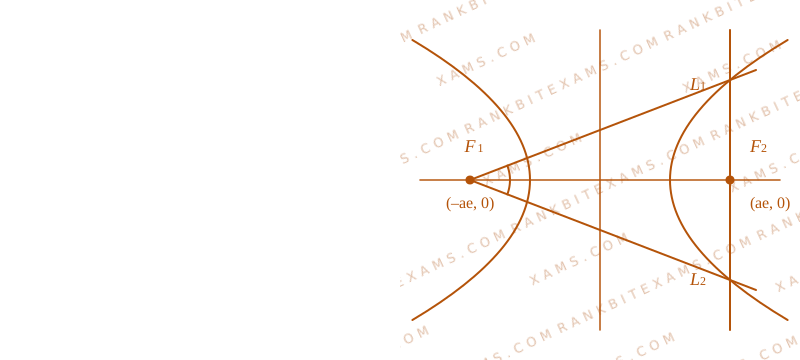
Given focus F₁ ≡ (-ae, 0) ≡ P(-3, 0)$F_1 \equiv (-ae, 0) \equiv P(-3, 0)$, so ae = 3$ae = 3$.
The other focus is F₂ ≡ (ae, 0) ≡ (3, 0)$F_2 \equiv (ae, 0) \equiv (3, 0)$.
The latus rectum passes vertically through F₂$F_2$, with endpoints L₁(ae, (b²)/(a))$L_1\left(ae, \frac{b^2}{a}\right)$ and L₂(ae, -(b²)/(a))$L_2\left(ae, -\frac{b^2}{a}\right)$.
This segment subtends a right angle at P(-ae, 0)$P(-ae, 0)$. By symmetry, the top half angle at P$P$ must be exactly 45^°$45^\circ$.
Step 1: Set Up Slope Relationship
Hyperbola diagram for Q73 - JEE Main 2025 Morning
Using the geometric slope relationship:
Recognizing that the right angle subtended at the opposite focus implies a perfect (45^°)$\tan(45^\circ)$ right triangle instantly yields the key linear constraint b² = 2a(ae)$b^2 = 2a(ae)$, avoiding the need for lengthy distance-formula tracking.
Chapter Mix
Class 11 Mathematics: Conic Sections
Q60jee_main_2025_08_april_eveningEllipse and Focal Distances
Let the ellipse 3x² + py² = 4$3x^{2} + py^{2} = 4$ pass through the centre C of the circle x² + y² - 2x - 4y - 11 = 0$x^{2} + y^{2} - 2x - 4y - 11 = 0$ of radius r. Let f₁, f₂$f_{1}, f_{2}$ be the focal distances of the point C on the ellipse. Then 6f₁f₂ - r$6f_{1}f_{2} - r$ is equal to
Pay attention to whether b > a$b > a$ or a > b$a > b$ when analyzing ellipse forms. Focal distance definitions swap directions immediately across major horizontal/vertical configurations.
Chapter Mix
Class 11 Mathematics: Conic Sections
Class 11 Mathematics: Circles
Q75jee_main_2025_08_april_eveningTangent to Parabola and Circle Properties
Let r$r$ be the radius of the circle, which touches x$x$ -axis at point (a, 0)$(a, 0)$ , a < 0$a < 0$ and the parabola y² = 9x$y^2 = 9x$ at the point (4, 6)$(4, 6)$ . Then r$r$ is equal to
Numerical Answer.Answer: 30 to 30
Solution
Related Formula
Tangent line at point (x₁, y₁) yy₁ = 2a(x+x₁)$$\text{Tangent line at point } (x_1, y_1) \implies yy_1 = 2a(x+x_1)$$
Core Logic
Establish the tangent vector expression at the parabola intersection mark. Since this path line functions as a shared contact tangent boundaries sheet for the circular arc, impose radius equations.
Step 1: Derive Shared Parabola Tangent Line
Tangent line profile for y² = 9x$y^2 = 9x$ at coordinate indicator (4,6)$(4,6)$:
Enforce circle equation intersection constraint profile (x-a)² + (y-r)² = r²$(x-a)^2 + (y-r)^2 = r^2$ at point (4,6)$(4,6)$:
a² - 8a - 12r + 52 = 0$$a^2 - 8a - 12r + 52 = 0$$
Evaluating the target systems from structural logic tracks rejects positive value parameters, providing:
a = -14, r = 30$$a = -14, \quad r = 30$$
{{SOL_IMG_75}}
Pattern Recognition
Shared tangent elements connect independent conic fields. Locating circular center boundaries using axial coordinate tracking simplifies secondary equations.
Chapter Mix
Class 11 Mathematics: Conic Sections
Class 11 Mathematics: Circles
Q59jee_main_2025_29_jan_eveningChord with a Given Midpoint
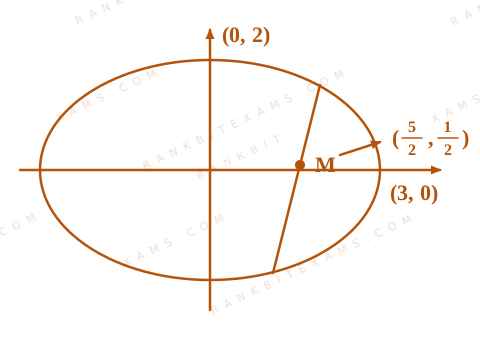
If α x + β y = 109$\alpha x + \beta y = 109$ is the equation of the chord of the ellipse (x²)/(9) +(y²)/(4) = 1$\frac{x^2}{9} +\frac{y^2}{4} = 1$, whose mid point is ((5)/(2),(1)/(2))$\left(\frac{5}{2},\frac{1}{2}\right)$, then α +β$\alpha +\beta$ is equal to
A.37$37$
B.46$46$
C.58$58$
D.72$72$
Solution
Related Formula
Equation of a chord of a conic section with a given midpoint (x₁, y₁)$(x_1, y_1)$ is:
T = S₁$T = S_1$
Core Logic
Given midpoint M((5)/(2), (1)/(2))$M\left(\frac{5}{2}, \frac{1}{2}\right)$ and ellipse (x²)/(9) + (y²)/(4) = 1$\frac{x^2}{9} + \frac{y^2}{4} = 1$.
Chord with a Given Midpoint diagram for Q59 - JEE Main 2025 Evening
Whenever you see 'chord whose midpoint is given', write T = S₁$T = S_1$ automatically. Match coefficients directly at the final step after equating constant integers.
Chapter Mix
Class 11 Mathematics: Conic Sections
More Circles Questions — jee_main_2024_29_jan_morning
Practice past-year questions one chapter at a time. Pick an exam → subject → chapter and get every PYQ for that topic — pulled together from all past papers — with the chapter's key formulas alongside.