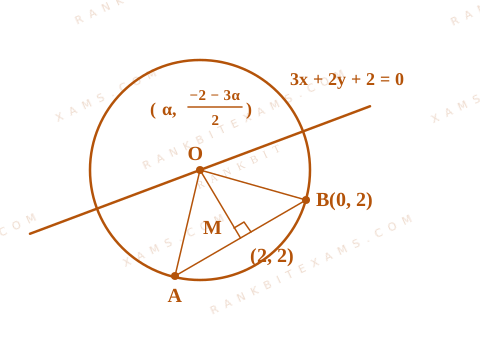
Equation of two diameters of a circle are 2x-3y=5$2x-3y=5$ and 3x-4y=7$3x-4y=7$. The line joining the points (-(22)/(7),-4)$(-\frac{22}{7},-4)$ and (-(1)/(7),3)$(-\frac{1}{7},3)$intersects the circle at only one pointP(α,β)$P(\alpha,\beta)$. Then 17β-α$17\beta-\alpha$ is equal to
Numerical Answer Type:
Enter a numerical valueAnswer: 2 to 2+4 marks
Solution & Explanation
Related Formula
The intersection of any two non-parallel diameters yields the center of the circle.
A line that intersects a circle at exactly one point is a tangent line.
The tangent at the point of contact P$P$ is always perpendicular to the radius CP$CP$, thus mtangent × mradius = -1$m_{\text{tangent}} \times m_{\text{radius}} = -1$.
Core Logic
Find the center C$C$ by solving the two diameter equations:
Multiply (1) by 3 and (2) by 2:
6x - 9y = 15$6x - 9y = 15$6x - 8y = 14$6x - 8y = 14$
Subtracting the equations gives -y = 1 ⇒ y = -1$-y = 1 \Rightarrow y = -1$.
Substitute y = -1$y = -1$ into (1): 2x + 3 = 5 ⇒ 2x = 2 ⇒ x = 1$2x + 3 = 5 \Rightarrow 2x = 2 \Rightarrow x = 1$.
Center C$C$ is (1, -1)$(1, -1)$.
Find the equation of the line joining A(-(22)/(7), -4)$A(-\frac{22}{7}, -4)$ and B(-(1)/(7), 3)$B(-\frac{1}{7}, 3)$.
Slope of AB$AB$: mAB = (3 - (-4))/(-1/7 - (-22/7)) = (7)/(21/7) = (7)/(3)$m_{AB} = \frac{3 - (-4)}{-1/7 - (-22/7)} = \frac{7}{21/7} = \frac{7}{3}$.
Equation of line AB$AB$:
Since line AB$AB$intersects the circle at only one pointP(α, β)$P(\alpha, \beta)$, line AB$AB$ is a tangent to the circle, and P$P$ is the point of tangency.
The radius line CP$CP$ is perpendicular to tangent AB$AB$.
Slope of CP$CP$ (mCP$m_{CP}$) must be -(3)/(7)$-\frac{3}{7}$.
Equation of the line passing through center C(1, -1)$C(1, -1)$ with slope -(3)/(7)$-\frac{3}{7}$:
When a line "intersects a circle at exactly one point", it's a coded cue to stop thinking about quadratics and discriminants, and immediately build a perpendicular geometric radius from the center to find the exact tangency coordinate.
Chapter Mix
Class 11 Mathematics: Circles
Class 11 Mathematics: Straight Lines
Keywords:#intersects the circle at only one point#JEE Main 2024 Morning Q21#Circles JEE Main 2024#Tangents and Normal JEE Main 2024
More Circles Previous-Year Questions — Page 10
Q64jee_main_2025_29_jan_eveningEquation of a Circle
Let a circle C$C$ pass through the points (4,2)$(4,2)$ and (0,2)$(0,2)$, and its centre lie on 3x + 2y + 2 = 0$3x + 2y + 2 = 0$. Then the length of the chord, of the circle C$C$, whose mid-point is (1,2)$(1,2)$, is:
A.√(3)$\sqrt{3}$
B.2√(3)$2\sqrt{3}$
C.4√(2)$4\sqrt{2}$
D.2√(2)$2\sqrt{2}$
Solution
Related Formula
Length of a chord with perpendicular distance d$d$ from the center of a circle of radius r$r$ is:
Points A(4,2)$A(4,2)$ and B(0,2)$B(0,2)$ have the same y-coordinate, meaning chord AB$AB$ is horizontal. The perpendicular bisector of a horizontal chord is vertical.
Equation of a Circle diagram for Q64 - JEE Main 2025 Evening
Midpoint of AB$AB$ is M(2,2)$M(2,2)$. Thus, the vertical line passing through the center is x = 2$x = 2$.
Step 1: Identify Center and Radius
Since the center lies on the line 3x + 2y + 2 = 0$3x + 2y + 2 = 0$, substitute x = 2$x = 2$ to find the y-coordinate:
Points sharing a coordinate define standard vertical or horizontal perpendicular configurations immediately. Always exploit geometrical configurations before jumping into standard circle equations.
Chapter Mix
Class 11 Mathematics: Circles
Q75jee_main_2025_29_jan_eveningProperties of Focal Chords
Let y² = 12x$y^2 = 12x$ the parabola and S$S$ be its focus. Let PQ$PQ$ be a focal chord of the parabola such that (SP) (SQ) = (147)/(4)$(SQ) = \frac{147}{4}$. Let C$C$ be the circle described taking PQ$PQ$ as a diameter. If the equation of a circle C$C$ is 64x² + 64y² - α x - 64√(3)y = β$64x^2 + 64y^2 - \alpha x - 64\sqrt{3}y = \beta$, then \beta - \alpha is equal to
Numerical Answer.Answer: 1328 to 1328
Solution
Related Formula
Properties of focal chord parameter metrics in parabolas y² = 4ax$y^2 = 4ax$:
The distance from focal chord endpoints to the focus equals their perpendicular distance to the directrix. This property connects parameter metrics to geometric lengths cleanly.
Chapter Mix
Class 11 Mathematics: Conic Sections
Class 11 Mathematics: Circles
Qjee_main_2025_28_jan_morningParabola and Trapezium Properties
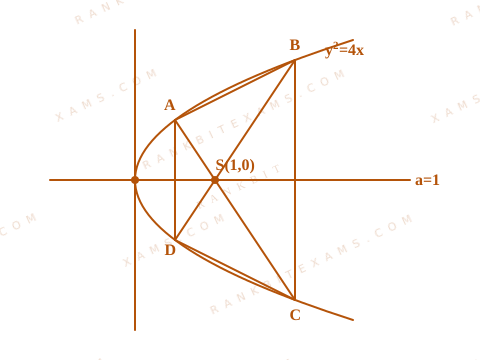
Let ABCD be a trapezium whose vertices lie on the parabola y² = 4x$y^2 = 4x$. Let the sides AD and BC of the trapezium be parallel to y-axis. If the diagonal AC is of length (25)/(4)$\frac{25}{4}$ and it passes through the point (1,0)$(1,0)$, then the area of ABCD is:
A.(75)/(4)$\frac{75}{4}$
B.(25)/(2)$\frac{25}{2}$
C.(125)/(8)$\frac{125}{8}$
D.(75)/(8)$\frac{75}{8}$
Solution
Related Formula
Area of a trapezium is given by:
Area = (1)/(2) × (sum of parallel sides) × (distance between them)$$\text{Area} = \frac{1}{2} \times (\text{sum of parallel sides}) \times (\text{distance between them})$$
Core Logic
Let the coordinates of the vertices be parameterized on the parabola y² = 4x$y^2 = 4x$. Since AD$AD$ and BC$BC$ are parallel to the y-axis, the coordinates take the form:
A(at₁², 2at₁)$A(at_1^2, 2at_1)$ and D(at₁², -2at₁)$D(at_1^2, -2at_1)$B(at₂², 2at₂)$B(at_2^2, 2at_2)$ and C(at₂², -2at₂)$C(at_2^2, -2at_2)$
Given a=1$a=1$, the points simplify accordingly. Parabola and Trapezium Properties diagram for Q52 - JEE Main 2025 Morning
Step 1: Using Diagonal Properties
The length of diagonal AC$AC$ passing through focal point (1,0)$(1,0)$ implies focal chord properties:
Focal chords of parabolas always satisfy t₁ t₂ = -1$t_1 t_2 = -1$. Recognizing the passage through (1,0)$(1,0)$ unlocks quick parametric simplifications.
Chapter Mix
Class 11 Maths: Conic Sections
Qjee_main_2025_28_jan_morningCircles Touching Axes and Intercepts
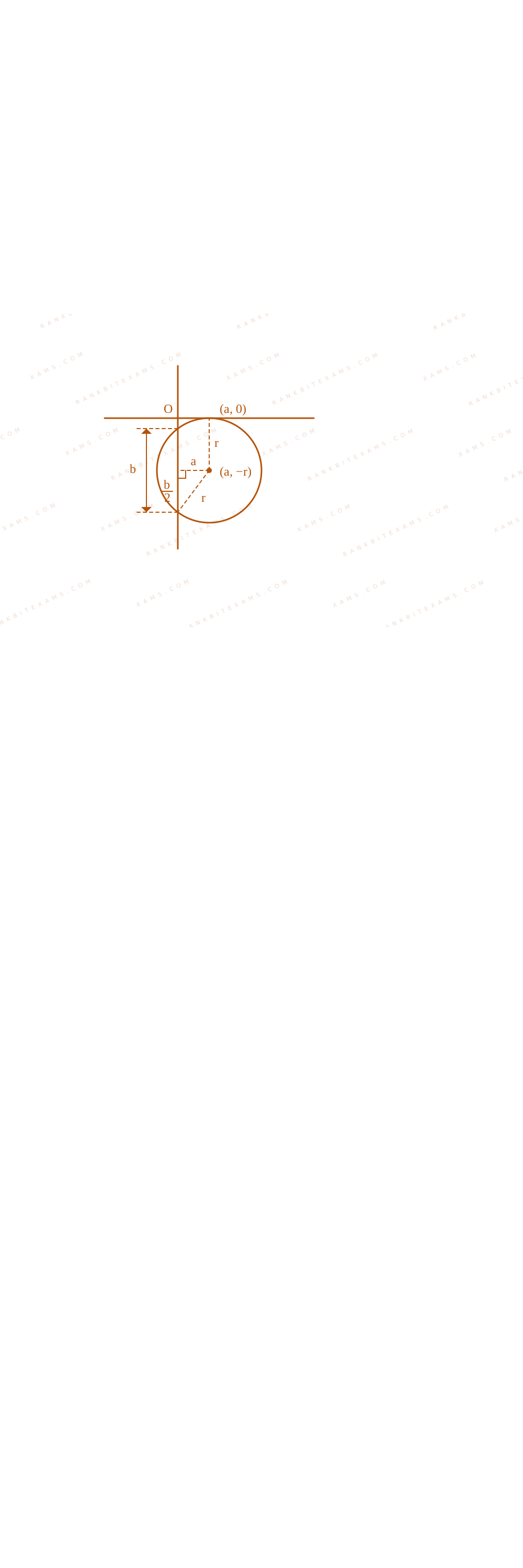
Let the equation of the circle, which touches x-axis at the point (a, 0), a > 0$a > 0$ and cuts off an intercept of length b on y-axis be x² + y² - α x + β y + γ = 0$x^2 + y^2 - \alpha x + \beta y + \gamma = 0$. If the circle lies below x-axis, then the ordered pair (2a, b²)$(2a, b^2)$ is equal to:
Since the circle touches the x-axis at (a,0)$(a,0)$ and lies entirely below it, its center is located at (a, -p)$(a, -p)$ where p$p$ matches its radius r$r$.
By Pythagoras' theorem: Circles Touching Axes and Intercepts diagram for Q58 - JEE Main 2025 Morning
Thus, the mapped ordered pair (2a, b²)$(2a, b^2)$ evaluates directly to (α, β² - 4γ)$(\alpha, \beta^2 - 4\gamma)$.
Pattern Recognition
Tangency conditions fix center parameters to match radius scale sizes instantly, reducing variable overhead in coordinate transformations.
Chapter Mix
Class 11 Maths: Circles
Q75jee_main_2025_28_jan_morningInfinite Series of Ellipses
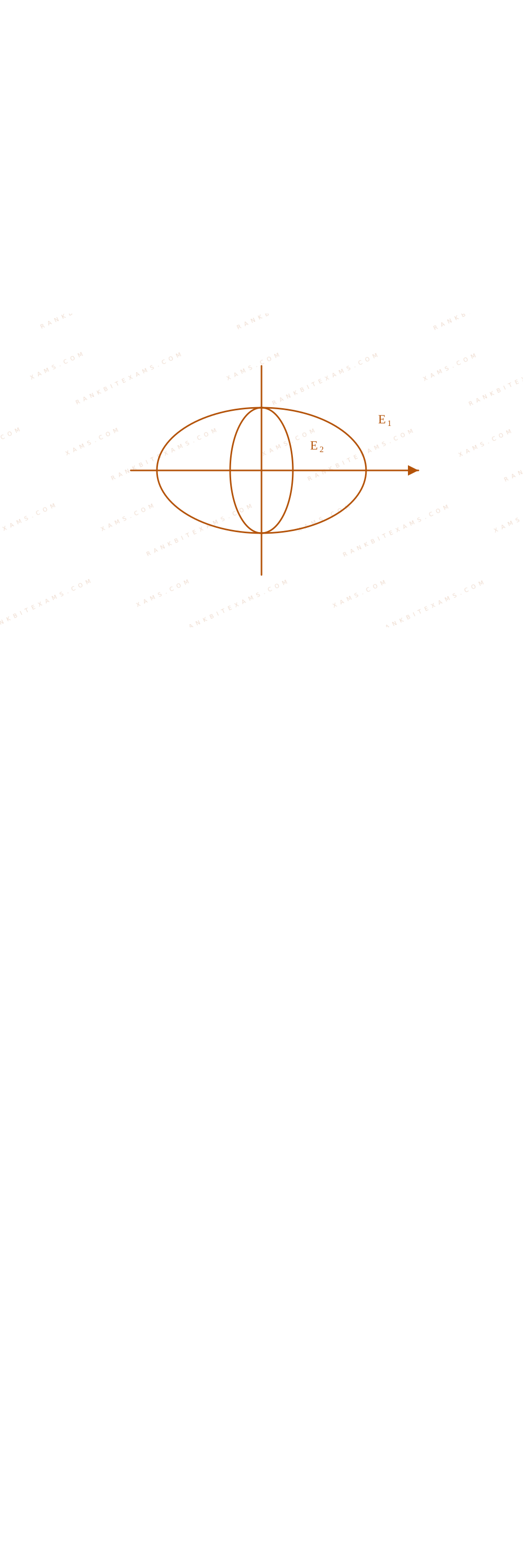
Let E₁: (x²)/(9) + (y²)/(4) = 1$E_1: \frac{x^2}{9} + \frac{y^2}{4} = 1$ be an ellipse. Ellipses Eᵢ$E_i$ 's are constructed such that their centres and eccentricities are same as that of E₁$E_1$ , and the length of minor axis of Eᵢ$E_i$ is the length of major axis of Eᵢ₊₁$E_{i+1}$ ( i ≥ 1$i \ge 1$ ). If Aᵢ$A_i$ is the area of the ellipse Eᵢ$E_i$ , then (5)/(pi) ( Σi=1∞ Aᵢ )$\frac{5}{pi} \left( \sum_{i=1}^{\infty} A_i \right)$ , is equal to ....
Numerical Answer.Answer: 54 to 54
Solution
Related Formula
Area of an ellipse with semi-axes a$a$ and b$b$:
Area = π a b$$\text{Area} = \pi a b$$
Core Logic
Calculate the constant eccentricity e$e$ from the initial ellipse E₁$E_1$: Infinite Series of Ellipses diagram for Q75 - JEE Main 2025 Morning
For any subsequent ellipse E₂$E_2$, its major axis equals the minor axis of E₁$E_1$ (2b₁ = 4 a₂ = 2$2b_1 = 4 \implies a_2 = 2$). Since eccentricity remains constant:
Practice past-year questions one chapter at a time. Pick an exam → subject → chapter and get every PYQ for that topic — pulled together from all past papers — with the chapter's key formulas alongside.