If P$P$ is a point on the circlex^2 + y^2 = 4$x^{2} + y^{2} = 4$, Q$Q$ is a point on the straight line 5x + y + 2 = 0$5x + y + 2 = 0$ and x - y + 1 = 0$x - y + 1 = 0$ is the perpendicular bisector of PQ$PQ$, then 13 times the sum of abscissa of all such point P$P$ is ____.
Numerical Answer Type:
Enter a numerical valueAnswer: 2 to 2+4 marks
Solution & Explanation
### Related Formula
textPerpendicular bisector properties: m_1m_2 = -1 text and mid-point lies on the line.$$\text{Perpendicular bisector properties: } m_1m_2 = -1 \text{ and mid-point lies on the line.}$$textParametric point on circle x^2+y^2=r^2 text is (rcostheta, rsintheta)$$\text{Parametric point on circle } x^2+y^2=r^2 \text{ is } (r\cos\theta, r\sin\theta)$$
### Core Logic
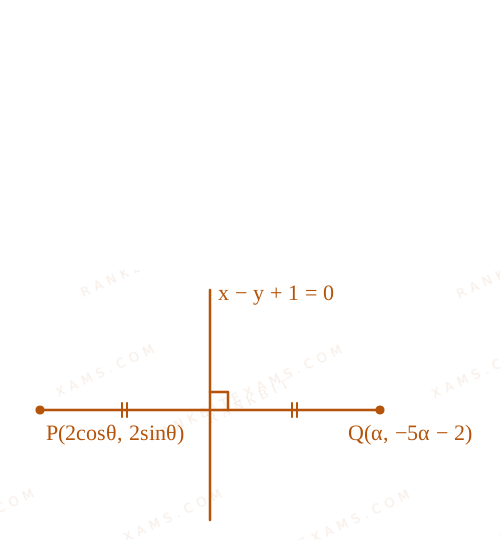
Circle locus perpendicular bisector diagram for Q25 - JEE Main 2026 Evening
Let P = (2costheta, 2sintheta)$P = (2\cos\theta, 2\sin\theta)$.
Let Q$Q$ on the line 5x + y + 2 = 0$5x + y + 2 = 0$ be Q(alpha, -5alpha-2)$Q(\alpha, -5\alpha-2)$.
The line x - y + 1 = 0$x - y + 1 = 0$ is the perpendicular bisector of PQ$PQ$. This gives two conditions: slope of PQ$PQ$ is -1$-1$, and mid-point of PQ$PQ$ satisfies the bisector equation.
### Step 1: Apply Slope Condition
Slope of bisector is 1$1$, so slope of PQ$PQ$ must be -1$-1$.
frac2sintheta - (-5alpha - 2)2costheta - alpha = -1$$\frac{2\sin\theta - (-5\alpha - 2)}{2\cos\theta - \alpha} = -1$$2sintheta + 5alpha + 2 = -2costheta + alpha$$2\sin\theta + 5\alpha + 2 = -2\cos\theta + \alpha$$sintheta + costheta + 2alpha + 1 = 0 quad dots (1)$$\sin\theta + \cos\theta + 2\alpha + 1 = 0 \quad \dots (1)$$
### Step 2: Apply Midpoint Condition
Midpoint of PQ$PQ$ is left( frac2costheta + alpha2, frac2sintheta - 5alpha - 22 right)$\left( \frac{2\cos\theta + \alpha}{2}, \frac{2\sin\theta - 5\alpha - 2}{2} \right)$.
Substitute into x - y + 1 = 0$x - y + 1 = 0$:
frac2costheta + alpha2 - frac2sintheta - 5alpha - 22 + 1 = 0$$\frac{2\cos\theta + \alpha}{2} - \frac{2\sin\theta - 5\alpha - 2}{2} + 1 = 0$$2costheta + alpha - 2sintheta + 5alpha + 2 + 2 = 0$$2\cos\theta + \alpha - 2\sin\theta + 5\alpha + 2 + 2 = 0$$costheta - sintheta + 3alpha + 2 = 0 quad dots (2)$$\cos\theta - \sin\theta + 3\alpha + 2 = 0 \quad \dots (2)$$
### Step 3: Eliminate alpha and Solve
From (1), 2alpha = -sintheta - costheta - 1 implies alpha = frac-sintheta - costheta - 12$2\alpha = -\sin\theta - \cos\theta - 1 \implies \alpha = \frac{-\sin\theta - \cos\theta - 1}{2}$.
Substitute alpha$\alpha$ into (2):
costheta - sintheta + 3left( frac-sintheta - costheta - 12 right) + 2 = 0$$\cos\theta - \sin\theta + 3\left( \frac{-\sin\theta - \cos\theta - 1}{2} \right) + 2 = 0$$2costheta - 2sintheta - 3sintheta - 3costheta - 3 + 4 = 0$$2\cos\theta - 2\sin\theta - 3\sin\theta - 3\cos\theta - 3 + 4 = 0$$-costheta - 5sintheta + 1 = 0 implies costheta + 5sintheta = 1$$-\cos\theta - 5\sin\theta + 1 = 0 \implies \cos\theta + 5\sin\theta = 1$$
Let's express in half angles:
1 - 2sin^2fractheta2 + 10sinfractheta2cosfractheta2 = 1$$1 - 2\sin^2\frac{\theta}{2} + 10\sin\frac{\theta}{2}\cos\frac{\theta}{2} = 1$$2sinfractheta2 left( 5cosfractheta2 - sinfractheta2 right) = 0$$2\sin\frac{\theta}{2} \left( 5\cos\frac{\theta}{2} - \sin\frac{\theta}{2} \right) = 0$$
So, sinfractheta2 = 0 implies costheta = 1$\sin\frac{\theta}{2} = 0 \implies \cos\theta = 1$
or tanfractheta2 = 5 implies costheta = frac1 - tan^2(theta/2)1 + tan^2(theta/2) = frac1 - 251 + 25 = -frac2426 = -frac1213$\tan\frac{\theta}{2} = 5 \implies \cos\theta = \frac{1 - \tan^2(\theta/2)}{1 + \tan^2(\theta/2)} = \frac{1 - 25}{1 + 25} = -\frac{24}{26} = -\frac{12}{13}$.
### Step 4: Final Calculation
The abscissa of P$P$ is 2costheta$2\cos\theta$.
Values of abscissa are 2(1) = 2$2(1) = 2$ and 2left(-frac1213right) = -frac2413$2\left(-\frac{12}{13}\right) = -\frac{24}{13}$.
Sum of abscissa values = 2 - frac2413 = frac26 - 2413 = frac213$= 2 - \frac{24}{13} = \frac{26 - 24}{13} = \frac{2}{13}$.
We need 13 times (textSum) = 13 times frac213 = 2$13 \times (\text{Sum}) = 13 \times \frac{2}{13} = 2$.
### Pattern Recognition
Instead of finding the image of a generic circle point in a line, construct the reflection point Q$Q$ parameter, use slope logic (m_1m_2=-1$m_1m_2=-1$) and midpoint logic simultaneously to create a trigonometric linear equation.
### Evaluation Rubric / Model Answer
null
### Chapter Mix
Class 11 Maths: Circles
Class 11 Maths: Straight Lines
We Map Every Repeating Question in Competitive Exams.
Say goodbye to generic mock test fatigue. RankBit uses smart analysis to group past exam questions into their foundational Repeating Question Types. Find chapter weightage, track repeating questions, and score higher with targeted practice.
Select Your Target Exam
Choose an exam track below to find formulas per chapter and patterns.
Syncing Exam Intelligence
Mapping formulas and patterns across all tracks…
PATH A — FULL LENGTH PRACTICE
Full Mock Test Hub
Simulate real NTA exam conditions with fully tracked mocks. Time yourself against past papers.
Practice past-year questions one chapter at a time. Pick an exam → subject → chapter and get every PYQ for that topic — pulled together from all past papers — with the chapter's key formulas alongside.