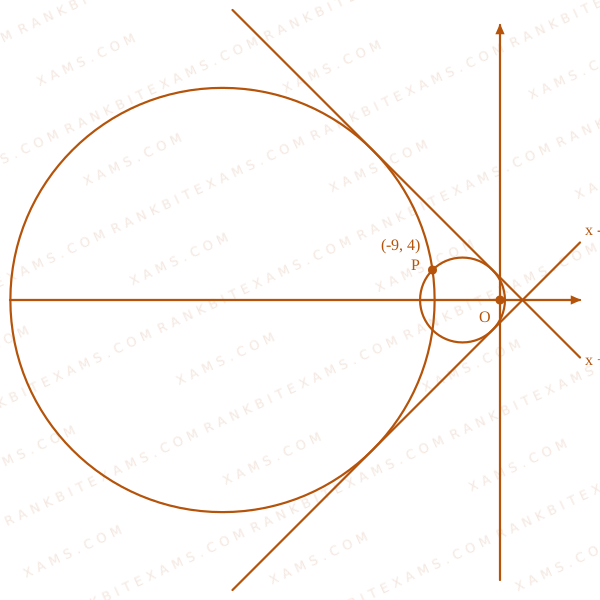
The absolute difference between the squares of the radii of the two circles passing through the point (-9, 4)$(-9, 4)$ and touching the lines x + y = 3$x + y = 3$ and x - y = 3$x - y = 3$, is equal to ________.
Numerical Answer Type:
Enter a numerical valueAnswer: 768 to 768+4 marks
Solution & Explanation
### Related Formula
Perpendicular distance from point (x_0, y_0)$(x_0, y_0)$ to line Ax + By + C = 0$Ax + By + C = 0$:
d = frac|Ax_0 + By_0 + C|sqrtA^2 + B^2$$d = \frac{|Ax_0 + By_0 + C|}{\sqrt{A^2 + B^2}}$$
### Core Logic
Since the circle touches two symmetric intersecting lines, its center must lie on their angle bisector (x$x$-axis). Use this property to find the center parameters. Tangent Properties of Circles diagram for Q75 - JEE Main 2025 Morning
### Step 1: Establish Center and Radius Equations
The lines are x+y-3=0$x+y-3=0$ and x-y-3=0$x-y-3=0$. The intersection point is (3,0)$(3,0)$, and the bisector line is the x$x$-axis.
Let the center be C(a, 0)$C(a, 0)$. The radius r$r$ is the perpendicular distance to either line:
r = frac|a - 0 - 3|sqrt1^2 + 1^2 = frac|a - 3|sqrt2$$r = \frac{|a - 0 - 3|}{\sqrt{1^2 + 1^2}} = \frac{|a - 3|}{\sqrt{2}}$$
### Step 2: Apply Point Passage Constraint
The circle equation is (x - a)^2 + y^2 = r^2$(x - a)^2 + y^2 = r^2$. Substitute the given passage point (-9, 4)$(-9, 4)$:
(-9 - a)^2 + 4^2 = left(fraca - 3sqrt2right)^2$$(-9 - a)^2 + 4^2 = \left(\frac{a - 3}{\sqrt{2}}\right)^2$$2left(a^2 + 18a + 81 + 16right) = a^2 - 6a + 9$$2\left(a^2 + 18a + 81 + 16\right) = a^2 - 6a + 9$$2a^2 + 36a + 194 = a^2 - 6a + 9 implies a^2 + 42a + 185 = 0$$2a^2 + 36a + 194 = a^2 - 6a + 9 \implies a^2 + 42a + 185 = 0$$
### Step 3: Solve for Quadratic Roots
Factor the quadratic equation:
(a + 37)(a + 5) = 0 implies a_1 = -37, quad a_2 = -5$$(a + 37)(a + 5) = 0 \implies a_1 = -37, \quad a_2 = -5$$
### Step 4: Compute Radii Squares Difference
Find the corresponding radius value for each root:
r_1 = frac|-37 - 3|sqrt2 = frac40sqrt2 = 20sqrt2 implies r_1^2 = 800$$r_1 = \frac{|-37 - 3|}{\sqrt{2}} = \frac{40}{\sqrt{2}} = 20\sqrt{2} \implies r_1^2 = 800$$r_2 = frac|-5 - 3|sqrt2 = frac8sqrt2 = 4sqrt2 implies r_2^2 = 32$$r_2 = \frac{|-5 - 3|}{\sqrt{2}} = \frac{8}{\sqrt{2}} = 4\sqrt{2} \implies r_2^2 = 32$$
The absolute difference between their squares is:
left|r_1^2 - r_2^2right| = |800 - 32| = 768$$\left|r_1^2 - r_2^2\right| = |800 - 32| = 768$$
### Pattern Recognition
Recognizing that the center must lie on the line of symmetry (x$x$-axis) eliminates one variable parameter immediately, reducing a difficult geometric system to a simple single-variable quadratic equation.
### Evaluation Rubric / Model Answer
null
### Chapter Mix
Class 11 Mathematics: Circles
Class 11 Mathematics: Straight Lines
Keywords:#circle tangent distance formula#angle bisector circle center#JEE Main 2025 Morning Q75#absolute difference radii squares
More Circles Previous-Year Questions
Q15jee_main_2026_21_jan_morningLocus of Intersection of Tangents
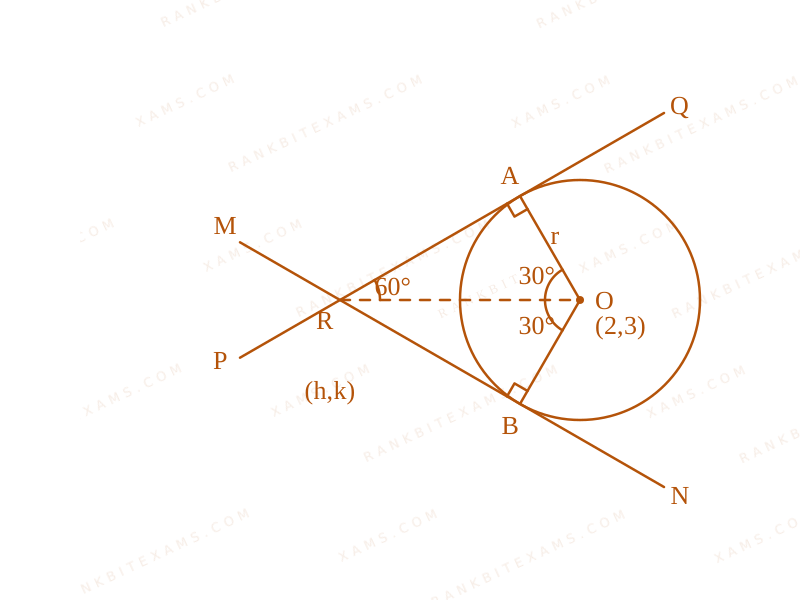
Let PQ and MN be two straight lines touching the circle x^2 + y^2 - 4x - 6y - 3 = 0$x^{2} + y^{2} - 4x - 6y - 3 = 0$ at the points A and B respectively. Let O be the centre of the circle and angle AOB = pi/3$\angle AOB = \pi/3$ . Then the locus of the point of intersection of the lines PQ and MN is:
### Related Formula
For external tangents from point R$R$ forming angle 2theta$2\theta$ at the center, the distance d$d$ from center to intersection point obeys cos theta = fracrd$\cos \theta = \frac{r}{d}$.
### Core Logic
Given circle: x^2 + y^2 - 4x - 6y - 3 = 0$x^2 + y^2 - 4x - 6y - 3 = 0$
Center O = (2, 3)$O = (2, 3)$
Radius r = sqrt(-2)^2 + (-3)^2 - (-3) = sqrt4 + 9 + 3 = sqrt16 = 4$r = \sqrt{(-2)^2 + (-3)^2 - (-3)} = \sqrt{4 + 9 + 3} = \sqrt{16} = 4$.
The tangents PQ and MN intersect at some point R(h, k)$R(h, k)$.
The radius vectors OA$OA$ and OB$OB$ subtend angle angle AOB = fracpi3 = 60^circ$\angle AOB = \frac{\pi}{3} = 60^{\circ}$ at the center.
The line joining O$O$ and R$R$ bisects the angle angle AOB$\angle AOB$.
Thus, angle AOR = 30^circ$\angle AOR = 30^{\circ}$.
### Step 1: Apply Trigonometric Relations
Circle tangents intersection locus diagram for Q15 - JEE Main 2026 Morning
In the right-angled triangle Delta AOR$\Delta AOR$, OA$OA$ is the radius (r = 4$r = 4$) and OR$OR$ is the hypotenuse.
cos(30^circ) = fracOAOR = fracrOR$$\cos(30^{\circ}) = \frac{OA}{OR} = \frac{r}{OR}$$fracsqrt32 = frac4OR Rightarrow OR = frac8sqrt3$$\frac{\sqrt{3}}{2} = \frac{4}{OR} \Rightarrow OR = \frac{8}{\sqrt{3}}$$
### Step 2: Construct the Locus Equation
The distance squared between O(2,3)$O(2,3)$ and R(h,k)$R(h,k)$ is OR^2$OR^2$:
OR^2 = (h - 2)^2 + (k - 3)^2 = left(frac8sqrt3right)^2$$OR^2 = (h - 2)^2 + (k - 3)^2 = \left(\frac{8}{\sqrt{3}}\right)^2$$(h - 2)^2 + (k - 3)^2 = frac643$$(h - 2)^2 + (k - 3)^2 = \frac{64}{3}$$h^2 - 4h + 4 + k^2 - 6k + 9 = frac643$$h^2 - 4h + 4 + k^2 - 6k + 9 = \frac{64}{3}$$3(h^2 + k^2 - 4h - 6k + 13) = 64$$3(h^2 + k^2 - 4h - 6k + 13) = 64$$3h^2 + 3k^2 - 12h - 18k + 39 - 64 = 0$$3h^2 + 3k^2 - 12h - 18k + 39 - 64 = 0$$3(h^2 + k^2) - 12h - 18k - 25 = 0$$3(h^2 + k^2) - 12h - 18k - 25 = 0$$
### Step 3: Generalize the Equation
Replace (h, k)$(h, k)$ with (x, y)$(x, y)$ for the general locus:
3(x^2 + y^2) - 12x - 18y - 25 = 0$$3(x^2 + y^2) - 12x - 18y - 25 = 0$$
### Pattern Recognition
The locus of the intersection of tangents enclosing a constant angle is simply a concentric circle. Its radius expands by 1/sin(alpha/2)$1/\sin(\alpha/2)$ or 1/cos(theta)$1/\cos(\theta)$ depending on whether the angle is measured at intersection or center.
### Evaluation Rubric / Model Answer
null
### Chapter Mix
Class 11 Maths: Conic Sections
Class 11 Maths: Straight Lines
Q25jee_main_2026_21_jan_eveningLocus
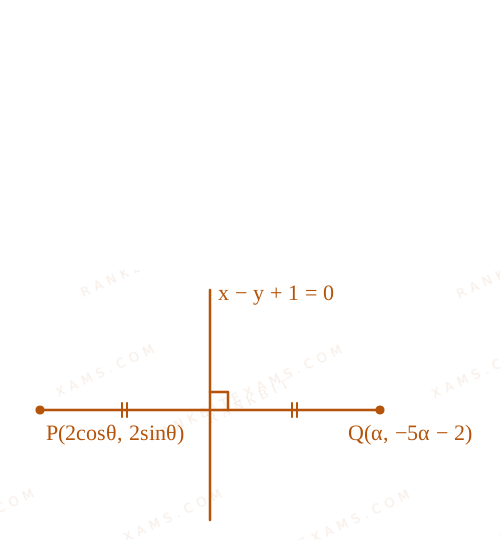
If P$P$ is a point on the circlex^2 + y^2 = 4$x^{2} + y^{2} = 4$, Q$Q$ is a point on the straight line 5x + y + 2 = 0$5x + y + 2 = 0$ and x - y + 1 = 0$x - y + 1 = 0$ is the perpendicular bisector of PQ$PQ$, then 13 times the sum of abscissa of all such point P$P$ is ____.
Numerical Answer.Answer: 2 to 2
Solution
### Related Formula
textPerpendicular bisector properties: m_1m_2 = -1 text and mid-point lies on the line.$$\text{Perpendicular bisector properties: } m_1m_2 = -1 \text{ and mid-point lies on the line.}$$textParametric point on circle x^2+y^2=r^2 text is (rcostheta, rsintheta)$$\text{Parametric point on circle } x^2+y^2=r^2 \text{ is } (r\cos\theta, r\sin\theta)$$
### Core Logic
Circle locus perpendicular bisector diagram for Q25 - JEE Main 2026 Evening
Let P = (2costheta, 2sintheta)$P = (2\cos\theta, 2\sin\theta)$.
Let Q$Q$ on the line 5x + y + 2 = 0$5x + y + 2 = 0$ be Q(alpha, -5alpha-2)$Q(\alpha, -5\alpha-2)$.
The line x - y + 1 = 0$x - y + 1 = 0$ is the perpendicular bisector of PQ$PQ$. This gives two conditions: slope of PQ$PQ$ is -1$-1$, and mid-point of PQ$PQ$ satisfies the bisector equation.
### Step 1: Apply Slope Condition
Slope of bisector is 1$1$, so slope of PQ$PQ$ must be -1$-1$.
frac2sintheta - (-5alpha - 2)2costheta - alpha = -1$$\frac{2\sin\theta - (-5\alpha - 2)}{2\cos\theta - \alpha} = -1$$2sintheta + 5alpha + 2 = -2costheta + alpha$$2\sin\theta + 5\alpha + 2 = -2\cos\theta + \alpha$$sintheta + costheta + 2alpha + 1 = 0 quad dots (1)$$\sin\theta + \cos\theta + 2\alpha + 1 = 0 \quad \dots (1)$$
### Step 2: Apply Midpoint Condition
Midpoint of PQ$PQ$ is left( frac2costheta + alpha2, frac2sintheta - 5alpha - 22 right)$\left( \frac{2\cos\theta + \alpha}{2}, \frac{2\sin\theta - 5\alpha - 2}{2} \right)$.
Substitute into x - y + 1 = 0$x - y + 1 = 0$:
frac2costheta + alpha2 - frac2sintheta - 5alpha - 22 + 1 = 0$$\frac{2\cos\theta + \alpha}{2} - \frac{2\sin\theta - 5\alpha - 2}{2} + 1 = 0$$2costheta + alpha - 2sintheta + 5alpha + 2 + 2 = 0$$2\cos\theta + \alpha - 2\sin\theta + 5\alpha + 2 + 2 = 0$$costheta - sintheta + 3alpha + 2 = 0 quad dots (2)$$\cos\theta - \sin\theta + 3\alpha + 2 = 0 \quad \dots (2)$$
### Step 3: Eliminate alpha and Solve
From (1), 2alpha = -sintheta - costheta - 1 implies alpha = frac-sintheta - costheta - 12$2\alpha = -\sin\theta - \cos\theta - 1 \implies \alpha = \frac{-\sin\theta - \cos\theta - 1}{2}$.
Substitute alpha$\alpha$ into (2):
costheta - sintheta + 3left( frac-sintheta - costheta - 12 right) + 2 = 0$$\cos\theta - \sin\theta + 3\left( \frac{-\sin\theta - \cos\theta - 1}{2} \right) + 2 = 0$$2costheta - 2sintheta - 3sintheta - 3costheta - 3 + 4 = 0$$2\cos\theta - 2\sin\theta - 3\sin\theta - 3\cos\theta - 3 + 4 = 0$$-costheta - 5sintheta + 1 = 0 implies costheta + 5sintheta = 1$$-\cos\theta - 5\sin\theta + 1 = 0 \implies \cos\theta + 5\sin\theta = 1$$
Let's express in half angles:
1 - 2sin^2fractheta2 + 10sinfractheta2cosfractheta2 = 1$$1 - 2\sin^2\frac{\theta}{2} + 10\sin\frac{\theta}{2}\cos\frac{\theta}{2} = 1$$2sinfractheta2 left( 5cosfractheta2 - sinfractheta2 right) = 0$$2\sin\frac{\theta}{2} \left( 5\cos\frac{\theta}{2} - \sin\frac{\theta}{2} \right) = 0$$
So, sinfractheta2 = 0 implies costheta = 1$\sin\frac{\theta}{2} = 0 \implies \cos\theta = 1$
or tanfractheta2 = 5 implies costheta = frac1 - tan^2(theta/2)1 + tan^2(theta/2) = frac1 - 251 + 25 = -frac2426 = -frac1213$\tan\frac{\theta}{2} = 5 \implies \cos\theta = \frac{1 - \tan^2(\theta/2)}{1 + \tan^2(\theta/2)} = \frac{1 - 25}{1 + 25} = -\frac{24}{26} = -\frac{12}{13}$.
### Step 4: Final Calculation
The abscissa of P$P$ is 2costheta$2\cos\theta$.
Values of abscissa are 2(1) = 2$2(1) = 2$ and 2left(-frac1213right) = -frac2413$2\left(-\frac{12}{13}\right) = -\frac{24}{13}$.
Sum of abscissa values = 2 - frac2413 = frac26 - 2413 = frac213$= 2 - \frac{24}{13} = \frac{26 - 24}{13} = \frac{2}{13}$.
We need 13 times (textSum) = 13 times frac213 = 2$13 \times (\text{Sum}) = 13 \times \frac{2}{13} = 2$.
### Pattern Recognition
Instead of finding the image of a generic circle point in a line, construct the reflection point Q$Q$ parameter, use slope logic (m_1m_2=-1$m_1m_2=-1$) and midpoint logic simultaneously to create a trigonometric linear equation.
### Evaluation Rubric / Model Answer
null
### Chapter Mix
Class 11 Maths: Circles
Class 11 Maths: Straight Lines
Q12jee_main_2026_22_january_morningIntersection of Two Circles
Let the set of all values of r$r$, for which the circles (x + 1)^2 + (y + 4)^2 = r^2$(x + 1)^2 + (y + 4)^2 = r^2$ and x^2 + y^2 - 4x - 2y - 4 = 0$x^2 + y^2 - 4x - 2y - 4 = 0$ intersect at two distinct points be the interval (alpha, beta)$(\alpha, \beta)$. Then alphabeta$\alpha\beta$ is equal to
A.25$25$
B.20$20$
C.21$21$
D.24$24$
Solution
### Related Formula
textTwo circles intersect at distinct points if |r_1 - r_2| < d < r_1 + r_2$$\text{Two circles intersect at distinct points if } |r_1 - r_2| < d < r_1 + r_2$$
where d$d$ is the distance between their centers.
### Core Logic
Circle 1: (x + 1)^2 + (y + 4)^2 = r^2$(x + 1)^2 + (y + 4)^2 = r^2$
Center C_1 = (-1, -4)$C_1 = (-1, -4)$ and Radius r_1 = r$r_1 = r$.
Circle 2: x^2 + y^2 - 4x - 2y - 4 = 0 implies (x - 2)^2 + (y - 1)^2 = 3^2$x^2 + y^2 - 4x - 2y - 4 = 0 \implies (x - 2)^2 + (y - 1)^2 = 3^2$
Center C_2 = (2, 1)$C_2 = (2, 1)$ and Radius r_2 = 3$r_2 = 3$.
### Step 1: Distance Between Centers
Distance d$d$ between C_1$C_1$ and C_2$C_2$:
d = sqrt(2 - (-1))^2 + (1 - (-4))^2$$d = \sqrt{(2 - (-1))^2 + (1 - (-4))^2}$$d = sqrt3^2 + 5^2 = sqrt9 + 25 = sqrt34$$d = \sqrt{3^2 + 5^2} = \sqrt{9 + 25} = \sqrt{34}$$
### Step 2: Applying the Intersection Condition
For two distinct intersection points:
|r - 3| < sqrt34 < r + 3$$|r - 3| < \sqrt{34} < r + 3$$
Breaking this down into two inequalities:
1) |r - 3| < sqrt34 implies -sqrt34 < r - 3 < sqrt34 implies 3 - sqrt34 < r < 3 + sqrt34$|r - 3| < \sqrt{34} \implies -\sqrt{34} < r - 3 < \sqrt{34} \implies 3 - \sqrt{34} < r < 3 + \sqrt{34}$
2) r + 3 > sqrt34 implies r > sqrt34 - 3$r + 3 > \sqrt{34} \implies r > \sqrt{34} - 3$
Since radius r > 0$r > 0$, taking the intersection of the conditions:
r in (sqrt34 - 3, sqrt34 + 3)$$r \in (\sqrt{34} - 3, \sqrt{34} + 3)$$
Thus, alpha = sqrt34 - 3$\alpha = \sqrt{34} - 3$ and beta = sqrt34 + 3$\beta = \sqrt{34} + 3$.
### Step 3: Calculating Final Product
alphabeta = (sqrt34 - 3)(sqrt34 + 3) = 34 - 9 = 25$$\alpha\beta = (\sqrt{34} - 3)(\sqrt{34} + 3) = 34 - 9 = 25$$
### Pattern Recognition
Intersection of two circles boils down to the fundamental triangle inequality relating the radii to the center distance: |r_1 - r_2| < d < r_1 + r_2$|r_1 - r_2| < d < r_1 + r_2$. Solving this naturally yields an interval (alpha, beta)$(\alpha, \beta)$ formatted as a difference of squares upon multiplication.
### Evaluation Rubric / Model Answer
null
### Chapter Mix
Class 11 Maths: Circles
Q8jee_main_2026_23_january_eveningFamily of Curves
If the points of intersection of the ellipsesx^2 + 2y^2 - 6x - 12y + 23 = 0$x^{2} + 2y^{2} - 6x - 12y + 23 = 0$ and
4x^2 + 2y^2 - 20x - 12y + 35 = 0$4x^2 + 2y^{2} - 20x - 12y + 35 = 0$
lie on a circle of radius r$r$ and centre (a, b)$(a, b)$, then the value of ab + 18r^2$ab + 18r^{2}$ is
A.53$53$
B.51$51$
C.52$52$
D.55$55$
Solution
### Related Formula
The equation of a family of curves passing through the intersection of two conics S_1 = 0$S_1 = 0$ and S_2 = 0$S_2 = 0$ is S_1 + lambda S_2 = 0$S_1 + \lambda S_2 = 0$.
For this resulting curve to be a circle, the coefficient of x^2$x^2$ must equal the coefficient of y^2$y^2$, and the coefficient of the xy$xy$ term must be zero.
### Core Logic
Let the two ellipses be:
S_1 equiv x^2 + 2y^2 - 6x - 12y + 23 = 0$S_1 \equiv x^2 + 2y^2 - 6x - 12y + 23 = 0$S_2 equiv 4x^2 + 2y^2 - 20x - 12y + 35 = 0$S_2 \equiv 4x^2 + 2y^2 - 20x - 12y + 35 = 0$
Equation of the curve passing through their intersection is S_1 + lambda S_2 = 0$S_1 + \lambda S_2 = 0$:
(1 + 4lambda)x^2 + (2 + 2lambda)y^2 - (6 + 20lambda)x - (12 + 12lambda)y + (23 + 35lambda) = 0$$(1 + 4\lambda)x^2 + (2 + 2\lambda)y^2 - (6 + 20\lambda)x - (12 + 12\lambda)y + (23 + 35\lambda) = 0$$
For this to represent a circle, coefficient of x^2$x^2$ = coefficient of y^2$y^2$:
1 + 4lambda = 2 + 2lambda implies 2lambda = 1 implies lambda = frac12$$1 + 4\lambda = 2 + 2\lambda \implies 2\lambda = 1 \implies \lambda = \frac{1}{2}$$
### Step 1: Finding Circle Parameters
Substitute lambda = 1/2$\lambda = 1/2$ back into the family equation:
(1 + 2)x^2 + (2 + 1)y^2 - (6 + 10)x - (12 + 6)y + left(23 + frac352right) = 0$$(1 + 2)x^2 + (2 + 1)y^2 - (6 + 10)x - (12 + 6)y + \left(23 + \frac{35}{2}\right) = 0$$3x^2 + 3y^2 - 16x - 18y + frac812 = 0$$3x^2 + 3y^2 - 16x - 18y + \frac{81}{2} = 0$$
Dividing by 3 to write in standard form:
x^2 + y^2 - frac163x - 6y + frac272 = 0$$x^2 + y^2 - \frac{16}{3}x - 6y + \frac{27}{2} = 0$$
The centre (a, b)$(a, b)$ is given by (-g, -f)$(-g, -f)$:
a = frac83, quad b = 3$$a = \frac{8}{3}, \quad b = 3$$
The radius r$r$ is given by r^2 = g^2 + f^2 - c$r^2 = g^2 + f^2 - c$:
r^2 = left(frac-83right)^2 + (-3)^2 - frac272 = frac649 + 9 - frac272 = frac128 + 162 - 24318 = frac4718$$r^2 = \left(\frac{-8}{3}\right)^2 + (-3)^2 - \frac{27}{2} = \frac{64}{9} + 9 - \frac{27}{2} = \frac{128 + 162 - 243}{18} = \frac{47}{18}$$
### Step 2: Final Calculation
We need to find ab + 18r^2$ab + 18r^2$:
ab = left(frac83right)(3) = 8$$ab = \left(\frac{8}{3}\right)(3) = 8$$18r^2 = 18left(frac4718right) = 47$$18r^2 = 18\left(\frac{47}{18}\right) = 47$$ab + 18r^2 = 8 + 47 = 55$$ab + 18r^2 = 8 + 47 = 55$$
### Pattern Recognition
When intersection points of two 2^textnd$2^{\text{nd}}$ degree curves form a circle, apply S_1 + lambda S_2 = 0$S_1 + \lambda S_2 = 0$ immediately, forcing the necessary symmetric coefficients to extract lambda$\lambda$.
### Evaluation Rubric / Model Answer
null
### Chapter Mix
Class 11 Maths: Conic Sections
Class 11 Maths: Circles
Q3jee_main_2026_28_january_morningChord of a Circle
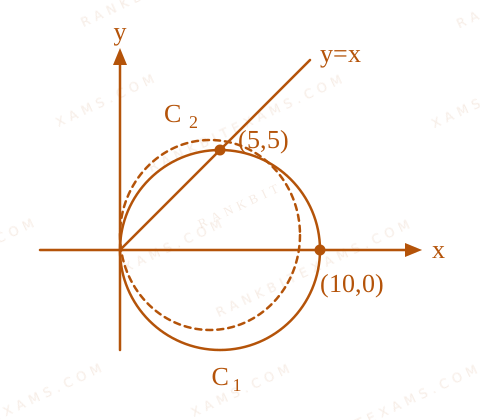
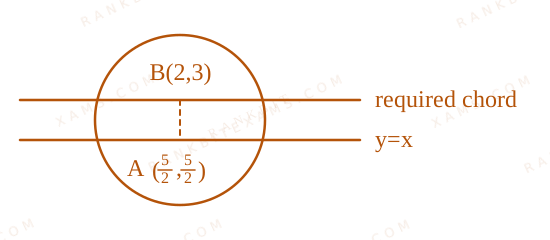
Let y = x$y = x$ be the equation of a chord of the circle C_1$C_{1}$ (in the closed half-plane x geq 0$x \geq 0$) of diameter 10$10$ passing through the origin. Let C_2$C_{2}$ be another circle described on the given chord as its diameter. If the equation of the chord of the circle C_2$C_{2}$, which passes through the point (2, 3)$(2, 3)$ and is farthest from the center of C_2$C_{2}$, is x + ay + b = 0$x + ay + b = 0$, then a - b$a - b$ is equal to:
A.10$10$
B.-6$-6$
C.-2$-2$
D.6$6$
Solution
### Core Logic
Chord of a CircleChord of a Circle
Equation of circle C_2$C_{2}$ with diameter along y=x$y=x$ passing through origin and having length 10. Wait, C_1$C_1$ has diameter 10. The chord y=x$y=x$ passes through (0,0)$(0,0)$. For the chord to be a diameter of C_2$C_2$, the points of intersection with C_1$C_1$ must form the diameter.
The center of C_2$C_2$ is the midpoint of the chord. Let the ends of the chord be (0,0)$(0,0)$ and (5,5)$(5,5)$ (since length is sqrt50$\sqrt{50}$? Wait, the problem implies the chord of C_1$C_1$ is y=x$y=x$. If C_1$C_1$ is a circle in x geq 0$x \geq 0$ of diameter 10 through origin. Center of C_2$C_2$ lies on the chord y=x$y=x$.
The equation of circle C_2$C_{2}$ is:
x^2 + y^2 - 5x - 5y = 0$$x^2 + y^2 - 5x - 5y = 0$$
Its center is Nleft(frac52, frac52right)$N\left(\frac{5}{2}, \frac{5}{2}\right)$.
### Step 1: Find Farthest Chord
We need the chord of C_2$C_2$ passing through B(2, 3)$B(2, 3)$ which is farthest from the center Nleft(frac52, frac52right)$N\left(\frac{5}{2}, \frac{5}{2}\right)$.
The farthest chord passing through a given point is always perpendicular to the line joining the center to that point.
Slope of line NB$NB$:
m_NB = frac3 - frac522 - frac52 = fracfrac12-frac12 = -1$$m_{NB} = \frac{3 - \frac{5}{2}}{2 - \frac{5}{2}} = \frac{\frac{1}{2}}{-\frac{1}{2}} = -1$$
### Step 2: Chord Equation
The slope of the required chord is perpendicular to m_NB$m_{NB}$:
textSlope of required chord = 1$$\text{Slope of required chord } = 1$$
Equation of the required chord passing through (2,3)$(2,3)$:
y - 3 = 1(x - 2)$$y - 3 = 1(x - 2)$$x - y + 1 = 0$x - y + 1 = 0$
Comparing this with x + ay + b = 0$x + ay + b = 0$, we get:
a = -1, quad b = 1$$a = -1, \quad b = 1$$
### Step 3: Final Calculation
a - b = -1 - 1 = -2$$a - b = -1 - 1 = -2$$
### Pattern Recognition
The chord of a circle passing through a given internal point that is FARTHEST from the center is exactly the chord that is PERPENDICULAR to the radius (or line segment) connecting the center to that internal point.
### Evaluation Rubric / Model Answer
null
### Chapter Mix
Class 11 Mathematics: Circles
Class 11 Mathematics: Straight Lines
More Circles Questions — jee_main_2025_02_april_morning
We Map Every Repeating Question in Competitive Exams.
Say goodbye to generic mock test fatigue. RankBit uses smart analysis to group past exam questions into their foundational Repeating Question Types. Find chapter weightage, track repeating questions, and score higher with targeted practice.
Select Your Target Exam
Choose an exam track below to find formulas per chapter and patterns.
Syncing Exam Intelligence
Mapping formulas and patterns across all tracks…
PATH A — FULL LENGTH PRACTICE
Full Mock Test Hub
Simulate real NTA exam conditions with fully tracked mocks. Time yourself against past papers.
Practice past-year questions one chapter at a time. Pick an exam → subject → chapter and get every PYQ for that topic — pulled together from all past papers — with the chapter's key formulas alongside.