Equation of two diameters of a circle are 2x-3y=5$2x-3y=5$ and 3x-4y=7$3x-4y=7$. The line joining the points (-(22)/(7),-4)$(-\frac{22}{7},-4)$ and (-(1)/(7),3)$(-\frac{1}{7},3)$intersects the circle at only one pointP(α,β)$P(\alpha,\beta)$. Then 17β-α$17\beta-\alpha$ is equal to
Numerical Answer Type:
Enter a numerical valueAnswer: 2 to 2+4 marks
Solution & Explanation
Related Formula
The intersection of any two non-parallel diameters yields the center of the circle.
A line that intersects a circle at exactly one point is a tangent line.
The tangent at the point of contact P$P$ is always perpendicular to the radius CP$CP$, thus mtangent × mradius = -1$m_{\text{tangent}} \times m_{\text{radius}} = -1$.
Core Logic
Find the center C$C$ by solving the two diameter equations:
Multiply (1) by 3 and (2) by 2:
6x - 9y = 15$6x - 9y = 15$6x - 8y = 14$6x - 8y = 14$
Subtracting the equations gives -y = 1 ⇒ y = -1$-y = 1 \Rightarrow y = -1$.
Substitute y = -1$y = -1$ into (1): 2x + 3 = 5 ⇒ 2x = 2 ⇒ x = 1$2x + 3 = 5 \Rightarrow 2x = 2 \Rightarrow x = 1$.
Center C$C$ is (1, -1)$(1, -1)$.
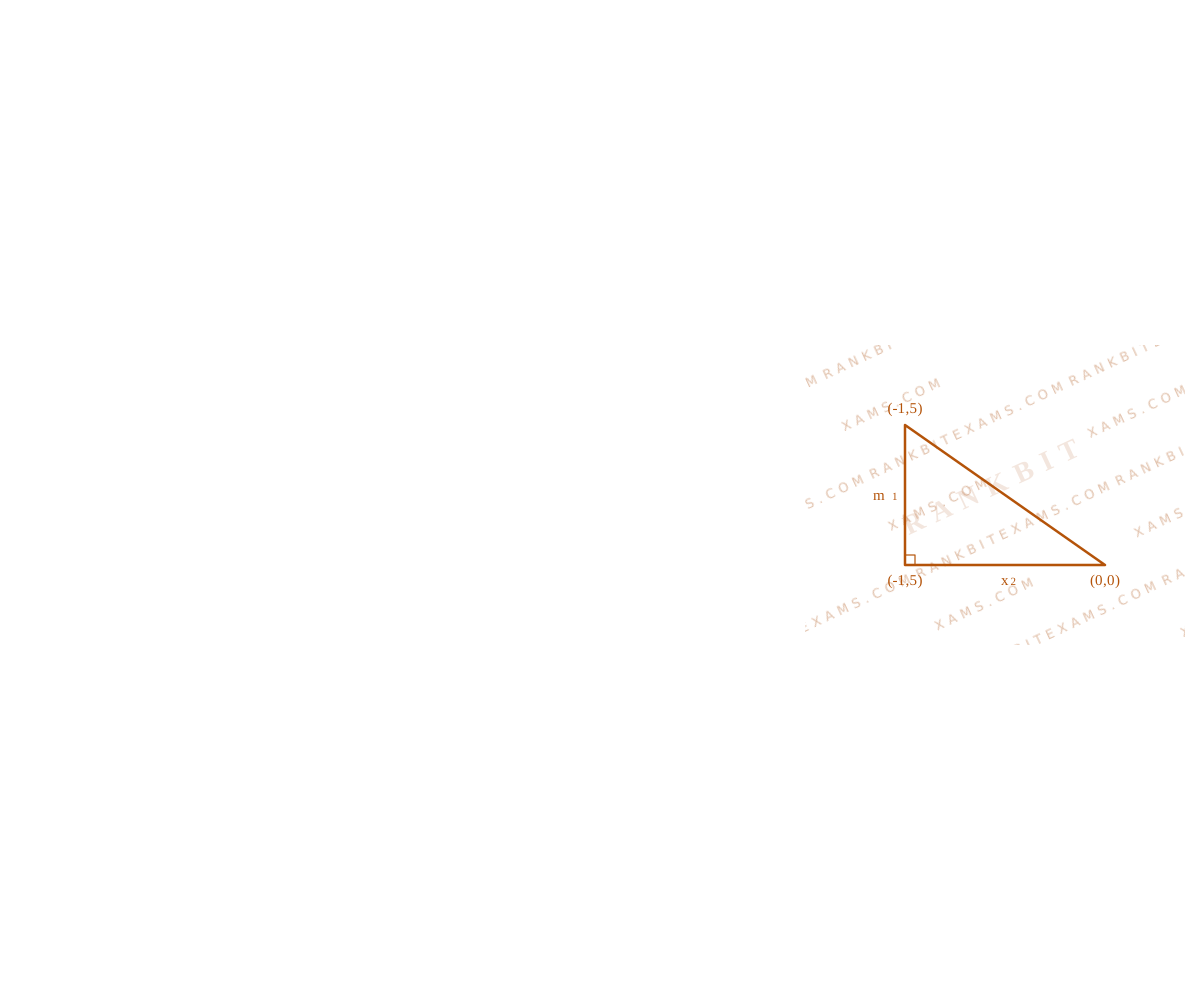
Find the equation of the line joining A(-(22)/(7), -4)$A(-\frac{22}{7}, -4)$ and B(-(1)/(7), 3)$B(-\frac{1}{7}, 3)$.
Slope of AB$AB$: mAB = (3 - (-4))/(-1/7 - (-22/7)) = (7)/(21/7) = (7)/(3)$m_{AB} = \frac{3 - (-4)}{-1/7 - (-22/7)} = \frac{7}{21/7} = \frac{7}{3}$.
Equation of line AB$AB$:
Since line AB$AB$intersects the circle at only one pointP(α, β)$P(\alpha, \beta)$, line AB$AB$ is a tangent to the circle, and P$P$ is the point of tangency.
The radius line CP$CP$ is perpendicular to tangent AB$AB$.
Slope of CP$CP$ (mCP$m_{CP}$) must be -(3)/(7)$-\frac{3}{7}$.
Equation of the line passing through center C(1, -1)$C(1, -1)$ with slope -(3)/(7)$-\frac{3}{7}$:
When a line "intersects a circle at exactly one point", it's a coded cue to stop thinking about quadratics and discriminants, and immediately build a perpendicular geometric radius from the center to find the exact tangency coordinate.
Chapter Mix
Class 11 Mathematics: Circles
Class 11 Mathematics: Straight Lines
Keywords:#intersects the circle at only one point#JEE Main 2024 Morning Q21#Circles JEE Main 2024#Tangents and Normal JEE Main 2024
More Circles Previous-Year Questions — Page 8
Q53jee_main_2025_03_april_eveningCircles
If the four distinct points (4, 6)$(4, 6)$, (-1, 5)$(-1, 5)$, (0, 0)$(0, 0)$ and (k, 3k)$(k, 3k)$ lie on a circle of radius r$r$, then 10k + r²$10k + r^2$ is equal to
Notice that the slope of the line joining origin (0,0)$(0,0)$ to the general point is y = 3x$y = 3x$. For three given coordinates, if origin is one of them, the circle equation lacks the constant c$c$. It is always faster to first solve for parameters g, f$g, f$ and then check geometry.
Chapter Mix
Class 11 Mathematics: Conic Sections
Class 10 Mathematics: Coordinate Geometry
Q67jee_main_2025_03_april_eveningEllipse
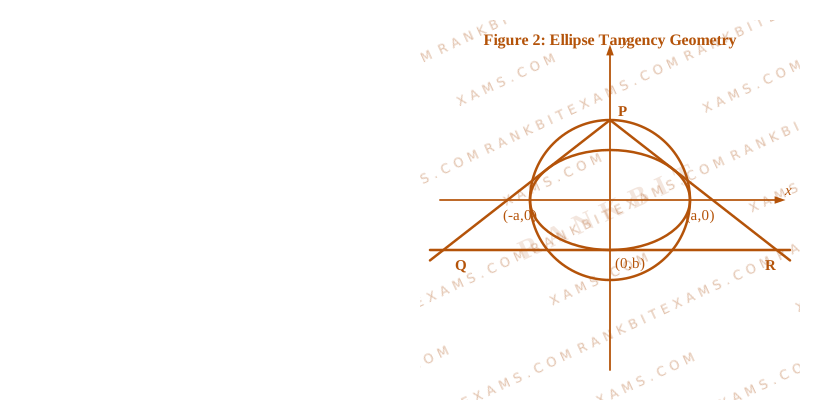
Let C$C$ be the circle of minimum area enclosing the ellipse E: (x²)/(a²) + (y²)/(b²) = 1$E: \frac{x^2}{a^2} + \frac{y^2}{b^2} = 1$ with eccentricity (1)/(2)$\frac{1}{2}$ and foci (pm 2, 0)$(pm 2, 0)$. Let PQR$PQR$ be a variable triangle, whose vertex P$P$ is on the circle C$C$ and the side QR$QR$ of length 8$8$ is parallel to the major axis of E$E$ and contains the point of intersection of E$E$ with the negative y$y$-axis. Then the maximum area of the triangle PQR$PQR$ is:
A.6(3 + √(2))$6(3 + \sqrt{2})$
B.8(3 + √(2))$8(3 + \sqrt{2})$
C.6(2 + √(3))$6(2 + \sqrt{3})$
D.8(2 + √(3))$8(2 + \sqrt{3})$
Solution
Related Formula
For an ellipse E$E$:
Foci: (± ae, 0)$(\pm ae, 0)$
Eccentricity: b² = a²(1 - e²)$b^2 = a^2(1 - e^2)$
The circle of minimum area enclosing a centered ellipse has diameter equal to the major axis of the ellipse (R = a$R = a$).
Area of triangle: Area = (1)/(2) · base · height$\text{Area} = \frac{1}{2} \cdot \text{base} \cdot \text{height}$
Core Logic
Let's first find coordinates a$a$ and b$b$:
ae = 2$ae = 2$
e = (1)/(2) a((1)/(2)) = 2 a = 4$e = \frac{1}{2} \implies a\left(\frac{1}{2}\right) = 2 \implies a = 4$
The enclosing circle C$C$ has radius R = a = 4$R = a = 4$, centered at (0,0)$(0,0)$. Thus, its equation is:
x² + y² = 16 P = (4 θ, 4 θ)$$x^2 + y^2 = 16 \implies P = (4\cos\theta, 4\sin\theta)$$
The intersection of the ellipse with the negative y$y$-axis is (0, -b) = (0, -2√(3))$(0, -b) = (0, -2\sqrt{3})$.
Since side QR$QR$ (length = 8$= 8$) is parallel to the major axis (x$x$-axis) and contains (0, -2√(3))$(0, -2\sqrt{3})$, the equation of the line containing QR$QR$ is:
y = -2√(3)$y = -2\sqrt{3}$
Enclosing circle diagram for Q67 - JEE Main 2025 Evening Shift
Step 2: Maximizing Area of Δ PQR$\Delta PQR$
The perpendicular height of vertex P(4 θ, 4 θ)$P(4\cos\theta, 4\sin\theta)$ from the base line y = -2√(3)$y = -2\sqrt{3}$ is:
The enclosing circle with minimum area is called the auxiliary circle. Its radius is equal to the semi-major axis a$a$. Max height of a triangle with a base fixed at line y=-k$y=-k$ and vertex on the circle is R + k$R + k$. This directly gives Area = (1)/(2) · base · (a+b)$\text{Area} = \frac{1}{2} \cdot \text{base} \cdot (a+b)$.
Chapter Mix
Class 11 Mathematics: Conic Sections
Q68jee_main_2025_03_april_eveningParabola
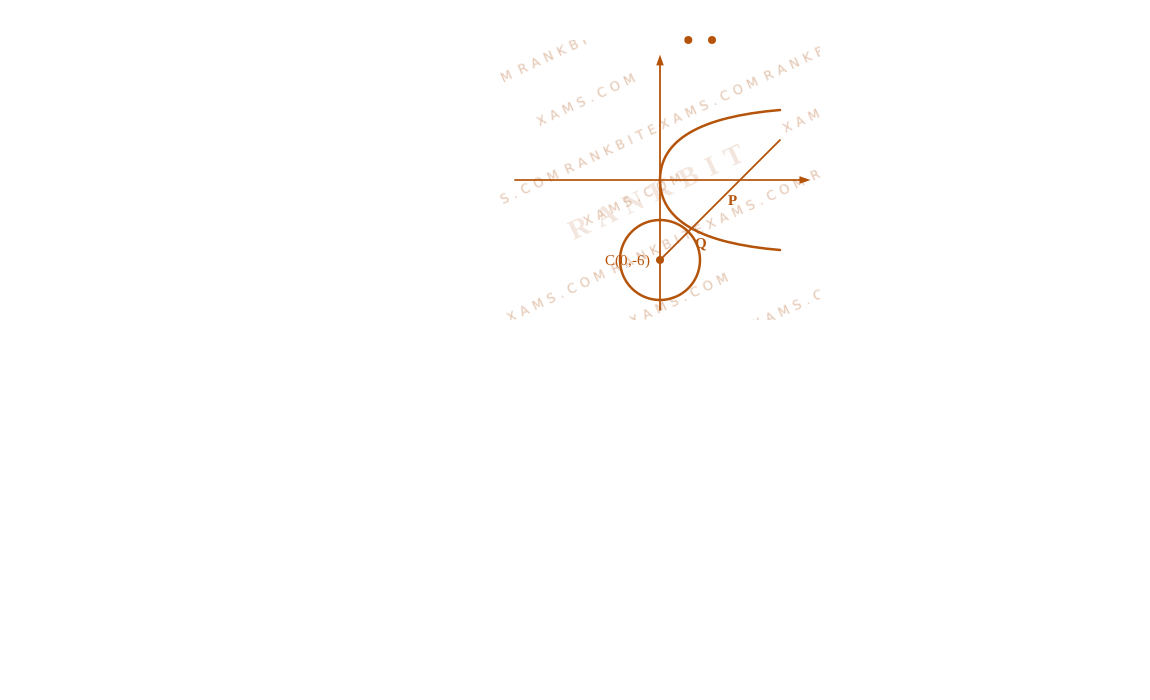
The shortest distance between the curves y² = 8x$y^2 = 8x$ and x² + y² + 12y + 35 = 0$x^2 + y^2 + 12y + 35 = 0$ is :
A.2√(3) - 1$2\sqrt{3} - 1$
B.√(2)$\sqrt{2}$
C.3√(2) - 1$3\sqrt{2} - 1$
D.2√(2) - 1$2\sqrt{2} - 1$
Solution
Related Formula
For a circle x² + (y-k)² = R²$x^2 + (y-k)^2 = R^2$ and any smooth curve, the shortest distance lies along the normal to the curve passing through the center of the circle C(h,k)$C(h,k)$:
Shortest Distance = Distance(P, C) - R$$\text{Shortest Distance} = \text{Distance}(P, C) - R$$
where P$P$ is the point of normal intersection on the curve.
SD = PC - R = 2√(2) - 1$$\text{SD} = PC - R = 2\sqrt{2} - 1$$
Pattern Recognition
The shortest distance between a parabola and a circle is always along the common normal of the parabola passing through the circle's center. Finding the normal in slope form and solving for m$m$ avoids complex calculus.
Chapter Mix
Class 11 Mathematics: Conic Sections
Q75jee_main_2025_03_april_eveningHyperbola
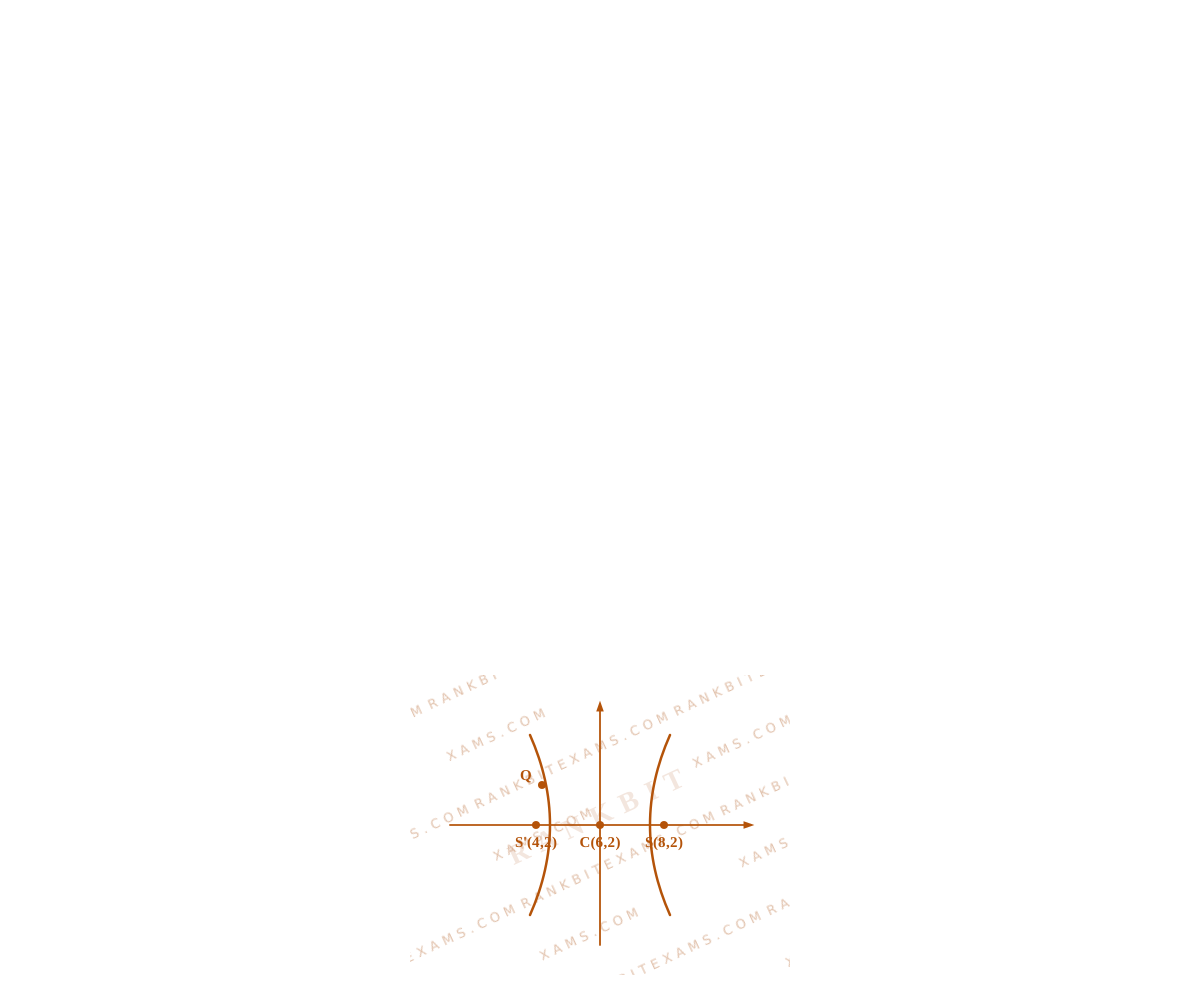
If the equation of the hyperbola with foci (4, 2)$(4, 2)$ and (8, 2)$(8, 2)$ is 3x² - y² - α x + β y + γ = 0$3x^2 - y^2 - \alpha x + \beta y + \gamma = 0$, then α + β + γ$\alpha + \beta + \gamma$ is equal to
Numerical Answer.Answer: 141 to 141
Solution
Related Formula
For a horizontal hyperbola centered at (h,k)$(h,k)$:
Comparing with 3x² - y² - α x + β y + γ = 0$3x^2 - y^2 - \alpha x + \beta y + \gamma = 0$, the ratio of coefficients of x²$x^2$ and y²$y^2$ is (3)/(-1) = -3$\frac{3}{-1} = -3$:
Hyperbola diagram for Q75 - JEE Main 2025 Evening Shift
Pattern Recognition
Symmetric focal coordinates (y=2$y=2$) indicate the hyperbola is horizontal. Identifying coordinates of the center (6,2)$(6,2)$ quickly and using coefficient ratio comparison restricts parameters immediately without requiring complex algebraic systems.
Chapter Mix
Class 11 Conic Sections
Qjee_main_2025_07_april_morningParabola
Let P$\mathrm{P}$ be the parabola, whose focus is (-2, 1)$(-2, 1)$ and directrix is 2x + y + 2 = 0$2\mathrm{x} + \mathrm{y} + 2 = 0$ . Then the sum of the ordinates of the points on P$\mathrm{P}$ , whose abscissa is -2$-2$ , is
A.(3)/(2)$\frac{3}{2}$
B.(5)/(2)$\frac{5}{2}$
C.(1)/(4)$\frac{1}{4}$
D.(3)/(4)$\frac{3}{4}$
Solution
Related Formula
By the definition of a parabola, the distance from any point (x, y)$(x, y)$ on the curve to the focus (xf, yf)$(x_f, y_f)$ equals its perpendicular distance to the directrix line Ax + By + C = 0$Ax + By + C = 0$:
Parabola diagram for Q55 - JEE Main 2025 Morning
We need the points whose abscissa (x-coordinate) is x = -2$x = -2$. Substitute x = -2$x = -2$ into the general equation:
Notice how evaluating the intersection layout directly simplifies when the substitution value matches the coordinate of the focus, converting the entire quadratic horizontal layout component to 0 immediately.
Chapter Mix
Class 11 Mathematics: Conic Sections
More Circles Questions — jee_main_2024_29_jan_morning
Practice past-year questions one chapter at a time. Pick an exam → subject → chapter and get every PYQ for that topic — pulled together from all past papers — with the chapter's key formulas alongside.

.svg)
