Equation of two diameters of a circle are 2x-3y=5$2x-3y=5$ and 3x-4y=7$3x-4y=7$. The line joining the points (-(22)/(7),-4)$(-\frac{22}{7},-4)$ and (-(1)/(7),3)$(-\frac{1}{7},3)$intersects the circle at only one pointP(α,β)$P(\alpha,\beta)$. Then 17β-α$17\beta-\alpha$ is equal to
Numerical Answer Type:
Enter a numerical valueAnswer: 2 to 2+4 marks
Solution & Explanation
Related Formula
The intersection of any two non-parallel diameters yields the center of the circle.
A line that intersects a circle at exactly one point is a tangent line.
The tangent at the point of contact P$P$ is always perpendicular to the radius CP$CP$, thus mtangent × mradius = -1$m_{\text{tangent}} \times m_{\text{radius}} = -1$.
Core Logic
Find the center C$C$ by solving the two diameter equations:
Multiply (1) by 3 and (2) by 2:
6x - 9y = 15$6x - 9y = 15$6x - 8y = 14$6x - 8y = 14$
Subtracting the equations gives -y = 1 ⇒ y = -1$-y = 1 \Rightarrow y = -1$.
Substitute y = -1$y = -1$ into (1): 2x + 3 = 5 ⇒ 2x = 2 ⇒ x = 1$2x + 3 = 5 \Rightarrow 2x = 2 \Rightarrow x = 1$.
Center C$C$ is (1, -1)$(1, -1)$.
Find the equation of the line joining A(-(22)/(7), -4)$A(-\frac{22}{7}, -4)$ and B(-(1)/(7), 3)$B(-\frac{1}{7}, 3)$.
Slope of AB$AB$: mAB = (3 - (-4))/(-1/7 - (-22/7)) = (7)/(21/7) = (7)/(3)$m_{AB} = \frac{3 - (-4)}{-1/7 - (-22/7)} = \frac{7}{21/7} = \frac{7}{3}$.
Equation of line AB$AB$:
Since line AB$AB$intersects the circle at only one pointP(α, β)$P(\alpha, \beta)$, line AB$AB$ is a tangent to the circle, and P$P$ is the point of tangency.
The radius line CP$CP$ is perpendicular to tangent AB$AB$.
Slope of CP$CP$ (mCP$m_{CP}$) must be -(3)/(7)$-\frac{3}{7}$.
Equation of the line passing through center C(1, -1)$C(1, -1)$ with slope -(3)/(7)$-\frac{3}{7}$:
When a line "intersects a circle at exactly one point", it's a coded cue to stop thinking about quadratics and discriminants, and immediately build a perpendicular geometric radius from the center to find the exact tangency coordinate.
Chapter Mix
Class 11 Mathematics: Circles
Class 11 Mathematics: Straight Lines
Keywords:#intersects the circle at only one point#JEE Main 2024 Morning Q21#Circles JEE Main 2024#Tangents and Normal JEE Main 2024
More Circles Previous-Year Questions — Page 7
Q67jee_main_2025_02_april_eveningParabola
Let the point P$\mathrm{P}$ of the focal chord PQ$\mathrm{PQ}$ of the parabola y² = 16x$\mathrm{y}^2 = 16\mathrm{x}$ be (1, -4)$(1, -4)$. If the focus of the parabola divides the chord PQ$\mathrm{PQ}$ in the ratio m : n$\mathrm{m} : \mathrm{n}$, (m, n) = 1$\gcd(\mathrm{m}, \mathrm{n}) = 1$, then m² + n²$\mathrm{m}^2 + \mathrm{n}^2$ is equal to:
We find the parametric parameters of coordinates P$P$ and Q$Q$, obtain their Cartesian values, and then apply the section formula with the focus S$S$ to calculate the splitting ratio.
Step 1: Find coordinates of P and Q
For parabola y² = 16x$y^2 = 16x$, the focal parameter is a = 4$a = 4$.
Focus is S(4, 0)$S(4, 0)$.
Let P$P$ be (a t₁², 2a t₁) = (1, -4)$(a t_1^2, 2a t_1) = (1, -4)$:
Q ≡ (a t₂², 2 a t₂) = (4(4), 2(4)(2)) = (16, 16)$$Q \equiv (a t_2^2, \, 2 a t_2) = (4(4), \, 2(4)(2)) = (16, \, 16)$$
Step 2: Solve for the dividing ratio
Let the focus S(4, 0)$S(4, 0)$ divide the line segment PQ$PQ$ internally in the ratio λ : 1$\lambda : 1$.
Using the y$y$-coordinate of the section formula:
Harmonic Mean Shortcut: In any parabola, the focus divides a focal chord internally into segments of lengths SP$SP$ and SQ$SQ$ such that the semi-latus rectum 2a$2a$ is the harmonic mean of these segments: (1)/(SP) + (1)/(SQ) = (1)/(a)$\frac{1}{SP} + \frac{1}{SQ} = \frac{1}{a}$.
Chapter Mix
Class 11 Mathematics: Conic Sections
Qjee_main_2025_02_april_morningProperties of Hyperbola
Let one focus of the hyperbola H: (x²)/(a²) - (y²)/(b²) = 1$H: \frac{x^2}{a^2} - \frac{y^2}{b^2} = 1$ be at (√(10), 0)$(\sqrt{10}, 0)$ and the corresponding directrix be x = 9√(10)$x = \frac{9}{\sqrt{10}}$. If e$e$ and l$l$ respectively are the eccentricity and the length of the latus rectum of H$H$, then 9(e² + l)$9(e^2 + l)$ is equal to:
A.14$14$
B.15$15$
C.16$16$
D.12$12$
Solution
Related Formula
For a standard hyperbola:
Focus: (± ae, 0)$(\pm ae, 0)$
Directrix: x = ± (a)/(e)$x = \pm \frac{a}{e}$
Eccentricity relation: (ae)² = a² + b²$(ae)^2 = a^2 + b^2$
Length of latus rectum: l = (2b²)/(a)$l = \frac{2b^2}{a}$
Core Logic
Given ae = √(10)$ae = \sqrt{10}$ and (a)/(e) = 9√(10)$\frac{a}{e} = \frac{9}{\sqrt{10}}$. Multiplying these gives a²$a^2$, which determines both parameters.
Multiplying focus location by directrix location immediately eliminates e$e$, giving a²$a^2$ directly. Once a²$a^2$ is known, b²$b^2$ follow seamlessly via (ae)² = a²+b²$(ae)^2 = a^2+b^2$.
Chapter Mix
Class 11 Mathematics: Conic Sections
Qjee_main_2025_02_april_morningProperties of Ellipse
If S$S$ and S'$S'$ are the foci of the ellipse (x²)/(18) + (y²)/(9) = 1$\frac{x^2}{18} + \frac{y^2}{9} = 1$ and P$P$ be a point on the ellipse, then (SP · S'P) + (SP · S'P)$\min(SP \cdot S'P) + \max(SP \cdot S'P)$ is equal to:
A.3(1+√(2))$3(1+\sqrt{2})$
B.3(6+√(2))$3(6+\sqrt{2})$
C.9$9$
D.27$27$
Solution
Related Formula
Focal distances of any point P(a θ, b θ)$P(a\cos\theta, b\sin\theta)$ on an ellipse are given by:
SP = a - exP = a(1 - e θ)$$SP = a - ex_P = a(1 - e\cos\theta)$$S'P = a + exP = a(1 + e θ)$$S'P = a + ex_P = a(1 + e\cos\theta)$$
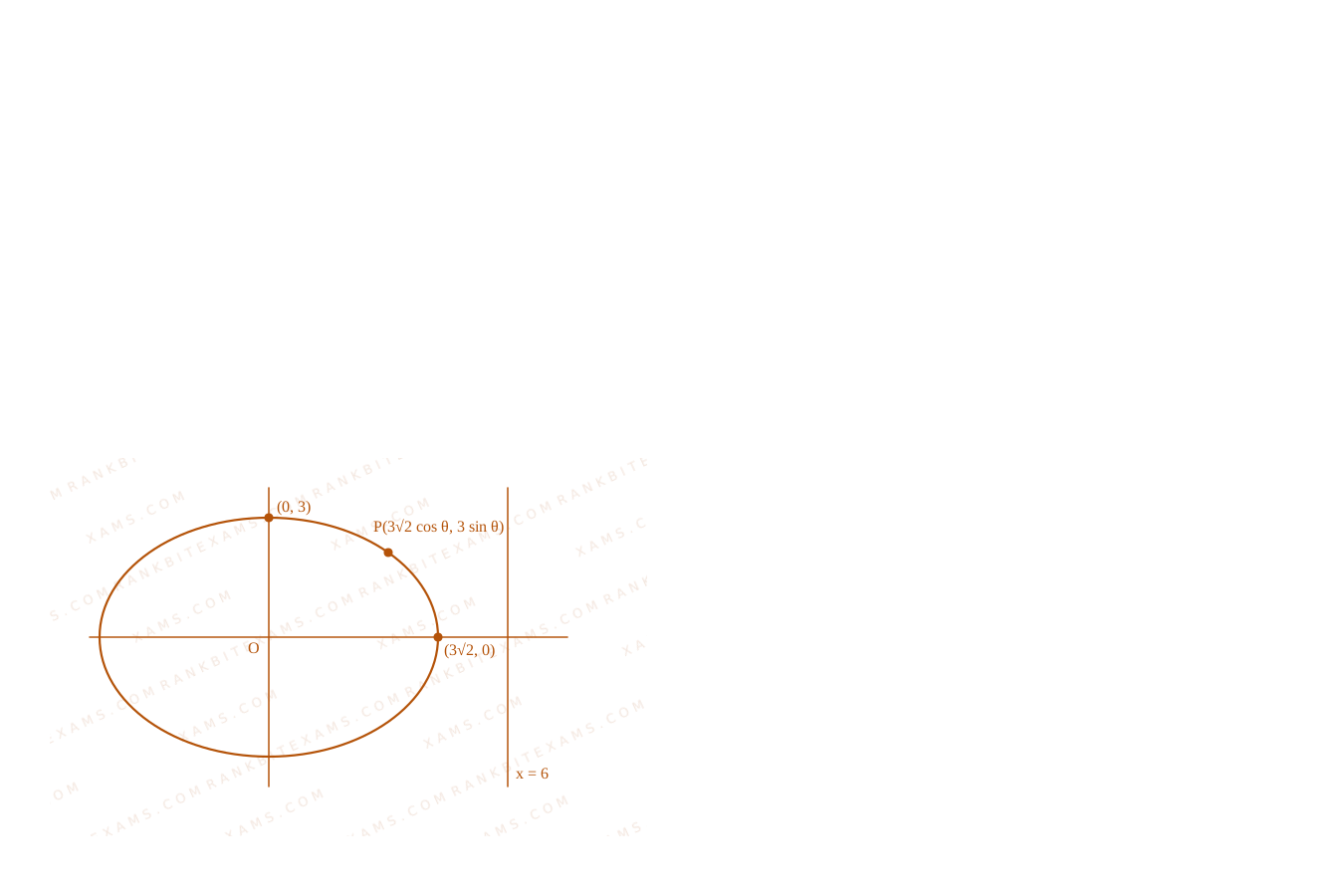
Compute the eccentricity e$e$, express the product SP · S'P$SP \cdot S'P$ in terms of ²θ$\cos^2\theta$, and analyze its bounds across the domain to find minimum and maximum limits. Properties of Ellipse diagram for Q66 - JEE Main 2025 Morning
The product of focal distances can also be written directly as b²$b^2$ at the minor axis vertices (max) and a²(1-e²)$a^2(1-e^2)$ varying down to a²-c²$a^2-c^2$. Summing them up yields b² + a² = 9 + 18 = 27$b^2 + a^2 = 9 + 18 = 27$ instantly.
Chapter Mix
Class 11 Mathematics: Conic Sections
Qjee_main_2025_02_april_morningProperties of Parabola
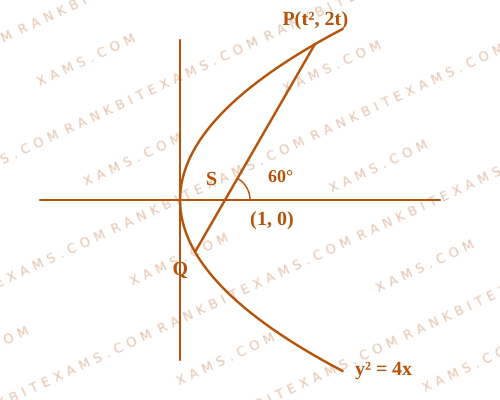
Let the focal chord PQ$PQ$ of the parabola y² = 4x$y^2 = 4x$ make an angle of 60^°$60^\circ$ with the positive x$x$-axis, where P$P$ lies in the first quadrant. If the circle, whose one diameter is PS$PS$, S$S$ being the focus of the parabola, touches the y$y$-axis at the point (0, a)$(0, a)$, then 5a²$5a^2$ is equal to:
A.15$15$
B.25$25$
C.30$30$
D.20$20$
Solution
Related Formula
For a standard parabola y² = 4ax$y^2 = 4ax$:
Focus: S(a, 0)$S(a, 0)$
Parametric coordinates: (at², 2at)$(at^2, 2at)$
Equation of a circle on diametric endpoints (x₁, y₁)$(x_1, y_1)$ and (x₂, y₂)$(x_2, y_2)$:
Find the point P$P$ using the slope of the focal chord, write the equation of the circle with diameter PS$PS$, and find its y$y$-intercept. Properties of Parabola diagram for Q70 - JEE Main 2025 Morning
Step 1: Determine P Coordinates
For y² = 4x$y^2 = 4x$, parameter a=1 S(1,0)$a=1 \implies S(1,0)$ and P(t², 2t)$P(t^2, 2t)$.
Slope of focal chord PS$PS$:
Since P$P$ is in the first quadrant, t > 0 t = √(3)$t > 0 \implies t = \sqrt{3}$.
Thus, P((√(3))², 2√(3)) = P(3, 2√(3))$P((\sqrt{3})^2, 2\sqrt{3}) = P(3, 2\sqrt{3})$.
Step 2: Construct the Diametric Circle Equation
Endpoints are S(1,0)$S(1,0)$ and P(3, 2√(3))$P(3, 2\sqrt{3})$:
This is a perfect square expression (y - √(3))² = 0 y = √(3)$(y - \sqrt{3})^2 = 0 \implies y = \sqrt{3}$.
Thus, the intercept value is a = √(3)$a = \sqrt{3}$.
Step 4: Compute Final Target Value
5a² = 5(√(3))² = 15$$5a^2 = 5(\sqrt{3})^2 = 15$$
Pattern Recognition
A circle whose diameter is a focal radius always touches the tangent at the vertex (y$y$-axis for a standard parabola). The coordinate of the contact point is simply given by a t = 1 · √(3) = √(3)$a t = 1 \cdot \sqrt{3} = \sqrt{3}$, bypasses the full equation construction entirely.
Chapter Mix
Class 11 Mathematics: Conic Sections
Q75jee_main_2025_02_april_morningTangent Properties of Circles
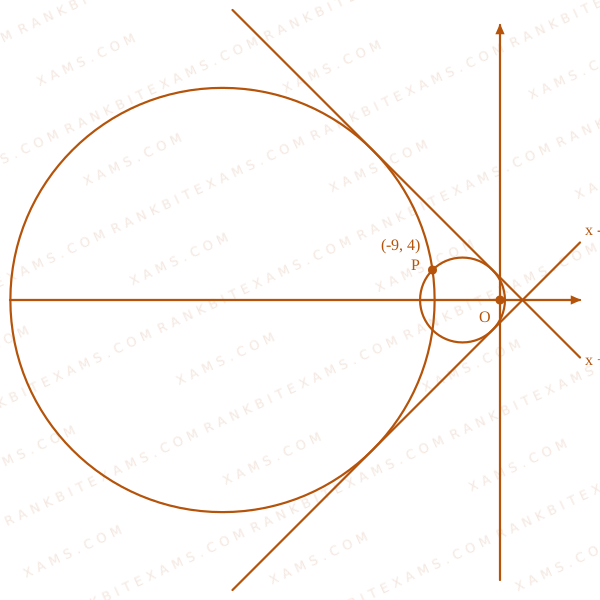
The absolute difference between the squares of the radii of the two circles passing through the point (-9, 4)$(-9, 4)$ and touching the lines x + y = 3$x + y = 3$ and x - y = 3$x - y = 3$, is equal to ________.
Numerical Answer.Answer: 768 to 768
Solution
Related Formula
Perpendicular distance from point (x₀, y₀)$(x_0, y_0)$ to line Ax + By + C = 0$Ax + By + C = 0$:
Since the circle touches two symmetric intersecting lines, its center must lie on their angle bisector (x$x$-axis). Use this property to find the center parameters. Tangent Properties of Circles diagram for Q75 - JEE Main 2025 Morning
Step 1: Establish Center and Radius Equations
The lines are x+y-3=0$x+y-3=0$ and x-y-3=0$x-y-3=0$. The intersection point is (3,0)$(3,0)$, and the bisector line is the x$x$-axis.
Let the center be C(a, 0)$C(a, 0)$. The radius r$r$ is the perpendicular distance to either line:
Recognizing that the center must lie on the line of symmetry (x$x$-axis) eliminates one variable parameter immediately, reducing a difficult geometric system to a simple single-variable quadratic equation.
Chapter Mix
Class 11 Mathematics: Circles
Class 11 Mathematics: Straight Lines
More Circles Questions — jee_main_2024_29_jan_morning
Practice past-year questions one chapter at a time. Pick an exam → subject → chapter and get every PYQ for that topic — pulled together from all past papers — with the chapter's key formulas alongside.