Equation of two diameters of a circle are 2x-3y=5$2x-3y=5$ and 3x-4y=7$3x-4y=7$. The line joining the points (-(22)/(7),-4)$(-\frac{22}{7},-4)$ and (-(1)/(7),3)$(-\frac{1}{7},3)$intersects the circle at only one pointP(α,β)$P(\alpha,\beta)$. Then 17β-α$17\beta-\alpha$ is equal to
Numerical Answer Type:
Enter a numerical valueAnswer: 2 to 2+4 marks
Solution & Explanation
Related Formula
The intersection of any two non-parallel diameters yields the center of the circle.
A line that intersects a circle at exactly one point is a tangent line.
The tangent at the point of contact P$P$ is always perpendicular to the radius CP$CP$, thus mtangent × mradius = -1$m_{\text{tangent}} \times m_{\text{radius}} = -1$.
Core Logic
Find the center C$C$ by solving the two diameter equations:
Multiply (1) by 3 and (2) by 2:
6x - 9y = 15$6x - 9y = 15$6x - 8y = 14$6x - 8y = 14$
Subtracting the equations gives -y = 1 ⇒ y = -1$-y = 1 \Rightarrow y = -1$.
Substitute y = -1$y = -1$ into (1): 2x + 3 = 5 ⇒ 2x = 2 ⇒ x = 1$2x + 3 = 5 \Rightarrow 2x = 2 \Rightarrow x = 1$.
Center C$C$ is (1, -1)$(1, -1)$.
Find the equation of the line joining A(-(22)/(7), -4)$A(-\frac{22}{7}, -4)$ and B(-(1)/(7), 3)$B(-\frac{1}{7}, 3)$.
Slope of AB$AB$: mAB = (3 - (-4))/(-1/7 - (-22/7)) = (7)/(21/7) = (7)/(3)$m_{AB} = \frac{3 - (-4)}{-1/7 - (-22/7)} = \frac{7}{21/7} = \frac{7}{3}$.
Equation of line AB$AB$:
Since line AB$AB$intersects the circle at only one pointP(α, β)$P(\alpha, \beta)$, line AB$AB$ is a tangent to the circle, and P$P$ is the point of tangency.
The radius line CP$CP$ is perpendicular to tangent AB$AB$.
Slope of CP$CP$ (mCP$m_{CP}$) must be -(3)/(7)$-\frac{3}{7}$.
Equation of the line passing through center C(1, -1)$C(1, -1)$ with slope -(3)/(7)$-\frac{3}{7}$:
When a line "intersects a circle at exactly one point", it's a coded cue to stop thinking about quadratics and discriminants, and immediately build a perpendicular geometric radius from the center to find the exact tangency coordinate.
Chapter Mix
Class 11 Mathematics: Circles
Class 11 Mathematics: Straight Lines
Keywords:#intersects the circle at only one point#JEE Main 2024 Morning Q21#Circles JEE Main 2024#Tangents and Normal JEE Main 2024
More Circles Previous-Year Questions — Page 6
Q3jee_main_2026_28_january_eveningParabola and Triangles
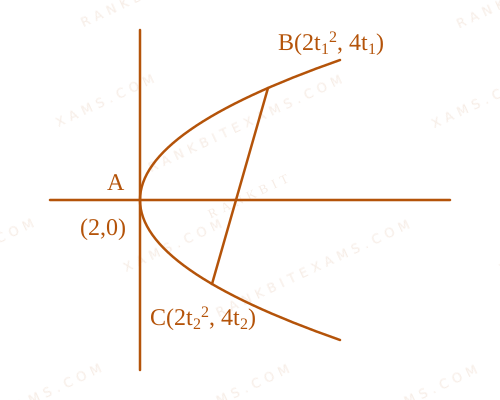
Let A$A$ be the focus of the parabolay² = 8x$y^{2} = 8x$. Let the line y = mx + c$y = mx + c$ intersect the parabola at two distinct points B$B$ and C$C$. If the centroid of the triangle ABC$ABC$ is ((7)/(3), (4)/(3))$\left(\frac{7}{3}, \frac{4}{3}\right)$, then (BC)²$(BC)^{2}$ is equal to :
Focus of y² = 8x$y^2 = 8x$ is A(2, 0)$A(2, 0)$ since 4a = 8 ⇒ a=2$4a = 8 \Rightarrow a=2$.
Let points on parabola be B(2t₁², 4t₁)$B(2t_1^2, 4t_1)$ and C(2t₂², 4t₂)$C(2t_2^2, 4t_2)$.
The centroid of Δ ABC$\Delta ABC$ is given as ((7)/(3), (4)/(3))$\left(\frac{7}{3}, \frac{4}{3}\right)$.
Equating coordinates:
Using parametric coordinates (at², 2at)$(at^2, 2at)$ systematically reduces algebraic complexity when determining intersections or triangle properties on a parabola.
Chapter Mix
Class 11 Maths: Conic Sections
Q9jee_main_2026_28_january_eveningEllipse Parameters and Latus Rectum
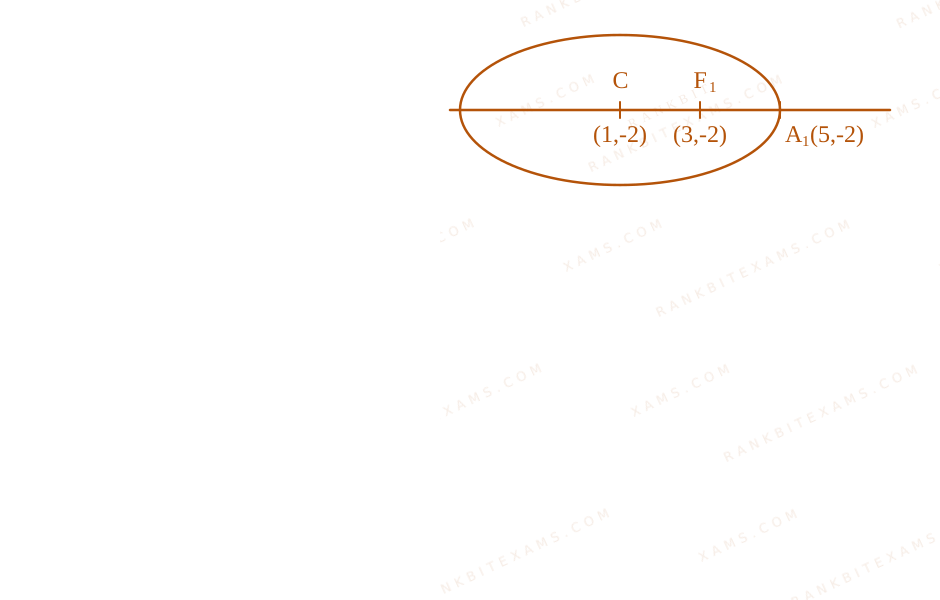
An ellipse has its center at (1,-2)$(1,-2)$, one focus at (3,-2)$(3,-2)$ and one vertex at (5, - 2)$(5, - 2)$. Then the length of its latus rectum is :
From the given coordinates on the major axis (y = -2$y = -2$):
Center C(1, -2)$C(1, -2)$, Focus F₁(3, -2)$F_1(3, -2)$, Vertex A₁(5, -2)$A_1(5, -2)$.
Distance from center to vertex, CA₁ = a = 5 - 1 = 4$CA_1 = a = 5 - 1 = 4$.
Distance from center to focus, CF₁ = ae = 3 - 1 = 2$CF_1 = ae = 3 - 1 = 2$.
Ellipse dimensions mapped to coordinates
Execution
Calculate eccentricity e$e$:
ae = 2 ⇒ 4e = 2 ⇒ e = (1)/(2)$$ae = 2 \Rightarrow 4e = 2 \Rightarrow e = \frac{1}{2}$$
Aligning focus, center, and vertex along a constant y-axis implies a standard shifted ellipse where absolute differences in x-coordinates yield standard parameters (a$a$ and ae$ae$) directly.
Chapter Mix
Class 11 Maths: Conic Sections
Q10jee_main_2026_28_january_eveningConfocal Ellipse and Hyperbola
Let the ellipse E: x²144 + y²169 = 1$E: \frac{x^{2}}{144} + \frac{y^{2}}{169} = 1$ and the hyperbola H: x²16 - y²λ² = -1$H: \frac{x^{2}}{16} - \frac{y^{2}}{\lambda^{2}} = -1$have the same foci. If e$e$ and L$L$ respectively denote the eccentricity and the length of the latus rectum of H$H$, then the value of 24(e + L)$24(e + L)$ is:
Eccentricity of hyperbola, e = (5)/(3)$e = \frac{5}{3}$.
Length of latus rectum of hyperbola, L = (2(16))/(λ) = (32)/(3)$L = \frac{2(16)}{\lambda} = \frac{32}{3}$.
Confocal conics usually align along the same major axis. Notice the -1$-1$ on the RHS of the hyperbola equation indicates a conjugate hyperbola orienting it vertically to match the b>a$b>a$ ellipse.
Chapter Mix
Class 11 Maths: Conic Sections
Q12jee_main_2026_28_january_eveningParametric Form and Chord Intersections
Let the circle x² + y² = 4$x^{2} + y^{2} = 4$ intersect x-axis at the points A(a, 0), a > 0$A(a, 0), a > 0$ and B(b, 0)$B(b, 0)$. Let P(2 α, 2 α), 0 < α < (π)/(2)$P(2 \cos\alpha, 2 \sin\alpha), 0 < \alpha < \frac{\pi}{2}$ and Q(2 β, 2 β)$Q(2 \cos\beta, 2 \sin\beta)$ be two points such that (α - β) = (π)/(2)$(\alpha - \beta) = \frac{\pi}{2}$. Then the point of intersection of AQ$AQ$ and BP$BP$ lies on:
Intersection of circle with x-axis provides A(2,0)$A(2,0)$ and B(-2,0)$B(-2,0)$.
Let the point of intersection of AQ$AQ$ and BP$BP$ be R(h, k)$R(h, k)$.
Since R$R$ lies on BP$BP$, the slope mBR = mBP$m_{BR} = m_{BP}$:
Locus of R$R$ is x² + y² - 4y - 4 = 0$x^2 + y^2 - 4y - 4 = 0$.
Pattern Recognition
Connecting chords from extreme diameter vertices to points whose parametric angles differ by π/2$\pi/2$ reliably generates perpendicular-like slope products or standard tangent angle identities, mapping directly to a circular locus.
Chapter Mix
Class 11 Maths: Circles
Q55jee_main_2025_02_april_eveningEllipse
If the length of the minor axis of an ellipse is equal to one fourth of the distance between the foci, then the eccentricity of the ellipse is :
A.4√(17)$\frac{4}{\sqrt{17}}$
B.√(3)16$\frac{\sqrt{3}}{16}$
C.3√(19)$\frac{3}{\sqrt{19}}$
D.√(5)7$\frac{\sqrt{5}}{7}$
Solution
Related Formula
Length of minor axis = 2b$$\text{Length of minor axis} = 2b$$Distance between foci = 2ae$$\text{Distance between foci} = 2ae$$Eccentricity: e = √(1 - (b²)/(a²))$$\text{Eccentricity: } e = \sqrt{1 - \frac{b^2}{a^2}}$$
Core Logic
We set up an algebraic equation relating b$b$, a$a$, and e$e$ from the given geometric condition, then substitute it into the eccentricity identity.
Step 1: Set up the geometric relation
Given that 2b = (1)/(4) (2ae)$2b = \frac{1}{4} (2ae)$:
Standard Ellipse relations: For standard ellipses, the ratio of axes and the eccentricity are coupled quadratic equations. Expressing b/a$b/a$ as a function of e$e$ allows direct solving of the eccentricity.
Chapter Mix
Class 11 Mathematics: Conic Sections
More Circles Questions — jee_main_2024_29_jan_morning
Practice past-year questions one chapter at a time. Pick an exam → subject → chapter and get every PYQ for that topic — pulled together from all past papers — with the chapter's key formulas alongside.