Equation of two diameters of a circle are 2x-3y=5$2x-3y=5$ and 3x-4y=7$3x-4y=7$. The line joining the points (-(22)/(7),-4)$(-\frac{22}{7},-4)$ and (-(1)/(7),3)$(-\frac{1}{7},3)$intersects the circle at only one pointP(α,β)$P(\alpha,\beta)$. Then 17β-α$17\beta-\alpha$ is equal to
Numerical Answer Type:
Enter a numerical valueAnswer: 2 to 2+4 marks
Solution & Explanation
Related Formula
The intersection of any two non-parallel diameters yields the center of the circle.
A line that intersects a circle at exactly one point is a tangent line.
The tangent at the point of contact P$P$ is always perpendicular to the radius CP$CP$, thus mtangent × mradius = -1$m_{\text{tangent}} \times m_{\text{radius}} = -1$.
Core Logic
Find the center C$C$ by solving the two diameter equations:
Multiply (1) by 3 and (2) by 2:
6x - 9y = 15$6x - 9y = 15$6x - 8y = 14$6x - 8y = 14$
Subtracting the equations gives -y = 1 ⇒ y = -1$-y = 1 \Rightarrow y = -1$.
Substitute y = -1$y = -1$ into (1): 2x + 3 = 5 ⇒ 2x = 2 ⇒ x = 1$2x + 3 = 5 \Rightarrow 2x = 2 \Rightarrow x = 1$.
Center C$C$ is (1, -1)$(1, -1)$.
Find the equation of the line joining A(-(22)/(7), -4)$A(-\frac{22}{7}, -4)$ and B(-(1)/(7), 3)$B(-\frac{1}{7}, 3)$.
Slope of AB$AB$: mAB = (3 - (-4))/(-1/7 - (-22/7)) = (7)/(21/7) = (7)/(3)$m_{AB} = \frac{3 - (-4)}{-1/7 - (-22/7)} = \frac{7}{21/7} = \frac{7}{3}$.
Equation of line AB$AB$:
Since line AB$AB$intersects the circle at only one pointP(α, β)$P(\alpha, \beta)$, line AB$AB$ is a tangent to the circle, and P$P$ is the point of tangency.
The radius line CP$CP$ is perpendicular to tangent AB$AB$.
Slope of CP$CP$ (mCP$m_{CP}$) must be -(3)/(7)$-\frac{3}{7}$.
Equation of the line passing through center C(1, -1)$C(1, -1)$ with slope -(3)/(7)$-\frac{3}{7}$:
When a line "intersects a circle at exactly one point", it's a coded cue to stop thinking about quadratics and discriminants, and immediately build a perpendicular geometric radius from the center to find the exact tangency coordinate.
Chapter Mix
Class 11 Mathematics: Circles
Class 11 Mathematics: Straight Lines
Keywords:#intersects the circle at only one point#JEE Main 2024 Morning Q21#Circles JEE Main 2024#Tangents and Normal JEE Main 2024
More Circles Previous-Year Questions — Page 5
Q2jee_main_2026_24_january_eveningStandard Equation of an Ellipse
Let the length of the latus rectum of an ellipsex²a²+ y²b²=1$\frac{x^{2}}{a^{2}}+\frac{y^{2}}{b^{2}}=1$, (a>b)$(a>b)$, be 30$30$. If its eccentricity is the maximum value of the function f(t)=-(3)/(4)+2t-t²$f(t)=-\frac{3}{4}+2t-t^{2}$, then (a²+b²)$(a^{2}+b^{2})$ is equal to
Whenever an ellipse's latus rectum and eccentricity are provided, it generates a standard system of two equations linking a$a$ and b²$b^{2}$. Solve for a$a$ first since b²$b^{2}$ is linear with respect to a$a$ via latus rectum.
Chapter Mix
Class 11 Maths: Ellipse
Class 12 Maths: Application of Derivatives
Q6jee_main_2026_24_january_eveningReflection of a Parabola
Let the image of parabolax²=4y$x^{2}=4y$, in the line x-y = 1$x-y = 1$ be (y+α)²=b(x-c)$(y+\alpha)^{2}=b(x-c)$, a, b, c in N$a, b, c \in \mathbb{N}$. Then a+b+c$a+b+c$ is equal to
A.12$12$
B.4$4$
C.6$6$
D.8$8$
Solution
Related Formula
Image of point (x₁, y₁) in line ax + by + c = 0 is given by:$$\text{Image of point } (x_1, y_1) \text{ in line } ax + by + c = 0 \text{ is given by:}$$(x - x₁)/(a) = (y - y₁)/(b) = -2 (ax₁ + by₁ + c)/(a² + b²)$$\frac{x - x_1}{a} = \frac{y - y_1}{b} = -2 \frac{ax_1 + by_1 + c}{a^2 + b^2}$$
Core Logic
Take a general parametric point P$P$ on the parabola x² = 4y$x^2 = 4y$, which is P(2t, t²)$P(2t, t^2)$.
We find the mirror image Q(h, k)$Q(h, k)$ of P$P$ with respect to the line x - y - 1 = 0$x - y - 1 = 0$.
Replacing (h, k)$(h, k)$ with (x, y)$(x, y)$, the image parabola is:
(y + 1)² = 4(x - 1)$$(y + 1)^2 = 4(x - 1)$$
Comparing this with (y + α)² = b(x - c)$(y + \alpha)^2 = b(x - c)$:
α = 1, b = 4, c = 1$\alpha = 1, b = 4, c = 1$
a + b + c = 1 + 4 + 1 = 6$$a + b + c = 1 + 4 + 1 = 6$$
Pattern Recognition
To find the image of a conic section across a linear axis, it is almost always computationally cleaner to reflect its general parametric point rather than manipulating the implicit Cartesian equation through coordinate transformations.
Chapter Mix
Class 11 Maths: Parabola
Class 11 Maths: Straight Lines
Q22jee_main_2026_24_january_eveningLocus of a Point
Let (h, k)$(h, k)$ lie on the circle C : x² + y² = 4$C : x^{2} + y^{2} = 4$ and the point (2h + 1, 3k + 2)$(2h + 1, 3k + 2)$ lie on an ellipse with eccentricity e$e$. Then the value of 5e²$\frac{5}{e^{2}}$ is equal to
Numerical Answer.Answer: 9 to 9
Solution
Related Formula
Parametric form of a circle x² + y² = r²: (r θ, r θ)$$\text{Parametric form of a circle } x^2 + y^2 = r^2: (r\cos\theta, r\sin\theta)$$Eccentricity of an ellipse: e² = 1 - (b²)/(a²) (where a > b)$$\text{Eccentricity of an ellipse: } e^2 = 1 - \frac{b^2}{a^2} \text{ (where } a > b)$$
Core Logic
Let the point P(h, k)$P(h, k)$ lie on x² + y² = 4$x^2 + y^2 = 4$. Using parametric coordinates:
h = 2 θ, k = 2 θ$$h = 2\cos\theta, \quad k = 2\sin\theta$$
y = 3k + 2 = 3(2 θ) + 2 = 6 θ + 2$$y = 3k + 2 = 3(2\sin\theta) + 2 = 6\sin\theta + 2$$ (Wait, PDF states 3k+2$3k+2$, parametric solution in PDF says 6 θ + 3$6\sin\theta + 3$. Checking exact text: "(2h + 1, 3k + 2)$(2h + 1, 3k + 2)$ lie on an ellipse..." but solution uses "6 θ + 3$6\sin\theta + 3$". If the question meant 3k+3$3k+3$, that would be a typo in the question paper. However, 3(2 θ)+2 = 6 θ+2$3(2\sin\theta)+2 = 6\sin\theta+2$. This implies (y-2)/(6) = θ$\frac{y-2}{6} = \sin\theta$. Either way, the denominators a$a$ and b$b$ of the resulting ellipse remain 4 and 6, so eccentricity is invariant to the constant offset).
Step 1: Finding the Locus
Isolating θ$\cos\theta$ and θ$\sin\theta$:
θ = (x - 1)/(4)$$\cos\theta = \frac{x - 1}{4}$$θ = (y - 2)/(6) (or (y-3)/(6) per the solution)$$\sin\theta = \frac{y - 2}{6} \quad \text{(or } \frac{y-3}{6} \text{ per the solution)}$$
Using ²θ + ²θ = 1$\sin^2\theta + \cos^2\theta = 1$:
Affine transformations (ax+b, cy+d)$(ax+b, cy+d)$ applied to a circle's locus purely stretch its semi-axes to the respective scaling constants (a$a$ and c$c$). Translational constants (b$b$ and d$d$) shift the center but do not affect the eccentricity.
Chapter Mix
Class 11 Maths: Ellipse
Class 11 Maths: Circles
Q3jee_main_2026_28_january_morningChord of a Circle
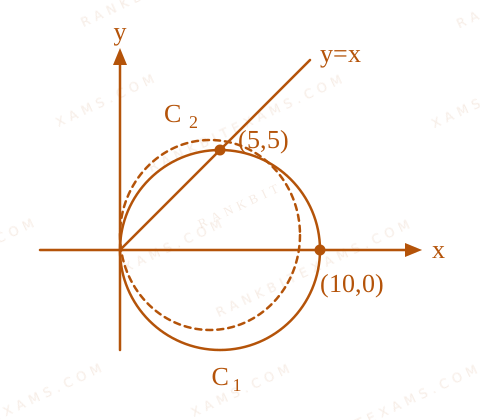
Let y = x$y = x$ be the equation of a chord of the circle C₁$C_{1}$ (in the closed half-plane x ≥ 0$x \geq 0$) of diameter 10$10$ passing through the origin. Let C₂$C_{2}$ be another circle described on the given chord as its diameter. If the equation of the chord of the circle C₂$C_{2}$, which passes through the point (2, 3)$(2, 3)$ and is farthest from the center of C₂$C_{2}$, is x + ay + b = 0$x + ay + b = 0$, then a - b$a - b$ is equal to:
A.10$10$
B.-6$-6$
C.-2$-2$
D.6$6$
Solution
Core Logic
Chord of a CircleChord of a Circle
Equation of circle C₂$C_{2}$ with diameter along y=x$y=x$ passing through origin and having length 10. Wait, C₁$C_1$ has diameter 10. The chord y=x$y=x$ passes through (0,0)$(0,0)$. For the chord to be a diameter of C₂$C_2$, the points of intersection with C₁$C_1$ must form the diameter.
The center of C₂$C_2$ is the midpoint of the chord. Let the ends of the chord be (0,0)$(0,0)$ and (5,5)$(5,5)$ (since length is √(50)$\sqrt{50}$? Wait, the problem implies the chord of C₁$C_1$ is y=x$y=x$. If C₁$C_1$ is a circle in x ≥ 0$x \geq 0$ of diameter 10 through origin. Center of C₂$C_2$ lies on the chord y=x$y=x$.
The equation of circle C₂$C_{2}$ is:
x² + y² - 5x - 5y = 0$$x^2 + y^2 - 5x - 5y = 0$$
Its center is N((5)/(2), (5)/(2))$N\left(\frac{5}{2}, \frac{5}{2}\right)$.
Step 1: Find Farthest Chord
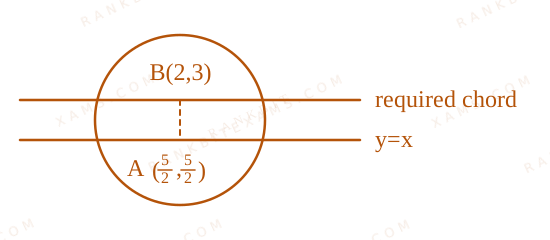
We need the chord of C₂$C_2$ passing through B(2, 3)$B(2, 3)$ which is farthest from the center N((5)/(2), (5)/(2))$N\left(\frac{5}{2}, \frac{5}{2}\right)$.
The farthest chord passing through a given point is always perpendicular to the line joining the center to that point.
Slope of line NB$NB$:
The slope of the required chord is perpendicular to mNB$m_{NB}$:
Slope of required chord = 1$$\text{Slope of required chord } = 1$$
Equation of the required chord passing through (2,3)$(2,3)$:
y - 3 = 1(x - 2)$$y - 3 = 1(x - 2)$$
x - y + 1 = 0$x - y + 1 = 0$
Comparing this with x + ay + b = 0$x + ay + b = 0$, we get:
a = -1, b = 1$$a = -1, \quad b = 1$$
Step 3: Final Calculation
a - b = -1 - 1 = -2$$a - b = -1 - 1 = -2$$
Pattern Recognition
The chord of a circle passing through a given internal point that is FARTHEST from the center is exactly the chord that is PERPENDICULAR to the radius (or line segment) connecting the center to that internal point.
Chapter Mix
Class 11 Mathematics: Circles
Class 11 Mathematics: Straight Lines
Q22jee_main_2026_28_january_morningEllipse and Hyperbola
For some θ in (0, (π)/(2))$\theta \in \left(0, \frac{\pi}{2}\right)$, let the eccentricity and the length of the latus rectum of the hyperbola x² - y² ² θ = 8$x^2 - y^2 \sec^2 \theta = 8$ be e₁$e_1$ and ₁$\ell_1$, respectively, and let the eccentricity and the length of the latus rectum of the ellipse x² ² θ + y² = 6$x^2 \sec^2 \theta + y^2 = 6$ be e₂$e_2$ and ₂$\ell_2$, respectively. If e₁² = e₂² ( ² θ + 1)$e_1^2 = e_2^2 (\sec^2 \theta + 1)$, then (( ₁ ₂)/(e₁ e₂)) ² θ$\left(\frac{\ell_1 \ell_2}{e_1 e_2}\right) \tan^2 \theta$ is equal to ____.
Practice past-year questions one chapter at a time. Pick an exam → subject → chapter and get every PYQ for that topic — pulled together from all past papers — with the chapter's key formulas alongside.