JEE Main · Physics ↓ Falling

Moving Charges and Magnetism appeared 42 times across 3 years — 4.9% of Physics. This question is from Magnetic Field due to Long Straight Wire.

Year 2026 2025 2024 Total
Questions 9 18 15 42

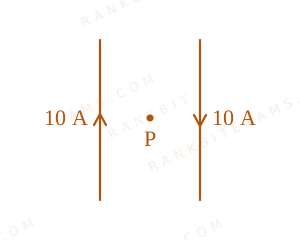
Two long, straight wires carry equal currents in opposite directions as shown in the figure. The separation between the wires is 5.0 cm. The magnitude of the magnetic field at a point P midway between the wires is ______ . (Given : μ₀ = 4π × 10⁻⁷ T ⁻¹, and each wire carries a current of 10 A).
Magnetic Field due to Long Straight Wire diagram for Q58 - JEE Main 2024 Morning
The diagram maps two vertical wires carrying anti-parallel currents of 10 A separated by 5.0 cm, with central node P denoting the common field contribution site.

Magnetic Field due to Long Straight Wire diagram for Q58 - JEE Main 2024 Morning
The diagram maps two vertical wires carrying anti-parallel currents of 10 A separated by 5.0 cm, with central node P denoting the common field contribution site.
Numerical Answer Type:
Enter a numerical value Answer: 160 to 160 +4 marks

Solution & Explanation

Related Formula
B = (μ₀ i)/(2π r)
Core Logic

Using the right-hand grip rule, both anti-parallel wire systems generate field arrays pointing in the exact same direction at the central midway coordinate. Hence, their field contributions add up directly:

Bₙₑₜ = 2 B₁ = 2 ((μ₀ i)/(2π r)) = (μ₀ i)/(π r)

Where i = 10 A, total distance = 5 cm r = 2.5 cm = 2.5 × 10⁻² m.

Step 1: Compute numeric value
Bₙₑₜ = 4π × 10⁻⁷ × 10π × (2.5 × 10⁻²) = 4 × 10⁻⁶2.5 × 10⁻² Bₙₑₜ = 1.6 × 10⁻⁴ T = 160 × 10⁻⁶ T = 160
Pattern Recognition

Anti-parallel current pairs generate collaborative field additions inside their spatial boundary zone, rather than destructive structural cancellations.

Chapter Mix

Class 12 Physics: Moving Charges and Magnetism

More Moving Charges and Magnetism Previous-Year Questions — Page 7

Q54 jee_main_2024_29_january_evening Magnetic Force on a Charge
A charge of 4.0 is moving with a velocity of 4.0 × 10⁶ ms⁻¹ along the positive y-axis under a magnetic field B of strength (2 k) T. The force acting on the charge is x i N. The value of x is ________.
Numerical Answer. Answer: 32 to 32

Solution

Related Formula

The magnetic force on a moving charge is given by the Lorentz force equation:

F = q ( v × B)
Core Logic

Given data:

  • Charge, q = 4.0 = 4.0 × 10⁻⁶ C
  • Velocity vector, v = (4.0 × 10⁶ j) ms⁻¹
  • Magnetic field vector, B = 2 k T
Step 1: Calculate the Force Vector

Substitute the values into the force equation:

F = (4.0 × 10⁻⁶) [ (4.0 × 10⁶ j) × (2 k) ] F = 4.0 × 10⁻⁶ × 8.0 × 10⁶ ( j × k)

Since j × k = i:

F = 32 i N

Comparing this to x i N, we find:

x = 32

Pattern Recognition

Cross-product check: j × k = i. The product of the scalar terms (4.0 × 10⁻⁶) × (4.0 × 10⁶) × 2 immediately simplifies to 4 × 4 × 2 = 32.

Chapter Mix

Class 12 Physics: Moving Charges and Magnetism

Q34 jee_main_2024_27_jan_morning Lorentz Force
A proton moving with a constant velocity passes through a region of space without any change in its velocity. If E and B represent the electric and magnetic fields respectively, then the region of space may have: (A) E = 0, B = 0 (B) E = 0, B ≠ 0 (C) E ≠ 0, B = 0 (D) E ≠ 0, B ≠ 0 Choose the most appropriate answer from the options given below:
  • A. (A), (B) and (C) only
  • B. (A), (C) and (D) only
  • C. (A), (B) and (D) only
  • D. (B), (C) and (D) only

Solution

Related Formula
Fₙₑₜ = q E + q( v × B)
Core Logic

For velocity to remain constant, the net force must be zero:

q E + q( v × B) = 0

Let's evaluate the cases:

  • Case (A): If E=0 and B=0, F = 0. (Possible)
  • Case (B): If E=0 and B ≠ 0, the magnetic force is zero if v is parallel or antiparallel to B (i.e., v × B = 0). (Possible)
  • Case (C): If E ≠ 0 and B=0, F = q E ≠ 0, velocity must change. (Not possible)
  • Case (D): If E ≠ 0 and B ≠ 0, the electric and magnetic forces can balance each other perfectly if q E = -q( v × B). (Possible)
Step 1: Conclusion

Hence, statements (A), (B), and (D) represent valid situations where velocity can remain constant.

Pattern Recognition

Velocity filter / velocity selector setups utilize crossed fields where electric fields perfectly balance magnetic components, an archetype of Case (D).

Chapter Mix

Class 12 Physics: Moving Charges and Magnetism

Q jee_main_2024_29_jan_morning Galvanometer and its Conversions
A galvanometer having coil resistance 10 Ω shows a full scale deflection for a current of 3 ~mA. For it to measure a current of 8 ~A, the value of the shunt should be:
  • A. 3 × 10⁻³ Ω
  • B. 4.85 × 10⁻³ Ω
  • C. 3.75 × 10⁻³ Ω
  • D. 2.75 × 10⁻³ Ω

Solution

Related Formula

To convert a galvanometer into an ammeter, a small resistance called a shunt (S) is connected in parallel with the galvanometer (G):

Ig G = (I - Ig) S S = (Ig G)/(I - Ig)

where, G = resistance of the galvanometer coil Ig = full-scale deflection current of the galvanometer I = total current to be measured S = shunt resistance

Core Logic

Given values:

G = 10 Ω Ig = 3 ~mA = 3 × 10⁻³ ~A I = 8 ~A
Step 1: Calculate Shunt Resistance

Substituting these values into the shunt formula:

S = (3 × 10⁻³) × 108 - 0.003 S = (0.03)/(7.997) S ≈ 3.75 × 10⁻³ Ω

Therefore, the required value of the shunt resistance is 3.75 × 10⁻³ Ω.

Circuit diagram of conversion of a galvanometer into an ammeter using parallel shunt resistance for Q42

Pattern Recognition

Since I gg Ig, the value I - Ig in the denominator can be approximated directly as I for a very accurate quick shortcut in choice selection: S ≈ (Ig G)/(I) = (0.03)/(8) = 3.75 × 10⁻³ Ω.

Chapter Mix

Class 12 Physics: Moving Charges and Magnetism
Q jee_main_2024_29_jan_morning Galvanometer and its Conversions
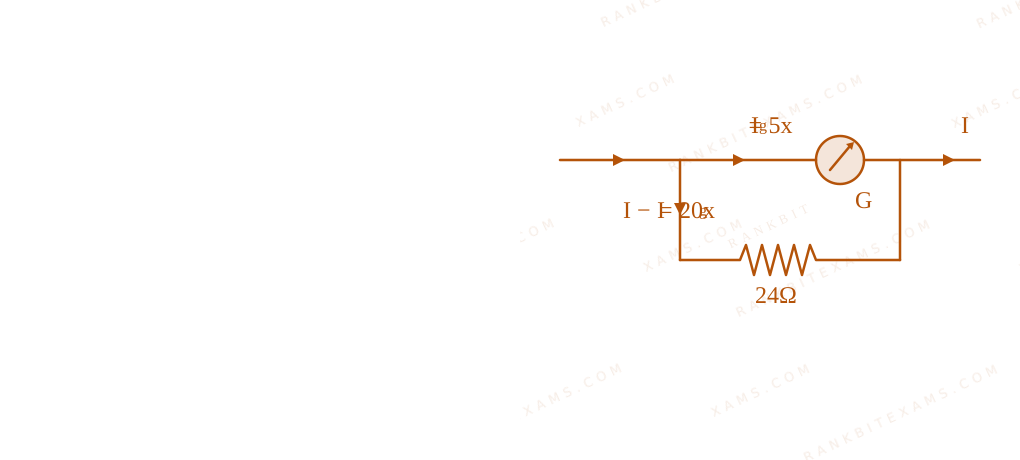
The deflection in moving coil galvanometer falls from 25 divisions to 5 division when a shunt of 24 Ω is applied. The resistance of galvanometer coil will be:
  • A. 12 Ω
  • B. 96 Ω
  • C. 48 Ω
  • D. 100 Ω

Solution

Related Formula

For a shunted galvanometer, the potential difference across the galvanometer is equal to the potential difference across the shunt resistor:

Ig G = (I - Ig) S
Core Logic

Let the current sensitivity per division be x.

  • Initially, without the shunt, the total current I gives a full scale deflection of 25 divisions:
  • I = 25x

    Schematic diagrams representing galvanometer before and after shunting for Q44
    Schematic diagrams representing galvanometer before and after shunting for Q44

  • When the shunt (S = 24 Ω) is connected in parallel, the current passing through the galvanometer branch (Ig) corresponds to a deflection of 5 divisions:
  • Ig = 5x

    Schematic diagrams representing galvanometer before and after shunting for Q44
    Schematic diagrams representing galvanometer before and after shunting for Q44

Step 1: Find Current through the Shunt

The current remaining for the shunt branch is:

I - Ig = 25x - 5x = 20x
Step 2: Equate Potential Drops

Applying the parallel branch condition:

5x · G = 20x · 24

Dividing both sides by 5x:

G = 4 × 24 = 96 Ω

Therefore, the resistance of the galvanometer coil is 96 Ω.

Pattern Recognition

The deflection is directly proportional to the branch current. A drop from 25 divisions to 5 divisions means only (5)/(25) = (1)/(5) of the total current flows through the galvanometer, leaving (4)/(5) to go through the shunt. Hence, the galvanometer resistance must be 4 times the shunt resistance.

Chapter Mix

Class 12 Physics: Moving Charges and Magnetism

More Moving Charges and Magnetism Questions — jee_main_2024_27_jan_morning

Practice all Moving Charges and Magnetism previous-year questions →

Rankbit System
JEE Physics: Waves (+15.5%) | Electrostatics: Concentric Shells (-29.7%) | Modern Physics: Photoelectric Clones (+34.2%) | Mathematics: Definite Integrals (+18.1%) | Chemistry: Coordination Splitting (-11.4%) | JEE Physics: Waves (+15.5%) | Electrostatics: Concentric Shells (-29.7%) | Modern Physics: Photoelectric Clones (+34.2%) | Mathematics: Definite Integrals (+18.1%) | Chemistry: Coordination Splitting (-11.4%)