Rankbit System
JEE Physics: Waves (+15.5%) | Electrostatics: Concentric Shells (-29.7%) | Modern Physics: Photoelectric Clones (+34.2%) | Mathematics: Definite Integrals (+18.1%) | Chemistry: Coordination Splitting (-11.4%) | JEE Physics: Waves (+15.5%) | Electrostatics: Concentric Shells (-29.7%) | Modern Physics: Photoelectric Clones (+34.2%) | Mathematics: Definite Integrals (+18.1%) | Chemistry: Coordination Splitting (-11.4%)

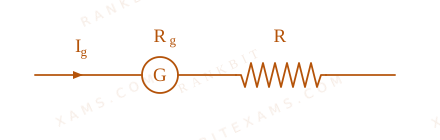
A galvanometer has a resistance of 50mathrm~Omega and it allows maximum current of 5mathrm~mA. It can be converted into voltmeter to measure upto 100mathrm~V by connecting in series a resistor of resistance:

Solution & Explanation

### Related Formula Voltmeter series conversion formula: V = I_g(R_g + R) R = fracVI_g - R_g ### Core Logic Given data: R_g = 50mathrm~Omega, I_g = 5mathrm~mA = 5 times 10^-3mathrm~A, target voltage range V = 100mathrm~V. Substitute values: R = frac1005 times 10^-3 - 50 ### Step 1: Complete Arithmetic Evaluation R = 20000 - 50 = 19950mathrm~Omega ### Pattern Recognition Voltmeter resistance is always high because it is connected in parallel to circuits to prevent current drawing leaks. ### Evaluation Rubric / Model Answer null ### Chapter Mix Class 12 Physics: Moving Charges and Magnetism Class 12 Physics: Current Electricity
Galvanometer conversion series loop schema for Q40

Reference Study Guides

More Moving Charges and Magnetism Previous-Year Questions — Page 4

Q39 jee_main_2024_29_january_evening Motion of Charged Particle in Magnetic Field
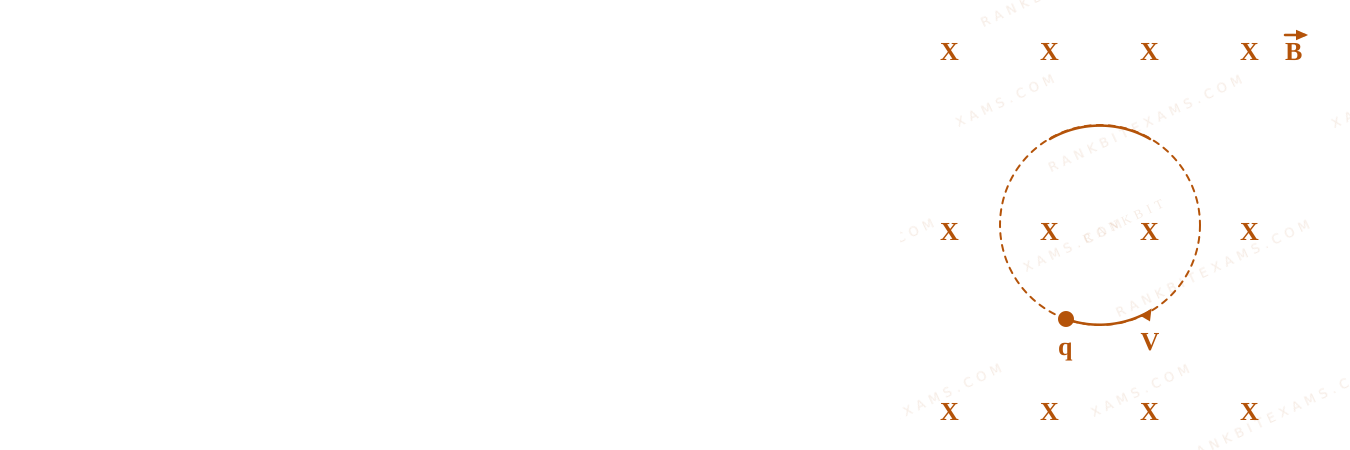
Two particles X and Y having equal charges are being accelerated through the same potential difference. Thereafter they enter normally in a region of uniform magnetic field and describes circular paths of radii R_1 and R_2 respectively. The mass ratio of X and Y is:
  • A. left(fracR_2R_1right)^2
  • B. left(fracR_1R_2right)^2
  • C. left(fracR_1R_2right)
  • D. left(fracR_2R_1right)

Solution

### Related Formula The radius R of the path of a charged particle moving perpendicular to a magnetic field B is: R = fracmvqB = fracpqB In terms of kinetic energy K: R = fracsqrt2mKqB Since the particle is accelerated through potential V, kinetic energy K = qV: R = fracsqrt2mqVqB R = frac1B sqrtfrac2mVq ### Core Logic For both particles X and Y, the following parameters are the same: * Potential Difference, V * Magnetic Field, B * Charge, q Therefore, we have the proportionality: R propto sqrtm implies R^2 propto m ### Step 1: Calculate Mass Ratio Using the proportionality relationship: fracm_1m_2 = left( fracR_1R_2 right)^2 Thus, the mass ratio of X and Y is left(fracR_1R_2right)^2. ### Pattern Recognition Shortcut: Whenever charges and potential differences are equal, the radius of orbit in a magnetic field scales as R propto sqrtm. Squaring both sides yields m propto R^2 instantly. ### Evaluation Rubric / Model Answer null ### Chapter Mix Class 12 Physics: Moving Charges and Magnetism
Q54 jee_main_2024_29_january_evening Magnetic Force on a Charge
A charge of 4.0\ mutextC is moving with a velocity of 4.0 times 10^6text ms^-1 along the positive y-axis under a magnetic field vecB of strength (2hatk)text T. The force acting on the charge is xhatitext N. The value of x is ________.
Numerical Answer. Answer: 32 to 32

Solution

### Related Formula The magnetic force on a moving charge is given by the Lorentz force equation: vecF = q (vecv times vecB) ### Core Logic Given data: * Charge, q = 4.0\ mutextC = 4.0 times 10^-6text C * Velocity vector, vecv = (4.0 times 10^6hatj)text ms^-1 * Magnetic field vector, vecB = 2hatktext T ### Step 1: Calculate the Force Vector Substitute the values into the force equation: vecF = (4.0 times 10^-6) left[ (4.0 times 10^6hatj) times (2hatk) right] vecF = 4.0 times 10^-6 times 8.0 times 10^6 (hatj times hatk) Since hatj times hatk = hati: vecF = 32hatitext N Comparing this to xhatitext N, we find: x = 32 ### Pattern Recognition Cross-product check: hatj times hatk = hati. The product of the scalar terms (4.0 times 10^-6) times (4.0 times 10^6) times 2 immediately simplifies to 4 times 4 times 2 = 32. ### Evaluation Rubric / Model Answer null ### Chapter Mix Class 12 Physics: Moving Charges and Magnetism
Q34 jee_main_2024_27_jan_morning Lorentz Force
A proton moving with a constant velocity passes through a region of space without any change in its velocity. If vecE and vecB represent the electric and magnetic fields respectively, then the region of space may have: (A) E = 0, B = 0 (B) E = 0, B neq 0 (C) E neq 0, B = 0 (D) E neq 0, B neq 0 Choose the most appropriate answer from the options given below:
  • A. text(A), (B) and (C) only
  • B. text(A), (C) and (D) only
  • C. text(A), (B) and (D) only
  • D. text(B), (C) and (D) only

Solution

### Related Formula vecF_textnet = qvecE + q(vecv times vecB) ### Core Logic For velocity to remain constant, the net force must be zero: qvecE + q(vecv times vecB) = 0 Let's evaluate the cases: - Case (A): If E=0 and B=0, vecF = 0. (Possible) - Case (B): If E=0 and B neq 0, the magnetic force is zero if vecv is parallel or antiparallel to vecB (i.e., vecv times vecB = 0). (Possible) - Case (C): If E neq 0 and B=0, vecF = qvecE neq 0, velocity must change. (Not possible) - Case (D): If E neq 0 and B neq 0, the electric and magnetic forces can balance each other perfectly if qvecE = -q(vecv times vecB). (Possible) ### Step 1: Conclusion Hence, statements (A), (B), and (D) represent valid situations where velocity can remain constant. ### Pattern Recognition Velocity filter / velocity selector setups utilize crossed fields where electric fields perfectly balance magnetic components, an archetype of Case (D). ### Evaluation Rubric / Model Answer null ### Chapter Mix Class 12 Physics: Moving Charges and Magnetism
Q58 jee_main_2024_27_jan_morning Magnetic Field due to Long Straight Wire
Two long, straight wires carry equal currents in opposite directions as shown in the figure. The separation between the wires is 5.0text cm. The magnitude of the magnetic field at a point P midway between the wires is ______ mutextT. (Given : mu_0 = 4pi times 10^-7text TcdottextmcdottextA^-1, and each wire carries a current of 10text A).
Magnetic Field due to Long Straight Wire diagram for Q58 - JEE Main 2024 Morning
The diagram maps two vertical wires carrying anti-parallel currents of 10 A separated by 5.0 cm, with central node P denoting the common field contribution site.
Numerical Answer. Answer: 160 to 160

Solution

### Related Formula B = fracmu_0 i2pi r ### Core Logic Using the right-hand grip rule, both anti-parallel wire systems generate field arrays pointing in the exact same direction at the central midway coordinate. Hence, their field contributions add up directly: B_textnet = 2 B_1 = 2 left(fracmu_0 i2pi rright) = fracmu_0 ipi r Where i = 10text A, total distance = 5text cm implies r = 2.5text cm = 2.5 times 10^-2text m. ### Step 1: Compute numeric value B_textnet = frac4pi times 10^-7 times 10pi times (2.5 times 10^-2) = frac4 times 10^-62.5 times 10^-2 B_textnet = 1.6 times 10^-4text T = 160 times 10^-6text T = 160\ mutextT ### Pattern Recognition Anti-parallel current pairs generate collaborative field additions inside their spatial boundary zone, rather than destructive structural cancellations. ### Evaluation Rubric / Model Answer null ### Chapter Mix Class 12 Physics: Moving Charges and Magnetism
Q42 jee_main_2024_29_jan_morning Galvanometer and its Conversions
A galvanometer having coil resistance 10 \, Omega shows a full scale deflection for a current of 3 mathrm~mA. For it to measure a current of 8 mathrm~A, the value of the shunt should be:
  • A. 3 times 10^-3 \, Omega
  • B. 4.85 times 10^-3 \, Omega
  • C. 3.75 times 10^-3 \, Omega
  • D. 2.75 times 10^-3 \, Omega

Solution

### Related Formula To convert a galvanometer into an ammeter, a small resistance called a shunt (S) is connected in parallel with the galvanometer (G): I_g G = (I - I_g) S implies S = fracI_g GI - I_g where, G = resistance of the galvanometer coil I_g = full-scale deflection current of the galvanometer I = total current to be measured S = shunt resistance ### Core Logic Given values: G = 10 \, Omega I_g = 3 mathrm~mA = 3 times 10^-3 mathrm~A I = 8 mathrm~A ### Step 1: Calculate Shunt Resistance Substituting these values into the shunt formula: S = frac(3 times 10^-3) times 108 - 0.003 S = frac0.037.997 S approx 3.75 times 10^-3 \, Omega Therefore, the required value of the shunt resistance is 3.75 times 10^-3 \, Omega.
Circuit diagram of conversion of a galvanometer into an ammeter using parallel shunt resistance for Q42
### Pattern Recognition Since I gg I_g, the value I - I_g in the denominator can be approximated directly as I for a very accurate quick shortcut in choice selection: S approx fracI_g GI = frac0.038 = 3.75 times 10^-3 \, Omega. ### Evaluation Rubric / Model Answer null ### Chapter Mix Class 12 Physics: Moving Charges and Magnetism

More Moving Charges and Magnetism Questions — jee_main_2024_01_february_morning

Practice all Moving Charges and Magnetism previous-year questions →

YOUR FIRST PREP STEP STARTS HERE

We Map Every Repeating Question in Competitive Exams.

Say goodbye to generic mock test fatigue. RankBit uses smart analysis to group past exam questions into their foundational Repeating Question Types. Find chapter weightage, track repeating questions, and score higher with targeted practice.

Select Your Target Exam

Choose an exam track below to find formulas per chapter and patterns.

Syncing Exam Intelligence

Mapping formulas and patterns across all tracks…

PATH A — FULL LENGTH PRACTICE

Full Mock Test Hub

Simulate real NTA exam conditions with fully tracked mocks. Time yourself against past papers.

Under Development
PATH B — TARGETED PRACTICE

Topic-wise Practice Hub

Practice past-year questions one chapter at a time. Pick an exam → subject → chapter and get every PYQ for that topic — pulled together from all past papers — with the chapter's key formulas alongside.

Loading Questions... Browse Topics
Latest from the Blog
View all →

Loading articles...