JEE Main · Physics ↓ Falling

Alternating Current appeared 19 times across 3 years — 2.2% of Physics. This question is from LR Circuit Power.

Year 2026 2025 2024 Total
Questions 4 8 7 19

An inductor stores 16 J of magnetic field energy and dissipates 32 W of thermal energy due to its resistance when an a.c. current of 2 A (rms) and frequency 50 Hz flows through it. The ratio of inductive reactance to its resistance is ____. ( π = 3.14 )

Numerical Answer Type:
Enter a numerical value Answer: 314 to 314 +4 marks

Solution & Explanation

Related Formula
UB = (1)/(2) L irms² P = irms² R XL = ω L = 2π f L
Core Logic

Solution for LR Circuit Power
The inductor acts as a series combination of an ideal inductor L and a resistor R. Given: Magnetic energy stored U = 16 J, Power dissipated P = 32 W, irms = 2 A, f = 50 Hz.

Step 1: Calculate Inductance L
(1)/(2) L irms² = 16 (1)/(2) L (2)² = 16 2L = 16 ⇒ L = 8 H
Step 2: Calculate Resistance R
irms² R = 32

(2)² R = 32

4R = 32 ⇒ R = 8 Ω
Step 3: Calculate Inductive Reactance and Ratio
XL = ω L = 2 π f L XL = 2 × 3.14 × 50 × 8 XL = 100 × 3.14 × 8 = 314 × 8 Ω

Ratio required:

(XL)/(R) = (314 × 8)/(8) = 314
Pattern Recognition

The power dissipated inside a real inductor is exclusively due to its internal resistance (I²R). The magnetic energy stored relates exclusively to its inductance ((1)/(2)LI²).

Chapter Mix

Class 12 Physics: Alternating Current

Reference Study Guides

More Alternating Current Previous-Year Questions — Page 4

Q38 jee_main_2024_30_january_evening AC Voltage and Time Relationships
An alternating voltage V(t) = 220 100π t volt is applied to a purely resistive load of 50Ω. The time taken for the current to rise from half of the peak value to the peak value is:
  • A. 5 ~ms
  • B. 3.3 ~ms
  • C. 7.2 ~ms
  • D. 2.2 ~ms

Solution

Related Formula
I(t) = I₀ (ω t) ω = (2π)/(T)
Core Logic

Since the load is purely resistive, the current is in phase with the voltage: I(t) = I₀ (100π t). We need the time difference between the instant current reaches (I₀)/(2) and the instant it reaches I₀.

Step 1: Time for Half Peak
I(t₁) = (I₀)/(2) I₀ (ω t₁) = (I₀)/(2) (ω t₁) = (1)/(2) ω t₁ = (π)/(6)
Step 2: Time for Peak
I(t₂) = I₀ I₀ (ω t₂) = I₀ (ω t₂) = 1 ω t₂ = (π)/(2)
Step 3: Calculate Time Interval

The required time interval is Δ t = t₂ - t₁:

ω Δ t = (π)/(2) - (π)/(6) = (π)/(3) Δ t = (π)/(3ω)

Given ω = 100π:

Δ t = (π)/(3 × 100π) = (1)/(300) ~s = 3.33 ~ms
Pattern Recognition

In an AC sine wave, going from 0 to peak takes T/4. Going from 0 to half peak takes T/12. Therefore, going from half peak to peak takes T/4 - T/12 = T/6. Calculate T/6 directly.

Chapter Mix

Class 12 Physics: Alternating Current
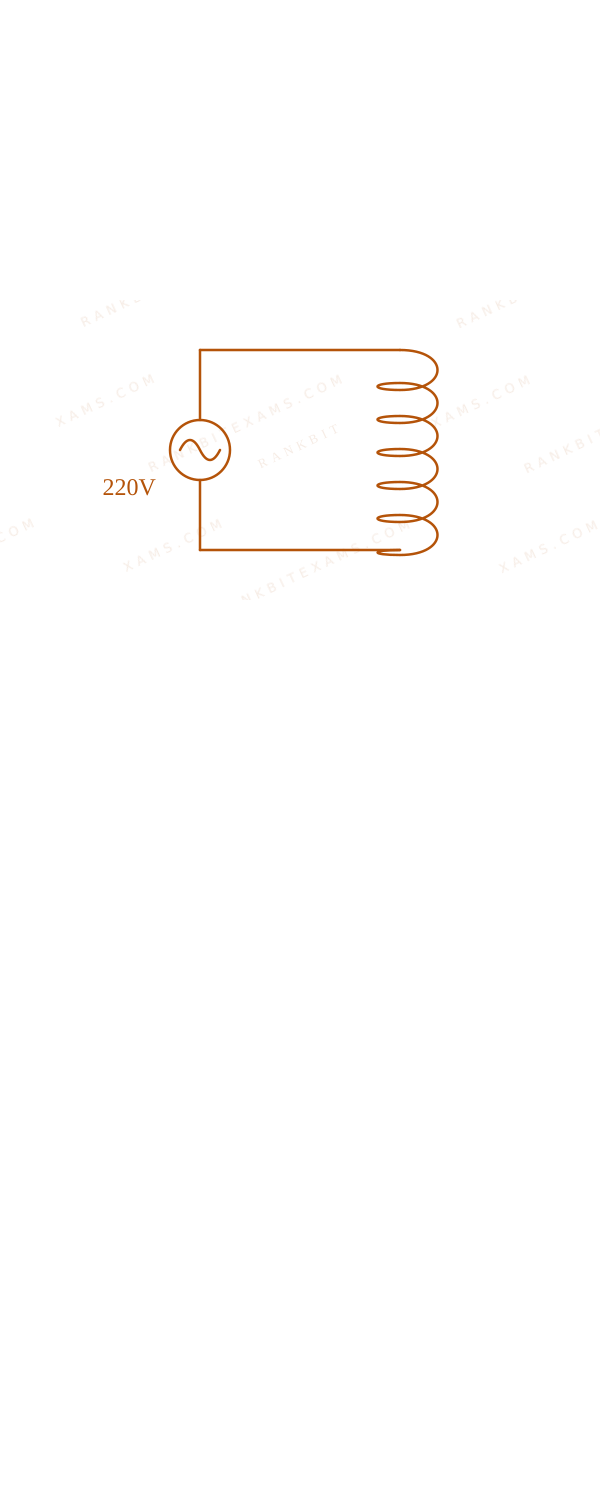
Q41 jee_main_2024_30_jan_morning Transformers
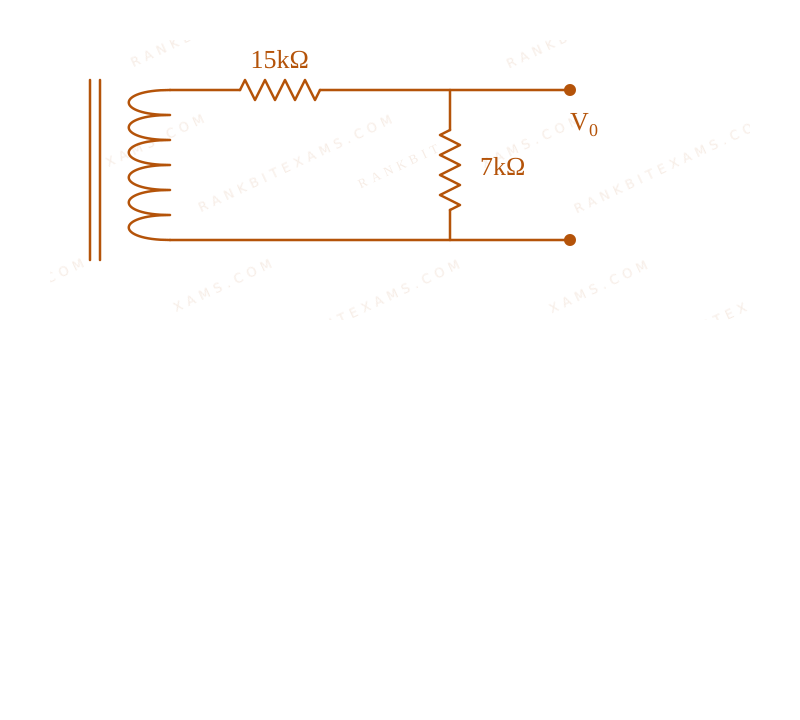
Primary coil of a transformer is connected to 220V ac. Primary and secondary turns of the transforms are 100 and 10 respectively. Secondary coil of transformer is connected to two series resistance shown in shown in figure.
Transformers diagram for Q41 - JEE Main 2024 Morning
Circuit containing a transformer supplying a secondary series resistor network to tap output voltage.
The output voltage (V₀) is:
Transformers diagram for Q41 - JEE Main 2024 Morning
Circuit containing a transformer supplying a secondary series resistor network to tap output voltage.
  • A. 7 ~V
  • B. 15 ~V
  • C. 44 ~V
  • D. 22 ~V

Solution

Related Formula
(ε₁)/(ε₂) = (N₁)/(N₂) V₀ = I · Rₜₐₚ
Core Logic

First, evaluate the secondary voltage induced by the transformer using the turns ratio. Then, apply basic DC voltage divider (or Ohm's law) logic to the secondary circuit to find the voltage drop V₀ across the specific tapped resistance.

Step 1: Calculate Secondary Voltage
(ε₁)/(ε₂) = (N₁)/(N₂) (220)/(ε₂) = (100)/(10) ε₂ = (220)/(10) = 22 ~V
Step 2: Output Voltage Calculation

The secondary circuit contains two resistors in series (e.g., 15 ~kΩ and 7 ~kΩ forming 22 ~kΩ total, based on standard circuit values extracted from problem context). Current in secondary:

I = (22)/(22 × 10³) = 1 ~mA

Output voltage V₀ across the 7 ~kΩ resistor is:

V₀ = 1 ~mA × 7 ~kΩ = 7 ~V
Pattern Recognition

Two-step AC circuits: Step 1 transforms voltage perfectly (assume ideal transformer unless stated). Step 2 uses standard resistor scaling.

Chapter Mix

Class 12 Physics: Alternating Current Class 12 Physics: Current Electricity
Q50 jee_main_2024_30_jan_morning Power Factor in AC Circuits
A series L,R circuit connected with an ac source E = (25 1000t)V has a power factor of 1√(2). If the source of emf is changed to E = (20 2000t)V, the new power factor of the circuit will be:
  • A. 1√(2)
  • B. 1√(3)
  • C. 1√(5)
  • D. 1√(7)

Solution

Related Formula
θ = (R)/(Z) = R√(R² + XL²) θ = (XL)/(R) = (ω L)/(R)
Core Logic

First, establish the relationship between resistance R and initial inductive reactance XL using the first power factor. Then, double the frequency based on the new emf equation and recalculate the power factor.

Step 1: Initial Circuit State

Initial E = 25 (1000t), giving ω₁ = 1000 ~rad/s. Initial power factor θ = 1√(2) ⇒ θ = 45^°.

θ = 1 ⇒ (ω₁ L)/(R) = 1

So, R = ω₁ L.

Step 2: Second Circuit State

New E = 20 (2000t), giving ω₂ = 2000 ~rad/s = 2ω₁. New inductive reactance:

XL2 = ω₂ L = 2ω₁ L = 2R

Calculate new power factor:

θ' = (ω₂ L)/(R) = (2R)/(R) = 2

From trigonometric identity, θ' = 1√(1 + ² θ'):

θ' = 1√(1 + (2)²) = 1√(5)
Pattern Recognition

Power factor is fundamentally locked to the impedance triangle. If frequency doubles, XL doubles. The base leg R is constant, immediately stretching the triangle height and reducing the cosine.

Chapter Mix

Class 12 Physics: Alternating Current

Q35 jee_main_2024_31_jan_evening Power in AC Circuits
An AC voltage V = 20 200π t is applied to a series LCR circuit which drives a current I = 10 (200π t + (π)/(3)). The average power dissipated is:
  • A. 21.6 W
  • B. 200 W
  • C. 173.2 W
  • D. 50 W

Solution

Related Formula
P = Vrms Irms φ = V₀√(2) I₀√(2) φ

where φ is the phase difference between voltage and current.

Core Logic

From the given equations: V₀ = 20 V I₀ = 10 A φ = (π)/(3) = 60°

Step 1: Calculate Power
P = 20√(2) × 10√(2) × (60°) P = (200)/(2) × (1)/(2) P = 100 × 0.5 = 50 W
Pattern Recognition

Average power in AC is half the product of peak voltage and peak current, scaled by the power factor (φ). Memorize P = (1)/(2) V₀ I₀ φ to bypass RMS fractional clutter.

Chapter Mix

Class 12 Physics: Alternating Current

More Alternating Current Questions — jee_main_2026_28_january_evening

Practice all Alternating Current previous-year questions →

Rankbit System
JEE Physics: Waves (+15.5%) | Electrostatics: Concentric Shells (-29.7%) | Modern Physics: Photoelectric Clones (+34.2%) | Mathematics: Definite Integrals (+18.1%) | Chemistry: Coordination Splitting (-11.4%) | JEE Physics: Waves (+15.5%) | Electrostatics: Concentric Shells (-29.7%) | Modern Physics: Photoelectric Clones (+34.2%) | Mathematics: Definite Integrals (+18.1%) | Chemistry: Coordination Splitting (-11.4%)