Always remember that rated values specify the RMS limits. Since the source voltage matches the bulb's rated voltage exactly, the actual power equals the rated power (
$
Pattern Recognition
Always remember that rated values specify the RMS limits. Since the source voltage matches the bulb's rated voltage exactly, the actual power equals the rated power ($
100\mathrm{~W}). Do not confuse$). Do not confuse $I_{\text{rms}}($ ($0.45\mathrm{~A}) with the peak current$) with the peak current $I_0($ ($0.64\mathrm{~A}$).
Keywords:#bulb rated 100W 220V peak value of current#JEE Main 2025 Evening Q15#Alternating Current power calculation#rms to peak current ratio
More Alternating Current Previous-Year Questions
Q48jee_main_2026_23_january_morningResonance
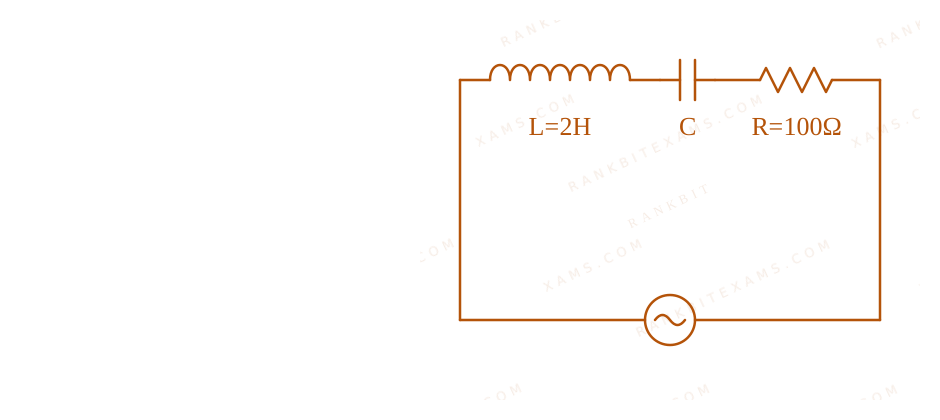
Using a variable-frequency a.c. voltage source, the maximum current measured in the given LCR circuit is 50 mA for V = 5 (100t)$V = 5\sin(100t)$. The values of L and R are shown in the figure. The capacitance of the capacitor (C) used is ____ $\mu\text{F}$.
A series LCR circuit with L=2H, R=100Ω and AC source V=5sin(100t).
Numerical Answer.Answer: 50 to 50
Solution
Related Formula
ω = 1√(LC)$$\omega = \frac{1}{\sqrt{LC}}$$
Core Logic
Current in an LCR circuit reaches a maximum value (measured as 50 mA$50 \text{ mA}$) exactly when the circuit is in resonance. At resonance, the inductive reactance equals the capacitive reactance, meaning XL = XC$X_L = X_C$, which gives the condition ω = 1/√(LC)$\omega = 1/\sqrt{LC}$.
Step 1: Identify Parameters
From the source equation V = 5 (100t)$V = 5\sin(100t)$:
ω = 100 rad/s$\omega = 100 \text{ rad/s}$
From the circuit diagram:
L = 2 H$L = 2 \text{ H}$
Sees: "maximum current" + "variable-frequency / given frequency" → Resonance! The impedance is purely resistive (Z=R$Z=R$), so ω L = 1/(ω C)$\omega L = 1/(\omega C)$. The 50 mA$50 \text{ mA}$ info is a distractor/cross-check (since Vpeak/R = 5/100 = 50 mA$V_{peak}/R = 5/100 = 50 \text{ mA}$, confirming resonance).
Chapter Mix
Class 12 Physics: Alternating Current
Q34jee_main_2026_24_january_morningPower in AC Circuit
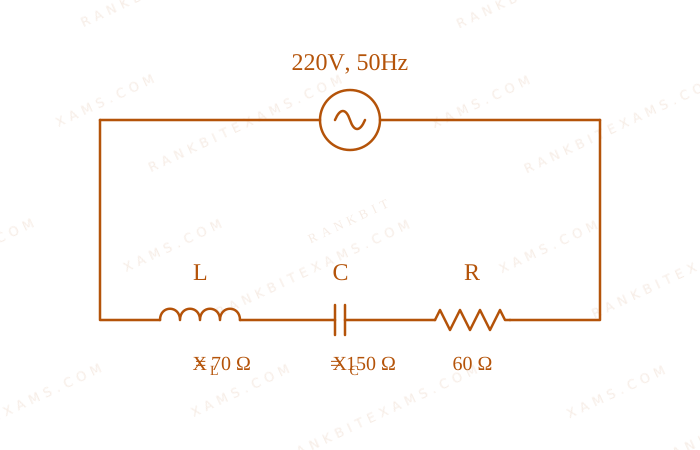
For the series LCR circuit connected with 220 V, 50 Hz a.c source as shown in the figure, the power factor is (α)/(10)$\frac{\alpha}{10}$. The value of α$\alpha$ is ____
A series LCR circuit connected to a 220 V, 50 Hz AC source.
To find the root mean square (rms) value of a varying current, we integrate the square of the current over the given time period, divide by the time period, and take the square root.
For any linearly varying quantity y = kt$y = kt$ passing through origin, the RMS value over time T$T$ is always Maximum Value√(3)$\frac{\text{Maximum Value}}{\sqrt{3}}$. A standard AC sine wave is 1/√(2)$1/\sqrt{2}$.
Chapter Mix
Class 12 Physics: Alternating Current
Q48jee_main_2026_28_january_eveningLR Circuit Power
An inductor stores 16 J$16 \text{ J}$ of magnetic field energy and dissipates 32 W$32 \text{ W}$ of thermal energy due to its resistance when an a.c. current of 2 A$2 \text{ A}$ (rms) and frequency 50 Hz$50 \text{ Hz}$ flows through it. The ratio of inductive reactance to its resistance is ____. ( π = 3.14$\pi = 3.14$ )
Numerical Answer.Answer: 314 to 314
Solution
Related Formula
UB = (1)/(2) L irms²$$U_B = \frac{1}{2} L i_{\text{rms}}^2$$P = irms² R$$P = i_{\text{rms}}^2 R$$XL = ω L = 2π f L$$X_L = \omega L = 2\pi f L$$
Core Logic
Solution for LR Circuit Power
The inductor acts as a series combination of an ideal inductor L$L$ and a resistor R$R$.
Given: Magnetic energy stored U = 16 J$U = 16 \text{ J}$, Power dissipated P = 32 W$P = 32 \text{ W}$, irms = 2 A$i_{\text{rms}} = 2 \text{ A}$, f = 50 Hz$f = 50 \text{ Hz}$.
Step 1: Calculate Inductance L
(1)/(2) L irms² = 16$$\frac{1}{2} L i_{\text{rms}}^2 = 16$$(1)/(2) L (2)² = 16$$\frac{1}{2} L (2)^2 = 16$$2L = 16 ⇒ L = 8 H$$2L = 16 \Rightarrow L = 8 \text{ H}$$
Step 2: Calculate Resistance R
irms² R = 32$$i_{\text{rms}}^2 R = 32$$
(2)² R = 32$(2)^2 R = 32$
4R = 32 ⇒ R = 8 Ω$$4R = 32 \Rightarrow R = 8 \, \Omega$$
The power dissipated inside a real inductor is exclusively due to its internal resistance (I²R$I^2R$). The magnetic energy stored relates exclusively to its inductance ((1)/(2)LI²$\frac{1}{2}LI^2$).
Chapter Mix
Class 12 Physics: Alternating Current
More Alternating Current Questions — jee_main_2025_03_april_evening
Practice past-year questions one chapter at a time. Pick an exam → subject → chapter and get every PYQ for that topic — pulled together from all past papers — with the chapter's key formulas alongside.