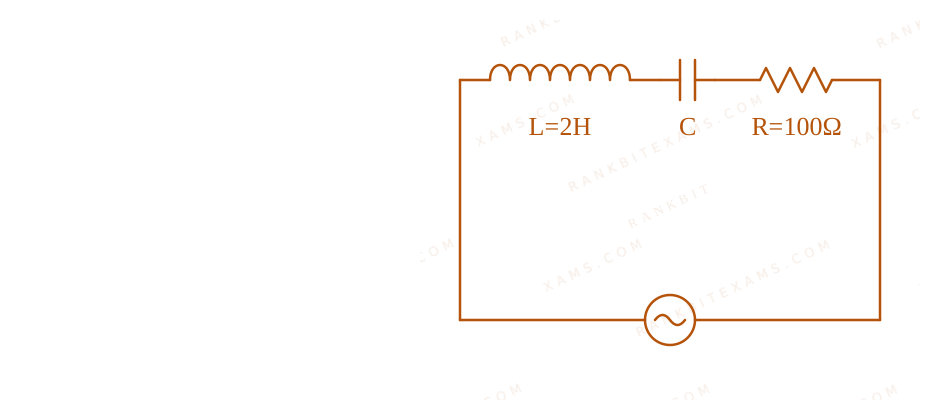
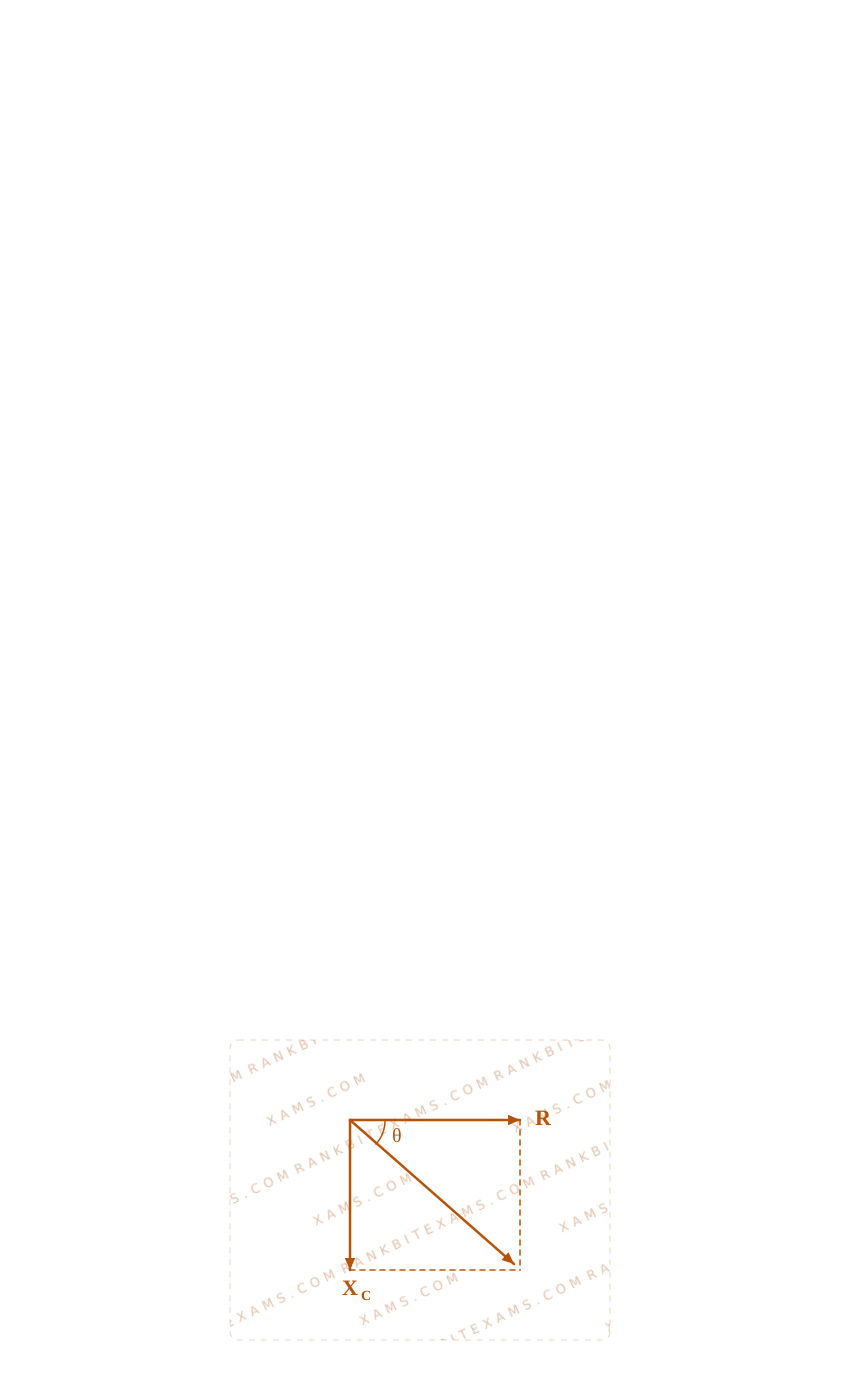
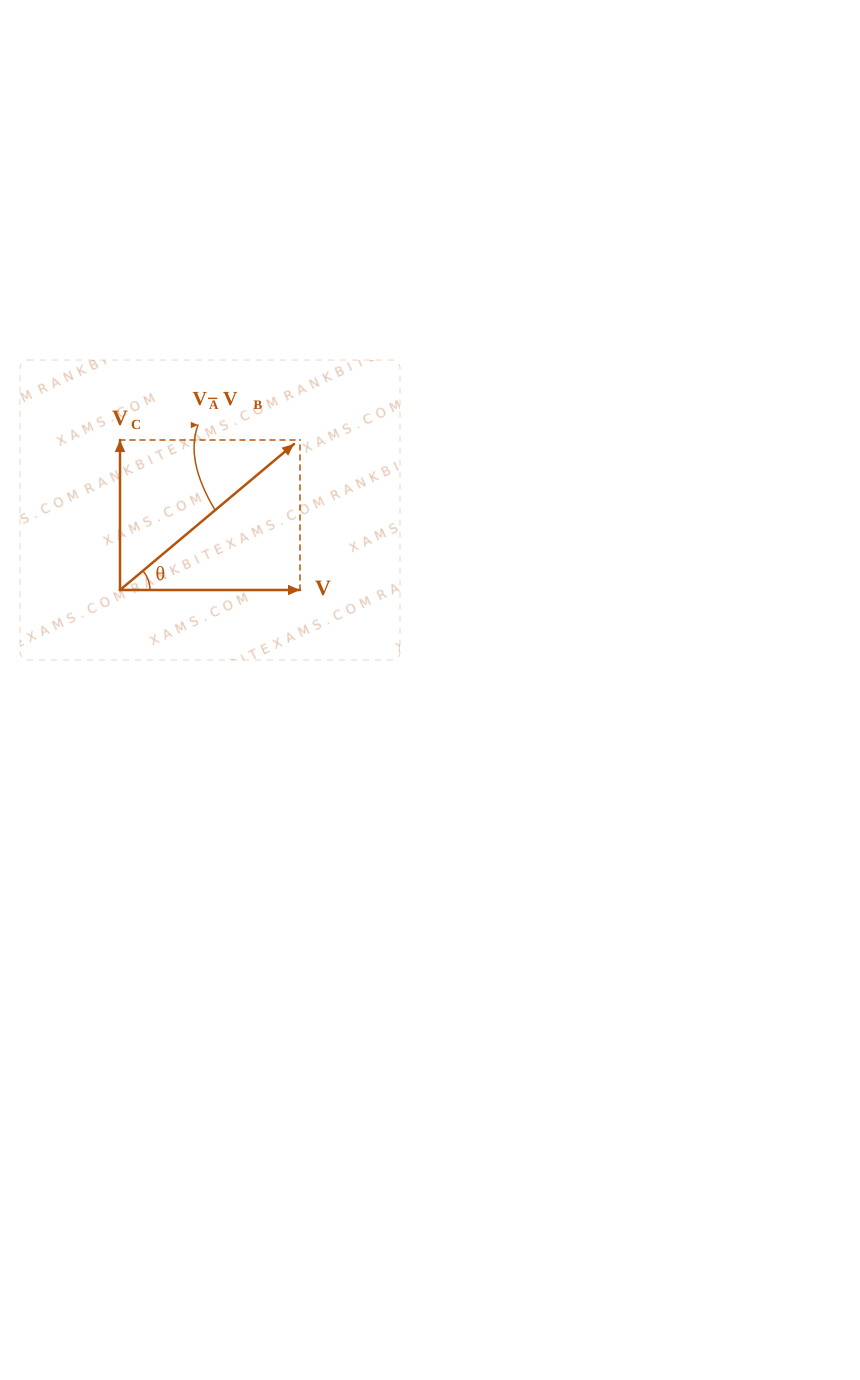
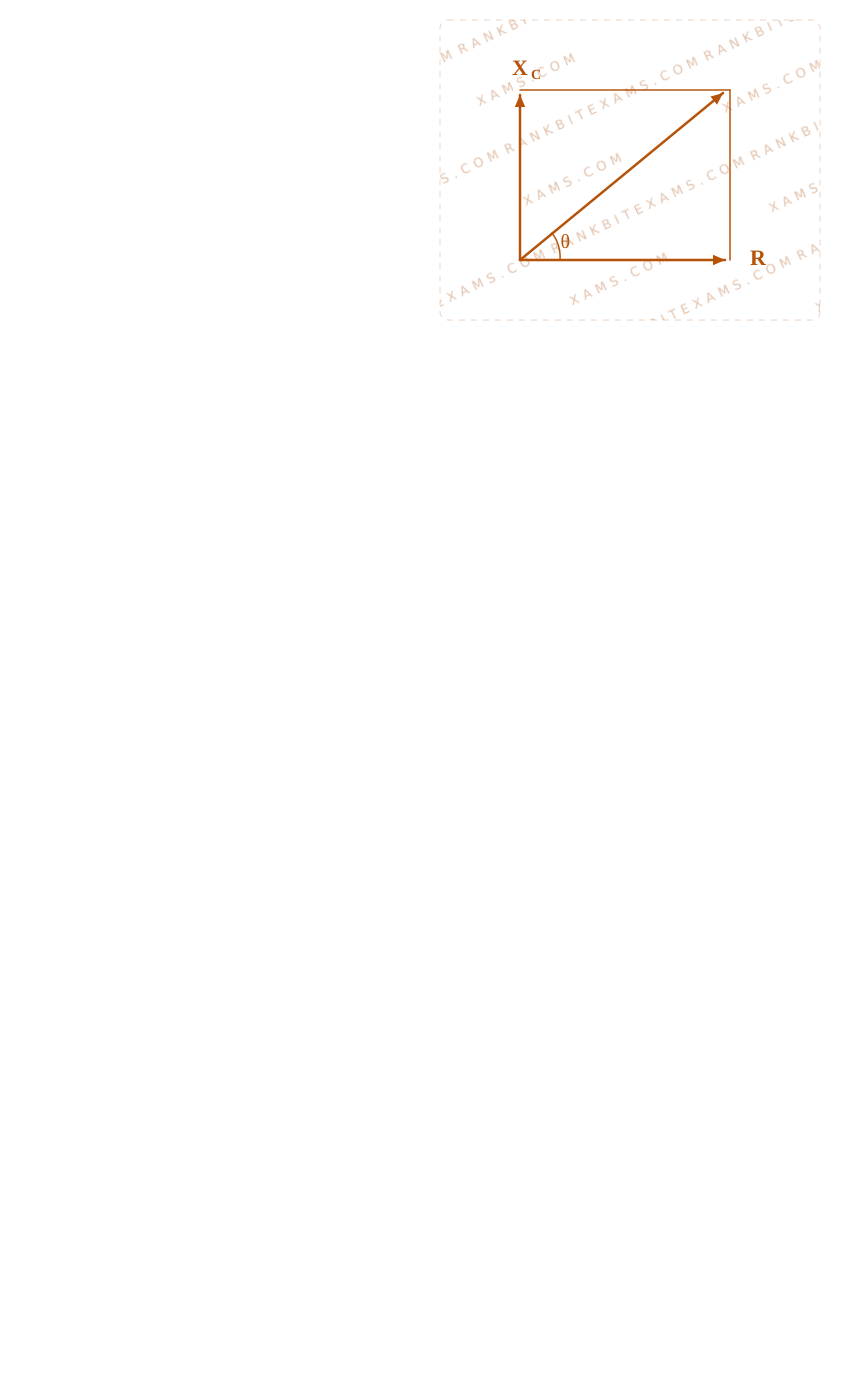
Using a variable-frequency a.c. voltage source, the maximum current measured in the given LCR circuit is 50 mA for V = 5sin(100t)$V = 5\sin(100t)$. The values of L and R are shown in the figure. The capacitance of the capacitor (C) used is ____ mutextF$\mu\text{F}$.
A series LCR circuit with L=2H, R=100Ω and AC source V=5sin(100t).
Numerical Answer Type:
Enter a numerical valueAnswer: 50 to 50+4 marks
Solution & Explanation
### Related Formula
omega = frac1sqrtLC$$\omega = \frac{1}{\sqrt{LC}}$$
### Core Logic
Current in an LCR circuit reaches a maximum value (measured as 50 text mA$50 \text{ mA}$) exactly when the circuit is in resonance. At resonance, the inductive reactance equals the capacitive reactance, meaning X_L = X_C$X_L = X_C$, which gives the condition omega = 1/sqrtLC$\omega = 1/\sqrt{LC}$.
### Step 1: Identify Parameters
From the source equation V = 5sin(100t)$V = 5\sin(100t)$:
omega = 100 text rad/s$\omega = 100 \text{ rad/s}$
From the circuit diagram:
L = 2 text H$L = 2 \text{ H}$
### Step 2: Evaluate Capacitance
omega^2 = frac1LC$$\omega^{2} = \frac{1}{LC}$$C = frac1omega^2L$$C = \frac{1}{\omega^{2}L}$$C = frac1(100)^2 times 2 = frac110000 times 2 = frac12 times 10^4$$C = \frac{1}{(100)^{2} \times 2} = \frac{1}{10000 \times 2} = \frac{1}{2 \times 10^{4}}$$C = 50 times 10^-6 text F$$C = 50 \times 10^{-6} \text{ F}$$C = 50 mutextF$$C = 50 \mu\text{F}$$
### Pattern Recognition
Sees: "maximum current" + "variable-frequency / given frequency" → Resonance! The impedance is purely resistive (Z=R$Z=R$), so omega L = 1/(omega C)$\omega L = 1/(\omega C)$. The 50 text mA$50 \text{ mA}$ info is a distractor/cross-check (since V_peak/R = 5/100 = 50 text mA$V_{peak}/R = 5/100 = 50 \text{ mA}$, confirming resonance).
### Evaluation Rubric / Model Answer
null
### Chapter Mix
Class 12 Physics: Alternating Current
Keywords:#LCR resonance#JEE Main 2026 Morning Q48#Alternating Current JEE Main 2026#Resonance JEE Main 2026#LCR series circuit#inductor#capacitor#resistor#AC source
More Alternating Current Previous-Year Questions
Q34jee_main_2026_24_january_morningPower in AC Circuit
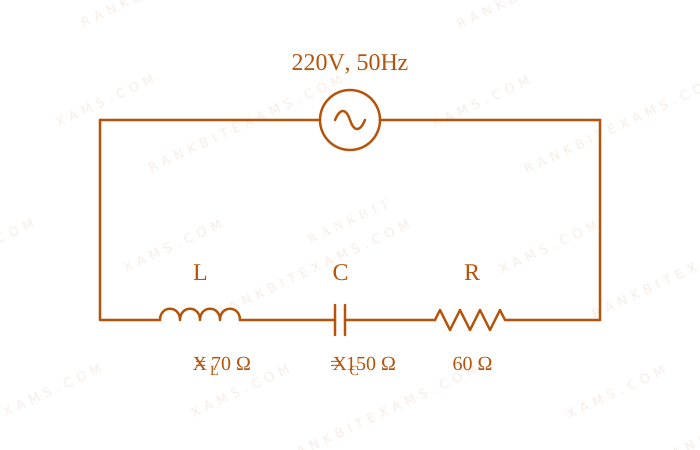
For the series LCR circuit connected with 220 V, 50 Hz a.c source as shown in the figure, the power factor is fracalpha10$\frac{\alpha}{10}$. The value of alpha$\alpha$ is ____
A series LCR circuit connected to a 220 V, 50 Hz AC source.
A.4$4$
B.10$10$
C.6$6$
D.8$8$
Solution
### Related Formula
textImpedance, Z = sqrtR^2 + (X_L - X_C)^2$$\text{Impedance, } Z = \sqrt{R^2 + (X_L - X_C)^2}$$textPower factor, cos phi = fracRZ$$\text{Power factor, } \cos \phi = \frac{R}{Z}$$
### Core Logic
Given from the circuit:
Resistance, R = 60\, Omega$R = 60\, \Omega$
Inductive reactance, X_L = 70\, Omega$X_L = 70\, \Omega$
Capacitive reactance, X_C = 150\, Omega$X_C = 150\, \Omega$
First, calculate the impedance Z$Z$:
Z = sqrt60^2 + (150 - 70)^2$$Z = \sqrt{60^2 + (150 - 70)^2}$$Z = sqrt60^2 + 80^2 = sqrt3600 + 6400 = sqrt10000 = 100\, Omega$$Z = \sqrt{60^2 + 80^2} = \sqrt{3600 + 6400} = \sqrt{10000} = 100\, \Omega$$
### Step 1: Calculate Power Factor
Power factor = fracRZ$= \frac{R}{Z}$textPower factor = frac60100 = frac610$$\text{Power factor} = \frac{60}{100} = \frac{6}{10}$$
Given that the power factor is fracalpha10$\frac{\alpha}{10}$, comparing both sides gives alpha = 6$\alpha = 6$.
### Pattern Recognition
A classic 3-4-5 impedance triangle where R=60, X_C-X_L=80$R=60, X_C-X_L=80$, immediately implies Z=100$Z=100$. The power factor is exactly R/Z = 60/100 = 6/10$R/Z = 60/100 = 6/10$.
### Evaluation Rubric / Model Answer
null
### Chapter Mix
Class 12 Physics: Alternating Current
Q15jee_main_2025_03_april_eveningPower and RMS Peak Current Relationships
An electric bulb rated as 100W 220V is connected to an ac source of rms voltage 220 V. The peak value of current through the bulb is:
A. 0.64 A
B. 0.45 A
C. 2.2 A
D. 0.32 A
Solution
### Related Formula
Power consumed in a purely resistive AC device (like a lightbulb) is:
P = V_textrms I_textrms$$P = V_{\text{rms}} I_{\text{rms}}$$
The peak current I_0$I_0$ is related to the rms current I_textrms$I_{\text{rms}}$ by:
I_0 = sqrt2 I_textrms$$I_0 = \sqrt{2} I_{\text{rms}}$$
### Core Logic
Given parameters:
- Power P = 100mathrm~W$P = 100\mathrm{~W}$
- rms Voltage V_textrms = 220mathrm~V$V_{\text{rms}} = 220\mathrm{~V}$
### Step 1: Calculate RMS Current (I_textrms$I_{\text{rms}}$)
I_textrms = fracPV_textrms = frac100220 = frac511mathrm~A approx 0.455mathrm~A$$I_{\text{rms}} = \frac{P}{V_{\text{rms}}} = \frac{100}{220} = \frac{5}{11}\mathrm{~A} \approx 0.455\mathrm{~A}$$
### Step 2: Calculate Peak Current ($
### Step 2: Calculate Peak Current ($I_0)
$)
$I_0 = sqrt2 I_textrms = 1.414 times frac511 = frac7.0711 approx 0.64mathrm~A$I_0 = \sqrt{2} I_{\text{rms}} = 1.414 \times \frac{5}{11} = \frac{7.07}{11} \approx 0.64\mathrm{~A}$
### Pattern Recognition
Always remember that rated values specify the RMS limits. Since the source voltage matches the bulb's rated voltage exactly, the actual power equals the rated power ($
### Pattern Recognition
Always remember that rated values specify the RMS limits. Since the source voltage matches the bulb's rated voltage exactly, the actual power equals the rated power ($100\mathrm{~W}). Do not confuse $). Do not confuse $I_{\text{rms}} ($ ($0.45\mathrm{~A}) with the peak current $) with the peak current $I_0 ($ ($0.64\mathrm{~A}$).
### Evaluation Rubric / Model Answer
null
### Chapter Mix
Class 12 Physics: Alternating Current
Qjee_main_2025_07_april_morningAc Circuits
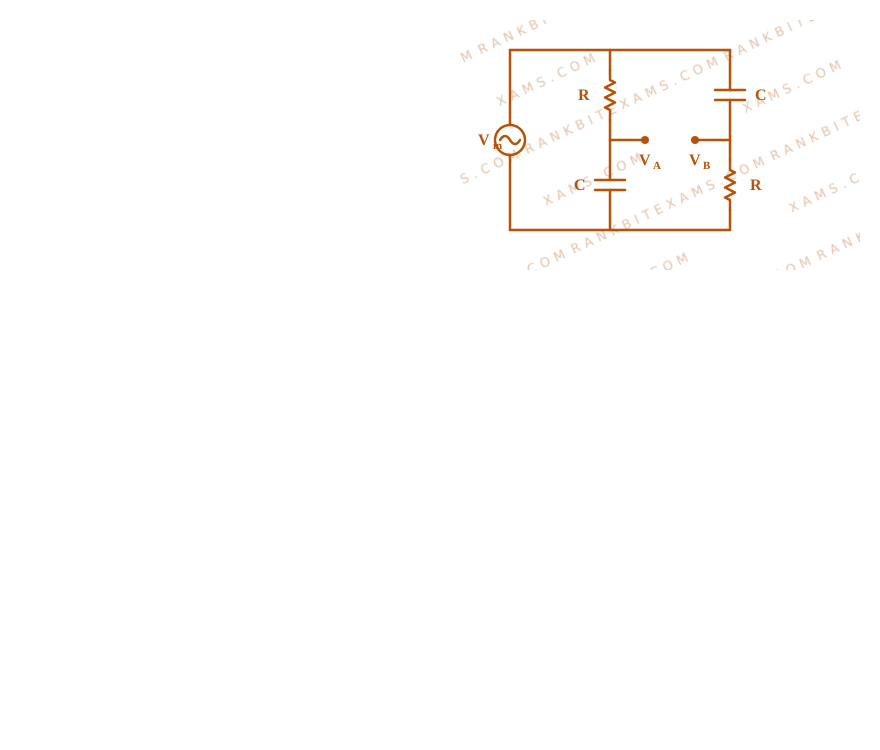
For ac circuit shown in figure, R = 100 \, textkOmega$R = 100 \, \text{k}\Omega$ and C = 100 \, textpF$C = 100 \, \text{pF}$ and the phase difference between V_textin$V_{\text{in}}$ and (V_textB - V_textA)$(V_{\text{B}} - V_{\text{A}})$ is 90^circ$90^\circ$ . The input signal frequency is 10^textx$10^{\text{x}}$ rad/sec, where 'x' is An AC bridge circuit with input voltage connected across symmetrically crossed pairs of 100 kOhm resistors and 100 pF capacitors.
Numerical Answer.Answer: 5 to 5
Solution
### Related Formula
For a series RC branch, the voltage phase angle theta$\theta$ is:
tantheta = fracX_CR = frac1omega C R$$\tan\theta = \frac{X_C}{R} = \frac{1}{\omega C R}$$
If the phase difference between V_textin$V_{\text{in}}$ and (V_B - V_A)$(V_B - V_A)$ is 90^circ$90^\circ$:
theta = 45^circ implies tantheta = 1$$\theta = 45^\circ \implies \tan\theta = 1$$
### Core Logic
An AC bridge circuit with input voltage connected across symmetrically crossed pairs of 100 kOhm resistors and 100 pF capacitors.An AC bridge circuit with input voltage connected across symmetrically crossed pairs of 100 kOhm resistors and 100 pF capacitors.
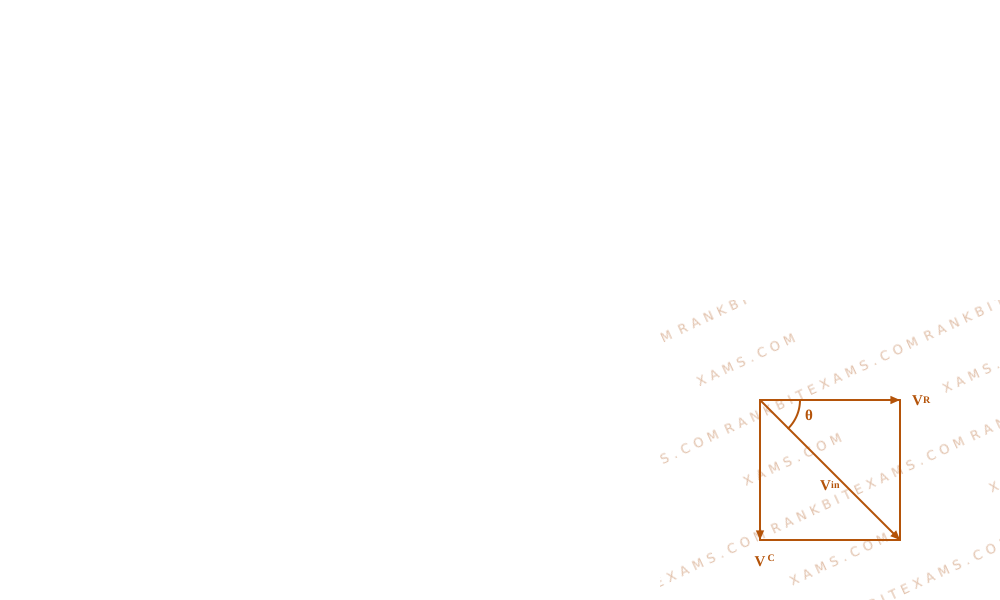
From the phasor representation of the symmetric RC divider bridge:
- The phase angle of V_A$V_A$ is theta$\theta$ behind the input voltage.
- The phase angle of V_B$V_B$ is 90^circ - theta$90^\circ - \theta$ ahead of the input.
- If their combined relative phase difference is 90^circ$90^\circ$, this symmetry dictates:
An AC bridge circuit with input voltage connected across symmetrically crossed pairs of 100 kOhm resistors and 100 pF capacitors.An AC bridge circuit with input voltage connected across symmetrically crossed pairs of 100 kOhm resistors and 100 pF capacitors.theta + theta = 90^circ implies theta = 45^circ$$\theta + \theta = 90^\circ \implies \theta = 45^\circ$$
Therefore, we have the condition:
X_C = R implies frac1omega C = R$$X_C = R \implies \frac{1}{\omega C} = R$$
### Step 1: Solve for Frequency
Rearrange to solve for omega$\omega$:
omega = frac1R C$$\omega = \frac{1}{R C}$$
Substitute the given values:
- R = 100 mathrm~kOmega = 10^5 Omega$R = 100 \mathrm{~k}\Omega = 10^5 \Omega$
- C = 100 mathrm~pF = 100 times 10^-12 mathrm~F = 10^-10 mathrm~F$C = 100 \mathrm{~pF} = 100 \times 10^{-12} \mathrm{~F} = 10^{-10} \mathrm{~F}$omega = frac110^5 times 10^-10 = frac110^-5 = 10^5 mathrm~rad/sec$$\omega = \frac{1}{10^5 \times 10^{-10}} = \frac{1}{10^{-5}} = 10^5 \mathrm{~rad/sec}$$
Since omega = 10^x$\omega = 10^x$, we get x = 5$x = 5$.
### Pattern Recognition
Sees: Phase shift of 90^circ$90^\circ$ across a symmetric RC bridge.
Shortcut: Clamping phase shift at 90^circ$90^\circ$ implies the reactive impedance equals the resistive impedance (X_C = R$X_C = R$). The frequency is simply the characteristic time constant frequency omega = 1/tau = 1/(RC)$\omega = 1/\tau = 1/(RC)$.
### Evaluation Rubric / Model Answer
null
### Chapter Mix
Class 12 Physics: Alternating Current
Q9jee_main_2025_07_april_morningRms Value of Current
An ac current is represented as
i = 5 sqrt 2 + 1 0 cos left(6 5 0 pi t + frac pi6right) mathrm A m p$$i = 5 \sqrt {2} + 1 0 \cos \left(6 5 0 \pi t + \frac {\pi}{6}\right) \mathrm {A m p}$$
The r.m.s value of the current is
A. 50 Amp
B.100mathrmAmp$100\mathrm{Amp}$
C. 10 Amp
D.5 sqrt2 mathrmAmp$5 \sqrt{2} \mathrm{Amp}$
Solution
### Related Formula
For a current having both DC and AC components i = I_textdc + I_0 cos(omega t + phi)$i = I_{\text{dc}} + I_0 \cos(\omega t + \phi)$, the mean-square value is:
langle i^2 rangle = I_textdc^2 + fracI_0^22$$\langle i^2 \rangle = I_{\text{dc}}^2 + \frac{I_0^2}{2}$$
The RMS current I_textrms$I_{\text{rms}}$ is:
I_textrms = sqrtlangle i^2 rangle = sqrtI_textdc^2 + fracI_0^22$$I_{\text{rms}} = \sqrt{\langle i^2 \rangle} = \sqrt{I_{\text{dc}}^2 + \frac{I_0^2}{2}}$$
### Core Logic
Identify the parameters from the given equation:
- I_textdc = 5sqrt2 mathrm~A$I_{\text{dc}} = 5\sqrt{2} \mathrm{~A}$
- I_0 = 10 mathrm~A$I_0 = 10 \mathrm{~A}$
Calculate the square of the components:
I_textdc^2 = (5sqrt2)^2 = 50$$I_{\text{dc}}^2 = (5\sqrt{2})^2 = 50$$fracI_0^22 = frac1002 = 50$$\frac{I_0^2}{2} = \frac{100}{2} = 50$$
### Step 1: Compute Resultant RMS
Substitute back into the RMS formula:
I_textrms = sqrt50 + 50 = sqrt100 = 10 mathrm~Amp$$I_{\text{rms}} = \sqrt{50 + 50} = \sqrt{100} = 10 \mathrm{~Amp}$$
### Pattern Recognition
Sees: Superposition of a DC current I_textdc$I_{\text{dc}}$ and a pure AC cosine wave with amplitude I_textac$I_{\text{ac}}$.
Shortcut: Use the orthogonal component RMS formula: I_textrms = sqrtI_textdc^2 + I_textac,rms^2$I_{\text{rms}} = \sqrt{I_{\text{dc}}^2 + I_{\text{ac,rms}}^2}$. Here I_textdc = 5sqrt2$I_{\text{dc}} = 5\sqrt{2}$ and I_textac,rms = 10/sqrt2 = 5sqrt2$I_{\text{ac,rms}} = 10/\sqrt{2} = 5\sqrt{2}$. Thus, I_textrms = sqrt50 + 50 = 10 mathrm~A$I_{\text{rms}} = \sqrt{50 + 50} = 10 \mathrm{~A}$.
### Evaluation Rubric / Model Answer
null
### Chapter Mix
Class 12 Physics: Alternating Current
More Alternating Current Questions — jee_main_2026_23_january_morning
We Map Every Repeating Question in Competitive Exams.
Say goodbye to generic mock test fatigue. RankBit uses smart analysis to group past exam questions into their foundational Repeating Question Types. Find chapter weightage, track repeating questions, and score higher with targeted practice.
Select Your Target Exam
Choose an exam track below to find formulas per chapter and patterns.
Syncing Exam Intelligence
Mapping formulas and patterns across all tracks…
PATH A — FULL LENGTH PRACTICE
Full Mock Test Hub
Simulate real NTA exam conditions with fully tracked mocks. Time yourself against past papers.
Practice past-year questions one chapter at a time. Pick an exam → subject → chapter and get every PYQ for that topic — pulled together from all past papers — with the chapter's key formulas alongside.