JEE Main · Chemistry → Steady

Structure of Atom appeared 39 times across 3 years — 4.5% of Chemistry. This question is from De Broglie Wavelength.

Year 2026 2025 2024 Total
Questions 14 16 9 39

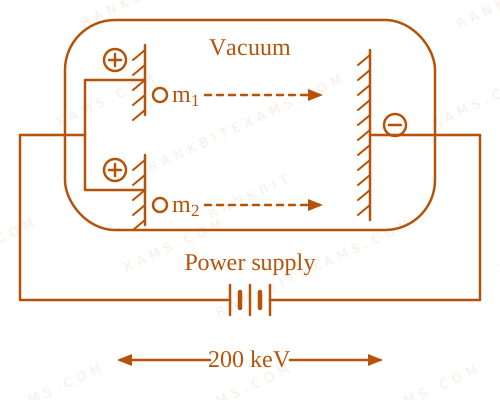
Two positively charged particles m₁ and m₂ have been accelerated across the same potential difference of 200 keV as shown below.
De Broglie Wavelength diagram for Q71 - JEE Main 2026 Evening
Two particles m1 and m2 are shown being accelerated in a vacuum over a 200 keV potential.
[Given mass of m₁=1 amu and m₂=4 amu] The deBroglie wavelength of m₁ will be x times of m₂. The value of x is ____. (nearest integer)

Numerical Answer Type:
Enter a numerical value Answer: 2 to 2 +4 marks

Solution & Explanation

Related Formula
λ = h√(2m(K.E.))

where K.E. is the kinetic energy acquired, which equals qV.

Core Logic

Since both particles have the same charge and are accelerated through the same potential difference (200 keV), they will acquire the exact same kinetic energy. So, λ ∝ 1√(m)

Ratio of their de Broglie wavelengths:

(λd)m₁(λd)m₂ = √((m₂)/(m₁)) = √((4)/(1)) = 2

Therefore, (λd)m₁ = 2 (λd)m₂

Step 1: Final Conclusion

The value of x is 2.

Pattern Recognition

For same K.E., λ depends purely on the inverse square root of mass.

Chapter Mix

Class 11 Chemistry: Structure of Atom Class 12 Physics: Dual Nature of Radiation and Matter

Reference Study Guides

More Structure of Atom Previous-Year Questions — Page 8

Q90 jee_main_2024_30_january_evening Atomic Spectra
Number of spectral lines obtained in He^+ spectra, when an electron makes transition from fifth excited state to first excited state will be
Numerical Answer. Answer: 10 to 10

Solution

Related Formula
Number of spectral lines = (Δ n (Δ n + 1))/(2)

where Δ n = n₂ - n₁

Core Logic

Identify the principal quantum numbers (n) for the given states:

  • Fifth excited state means n₂ = 5 + 1 = 6.
  • First excited state means n₁ = 1 + 1 = 2.
  • Calculate the difference:

Δ n = n₂ - n₁ = 6 - 2 = 4
Step 1: Calculate Total Spectral Lines

Substitute Δ n = 4 into the formula:

Maximum number of spectral lines = (4(4 + 1))/(2) = (4 × 5)/(2)

= 10

Chapter Mix

Class 11 Chemistry: Structure of Atom

Q68 jee_main_2024_30_jan_morning Quantum Mechanical Model
Given below are two statements: Statement-I: The orbitals having same energy are called as degenerate orbitals. Statement-II: In hydrogen atom, 3p and 3d orbitals are not degenerate orbitals. In the light of the above statements, choose the most appropriate answer from the options given
  • A. Statement-I is true but Statement-II is false
  • B. Both Statement-I and Statement-II are true.
  • C. Both Statement-I and Statement-II are false
  • D. Statement-I is false but Statement-II is true

Solution

Core Logic

Statement-I defines degenerate orbitals correctly: Orbitals that share the exact same energy level are called degenerate orbitals. Statement-II claims 3p and 3d are not degenerate in a hydrogen atom. For a single-electron system like Hydrogen (1s¹), the energy of an orbital depends only on the principal quantum number 'n'.

Step 1: Final conclusion

In a hydrogen atom, energy of 3s = 3p = 3d. Therefore, 3p and 3d are degenerate. Thus, Statement-II is false.

Pattern Recognition

Hydrogen atom (single electron species) = Energy dictated strictly by n. Multi-electron atoms = Energy dictated by (n + l) rule.

Chapter Mix

Class 11 Chemistry: Structure of Atom

Q jee_main_2024_31_jan_evening Quantum Numbers
The four quantum numbers for the electron in the outer most orbital of potassium (atomic no. 19) are
  • A. n = 4, l = 2, m = -1, s = +(1)/(2)
  • B. n = 4, l = 0, m = 0, s = +(1)/(2)
  • C. n = 3, l = 0, m = 1, s = +(1)/(2)
  • D. n = 2, l = 0, m = 0, s = +(1)/(2)

Solution

Core Logic

The atomic number of potassium (K) is 19. Its electronic configuration is: 1s², 2s², 2p⁶, 3s², 3p⁶, 4s¹. The outermost orbital of potassium is the 4s orbital.

For the 4s orbital: Principal quantum number, n = 4 Azimuthal quantum number, l = 0 (for s-subshell) Magnetic quantum number, m = 0 (since l = 0) Spin quantum number, s = ± (1)/(2)

Step 1: Final Matching

Comparing these values with the options, option (2) provides n = 4, l = 0, m = 0, s = +(1)/(2), which perfectly describes the outermost electron.

Chapter Mix

Class 11 Chemistry: Structure of Atom

Q89 jee_main_2024_31_jan_morning Photoelectric Effect and Ionization Energy
The ionization energy of sodium in kJ mol⁻¹. If electromagnetic radiation of wavelength 242 nm is just sufficient to ionize sodium atom is ________
Numerical Answer. Answer: 493 to 495

Solution

Related Formula
E = 1240λ (nm) eV Etotal = E × NA
Step 1: Energy per atom
E = (1240)/(242) eV = 5.12 eV

Converting eV to Joules:

E = 5.12 × 1.6 × 10⁻¹⁹ J/atom E = 8.192 × 10⁻¹⁹ J/atom
Step 2: Energy per mole

To find the ionization energy per mole, multiply by Avogadro's number (NA ≈ 6.022 × 10²³):

IE = 8.192 × 10⁻¹⁹ × 6.022 × 10²³ J/mol IE ≈ 493.3 × 10³ J/mol ≈ 494 kJ/mol
Chapter Mix

Class 11 Chemistry: Structure of Atom

More Structure of Atom Questions — jee_main_2026_28_january_evening

Practice all Structure of Atom previous-year questions →

Rankbit System
JEE Physics: Waves (+15.5%) | Electrostatics: Concentric Shells (-29.7%) | Modern Physics: Photoelectric Clones (+34.2%) | Mathematics: Definite Integrals (+18.1%) | Chemistry: Coordination Splitting (-11.4%) | JEE Physics: Waves (+15.5%) | Electrostatics: Concentric Shells (-29.7%) | Modern Physics: Photoelectric Clones (+34.2%) | Mathematics: Definite Integrals (+18.1%) | Chemistry: Coordination Splitting (-11.4%)