JEE Main · Chemistry → Steady

Structure of Atom appeared 39 times across 3 years — 4.5% of Chemistry. This question is from De Broglie Wavelength.

Year 2026 2025 2024 Total
Questions 14 16 9 39

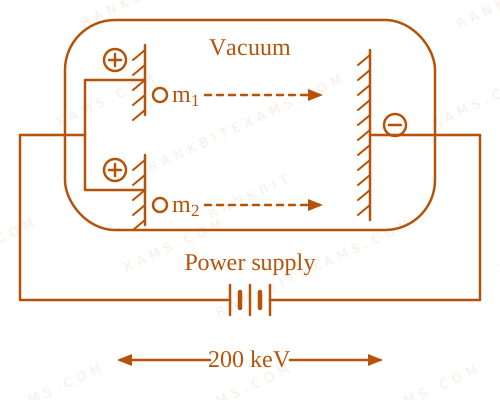
Two positively charged particles m₁ and m₂ have been accelerated across the same potential difference of 200 keV as shown below.
De Broglie Wavelength diagram for Q71 - JEE Main 2026 Evening
Two particles m1 and m2 are shown being accelerated in a vacuum over a 200 keV potential.
[Given mass of m₁=1 amu and m₂=4 amu] The deBroglie wavelength of m₁ will be x times of m₂. The value of x is ____. (nearest integer)

Numerical Answer Type:
Enter a numerical value Answer: 2 to 2 +4 marks

Solution & Explanation

Related Formula
λ = h√(2m(K.E.))

where K.E. is the kinetic energy acquired, which equals qV.

Core Logic

Since both particles have the same charge and are accelerated through the same potential difference (200 keV), they will acquire the exact same kinetic energy. So, λ ∝ 1√(m)

Ratio of their de Broglie wavelengths:

(λd)m₁(λd)m₂ = √((m₂)/(m₁)) = √((4)/(1)) = 2

Therefore, (λd)m₁ = 2 (λd)m₂

Step 1: Final Conclusion

The value of x is 2.

Pattern Recognition

For same K.E., λ depends purely on the inverse square root of mass.

Chapter Mix

Class 11 Chemistry: Structure of Atom Class 12 Physics: Dual Nature of Radiation and Matter

Reference Study Guides

More Structure of Atom Previous-Year Questions — Page 7

Q jee_main_2024_01_february_morning Dual Behaviour of Matter
According to the wave-particle duality of matter by de-Broglie, which of the following graph plot presents most appropriate relationship between wavelength of electron (λ) and momentum of electron (p)?
  • A.
  • B.
  • C.
  • D.

Solution

Related Formula
λ = (h)/(p)
Core Logic

From the de-Broglie equation: λ ∝ (1)/(p) ⇒ λ p = h (constant)

This represents the equation of a rectangular hyperbola (xy = c).

Step 1: Graph Identification

The plot of λ versus p will be a rectangular hyperbola curve in the first quadrant. Graph 1 correctly depicts this hyperbolic relationship.

Dual Behaviour of Matter diagram for Q66 - JEE Main 2024 Morning

Pattern Recognition

Inverse proportionality y = (k)/(x) always graphs as a rectangular hyperbola in the positive quadrant.

Chapter Mix

Class 11 Chemistry: Structure of Atom

Q jee_main_2024_29_january_evening Hydrogen Spectral Series
Match List I with List II:
List I (Spectral Series for Hydrogen)List II (Spectral Region/Higher Energy State)
A. LymanI. Infrared region
B. BalmerII. UV region
C. PaschenIII. Infrared region
D. PfundIV. Visible region
Choose the correct answer from the options given below :
  • A. A-II, B-III, C-I, D-IV
  • B. A-I, B-III, C-II, D-IV
  • C. A-II, B-IV, C-III, D-I
  • D. A-I, B-II, C-III, D-IV

Solution

Related Formula
(1)/(λ) = RH ( (1)/(n₁²) - (1)/(n₂²) )
Core Logic

Analyzing electromagnetic spectrum regions for each hydrogen electronic decay series:

  • Lyman Series (n₁=1) emits photons in the high-energy Ultraviolet (UV) region (II).
  • Balmer Series (n₁=2) falls cleanly into the Visible region spectrum (IV).
  • Paschen Series (n₁=3) transitions sit inside the standard Near-Infrared region (III).
  • Pfund Series (n₁=5) shifts sit even deeper in the Infrared region zone (I).
Step 1: Resolution

Thus, compiling match mappings yields configuration: A-II, B-IV, C-III, D-I.

Pattern Recognition

Lyman is always UV; Balmer is visible; all subsequent higher level series (n₁ ≥ 3) belong strictly to infrared segments.

Chapter Mix

Class 11 Chemistry: Atomic Structure

Q jee_main_2024_27_jan_morning Quantum Numbers and Electron Capacity
The number of electrons present in all the completely filled subshells having n=4 and s=+(1)/(2) is . (Where n= principal quantum number and s= spin quantum number)
Numerical Answer. Answer: 16 to 16

Solution

Step 1: Identify all available subshells within the n=4 energy shell

For principal quantum level n=4, the allowed values of azimuthal quantum numbers (l) are:

  • 4s (l=0) arrow 1 orbital arrow 2 electrons capacity
  • 4p (l=1) arrow 3 orbitals arrow 6 electrons capacity
  • 4d (l=2) arrow 5 orbitals arrow 10 electrons capacity
  • 4f (l=3) arrow 7 orbitals arrow 14 electrons capacity
Step 2: Filter capacity using spin values

Every single spatial orbital holds exactly 2 electrons maximum; one with spin s=+(1)/(2) and one with spin s=-(1)/(2). Total number of orbitals across n=4 is:

1 + 3 + 5 + 7 = 16 orbitals

Thus, the total count of electrons featuring spin value s=+(1)/(2) across these completely filled configurations is exactly 16.

Pattern Recognition

Total orbitals in shell n is n². Since each orbital contributes exactly 1 electron with s=+(1)/(2), capacity is simply n² = 4² = 16.

Chapter Mix

Class 11 Chemistry: Structure of Atom

Q65 jee_main_2024_27_jan_morning Electronic Configuration and Magnetic Moment
Which of the following electronic configuration would be associated with the highest magnetic moment?
  • A. [Ar] 3d⁷
  • B. [Ar] 3d⁸
  • C. [Ar] 3d³
  • D. [Ar] 3d⁶

Solution

Related Formula

Spin-only magnetic moment formula:

μ = √(n(n+2)) BM

where n is the number of unpaired electrons.

Step 1: Audit configurations and count unpaired electrons

ConfigurationUnpaired e^- (n)Magnetic Moment (BM)
[Ar] 3d⁷3√(15)
[Ar] 3d⁸2√(8)
[Ar] 3d³3√(15)
[Ar] 3d⁶4√(24)

Step 2: Conclusion

Since [Ar] 3d⁶ contains the maximal count of 4 unpaired electrons, it yields the highest spin-only magnetic moment value.

Pattern Recognition

Maximal unpaired configuration in high-spin 3dⁿ series yields the highest μ. Check n systematically.

Chapter Mix

Class 11 Chemistry: Structure of Atom Class 12 Chemistry: d-and f-Block Elements

Q66 jee_main_2024_29_jan_morning Quantum Numbers
The correct set of four quantum numbers for the valence electron of rubidium atom (Z = 37) is:
  • A. 5, 0, 0, +(1)/(2)
  • B. 5, 0, 1, +(1)/(2)
  • C. 5, 1, 0, +(1)/(2)
  • D. 5, 1, 1, +(1)/(2)

Solution

Core Logic

Rubidium (Rb) has the atomic number Z = 37.

The noble gas core preceding it is Krypton (Kr, Z = 36). The electronic configuration is:

Rb arrow [Kr] 5s¹

Thus, the valence electron resides in the 5s orbital.

Step 1: Assigning Quantum Numbers

For a 5s electron:

  • Principal quantum number, n = 5 (from the shell number).
  • Azimuthal quantum number, l = 0 (for an s-orbital).
  • Magnetic quantum number, m = 0 (since m ranges from -l to +l, and l=0).
  • Spin quantum number, s = +(1)/(2) or -(1)/(2).
  • The correct set matching this is 5, 0, 0, +(1)/(2).

Chapter Mix

Class 11 Chemistry: Structure of Atom

More Structure of Atom Questions — jee_main_2026_28_january_evening

Practice all Structure of Atom previous-year questions →

Rankbit System
JEE Physics: Waves (+15.5%) | Electrostatics: Concentric Shells (-29.7%) | Modern Physics: Photoelectric Clones (+34.2%) | Mathematics: Definite Integrals (+18.1%) | Chemistry: Coordination Splitting (-11.4%) | JEE Physics: Waves (+15.5%) | Electrostatics: Concentric Shells (-29.7%) | Modern Physics: Photoelectric Clones (+34.2%) | Mathematics: Definite Integrals (+18.1%) | Chemistry: Coordination Splitting (-11.4%)