Solution
Related Formula
Area = ∫x₁x₂ (yupper - ylower) dxCore Logic
Evaluate f(0) by setting α = 0 in the function for y.
At α = 0 y = |0· x - 5| - |1 - 0· x| + 0· x²
y = |-5| - |1| = 5 - 1 = 4So for f(0), the bounded area A₁ is between y = 4, y = √(x), from x = 0 to x = 1.
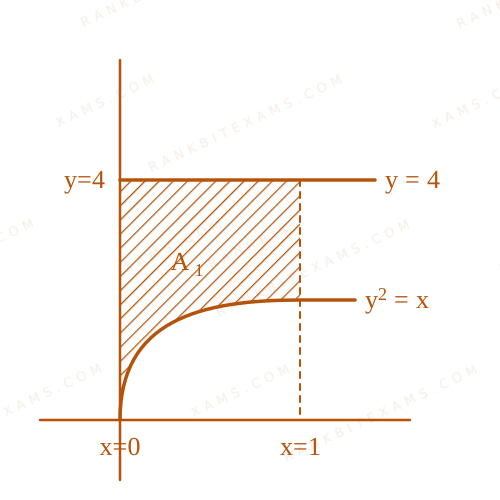
Step 1: Calculating f(0)
A₁ = ∫₀¹ (4 - √(x)) dx = [ 4x - x3/23/2 ]₀¹ = 4(1) - (2)/(3)(1) = (10)/(3)So, f(0) = (10)/(3).
Step 2: Determining curve for f(1)
Evaluate f(1) by setting α = 1 in the function for y.
At α = 1 y = |x - 5| - |1 - x| + x². Since the area is restricted to x in [0, 1]: x - 5 is negative, so |x - 5| = 5 - x. 1 - x is positive, so |1 - x| = 1 - x.
y = (5 - x) - (1 - x) + x² y = 5 - x - 1 + x + x² = 4 + x²
Step 3: Calculating f(1)
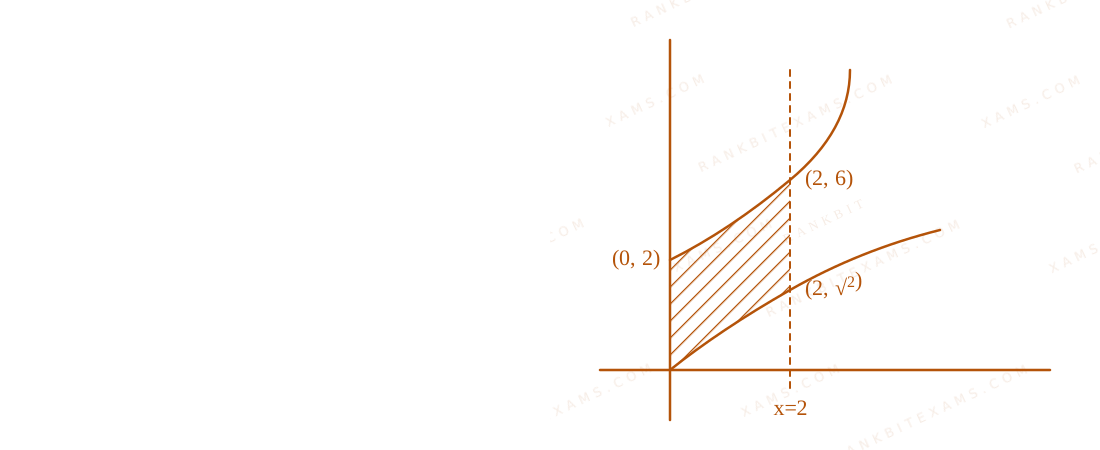
For f(1), the bounded area A₂ is between y = 4 + x² and y = √(x), from x = 0 to x = 1.
A₂ = ∫₀¹ ((4 + x²) - √(x)) dx = [ 4x + (x³)/(3) - x3/23/2 ]₀¹ = ( 4 + (1)/(3) - (2)/(3) ) = 4 - (1)/(3) = (11)/(3)So, f(1) = (11)/(3).
Step 4: Final Sum
|f(0) + f(1)| = | A₁ + A₂ | = | (10)/(3) + (11)/(3) | = (21)/(3) = 7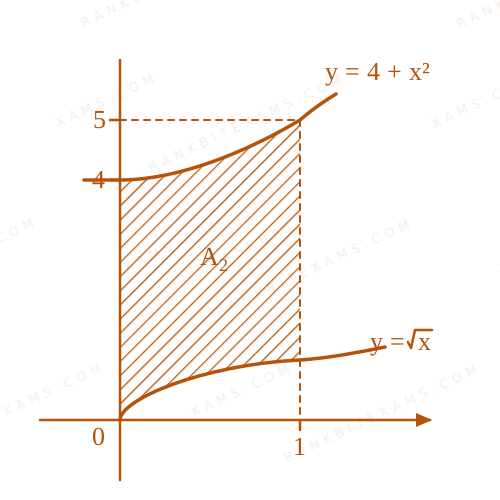
Pattern Recognition
Modulus functions combined with parametric limits should be instantly resolved by plugging in the bounds of x (here [0,1]) to drop the absolute value signs before attempting any integral.
Chapter Mix
Class 12 Maths: Area Under the Curve Class 11 Maths: Modulus Function