Keywords:#area bounded curve#JEE Main 2025 Evening Q71#parabola integration path#application of integrals
More Application of Integrals Previous-Year Questions
Q2jee_main_2026_21_jan_morningArea Bounded by Ellipse and Modulus Functions
The area of the region, inside the ellipse x² + 4y² = 4$x^{2} + 4y^{2} = 4$ and outside the region bounded by the curves y = |x| - 1$y = |x| - 1$ and y = 1 - |x|$y = 1 - |x|$ , is:
A.2(π - 1)$2(\pi - 1)$
B.2π - (1)/(2)$2\pi - \frac{1}{2}$
C.3(π - 1)$3(\pi - 1)$
D.2π - 1$2\pi - 1$
Solution
### Related Formula
Area of an ellipse (x²)/(a²) + (y²)/(b²) = 1$\frac{x^2}{a^2} + \frac{y^2}{b^2} = 1$ is given by:
Area = π a b$$\text{Area} = \pi a b$$
Area of a rhombus bounded by |x| + |y| = a$|x| + |y| = a$ is 2a²$2a^2$.
### Core Logic
The given curves form a bounded geometric area.
Ellipse: x² + 4y² = 4 ⇒ (x²)/(4) + (y²)/(1) = 1$x^2 + 4y^2 = 4 \Rightarrow \frac{x^2}{4} + \frac{y^2}{1} = 1$.
Here, a = 2$a = 2$, b = 1$b = 1$.
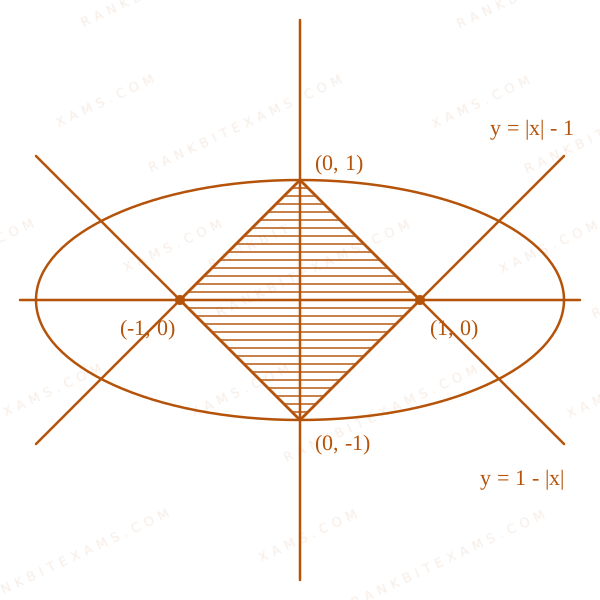
The region to be excluded is bounded by y = |x| - 1$y = |x| - 1$ and y = 1 - |x|$y = 1 - |x|$, which rearranges to |x| + |y| = 1$|x| + |y| = 1$. This forms a square/rhombus centered at the origin with vertices at (1, 0), (0, 1), (-1, 0), (0, -1)$(1, 0), (0, 1), (-1, 0), (0, -1)$.
### Step 1: Calculate Total and Excluded Areas
Total Area of the Ellipse:
Area = π (2)(1) = 2π$$\text{Area} = \pi (2)(1) = 2\pi$$
Excluded Area (Rhombus |x| + |y| = 1$|x| + |y| = 1$):
The rhombus consists of 4 identical right-angled triangles in each quadrant.
Area of one triangle = (1)/(2) × base × height = (1)/(2) × 1 × 1 = (1)/(2)$\frac{1}{2} \times \text{base} \times \text{height} = \frac{1}{2} \times 1 \times 1 = \frac{1}{2}$.
Total excluded area = 4 × (1)/(2) = 2$4 \times \frac{1}{2} = 2$.
### Step 2: Calculate Required Area
Ellipse and Modulus area diagram for Q2 - JEE Main 2026 Morning
Required Area = Area of ellipse -$-$ Shaded Area
= 2π - 2$= 2\pi - 2$= 2(π - 1)$= 2(\pi - 1)$
### Pattern Recognition
Transform absolute value equations y = ±(|x| - a)$y = \pm(|x| - a)$ into |x| + |y| = a$|x| + |y| = a$ to instantly recognize a standard rhombus, allowing direct geometry formulas instead of integration.
### Evaluation Rubric / Model Answer
null
### Chapter Mix
Class 12 Maths: Area Under Curves
Class 11 Maths: Conic Sections
Q11jee_main_2026_21_jan_eveningArea Under Curve
If the area of the region(x, y) : 1 - 2x ≤ y ≤ 4 - x², x ≥ 0, y ≥ 0$\{(x, y) : 1 - 2x \leq y \leq 4 - x^{2}, x \geq 0, y \geq 0\}$ is (α)/(β), α, β, in N, (α, β) = 1$\frac{\alpha}{\beta}, \alpha, \beta, \in N, \gcd(\alpha, \beta) = 1$, then the value of (α + β)$(\alpha + \beta)$ is :
A.73$73$
B.85$85$
C.91$91$
D.67$67$
Solution
### Related Formula
Area = ∫x₁x₂ (f(x) - g(x)) dx$$\text{Area} = \int_{x_1}^{x_2} (f(x) - g(x)) dx$$Area of Parabola piece: ∫₀² (4-x²) dx$$\text{Area of Parabola piece: } \int_{0}^{2} (4-x^2) dx$$
### Core Logic
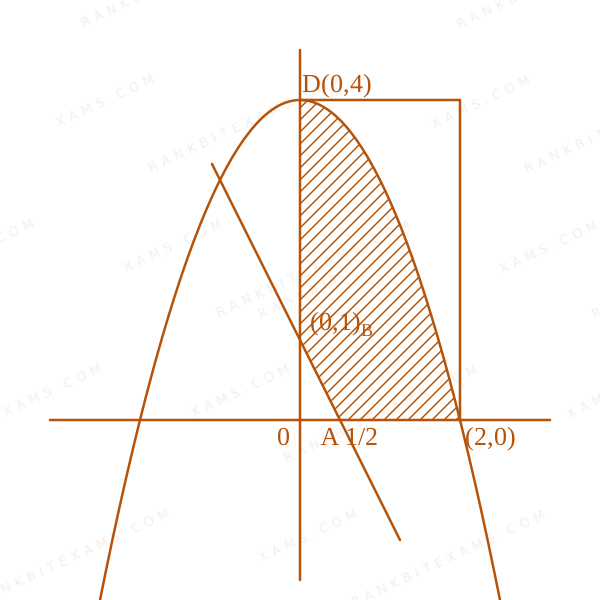
Area under curve diagram for Q11 - JEE Main 2026 Evening
The region is bounded above by y = 4 - x²$y = 4 - x^2$, below by y = 1 - 2x$y = 1 - 2x$, and constrained to x ≥ 0, y ≥ 0$x \geq 0, y \geq 0$.
The parabola intersects the x-axis at x=2$x=2$ (since 4-x²=0, x≥ 0$4-x^2=0, x\geq 0$).
The line intersects the x-axis at x=(1)/(2)$x=\frac{1}{2}$ (since 1-2x=0$1-2x=0$) and y-axis at y=1$y=1$.
The required area is the area under the parabola in the first quadrant minus the small triangular region bounded by y = 1-2x, x=0, y=0$y = 1-2x, x=0, y=0$.
### Step 1: Calculate the Area
Total area under parabola in 1st quadrant = ∫₀² (4 - x²) dx = [ 4x - (x³)/(3) ]₀² = 8 - (8)/(3) = (16)/(3)$$\text{Total area under parabola in 1st quadrant} = \int_0^2 (4 - x^2) dx = \left[ 4x - \frac{x^3}{3} \right]_0^2 = 8 - \frac{8}{3} = \frac{16}{3}$$
Area of the small right triangle formed by the line y=1-2x$y=1-2x$ in the first quadrant:
Vertices are (0,0), (1/2,0), (0,1)$(0,0), (1/2,0), (0,1)$.
Area of triangle = (1)/(2) × base × height = (1)/(2) × (1)/(2) × 1 = (1)/(4)$$\text{Area of triangle} = \frac{1}{2} \times \text{base} \times \text{height} = \frac{1}{2} \times \frac{1}{2} \times 1 = \frac{1}{4}$$
### Step 2: Subtraction and Format Match
Required Area = (16)/(3) - (1)/(4) = (64 - 3)/(12) = (61)/(12)$$\text{Required Area} = \frac{16}{3} - \frac{1}{4} = \frac{64 - 3}{12} = \frac{61}{12}$$
Here, α = 61, β = 12$\alpha = 61, \beta = 12$.
Check (61, 12) = 1$\gcd(61, 12) = 1$. This matches.
So, α + β = 61 + 12 = 73$\alpha + \beta = 61 + 12 = 73$.
### Pattern Recognition
For areas defined by y ≥ g(x)$y \geq g(x)$ when g(x)$g(x)$ forms a simple geometric shape (like a line), subtract the geometric area directly rather than splitting the integral algebraically. It eliminates integration errors.
### Evaluation Rubric / Model Answer
null
### Chapter Mix
Class 12 Maths: Application of Integrals
Q3jee_main_2026_22_january_morningArea Between Two Curves
Let the line x = -1$x = -1$divide the area of the region(x,y):1+x²≤ y≤3-x$\left\{(x,y):1+x^{2}\leq y\leq3-x\right\}$ in the ratio m:n$m:n$, gcd (m,n)=1$(m,n)=1$. Then m+n$m+n$ is equal to
A.25$25$
B.28$28$
C.26$26$
D.27$27$
Solution
### Related Formula
Area = ∫ₐb (yupper - ylower) dx$$\text{Area} = \int_{a}^{b} (y_{\text{upper}} - y_{\text{lower}}) \,dx$$
### Core Logic
First, find the points of intersection for the curves y = 1 + x²$y = 1 + x^2$ and y = 3 - x$y = 3 - x$:
1 + x² = 3 - x$1 + x^2 = 3 - x$x² + x - 2 = 0$x^2 + x - 2 = 0$(x + 2)(x - 1) = 0 x = -2, x = 1$$(x + 2)(x - 1) = 0 \implies x = -2, x = 1$$
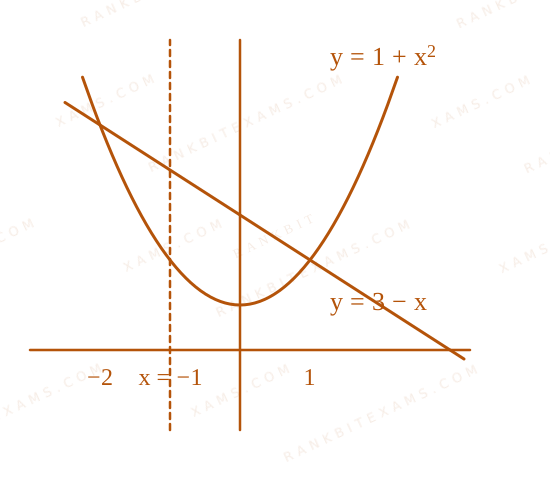
So the total region is bounded between x = -2$x = -2$ and x = 1$x = 1$. The line x = -1$x = -1$ divides this region into two parts.
Area Between Two Curves diagram for Q3 - JEE Main 2026 Morning
### Step 1: Setting up the Areas
Let the area to the left of x = -1$x = -1$ be proportional to m$m$ and the area to the right be proportional to n$n$.
Am = ∫₋₂⁻¹ [(3 - x) - (1 + x²)] dx$$A_m = \int_{-2}^{-1} [(3 - x) - (1 + x^2)] \,dx$$Aₙ = ∫₋₁¹ [(3 - x) - (1 + x²)] dx$$A_n = \int_{-1}^{1} [(3 - x) - (1 + x^2)] \,dx$$
The integrand simplifies to 2 - x - x²$2 - x - x^2$.
Area Between Two Curves diagram for Q3 - JEE Main 2026 Morning
### Step 2: Integration
∫ (2 - x - x²) dx = 2x - (x²)/(2) - (x³)/(3)$$\int (2 - x - x^2) \,dx = 2x - \frac{x^2}{2} - \frac{x^3}{3}$$
Evaluate Am$A_m$:
Am = [2x - (x²)/(2) - (x³)/(3)]₋₂⁻¹$$A_m = \left[2x - \frac{x^2}{2} - \frac{x^3}{3}\right]_{-2}^{-1}$$Am = (-2 - (1)/(2) + (1)/(3)) - (-4 - 2 + (8)/(3)) = (-(13)/(6)) - (-(10)/(3)) = (7)/(6)$$A_m = \left(-2 - \frac{1}{2} + \frac{1}{3}\right) - \left(-4 - 2 + \frac{8}{3}\right) = \left(-\frac{13}{6}\right) - \left(-\frac{10}{3}\right) = \frac{7}{6}$$
Evaluate Aₙ$A_n$:
Aₙ = [2x - (x²)/(2) - (x³)/(3)]₋₁¹$$A_n = \left[2x - \frac{x^2}{2} - \frac{x^3}{3}\right]_{-1}^{1}$$Aₙ = (2 - (1)/(2) - (1)/(3)) - (-2 - (1)/(2) + (1)/(3)) = ((7)/(6)) - (-(13)/(6)) = (20)/(6)$$A_n = \left(2 - \frac{1}{2} - \frac{1}{3}\right) - \left(-2 - \frac{1}{2} + \frac{1}{3}\right) = \left(\frac{7}{6}\right) - \left(-\frac{13}{6}\right) = \frac{20}{6}$$
### Step 3: Finding the Ratio
The ratio of the areas m:n$m:n$ is:
(m)/(n) = (Aₙ)/(Am) or (Am)/(Aₙ)$$\frac{m}{n} = \frac{A_n}{A_m} \text{ or } \frac{A_m}{A_n}$$
Wait, the solution designates (m)/(n) = ∫₋₁¹∫₋₂⁻¹ = (20/6)/(7/6) = (20)/(7)$\frac{m}{n} = \frac{\int_{-1}^{1}}{\int_{-2}^{-1}} = \frac{20/6}{7/6} = \frac{20}{7}$. (Since (20,7)=1$\gcd(20,7)=1$, m=20$m=20$ and n=7$n=7$).
Therefore, m+n = 20 + 7 = 27$m+n = 20 + 7 = 27$.
### Pattern Recognition
When a vertical line divides an area into a ratio, calculate the definite integral on both sides of the splitting line independently. Keep fractions with a common denominator until the final ratio step.
### Evaluation Rubric / Model Answer
null
### Chapter Mix
Class 12 Maths: Applications of Integrals
Q22jee_main_2026_23_january_morningArea Under the Curve
Let the area of the region bounded by the curve y = x, x$y = \max \{\sin x, \cos x\}$, lines x = 0, x = (3π)/(2)$x = 0, x = \frac{3\pi}{2}$, and the x$x$-axis be A$A$. Then, A + A²$A + A^2$ is equal to _____.
Numerical Answer.Answer: 12 to 12
Solution
### Core Logic
To evaluate the area under y = x, x$y = \max \{\sin x, \cos x\}$, we must identify where one function is greater than the other in [0, (3π)/(2)]$[0, \frac{3\pi}{2}]$.
Area Under the Curve diagram for Q22 - JEE Main 2026 Morning
From 0$0$ to (π)/(4)$\frac{\pi}{4}$: x > x ⇒ y = x$\cos x > \sin x \Rightarrow y = \cos x$
From (π)/(4)$\frac{\pi}{4}$ to (5π)/(4)$\frac{5\pi}{4}$: x > x ⇒ y = x$\sin x > \cos x \Rightarrow y = \sin x$
From (5π)/(4)$\frac{5\pi}{4}$ to (3π)/(2)$\frac{3\pi}{2}$: x > x ⇒ y = x$\cos x > \sin x \Rightarrow y = \cos x$
### Step 1: Formulate the Area Integral
Since area is bounded by the x-axis, we must take the absolute value if the function goes below the axis.
Wait, the function x$\sin x$ is negative from π$\pi$ to (5π)/(4)$\frac{5\pi}{4}$, and x$\cos x$ is negative from (5π)/(4)$\frac{5\pi}{4}$ to (3π)/(2)$\frac{3\pi}{2}$.
Let's integrate carefully:
A = ∫₀π/4 x dx + ∫π/4π x dx + ∫π5π/4 | x| dx + ∫5π/43π/2 | x| dx$$A = \int_0^{\pi/4} \cos x \, dx + \int_{\pi/4}^{\pi} \sin x \, dx + \int_{\pi}^{5\pi/4} |\sin x| \, dx + \int_{5\pi/4}^{3\pi/2} |\cos x| \, dx$$
Because area is geometric, absolute values are explicitly integrated:
A = ∫₀π/4 x dx + ∫π/4π x dx + ∫π5π/4 (- x) dx + ∫5π/43π/2 (- x) dx$$A = \int_0^{\pi/4} \cos x \, dx + \int_{\pi/4}^{\pi} \sin x \, dx + \int_{\pi}^{5\pi/4} (-\sin x) \, dx + \int_{5\pi/4}^{3\pi/2} (-\cos x) \, dx$$
### Step 2: Evaluate Integrals
∫₀π/4 x dx = [ x]₀π/4 = 1√(2) - 0 = 1√(2)$$\int_0^{\pi/4} \cos x \, dx = [\sin x]_0^{\pi/4} = \frac{1}{\sqrt{2}} - 0 = \frac{1}{\sqrt{2}}$$∫π/4π x dx = [- x]π/4π = -(-1) - (- 1√(2)) = 1 + 1√(2)$$\int_{\pi/4}^{\pi} \sin x \, dx = [-\cos x]_{\pi/4}^{\pi} = -(-1) - \left(-\frac{1}{\sqrt{2}}\right) = 1 + \frac{1}{\sqrt{2}}$$∫π5π/4 (- x) dx = [ x]π5π/4 = - 1√(2) - (-1) = 1 - 1√(2)$$\int_{\pi}^{5\pi/4} (-\sin x) \, dx = [\cos x]_{\pi}^{5\pi/4} = -\frac{1}{\sqrt{2}} - (-1) = 1 - \frac{1}{\sqrt{2}}$$∫5π/43π/2 (- x) dx = [- x]5π/43π/2 = -(-1) - ( -(- 1√(2)) ) = 1 - 1√(2)$$\int_{5\pi/4}^{3\pi/2} (-\cos x) \, dx = [-\sin x]_{5\pi/4}^{3\pi/2} = -(-1) - \left( -\left(-\frac{1}{\sqrt{2}}\right) \right) = 1 - \frac{1}{\sqrt{2}}$$
### Step 3: Total Area
Sum the areas together:
A = 1√(2) + (1 + 1√(2)) + (1 - 1√(2)) + (1 - 1√(2))$$A = \frac{1}{\sqrt{2}} + \left(1 + \frac{1}{\sqrt{2}}\right) + \left(1 - \frac{1}{\sqrt{2}}\right) + \left(1 - \frac{1}{\sqrt{2}}\right)$$A = 1√(2) + 1 + 1√(2) + 1 - 1√(2) + 1 - 1√(2) = 3$$A = \frac{1}{\sqrt{2}} + 1 + \frac{1}{\sqrt{2}} + 1 - \frac{1}{\sqrt{2}} + 1 - \frac{1}{\sqrt{2}} = 3$$
Now calculate A² + A$A^2 + A$:
A² + A = (3)² + 3 = 9 + 3 = 12$$A^2 + A = (3)^2 + 3 = 9 + 3 = 12$$
### Pattern Recognition
The expression ( x, x)$\max(\sin x, \cos x)$ always splits segments exactly at nπ + π/4$n\pi + \pi/4$. When bounded by the x-axis, parts below y=0$y=0$ explicitly require negation. Charting the piecewise transitions is non-negotiable.
### Evaluation Rubric / Model Answer
null
### Chapter Mix
Class 12 Maths: Application of Integrals
Q12jee_main_2026_23_january_eveningArea Between Two Curves
Practice past-year questions one chapter at a time. Pick an exam → subject → chapter and get every PYQ for that topic — pulled together from all past papers — with the chapter's key formulas alongside.