Let the area of the region bounded by the curve y = max \sin x, cos x\$y = \max \{\sin x, \cos x\}$, lines x = 0, x = frac3pi2$x = 0, x = \frac{3\pi}{2}$, and the x$x$-axis be A$A$. Then, A + A^2$A + A^2$ is equal to _____.
Numerical Answer Type:
Enter a numerical valueAnswer: 12 to 12+4 marks
Solution & Explanation
### Core Logic
To evaluate the area under y = max \sin x, cos x\$y = \max \{\sin x, \cos x\}$, we must identify where one function is greater than the other in [0, frac3pi2]$[0, \frac{3\pi}{2}]$.
Area Under the Curve diagram for Q22 - JEE Main 2026 Morning
From 0$0$ to fracpi4$\frac{\pi}{4}$: cos x > sin x Rightarrow y = cos x$\cos x > \sin x \Rightarrow y = \cos x$
From fracpi4$\frac{\pi}{4}$ to frac5pi4$\frac{5\pi}{4}$: sin x > cos x Rightarrow y = sin x$\sin x > \cos x \Rightarrow y = \sin x$
From frac5pi4$\frac{5\pi}{4}$ to frac3pi2$\frac{3\pi}{2}$: cos x > sin x Rightarrow y = cos x$\cos x > \sin x \Rightarrow y = \cos x$
### Step 1: Formulate the Area Integral
Since area is bounded by the x-axis, we must take the absolute value if the function goes below the axis.
Wait, the function sin x$\sin x$ is negative from pi$\pi$ to frac5pi4$\frac{5\pi}{4}$, and cos x$\cos x$ is negative from frac5pi4$\frac{5\pi}{4}$ to frac3pi2$\frac{3\pi}{2}$.
Let's integrate carefully:
A = int_0^pi/4 cos x \, dx + int_pi/4^pi sin x \, dx + int_pi^5pi/4 |sin x| \, dx + int_5pi/4^3pi/2 |cos x| \, dx$$A = \int_0^{\pi/4} \cos x \, dx + \int_{\pi/4}^{\pi} \sin x \, dx + \int_{\pi}^{5\pi/4} |\sin x| \, dx + \int_{5\pi/4}^{3\pi/2} |\cos x| \, dx$$
Because area is geometric, absolute values are explicitly integrated:
A = int_0^pi/4 cos x \, dx + int_pi/4^pi sin x \, dx + int_pi^5pi/4 (-sin x) \, dx + int_5pi/4^3pi/2 (-cos x) \, dx$$A = \int_0^{\pi/4} \cos x \, dx + \int_{\pi/4}^{\pi} \sin x \, dx + \int_{\pi}^{5\pi/4} (-\sin x) \, dx + \int_{5\pi/4}^{3\pi/2} (-\cos x) \, dx$$
### Step 2: Evaluate Integrals
int_0^pi/4 cos x \, dx = [sin x]_0^pi/4 = frac1sqrt2 - 0 = frac1sqrt2$$\int_0^{\pi/4} \cos x \, dx = [\sin x]_0^{\pi/4} = \frac{1}{\sqrt{2}} - 0 = \frac{1}{\sqrt{2}}$$int_pi/4^pi sin x \, dx = [-cos x]_pi/4^pi = -(-1) - left(-frac1sqrt2right) = 1 + frac1sqrt2$$\int_{\pi/4}^{\pi} \sin x \, dx = [-\cos x]_{\pi/4}^{\pi} = -(-1) - \left(-\frac{1}{\sqrt{2}}\right) = 1 + \frac{1}{\sqrt{2}}$$int_pi^5pi/4 (-sin x) \, dx = [cos x]_pi^5pi/4 = -frac1sqrt2 - (-1) = 1 - frac1sqrt2$$\int_{\pi}^{5\pi/4} (-\sin x) \, dx = [\cos x]_{\pi}^{5\pi/4} = -\frac{1}{\sqrt{2}} - (-1) = 1 - \frac{1}{\sqrt{2}}$$int_5pi/4^3pi/2 (-cos x) \, dx = [-sin x]_5pi/4^3pi/2 = -(-1) - left( -left(-frac1sqrt2right) right) = 1 - frac1sqrt2$$\int_{5\pi/4}^{3\pi/2} (-\cos x) \, dx = [-\sin x]_{5\pi/4}^{3\pi/2} = -(-1) - \left( -\left(-\frac{1}{\sqrt{2}}\right) \right) = 1 - \frac{1}{\sqrt{2}}$$
### Step 3: Total Area
Sum the areas together:
A = frac1sqrt2 + left(1 + frac1sqrt2right) + left(1 - frac1sqrt2right) + left(1 - frac1sqrt2right)$$A = \frac{1}{\sqrt{2}} + \left(1 + \frac{1}{\sqrt{2}}\right) + \left(1 - \frac{1}{\sqrt{2}}\right) + \left(1 - \frac{1}{\sqrt{2}}\right)$$A = frac1sqrt2 + 1 + frac1sqrt2 + 1 - frac1sqrt2 + 1 - frac1sqrt2 = 3$$A = \frac{1}{\sqrt{2}} + 1 + \frac{1}{\sqrt{2}} + 1 - \frac{1}{\sqrt{2}} + 1 - \frac{1}{\sqrt{2}} = 3$$
Now calculate A^2 + A$A^2 + A$:
A^2 + A = (3)^2 + 3 = 9 + 3 = 12$$A^2 + A = (3)^2 + 3 = 9 + 3 = 12$$
### Pattern Recognition
The expression max(sin x, cos x)$\max(\sin x, \cos x)$ always splits segments exactly at npi + pi/4$n\pi + \pi/4$. When bounded by the x-axis, parts below y=0$y=0$ explicitly require negation. Charting the piecewise transitions is non-negotiable.
### Evaluation Rubric / Model Answer
null
### Chapter Mix
Class 12 Maths: Application of Integrals
Keywords:#area bounded by max#JEE Main 2026 Morning Q22#Application of Integrals JEE Main 2026#Area Under the Curve JEE Main 2026
More Application of Integrals Previous-Year Questions
Q2jee_main_2026_21_jan_morningArea Bounded by Ellipse and Modulus Functions
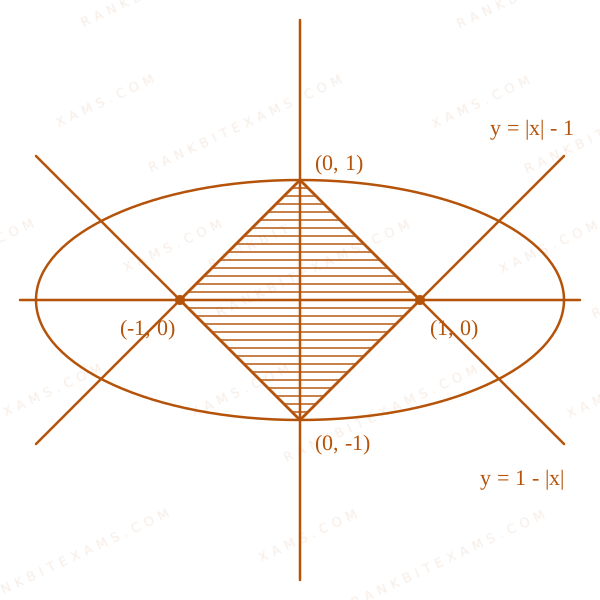
The area of the region, inside the ellipse x^2 + 4y^2 = 4$x^{2} + 4y^{2} = 4$ and outside the region bounded by the curves y = |x| - 1$y = |x| - 1$ and y = 1 - |x|$y = 1 - |x|$ , is:
A.2(pi - 1)$2(\pi - 1)$
B.2pi - frac12$2\pi - \frac{1}{2}$
C.3(pi - 1)$3(\pi - 1)$
D.2pi - 1$2\pi - 1$
Solution
### Related Formula
Area of an ellipse fracx^2a^2 + fracy^2b^2 = 1$\frac{x^2}{a^2} + \frac{y^2}{b^2} = 1$ is given by:
textArea = pi a b$$\text{Area} = \pi a b$$
Area of a rhombus bounded by |x| + |y| = a$|x| + |y| = a$ is 2a^2$2a^2$.
### Core Logic
The given curves form a bounded geometric area.
Ellipse: x^2 + 4y^2 = 4 Rightarrow fracx^24 + fracy^21 = 1$x^2 + 4y^2 = 4 \Rightarrow \frac{x^2}{4} + \frac{y^2}{1} = 1$.
Here, a = 2$a = 2$, b = 1$b = 1$.
The region to be excluded is bounded by y = |x| - 1$y = |x| - 1$ and y = 1 - |x|$y = 1 - |x|$, which rearranges to |x| + |y| = 1$|x| + |y| = 1$. This forms a square/rhombus centered at the origin with vertices at (1, 0), (0, 1), (-1, 0), (0, -1)$(1, 0), (0, 1), (-1, 0), (0, -1)$.
### Step 1: Calculate Total and Excluded Areas
Total Area of the Ellipse:
textArea = pi (2)(1) = 2pi$$\text{Area} = \pi (2)(1) = 2\pi$$
Excluded Area (Rhombus |x| + |y| = 1$|x| + |y| = 1$):
The rhombus consists of 4 identical right-angled triangles in each quadrant.
Area of one triangle = frac12 times textbase times textheight = frac12 times 1 times 1 = frac12$\frac{1}{2} \times \text{base} \times \text{height} = \frac{1}{2} \times 1 \times 1 = \frac{1}{2}$.
Total excluded area = 4 times frac12 = 2$4 \times \frac{1}{2} = 2$.
### Step 2: Calculate Required Area
Ellipse and Modulus area diagram for Q2 - JEE Main 2026 Morning
Required Area = Area of ellipse -$-$ Shaded Area
= 2pi - 2$= 2\pi - 2$= 2(pi - 1)$= 2(\pi - 1)$
### Pattern Recognition
Transform absolute value equations y = pm(|x| - a)$y = \pm(|x| - a)$ into |x| + |y| = a$|x| + |y| = a$ to instantly recognize a standard rhombus, allowing direct geometry formulas instead of integration.
### Evaluation Rubric / Model Answer
null
### Chapter Mix
Class 12 Maths: Area Under Curves
Class 11 Maths: Conic Sections
Q11jee_main_2026_21_jan_eveningArea Under Curve
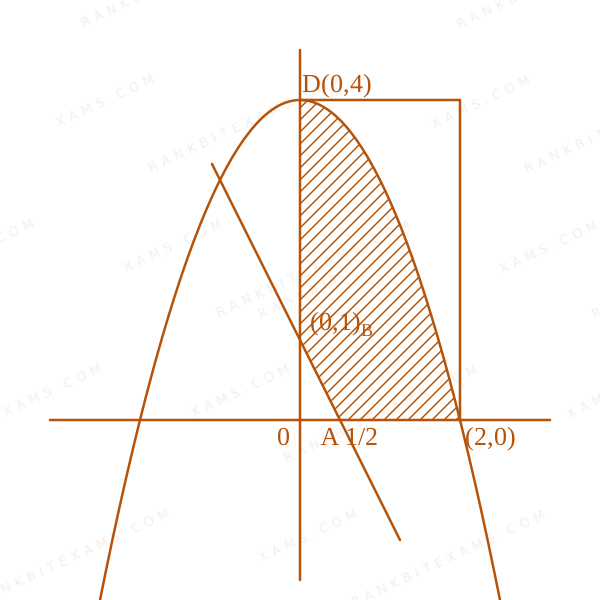
If the area of the region\(x, y) : 1 - 2x leq y leq 4 - x^2, x geq 0, y geq 0\$\{(x, y) : 1 - 2x \leq y \leq 4 - x^{2}, x \geq 0, y \geq 0\}$ is fracalphabeta, alpha, beta, in N, gcd(alpha, beta) = 1$\frac{\alpha}{\beta}, \alpha, \beta, \in N, \gcd(\alpha, \beta) = 1$, then the value of (alpha + beta)$(\alpha + \beta)$ is :
A.73$73$
B.85$85$
C.91$91$
D.67$67$
Solution
### Related Formula
textArea = int_x_1^x_2 (f(x) - g(x)) dx$$\text{Area} = \int_{x_1}^{x_2} (f(x) - g(x)) dx$$textArea of Parabola piece: int_0^2 (4-x^2) dx$$\text{Area of Parabola piece: } \int_{0}^{2} (4-x^2) dx$$
### Core Logic
Area under curve diagram for Q11 - JEE Main 2026 Evening
The region is bounded above by y = 4 - x^2$y = 4 - x^2$, below by y = 1 - 2x$y = 1 - 2x$, and constrained to x geq 0, y geq 0$x \geq 0, y \geq 0$.
The parabola intersects the x-axis at x=2$x=2$ (since 4-x^2=0, xgeq 0$4-x^2=0, x\geq 0$).
The line intersects the x-axis at x=frac12$x=\frac{1}{2}$ (since 1-2x=0$1-2x=0$) and y-axis at y=1$y=1$.
The required area is the area under the parabola in the first quadrant minus the small triangular region bounded by y = 1-2x, x=0, y=0$y = 1-2x, x=0, y=0$.
### Step 1: Calculate the Area
textTotal area under parabola in 1st quadrant = int_0^2 (4 - x^2) dx = left[ 4x - fracx^33 right]_0^2 = 8 - frac83 = frac163$$\text{Total area under parabola in 1st quadrant} = \int_0^2 (4 - x^2) dx = \left[ 4x - \frac{x^3}{3} \right]_0^2 = 8 - \frac{8}{3} = \frac{16}{3}$$
Area of the small right triangle formed by the line y=1-2x$y=1-2x$ in the first quadrant:
Vertices are (0,0), (1/2,0), (0,1)$(0,0), (1/2,0), (0,1)$.
textArea of triangle = frac12 times textbase times textheight = frac12 times frac12 times 1 = frac14$$\text{Area of triangle} = \frac{1}{2} \times \text{base} \times \text{height} = \frac{1}{2} \times \frac{1}{2} \times 1 = \frac{1}{4}$$
### Step 2: Subtraction and Format Match
textRequired Area = frac163 - frac14 = frac64 - 312 = frac6112$$\text{Required Area} = \frac{16}{3} - \frac{1}{4} = \frac{64 - 3}{12} = \frac{61}{12}$$
Here, alpha = 61, beta = 12$\alpha = 61, \beta = 12$.
Check gcd(61, 12) = 1$\gcd(61, 12) = 1$. This matches.
So, alpha + beta = 61 + 12 = 73$\alpha + \beta = 61 + 12 = 73$.
### Pattern Recognition
For areas defined by y geq g(x)$y \geq g(x)$ when g(x)$g(x)$ forms a simple geometric shape (like a line), subtract the geometric area directly rather than splitting the integral algebraically. It eliminates integration errors.
### Evaluation Rubric / Model Answer
null
### Chapter Mix
Class 12 Maths: Application of Integrals
Q3jee_main_2026_22_january_morningArea Between Two Curves
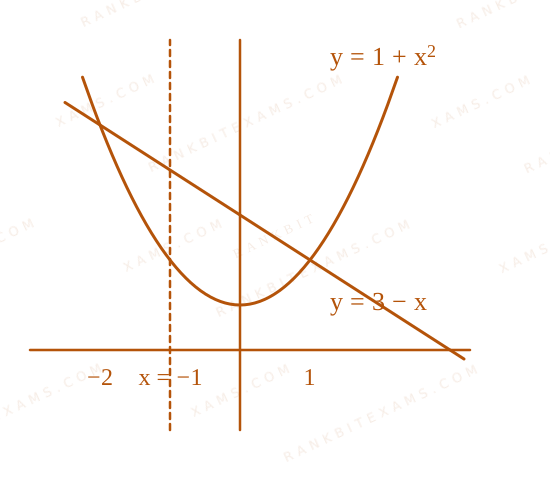
Let the line x = -1$x = -1$divide the area of the regionleft\(x,y):1+x^2leq yleq3-xright\$\left\{(x,y):1+x^{2}\leq y\leq3-x\right\}$ in the ratio m:n$m:n$, gcd (m,n)=1$(m,n)=1$. Then m+n$m+n$ is equal to
A.25$25$
B.28$28$
C.26$26$
D.27$27$
Solution
### Related Formula
textArea = int_a^b (y_textupper - y_textlower) \,dx$$\text{Area} = \int_{a}^{b} (y_{\text{upper}} - y_{\text{lower}}) \,dx$$
### Core Logic
First, find the points of intersection for the curves y = 1 + x^2$y = 1 + x^2$ and y = 3 - x$y = 3 - x$:
1 + x^2 = 3 - x$1 + x^2 = 3 - x$x^2 + x - 2 = 0$x^2 + x - 2 = 0$(x + 2)(x - 1) = 0 implies x = -2, x = 1$$(x + 2)(x - 1) = 0 \implies x = -2, x = 1$$
So the total region is bounded between x = -2$x = -2$ and x = 1$x = 1$. The line x = -1$x = -1$ divides this region into two parts.
Area Between Two Curves diagram for Q3 - JEE Main 2026 Morning
### Step 1: Setting up the Areas
Let the area to the left of x = -1$x = -1$ be proportional to m$m$ and the area to the right be proportional to n$n$.
A_m = int_-2^-1 [(3 - x) - (1 + x^2)] \,dx$$A_m = \int_{-2}^{-1} [(3 - x) - (1 + x^2)] \,dx$$A_n = int_-1^1 [(3 - x) - (1 + x^2)] \,dx$$A_n = \int_{-1}^{1} [(3 - x) - (1 + x^2)] \,dx$$
The integrand simplifies to 2 - x - x^2$2 - x - x^2$.
Area Between Two Curves diagram for Q3 - JEE Main 2026 Morning
### Step 2: Integration
int (2 - x - x^2) \,dx = 2x - fracx^22 - fracx^33$$\int (2 - x - x^2) \,dx = 2x - \frac{x^2}{2} - \frac{x^3}{3}$$
Evaluate A_m$A_m$:
A_m = left[2x - fracx^22 - fracx^33right]_-2^-1$$A_m = \left[2x - \frac{x^2}{2} - \frac{x^3}{3}\right]_{-2}^{-1}$$A_m = left(-2 - frac12 + frac13right) - left(-4 - 2 + frac83right) = left(-frac136right) - left(-frac103right) = frac76$$A_m = \left(-2 - \frac{1}{2} + \frac{1}{3}\right) - \left(-4 - 2 + \frac{8}{3}\right) = \left(-\frac{13}{6}\right) - \left(-\frac{10}{3}\right) = \frac{7}{6}$$
Evaluate A_n$A_n$:
A_n = left[2x - fracx^22 - fracx^33right]_-1^1$$A_n = \left[2x - \frac{x^2}{2} - \frac{x^3}{3}\right]_{-1}^{1}$$A_n = left(2 - frac12 - frac13right) - left(-2 - frac12 + frac13right) = left(frac76right) - left(-frac136right) = frac206$$A_n = \left(2 - \frac{1}{2} - \frac{1}{3}\right) - \left(-2 - \frac{1}{2} + \frac{1}{3}\right) = \left(\frac{7}{6}\right) - \left(-\frac{13}{6}\right) = \frac{20}{6}$$
### Step 3: Finding the Ratio
The ratio of the areas m:n$m:n$ is:
fracmn = fracA_nA_m text or fracA_mA_n$$\frac{m}{n} = \frac{A_n}{A_m} \text{ or } \frac{A_m}{A_n}$$
Wait, the solution designates fracmn = fracint_-1^1int_-2^-1 = frac20/67/6 = frac207$\frac{m}{n} = \frac{\int_{-1}^{1}}{\int_{-2}^{-1}} = \frac{20/6}{7/6} = \frac{20}{7}$. (Since gcd(20,7)=1$\gcd(20,7)=1$, m=20$m=20$ and n=7$n=7$).
Therefore, m+n = 20 + 7 = 27$m+n = 20 + 7 = 27$.
### Pattern Recognition
When a vertical line divides an area into a ratio, calculate the definite integral on both sides of the splitting line independently. Keep fractions with a common denominator until the final ratio step.
### Evaluation Rubric / Model Answer
null
### Chapter Mix
Class 12 Maths: Applications of Integrals
Q12jee_main_2026_23_january_eveningArea Between Two Curves
We Map Every Repeating Question in Competitive Exams.
Say goodbye to generic mock test fatigue. RankBit uses smart analysis to group past exam questions into their foundational Repeating Question Types. Find chapter weightage, track repeating questions, and score higher with targeted practice.
Select Your Target Exam
Choose an exam track below to find formulas per chapter and patterns.
Syncing Exam Intelligence
Mapping formulas and patterns across all tracks…
PATH A — FULL LENGTH PRACTICE
Full Mock Test Hub
Simulate real NTA exam conditions with fully tracked mocks. Time yourself against past papers.
Practice past-year questions one chapter at a time. Pick an exam → subject → chapter and get every PYQ for that topic — pulled together from all past papers — with the chapter's key formulas alongside.