The area (in sq. units) of the part of circle x²+y²=169$x^2+y^2=169$ which is below the line 5x-y=13$5x-y=13$ is (πα)/(2β)-(65)/(2)+(α)/(β) ⁻¹((12)/(13))$\frac{\pi\alpha}{2\beta}-\frac{65}{2}+\frac{\alpha}{\beta}\sin^{-1}(\frac{12}{13})$ where α,β$\alpha,\beta$ are coprime numbers. Then α+β$\alpha+\beta$ is equal to
Numerical Answer Type:
Enter a numerical valueAnswer: 171 to 171+4 marks
Solution & Explanation
Related Formula
Standard Integral: ∫ √(a²-y²) dy = (y)/(2)√(a²-y²) + (a²)/(2) ⁻¹((y)/(a)) + C$$\text{Standard Integral: } \int \sqrt{a^2-y^2} dy = \frac{y}{2}\sqrt{a^2-y^2} + \frac{a^2}{2}\sin^{-1}\left(\frac{y}{a}\right) + C$$Area of right triangle = (1)/(2) × base × height$$\text{Area of right triangle } = \frac{1}{2} \times \text{base} \times \text{height}$$
Core Logic
First, find the points of intersection between the circle x²+y²=169$x^2+y^2=169$ and the line 5x-y=13 ⇒ y = 5x-13$5x-y=13 \Rightarrow y = 5x-13$.
Substitute y$y$ into the circle equation:
The solutions are x=0$x=0$ and x=5$x=5$.
When x=0, y=-13$x=0, y=-13$. Point is (0, -13)$(0, -13)$.
When x=5, y=12$x=5, y=12$. Point is (5, 12)$(5, 12)$.
The required area is bounded below the line x = (y+13)/(5)$x = \frac{y+13}{5}$ and above the right-hand boundary of the circle x = √(169-y²)$x = \sqrt{169-y^2}$ across the y-axis boundaries [-13, 12]$[-13, 12]$.
Area Under Curves
Step 1: Setup Area Integral
Integrate with respect to y$y$ (from left to right curves, bounded horizontally):
Split the integral into two parts:
Part A (Circle): ∫₋₁₃¹² √(169-y²) dy$\int_{-13}^{12} \sqrt{169-y^2} dy$
Part B (Line): ∫₋₁₃¹² (y+13)/(5) dy$\int_{-13}^{12} \frac{y+13}{5} dy$
Comparing this exactly with the given format (πα)/(2β) - (65)/(2) + (α)/(β) ⁻¹((12)/(13))$\frac{\pi\alpha}{2\beta} - \frac{65}{2} + \frac{\alpha}{\beta}\sin^{-1}(\frac{12}{13})$:
We see that (α)/(β) = (169)/(2)$\frac{\alpha}{\beta} = \frac{169}{2}$.
Since 169 and 2 are coprime, α = 169$\alpha = 169$ and β = 2$\beta = 2$.
When evaluating line integrals forming a triangle with horizontal bounds, bypass algebraic integration and visually calculate (1)/(2) · b · h$\frac{1}{2} \cdot b \cdot h$. Here, base=25 along y-axis, height=5 along x-axis, area = 125/2$125/2$. Instantly saves integration time.
Chapter Mix
Class 12 Mathematics: Application of Integrals
Class 11 Mathematics: Straight Lines
Keywords:#area of the part of circle#JEE Main 2024 Morning Q28#Application of Integrals JEE Main 2024#Area Under Curves JEE Main 2024
More Application of Integrals Previous-Year Questions
Q2jee_main_2026_21_jan_morningArea Bounded by Ellipse and Modulus Functions
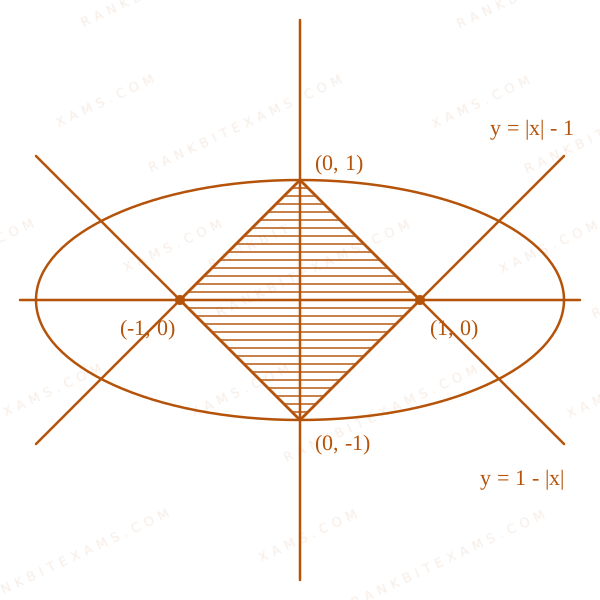
The area of the region, inside the ellipse x² + 4y² = 4$x^{2} + 4y^{2} = 4$ and outside the region bounded by the curves y = |x| - 1$y = |x| - 1$ and y = 1 - |x|$y = 1 - |x|$ , is:
A.2(π - 1)$2(\pi - 1)$
B.2π - (1)/(2)$2\pi - \frac{1}{2}$
C.3(π - 1)$3(\pi - 1)$
D.2π - 1$2\pi - 1$
Solution
Related Formula
Area of an ellipse (x²)/(a²) + (y²)/(b²) = 1$\frac{x^2}{a^2} + \frac{y^2}{b^2} = 1$ is given by:
Area = π a b$$\text{Area} = \pi a b$$
Area of a rhombus bounded by |x| + |y| = a$|x| + |y| = a$ is 2a²$2a^2$.
Core Logic
The given curves form a bounded geometric area.
Ellipse: x² + 4y² = 4 ⇒ (x²)/(4) + (y²)/(1) = 1$x^2 + 4y^2 = 4 \Rightarrow \frac{x^2}{4} + \frac{y^2}{1} = 1$.
Here, a = 2$a = 2$, b = 1$b = 1$.
The region to be excluded is bounded by y = |x| - 1$y = |x| - 1$ and y = 1 - |x|$y = 1 - |x|$, which rearranges to |x| + |y| = 1$|x| + |y| = 1$. This forms a square/rhombus centered at the origin with vertices at (1, 0), (0, 1), (-1, 0), (0, -1)$(1, 0), (0, 1), (-1, 0), (0, -1)$.
Excluded Area (Rhombus |x| + |y| = 1$|x| + |y| = 1$):
The rhombus consists of 4 identical right-angled triangles in each quadrant.
Area of one triangle = (1)/(2) × base × height = (1)/(2) × 1 × 1 = (1)/(2)$\frac{1}{2} \times \text{base} \times \text{height} = \frac{1}{2} \times 1 \times 1 = \frac{1}{2}$.
Total excluded area = 4 × (1)/(2) = 2$4 \times \frac{1}{2} = 2$.
Step 2: Calculate Required Area
Ellipse and Modulus area diagram for Q2 - JEE Main 2026 Morning
Required Area = Area of ellipse -$-$ Shaded Area
= 2π - 2$= 2\pi - 2$= 2(π - 1)$= 2(\pi - 1)$
Pattern Recognition
Transform absolute value equations y = ±(|x| - a)$y = \pm(|x| - a)$ into |x| + |y| = a$|x| + |y| = a$ to instantly recognize a standard rhombus, allowing direct geometry formulas instead of integration.
Chapter Mix
Class 12 Maths: Area Under Curves
Class 11 Maths: Conic Sections
Q11jee_main_2026_21_jan_eveningArea Under Curve
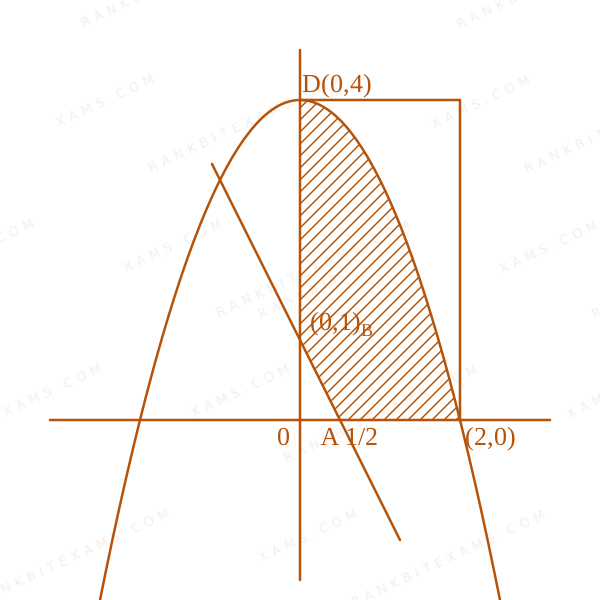
If the area of the region(x, y) : 1 - 2x ≤ y ≤ 4 - x², x ≥ 0, y ≥ 0$\{(x, y) : 1 - 2x \leq y \leq 4 - x^{2}, x \geq 0, y \geq 0\}$ is (α)/(β), α, β, in N, (α, β) = 1$\frac{\alpha}{\beta}, \alpha, \beta, \in N, \gcd(\alpha, \beta) = 1$, then the value of (α + β)$(\alpha + \beta)$ is :
A.73$73$
B.85$85$
C.91$91$
D.67$67$
Solution
Related Formula
Area = ∫x₁x₂ (f(x) - g(x)) dx$$\text{Area} = \int_{x_1}^{x_2} (f(x) - g(x)) dx$$Area of Parabola piece: ∫₀² (4-x²) dx$$\text{Area of Parabola piece: } \int_{0}^{2} (4-x^2) dx$$
Core Logic
Area under curve diagram for Q11 - JEE Main 2026 Evening
The region is bounded above by y = 4 - x²$y = 4 - x^2$, below by y = 1 - 2x$y = 1 - 2x$, and constrained to x ≥ 0, y ≥ 0$x \geq 0, y \geq 0$.
The parabola intersects the x-axis at x=2$x=2$ (since 4-x²=0, x≥ 0$4-x^2=0, x\geq 0$).
The line intersects the x-axis at x=(1)/(2)$x=\frac{1}{2}$ (since 1-2x=0$1-2x=0$) and y-axis at y=1$y=1$.
The required area is the area under the parabola in the first quadrant minus the small triangular region bounded by y = 1-2x, x=0, y=0$y = 1-2x, x=0, y=0$.
Step 1: Calculate the Area
Total area under parabola in 1st quadrant = ∫₀² (4 - x²) dx = [ 4x - (x³)/(3) ]₀² = 8 - (8)/(3) = (16)/(3)$$\text{Total area under parabola in 1st quadrant} = \int_0^2 (4 - x^2) dx = \left[ 4x - \frac{x^3}{3} \right]_0^2 = 8 - \frac{8}{3} = \frac{16}{3}$$
Area of the small right triangle formed by the line y=1-2x$y=1-2x$ in the first quadrant:
Vertices are (0,0), (1/2,0), (0,1)$(0,0), (1/2,0), (0,1)$.
Area of triangle = (1)/(2) × base × height = (1)/(2) × (1)/(2) × 1 = (1)/(4)$$\text{Area of triangle} = \frac{1}{2} \times \text{base} \times \text{height} = \frac{1}{2} \times \frac{1}{2} \times 1 = \frac{1}{4}$$
For areas defined by y ≥ g(x)$y \geq g(x)$ when g(x)$g(x)$ forms a simple geometric shape (like a line), subtract the geometric area directly rather than splitting the integral algebraically. It eliminates integration errors.
Chapter Mix
Class 12 Maths: Application of Integrals
Q3jee_main_2026_22_january_morningArea Between Two Curves
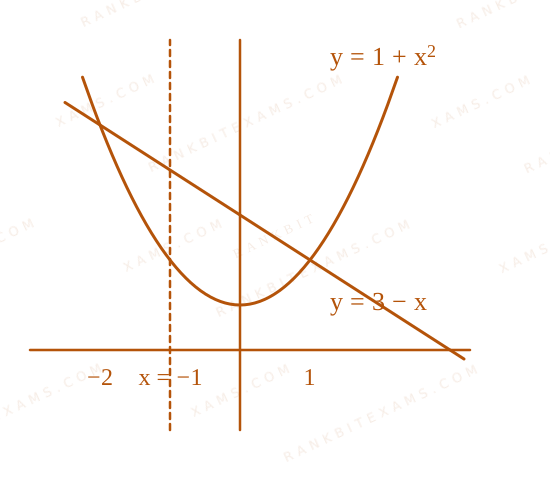
Let the line x = -1$x = -1$divide the area of the region(x,y):1+x²≤ y≤3-x$\left\{(x,y):1+x^{2}\leq y\leq3-x\right\}$ in the ratio m:n$m:n$, gcd (m,n)=1$(m,n)=1$. Then m+n$m+n$ is equal to
When a vertical line divides an area into a ratio, calculate the definite integral on both sides of the splitting line independently. Keep fractions with a common denominator until the final ratio step.
Chapter Mix
Class 12 Maths: Applications of Integrals
Q22jee_main_2026_23_january_morningArea Under the Curve
Let the area of the region bounded by the curve y = x, x$y = \max \{\sin x, \cos x\}$, lines x = 0, x = (3π)/(2)$x = 0, x = \frac{3\pi}{2}$, and the x$x$-axis be A$A$. Then, A + A²$A + A^2$ is equal to _____.
Numerical Answer.Answer: 12 to 12
Solution
Core Logic
To evaluate the area under y = x, x$y = \max \{\sin x, \cos x\}$, we must identify where one function is greater than the other in [0, (3π)/(2)]$[0, \frac{3\pi}{2}]$.
Area Under the Curve diagram for Q22 - JEE Main 2026 Morning
From 0$0$ to (π)/(4)$\frac{\pi}{4}$: x > x ⇒ y = x$\cos x > \sin x \Rightarrow y = \cos x$
From (π)/(4)$\frac{\pi}{4}$ to (5π)/(4)$\frac{5\pi}{4}$: x > x ⇒ y = x$\sin x > \cos x \Rightarrow y = \sin x$
From (5π)/(4)$\frac{5\pi}{4}$ to (3π)/(2)$\frac{3\pi}{2}$: x > x ⇒ y = x$\cos x > \sin x \Rightarrow y = \cos x$
Step 1: Formulate the Area Integral
Since area is bounded by the x-axis, we must take the absolute value if the function goes below the axis.
Wait, the function x$\sin x$ is negative from π$\pi$ to (5π)/(4)$\frac{5\pi}{4}$, and x$\cos x$ is negative from (5π)/(4)$\frac{5\pi}{4}$ to (3π)/(2)$\frac{3\pi}{2}$.
Let's integrate carefully:
A = ∫₀π/4 x dx + ∫π/4π x dx + ∫π5π/4 | x| dx + ∫5π/43π/2 | x| dx$$A = \int_0^{\pi/4} \cos x \, dx + \int_{\pi/4}^{\pi} \sin x \, dx + \int_{\pi}^{5\pi/4} |\sin x| \, dx + \int_{5\pi/4}^{3\pi/2} |\cos x| \, dx$$
Because area is geometric, absolute values are explicitly integrated:
A = ∫₀π/4 x dx + ∫π/4π x dx + ∫π5π/4 (- x) dx + ∫5π/43π/2 (- x) dx$$A = \int_0^{\pi/4} \cos x \, dx + \int_{\pi/4}^{\pi} \sin x \, dx + \int_{\pi}^{5\pi/4} (-\sin x) \, dx + \int_{5\pi/4}^{3\pi/2} (-\cos x) \, dx$$
The expression ( x, x)$\max(\sin x, \cos x)$ always splits segments exactly at nπ + π/4$n\pi + \pi/4$. When bounded by the x-axis, parts below y=0$y=0$ explicitly require negation. Charting the piecewise transitions is non-negotiable.
Chapter Mix
Class 12 Maths: Application of Integrals
Q12jee_main_2026_23_january_eveningArea Between Two Curves
Area Between Two Curves diagram for Q12 - JEE Main 2026 Evening
The intersection points of x² + y² = 4$x^2 + y^2 = 4$ and x² + (y-2)² = 4$x^2 + (y-2)^2 = 4$:
Subtracting the equations gives y² - (y-2)² = 0 y² - (y² - 4y + 4) = 0 4y = 4 y = 1$y^2 - (y-2)^2 = 0 \implies y^2 - (y^2 - 4y + 4) = 0 \implies 4y = 4 \implies y = 1$.
Substitute y=1$y=1$ back: x² + 1 = 4 x = ± √(3)$x^2 + 1 = 4 \implies x = \pm \sqrt{3}$.
The points of intersection are (√(3), 1)$(\sqrt{3}, 1)$ and (-√(3), 1)$(-\sqrt{3}, 1)$.
The area is symmetric about the y-axis, so we integrate from x = 0$x = 0$ to x = √(3)$x = \sqrt{3}$ and double the result.
Upper curve is the lower arc of the top circle: y = 2 - √(4-x²)$y = 2 - \sqrt{4-x^2}$ -- wait, the area is bounded by the top arc of the bottom circle and the bottom arc of the top circle.
Upper curve for area: y = √(4-x²)$y = \sqrt{4-x^2}$ (from x²+y²=4$x^2+y^2=4$)
Lower curve for area: y = 2 - √(4-x²)$y = 2 - \sqrt{4-x^2}$ (from x²+(y-2)²=4$x^2+(y-2)^2=4$)
For intersecting identical circles with centres on an axis, symmetry simplifies the integration drastically. Recognize that integrating the circle arc function handles the bulk of the calculation.
Chapter Mix
Class 12 Maths: Area Under Curves
More Application of Integrals Questions — jee_main_2024_29_jan_morning
Practice past-year questions one chapter at a time. Pick an exam → subject → chapter and get every PYQ for that topic — pulled together from all past papers — with the chapter's key formulas alongside.