A prism of angle 75°$75^{\circ}$ and refractive index √(3)$\sqrt{3}$ is coated with thin film of refractive index 1.5 only at the back exit surface. To have total internal reflection at the back exit surface the incident angle must be ____. (15° = 0.25$\sin 15^{\circ} = 0.25$ and 25° = 0.43$\sin 25^{\circ} = 0.43$)
[✓] A.between 15° and 20°$\text{between } 15^{\circ} \text{ and } 20^{\circ}$
[✓] B.15°$15^{\circ}$
[ ] C.> 25°$> 25^{\circ}$
[✓] D.< 15°$< 15^{\circ}$
Note: 3 options are correct — select all for full marks.
Solution & Explanation
Related Formula
r₁ + r₂ = A$r_1 + r_2 = A$
Snell's Law: μ₁ i = μ₂ r$\mu_1 \sin i = \mu_2 \sin r$
Condition for TIR: θ > θC$\theta > \theta_C$, where θC = μᵣₐᵣₑᵣμdenser$\sin \theta_C = \frac{\mu_{\text{rarer}}}{\mu_{\text{denser}}}$
Core Logic
Prism and Total Internal Reflection diagram for Q40 - JEE Main 2026 Evening
Given prism angle A = 75°$A = 75^{\circ}$.
For TIR at the back surface, light travels from prism (μ = √(3)$\mu = \sqrt{3}$) to film (μ = 1.5$\mu = 1.5$).
r₁ + r₂ = 75°$$r_1 + r_2 = 75^{\circ}$$
Step 1: Critical Angle for TIR
Applying Snell's Law for critical angle at the back surface:
We know 25° = 0.43$\sin 25^{\circ} = 0.43$. Thus 0.433$0.433$ is roughly 25°$\sin 25^{\circ}$.
So i ≤ 25°$i \le 25^{\circ}$ is required. Any angle less than 25°$25^{\circ}$ ensures r₁ ≤ 15°$r_1 \le 15^{\circ}$ and thus r₂ ≥ 60°$r_2 \ge 60^{\circ}$.
Step 4: Analyze Options
Any angle i < 25°$i < 25^{\circ}$ guarantees TIR.
Option (1): between 15°$15^{\circ}$ and 20°$20^{\circ}$ (Valid)
Option (2): 15°$15^{\circ}$ (Valid)
Option (4): < 15°$< 15^{\circ}$ (Valid)
Since this is an MCQ frame inherently reflecting all suitable subsets, (1), (2), and (4) are all physically sufficient.
Pattern Recognition
In prism TIR problems, trace backward from the critical surface constraint. Maximum r₂$r_2$ means minimum r₁$r_1$, which dictates maximum i$i$. If imax = 25°$i_{\text{max}} = 25^{\circ}$, any choice strictly bounded below 25°$25^{\circ}$ is physically correct.
Chapter Mix
Class 12 Physics: Ray Optics and Optical Instruments
Keywords:#thin film of refractive index#total internal reflection at the back#JEE Main 2026 Evening Q40#Ray Optics and Optical Instruments JEE Main 2026
More Ray Optics and Optical Instruments Previous-Year Questions — Page 9
Qjee_main_2025_04_april_morningSpherical Mirrors
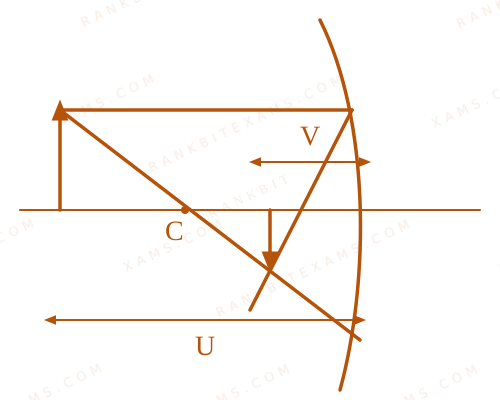
Distance between object and its image (magnified by -(1)/(3)$-\frac{1}{3}$) is 30 cm$30\text{ cm}$. The focal length of the mirror used is ((x)/(4)) cm$\left(\frac{x}{4}\right)\text{ cm}$, where magnitude of value of x$x$ is
Matching this with the prompt pattern form (x)/(4)$\frac{x}{4}$ yields:
x = 45$x = 45$
Pattern Recognition
Real inverted diminished images (|m| < 1$|m| < 1$) mean the image forms closer to the mirror surface than the object, situated between the focal center F$F$ and center of curvature C$C$.
Chapter Mix
Class 12 Physics: Ray Optics and Optical Instruments
Q9jee_main_2025_07_april_eveningSpherical Mirrors
A mirror is used to produce an image with magnification of (1)/(4)$\frac{1}{4}$
If the distance between object and its image is 40 cm, then the focal length of the mirror is [cite: 113, 114, 116]
Rounding to the matching options choice gives 10.7 cm$10.7\ \text{cm}$[cite: 118, 712].
Pattern Recognition
Pay attention to sign conventions in mirror systems. A smaller real image formed by a concave mirror sits between the focus and center of curvature, resulting in u > v$u > v$ configurations.
Chapter Mix
Class 12 Physics: Ray Optics and Optical Instruments
Q14jee_main_2025_07_april_eveningRefractive Index
Given below are two statements: one is labelled as Assertion (A) and the other is labelled as Reason (R).
Assertion (A) : Refractive index of glass is higher than that of air. [cite: 130]
Reason (R): Optical density of a medium is directly proportionate to its mass density which results in a proportionate refractive index. [cite: 131]
In the light of the above statements, choose the most appropriate answer from the options given below: [cite: 132]
A. (A) is not correct but (R) is correct [cite: 133]
B. Both (A) and (R) are correct and (R) is the correct explanation of (A) [cite: 134]
C. (A) is correct but (R) is not correct [cite: 135]
D. Both (A) and (R) are correct but (R) is not the correct explanation of (A) [cite: 136]
Solution
Core Logic
Refractive index represents the ratio of the speed of light in vacuum to its speed in a given medium[cite: 719]. Glass slows light down more than air does, hence μglass ≈ 1.5 > μₐᵢᵣ ≈ 1.0$\mu_{\text{glass}} \approx 1.5 > \mu_{\text{air}} \approx 1.0$, which makes Assertion (A) correct[cite: 130]. However, optical density is defined by a medium's capacity to refract light and is completely conceptually distinct from inertial mass density (mass per unit volume)[cite: 719]. For example, turpentine has a lower mass density than water but possesses a higher optical density and refractive index. Therefore, Reason (R) is fundamentally incorrect[cite: 722].
Pattern Recognition
Optical density vs mass density is a signature conceptual trick in refraction theory[cite: 719]. They share the word 'density' but have entirely different physical meanings and no fixed mathematical proportionality[cite: 719, 722].
Chapter Mix
Class 12 Physics: Ray Optics and Optical Instruments
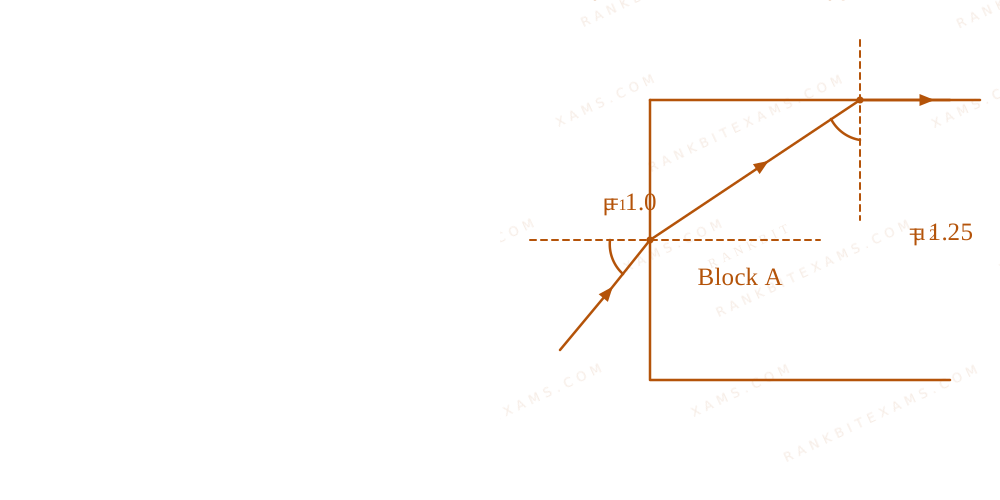
A transparent block A having refractive index μ=1.25$\mu=1.25$ is surrounded by another medium of refractive index μ=1.0$\mu=1.0$ as shown in figure. A light ray is incident on the flat face of the block with incident angle θ$\theta$ as shown in figure. What is the maximum value of θ$\theta$ for which light suffers total internal reflection at the top surface of the block?
The diagram displays a light ray entering a rectangular block from a medium of lower refractive index, hitting the top wall at the critical boundary angle. [cite: 169, 170, 171]
Maximum angle at the entry face ensures minimum angle of incidence at the subsequent wall[cite: 806, 807]. Setting that exact internal angle equal to the critical threshold condition values solves for the operational scanning range edge directly[cite: 808].
Chapter Mix
Class 12 Physics: Ray Optics and Optical Instruments
Q14jee_main_2025_24_jan_eveningLenses and Magnification
A photograph of a landscape is captured by a drone camera at a height of 18 km. The size of the camera film is 2 cm × 2 cm$2 \, cm \times 2 \, cm$ and the area of the landscape photographed is 400 km²$400 \, km^2$ . The focal length of the lens in the drone camera is:
For aerial satellite imaging contexts where u gg f$u \gg f$, linear sizing scales directly as film sideground side = (f)/(H)$\frac{\text{film side}}{\text{ground side}} = \frac{f}{H}$.
Chapter Mix
Class 12 Physics: Ray Optics and Optical Instruments
More Ray Optics and Optical Instruments Questions — jee_main_2026_23_january_evening
Practice past-year questions one chapter at a time. Pick an exam → subject → chapter and get every PYQ for that topic — pulled together from all past papers — with the chapter's key formulas alongside.