A prism of angle 75°$75^{\circ}$ and refractive index √(3)$\sqrt{3}$ is coated with thin film of refractive index 1.5 only at the back exit surface. To have total internal reflection at the back exit surface the incident angle must be ____. (15° = 0.25$\sin 15^{\circ} = 0.25$ and 25° = 0.43$\sin 25^{\circ} = 0.43$)
[✓] A.between 15° and 20°$\text{between } 15^{\circ} \text{ and } 20^{\circ}$
[✓] B.15°$15^{\circ}$
[ ] C.> 25°$> 25^{\circ}$
[✓] D.< 15°$< 15^{\circ}$
Note: 3 options are correct — select all for full marks.
Solution & Explanation
Related Formula
r₁ + r₂ = A$r_1 + r_2 = A$
Snell's Law: μ₁ i = μ₂ r$\mu_1 \sin i = \mu_2 \sin r$
Condition for TIR: θ > θC$\theta > \theta_C$, where θC = μᵣₐᵣₑᵣμdenser$\sin \theta_C = \frac{\mu_{\text{rarer}}}{\mu_{\text{denser}}}$
Core Logic
Prism and Total Internal Reflection diagram for Q40 - JEE Main 2026 Evening
Given prism angle A = 75°$A = 75^{\circ}$.
For TIR at the back surface, light travels from prism (μ = √(3)$\mu = \sqrt{3}$) to film (μ = 1.5$\mu = 1.5$).
r₁ + r₂ = 75°$$r_1 + r_2 = 75^{\circ}$$
Step 1: Critical Angle for TIR
Applying Snell's Law for critical angle at the back surface:
We know 25° = 0.43$\sin 25^{\circ} = 0.43$. Thus 0.433$0.433$ is roughly 25°$\sin 25^{\circ}$.
So i ≤ 25°$i \le 25^{\circ}$ is required. Any angle less than 25°$25^{\circ}$ ensures r₁ ≤ 15°$r_1 \le 15^{\circ}$ and thus r₂ ≥ 60°$r_2 \ge 60^{\circ}$.
Step 4: Analyze Options
Any angle i < 25°$i < 25^{\circ}$ guarantees TIR.
Option (1): between 15°$15^{\circ}$ and 20°$20^{\circ}$ (Valid)
Option (2): 15°$15^{\circ}$ (Valid)
Option (4): < 15°$< 15^{\circ}$ (Valid)
Since this is an MCQ frame inherently reflecting all suitable subsets, (1), (2), and (4) are all physically sufficient.
Pattern Recognition
In prism TIR problems, trace backward from the critical surface constraint. Maximum r₂$r_2$ means minimum r₁$r_1$, which dictates maximum i$i$. If imax = 25°$i_{\text{max}} = 25^{\circ}$, any choice strictly bounded below 25°$25^{\circ}$ is physically correct.
Chapter Mix
Class 12 Physics: Ray Optics and Optical Instruments
Keywords:#thin film of refractive index#total internal reflection at the back#JEE Main 2026 Evening Q40#Ray Optics and Optical Instruments JEE Main 2026
More Ray Optics and Optical Instruments Previous-Year Questions — Page 4
Q36jee_main_2026_28_january_morningLens Maker's Formula
The magnitudes of power of a biconvex lens (refractive index 1.5) and that of a plano-concave lens (refractive index = 1.7) are same. If the curvature of plano-concave lens exactly matches with the curvature of back surface of the biconvex lens, then ratio of radius of curvature of front and back surface of the biconvex lens is ____.
Equate the magnitudes of the power of the two lenses using the Lens Maker's formula.
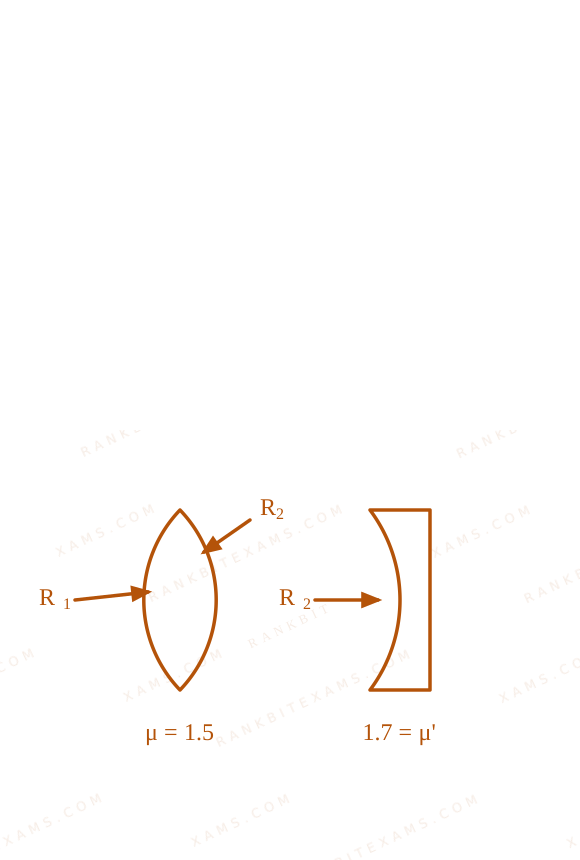
Lens geometry diagram
Step 1: Power of Biconvex Lens
For a biconvex lens (μ = 1.5$\mu = 1.5$), let the front radius be R₁$R_1$ and back radius be R₂$R_2$. By sign convention, R₁ > 0$R_1 > 0$ and R₂ < 0$R_2 < 0$.
For a plano-concave lens (μ' = 1.7$\mu' = 1.7$), the flat surface has radius ∞$\infty$. The curved surface matches the back surface of the biconvex lens, so its radius is R₂$R_2$.
Matching curvatures means treating the absolute value of the radius as the same variable R₂$R_2$ across the two equations. Always use magnitude equations when explicitly stated 'magnitudes of power are same'.
Chapter Mix
Class 12 Physics: Ray Optics and Optical Instruments
Q49jee_main_2026_28_january_morningLens in Liquid
A convex lens of refractive index 1.5 and focal length f = 18 ~cm$f = 18 \mathrm{~cm}$ is immersed in water. The difference in focal lengths of the given lens when it is in water and in air is α × f$\alpha \times f$ . The value of α$\alpha$ is ____.
(refractive index of water = 4/3)
Use the Lens Maker's formula for the lens in air, and then for the lens in water. Divide the two equations to eliminate the radius terms and solve for the focal length in water.
fwater - fₐᵢᵣ = 4f - f = 3f$$f_{\text{water}} - f_{\text{air}} = 4f - f = 3f$$
Therefore, α = 3$\alpha = 3$.
Pattern Recognition
Standard result to memorize: A glass lens (μ = 1.5$\mu = 1.5$) immersed in water (μ = 4/3$\mu = 4/3$) has its focal length become exactly 4 times its focal length in air.
Chapter Mix
Class 12 Physics: Ray Optics and Optical Instruments
Q28jee_main_2026_28_january_eveningLens Maker's Formula
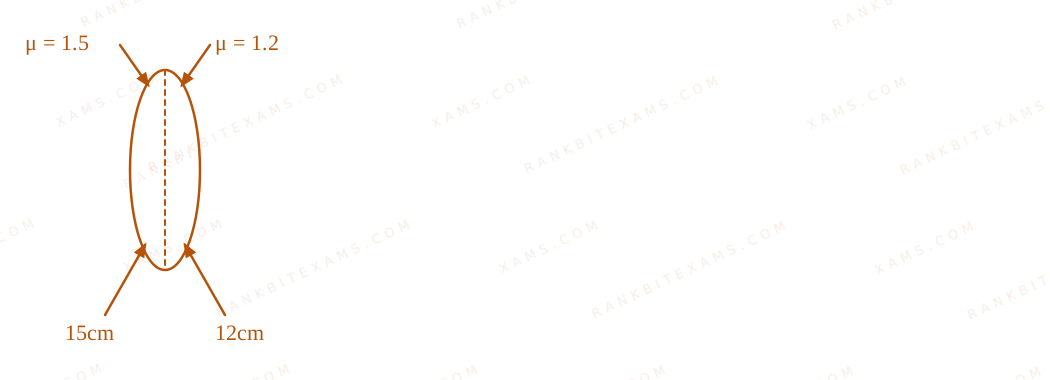
A biconvex lens is formed by using two thin planoconvex lenses, as shown in the figure. Two planoconvex lenses joined to form a biconvex lens with distinct refractive indices. The refractive index and radius of curved surfaces are also mentioned in figure. When an object is placed on the left side of lens at a distance of 30 cm$30 \text{ cm}$ from the biconvex lens, the magnification of the image will be :
Combination of thin lenses in contact: simply add their powers 1/fₙₑₜ = 1/f₁ + 1/f₂$1/f_{net} = 1/f_1 + 1/f_2$. Apply lens maker's formula carefully with correct sign conventions for the planar boundary (R=∞$R=\infty$).
Chapter Mix
Class 12 Physics: Ray Optics and Optical Instruments
Since A > 0$A > 0$, (A/2) < 1$\cos(A/2) < 1$. Thus, n < 2$n < 2$.
Step 1: Applying Physical Bounds
At minimum deviation, i = δ + A2$i = \frac{\delta_{\min} + A}{2}$.
Since δ = A$\delta_{\min} = A$, we have i = (2A)/(2) = A$i = \frac{2A}{2} = A$.
For light to enter the prism, the angle of incidence must be less than 90^°$90^\circ$ (grazing incidence is the limit).
Thus, i < 90^° ⇒ A < 90^°$i < 90^\circ \Rightarrow A < 90^\circ$.
Step 2: Calculate Limits for n
Since A < 90^°$A < 90^\circ$, we have A/2 < 45^°$A/2 < 45^\circ$.
The cosine function is strictly decreasing in the first quadrant, so:
If A/2 < 45^°$A/2 < 45^\circ$, then (A/2) > (45^°) = 1√(2)$\cos(A/2) > \cos(45^\circ) = \frac{1}{\sqrt{2}}$.
When δmin = A$\delta_{min} = A$, μ = 2 (A/2)$\mu = 2\cos(A/2)$. The extreme bounding conditions arise from A > 0$A > 0$ and i < 90^°$i < 90^\circ$. This guarantees the theoretical range √(2) < μ < 2$\sqrt{2} < \mu < 2$.
Chapter Mix
Class 12 Physics: Ray Optics and Optical Instruments
Qjee_main_2025_02_april_eveningSpherical Mirrors and Magnification
Two identical objects are placed in front of convex mirror and concave mirror having same radii of curvature of 12 cm$12 \, \text{cm}$ , at the same distance of 18 cm$18 \, \text{cm}$ from the respective mirrors. The ratio of sizes of the images formed by convex mirror and by concave mirror is:
A.1 / 2$1 / 2$
B.2$2$
C.3$3$
D.1 / 3$1 / 3$
Solution
Related Formula
Mirror focal length:
f = (R)/(2)$$f = \frac{R}{2}$$
Magnification (image size relative to object size):
Sees: Parallel convex vs concave mirror magnification.
Trap: Reversing the signs of focal lengths (Convex focal length is +$+$, Concave is -$-$ in standard coordinate systems).
Shortcut: Use direct magnification equation m = (f)/(f-u)$m = \frac{f}{f-u}$. For convex, m = (6)/(24) = (1)/(4)$m = \frac{6}{24} = \frac{1}{4}$. For concave, m = (-6)/(12) = -(1)/(2)$m = \frac{-6}{12} = -\frac{1}{2}$. Ratio of absolute values is (1/4)/(1/2) = 1/2$\frac{1/4}{1/2} = 1/2$.
Chapter Mix
Class 12 Physics: Ray Optics and Optical Instruments
More Ray Optics and Optical Instruments Questions — jee_main_2026_23_january_evening
Practice past-year questions one chapter at a time. Pick an exam → subject → chapter and get every PYQ for that topic — pulled together from all past papers — with the chapter's key formulas alongside.