JEE Main · Mathematics → Steady

Vector Algebra appeared 46 times across 3 years — 5.3% of Mathematics. This question is from Projection Of A Vector On Another Vector.

Year 2026 2025 2024 Total
Questions 15 17 14 46

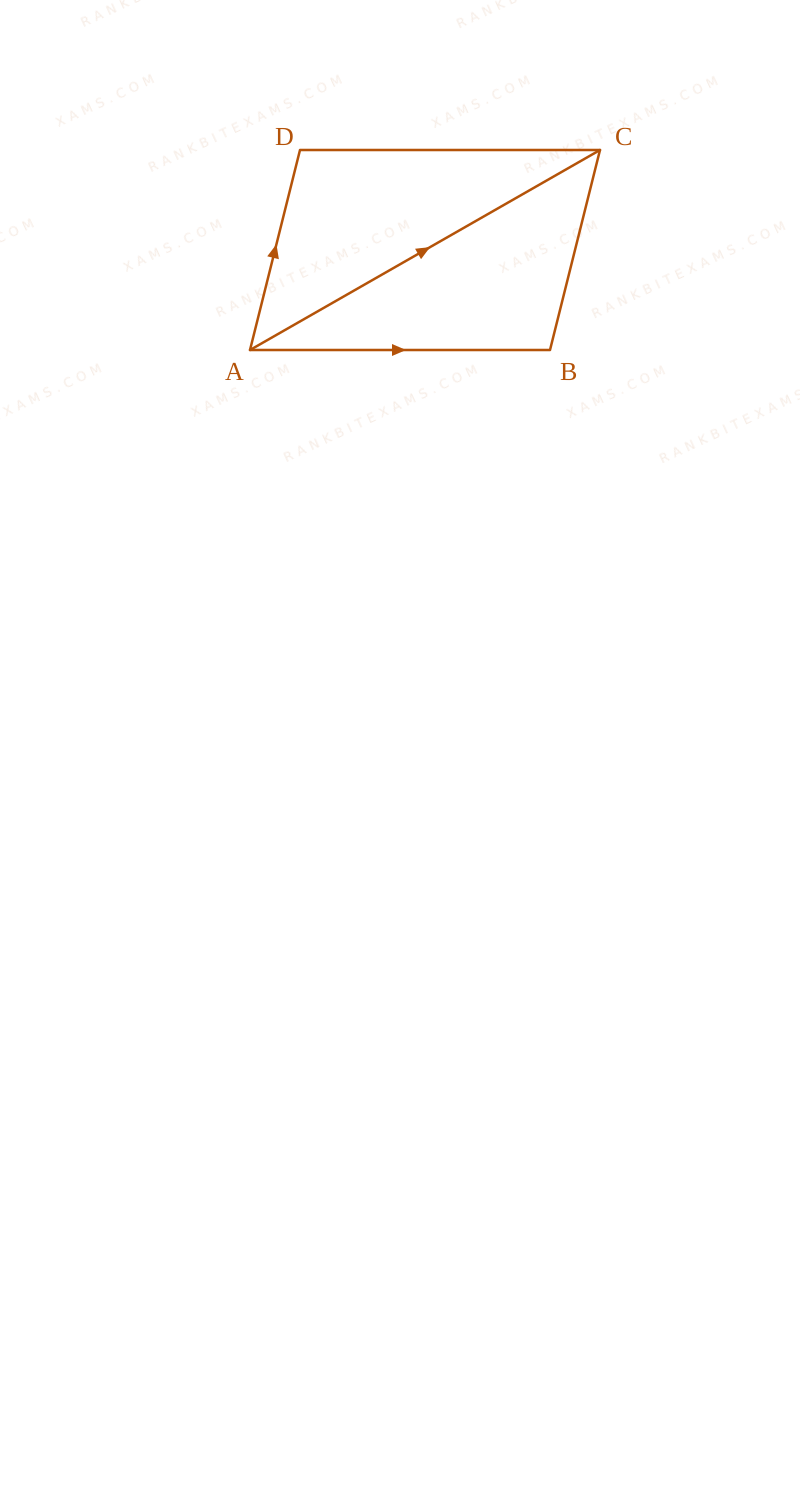
Let AB=2 i+4 j-5 k and AD= i+2 j+λ k, λin R. Let the projection of the vector v= i+ j+ k on the diagonal AC of the parallelogram ABCD be of length one unit. If α,β, where α>β, be the roots of the equation λ²x²-6λ x+5=0, then 2α-β is equal to

Solution & Explanation

Related Formula
Projection of v on a = v · a| a| AC = AB + AD
Core Logic

Using the parallelogram law of vector addition, the diagonal AC is given by:

AC = AB + AD = (2 i+4 j-5 k) + ( i+2 j+λ k) AC = 3 i + 6 j + (λ - 5) k
Step 1: Applying the Projection Condition

The projection of v = i+ j+ k on AC is 1. Therefore:

v · AC| AC| = 1 3(1) + 6(1) + (λ - 5)(1)√(3² + 6² + (λ - 5)²) = 1 3 + 6 + λ - 5 = √(9 + 36 + (λ - 5)²) λ + 4 = √(45 + (λ - 5)²)

Squaring both sides:

(λ + 4)² = 45 + (λ - 5)² λ² + 8λ + 16 = λ² - 10λ + 25 + 45 18λ = 54 λ = 3
Step 2: Solving the Quadratic Equation

Substitute λ = 3 into the given quadratic equation λ²x² - 6λ x + 5 = 0:

9x² - 18x + 5 = 0 (3x - 1)(3x - 5) = 0 x = (1)/(3), (5)/(3)

Given α > β, we have α = (5)/(3) and β = (1)/(3).

Calculate 2α - β:

2((5)/(3)) - (1)/(3) = (10 - 1)/(3) = 3

Projection of A Vector diagram for Q1 - JEE Main 2026 Morning

Pattern Recognition

Projection questions in 3D geometry often couple a simple dot product identity with an unknown parameter. Squaring a linear equation derived from vector magnitudes often cancels the squared terms, making it easily solvable.

Chapter Mix

Class 12 Maths: Vector Algebra Class 11 Maths: Quadratic Equations

Reference Study Guides

More Vector Algebra Previous-Year Questions — Page 4

Q68 jee_main_2025_02_april_evening Properties of Vectors
Let a = 2 i - 3 j + k, b = 3 i + 2 j + 5 k and a vector c be such that ( a - c) × b = -18 i - 3 j + 12 k and a · c = 3. If b × c = d, then | a · d| is equal to:
  • A. 18
  • B. 12
  • C. 9
  • D. 15

Solution

Related Formula
Vector Cross product distributes over subtraction: ( a - c) × b = a × b - c × b Scalar Triple Product cyclic identity: a · ( b × c) = ( a × b) · c Antisymmetry: c × b = - b × c
Core Logic

Instead of solving for the individual coordinates of vector c, we apply vector algebraic identities to compute the target scalar triple product directly.

Step 1: Expand and rewrite the cross product

Given ( a - c) × b = -18 i - 3 j + 12 k:

a × b - c × b = -18 i - 3 j + 12 k a × b + b × c = -18 i - 3 j + 12 k b × c = (-18 i - 3 j + 12 k) - ( a × b) --- (1)
Step 2: Calculate a x b

Evaluate the cross product:

a × b = vmatrix i & j & k 2 & -3 & 1 3 & 2 & 5 vmatrix a × b = i(-15 - 2) - j(10 - 3) + k(4 - (-9)) = -17 i - 7 j + 13 k
Step 3: Solve for the vector d

Substitute a × b back into equation (1):

d = b × c = (-18 i - 3 j + 12 k) - (-17 i - 7 j + 13 k) d = - i + 4 j - k
Step 4: Compute the final dot product

Now compute the requested dot product:

a · d = (2 i - 3 j + k) · (- i + 4 j - k) a · d = 2(-1) + (-3)(4) + 1(-1) = -2 - 12 - 1 = -15 | a · d | = 15
Pattern Recognition

Scalar triple product shortcut: Recognizing that a · d = a · ( b × c) = [ a b c ] allows you to find the scalar value through simple determinants and linear equations instead of solving for the vector components.

Chapter Mix

Class 12 Mathematics: Vector Algebra

Q jee_main_2025_02_april_morning Vector Projections
If a is a nonzero vector such that its projections on the vectors 2 i - j + 2 k, i + 2 j - 2 k and k are equal, then a unit vector along a is:
  • A. 1√(155)(-7 i + 9 j + 5 k)
  • B. 1√(155)(-7 i + 9 j - 5 k)
  • C. 1√(155)(7 i + 9 j + 5 k)
  • D. 1√(155)(7 i + 9 j - 5 k)

Solution

Related Formula

The projection of vector a onto vector b is:

Proj_ b a = a · b| b|
Core Logic

Let a = a₁ i + a₂ j + a₃ k. Set up equations equating the three projections to determine the ratios of components.

Step 1: Set up Projection Ratios

Let b = 2 i- j+2 k | b| = 3

Let c = i+2 j-2 k | c| = 3

Let d = k | d| = 1

Equating projections:

(2a₁ - a₂ + 2a₃)/(3) = (a₁ + 2a₂ - 2a₃)/(3) = (a₃)/(1)
Step 2: Solve System of Linear Equations

From the last equality:

2a₁ - a₂ + 2a₃ = 3a₃ 2a₁ - a₂ = a₃ (1) a₁ + 2a₂ - 2a₃ = 3a₃ a₁ + 2a₂ = 5a₃ (2)

Multiply (1) by 2 and add to (2):

4a₁ - 2a₂ + a₁ + 2a₂ = 2a₃ + 5a₃ 5a₁ = 7a₃ a₁ = (7)/(5)a₃

Substitute back to find a₂:

a₂ = 2a₁ - a₃ = 2((7)/(5)a₃) - a₃ = (9)/(5)a₃
Step 3: Normalize to Unit Vector

The vector components are in ratio a₁ : a₂ : a₃ = (7)/(5) : (9)/(5) : 1 = 7 : 9 : 5.

Magnitude factor = √(7² + 9² + 5²) = √(49 + 81 + 25) = √(155)

Thus, the unit vector is:

a = 1√(155)(7 i + 9 j + 5 k)
Pattern Recognition

Looking at the options, only option (C) provides components with positive signs for all three unit basis elements matching our proportional derivation of 7:9:5 directly.

Chapter Mix

Class 12 Mathematics: Vector Algebra

Q74 jee_main_2025_03_april_evening Vector Products
Let a = i + 2 j + k, b = 3 i - 3 j + 3 k, c = 2 i - j + 2 k and d be a vector such that b × d = c × d and a · d = 4. Then |( a × d)|² is equal to
Numerical Answer. Answer: 128 to 128

Solution

Related Formula

Lagrange's Identity:

| u × v|² = | u|² | v|² - ( u · v)²

Also, if u × w = v × w ( u - v) × w = 0 w is parallel/collinear to u - v.

Core Logic

Rearranging the cross product:

b × d - c × d = 0 ( b - c) × d = 0

Thus, d = λ ( b - c).

Step 1: Finding vector d

Calculate ( b - c):

b - c = (3 i - 3 j + 3 k) - (2 i - j + 2 k) = i - 2 j + k

Therefore:

d = λ( i - 2 j + k)

Substitute into a · d = 4:

λ( i + 2 j + k) · ( i - 2 j + k) = 4 λ(1 - 4 + 1) = 4 -2λ = 4 λ = -2

Thus:

d = -2( i - 2 j + k) = -2 i + 4 j - 2 k | d|² = (-2)² + 4² + (-2)² = 4 + 16 + 4 = 24
Step 2: Calculating | a × d|² using Lagrange's Identity

Given | a|² = 1² + 2² + 1² = 6:

| a × d|² = | a|² | d|² - ( a · d)² | a × d|² = 6 × 24 - 4² = 144 - 16 = 128
Pattern Recognition

Applying Lagrange's Identity avoids computing the actual cross product determinants vector-by-vector. This is extremely efficient and reduces chances of sign errors.

Chapter Mix

Class 12 Mathematics: Vector Algebra

Q69 jee_main_2025_07_april_morning Dot and Cross Products
Let the angle θ, 0 < θ < (π)/(2) between two unit vectors a and b be ⁻¹( √(65)9) . If the vector c = 3 a + 6 b + 9( a × b) , then the value of 9( c · a) - 3( c · b) is
  • A. 31
  • B. 27
  • C. 29
  • D. 24

Solution

Related Formula

Properties of dot and cross vector setups:

a · a = | a|² = 1 a · b = | a|| b| θ = θ a · ( a × b) = 0, b · ( a × b) = 0
Core Logic

Given θ = √(65)9. Since θ lies in the first quadrant:

θ = √(1 - ²θ) = √(1 - (65)/(81)) = √((16)/(81)) = (4)/(9)

Now, let's take individual dot product equations using c = 3 a + 6 b + 9( a × b):

  • Find c · a:
c · a = 3( a · a) + 6( b · a) + 9(( a × b) · a) c · a = 3(1) + 6 θ + 0 = 3 + 6((4)/(9)) = 3 + (24)/(9) = (51)/(9)
Step 1: Compute Second Dot Product Term
  • Find c · b:
c · b = 3( a · b) + 6( b · b) + 9(( a × b) · b) c · b = 3 θ + 6(1) + 0 = 3((4)/(9)) + 6 = (12)/(9) + 6 = (12 + 54)/(9) = (66)/(9) = (22)/(3)
Step 2: Substitute and Finalize Result

Evaluate the target expression layout:

Value = 9( c · a) - 3( c · b) Value = 9((51)/(9)) - 3((22)/(3)) = 51 - 22 = 29
Pattern Recognition

Remember that a cross product vector ( a × b) is orthogonal to both constituent vectors. Thus, taking their dot product evaluates to 0 immediately, allowing you to ignore that entire component during computation steps.

Chapter Mix

Class 12 Mathematics: Vector Algebra

Q59 jee_main_2025_08_april_evening Coplanar and Perpendicular Vectors
Let a = i + 2 j + k and b = 2 i + j - k. Let c be a unit vector in the plane of the vectors a and b and be perpendicular to a. Then such a vector c is:
  • A. 1√(5) ( j - 2 k)
  • B. 1√(3)(- i + j - k)
  • C. 1√(3)( i - j + k)
  • D. 1√(2)(- i + k)

Solution

Related Formula
p = K( a + λ b) p · a = 0
Core Logic

Formulate a coplanar parameterization vector, apply the zero dot-product geometric orthogonality constraint to pin down the linear parameter, and then normalize.

Step 1: Define Coplanar Structural Form

Let the targeting vector path be:

p = K( a + λ b) = K( (1+2λ) i + (2+λ) j + (1-λ) k )
Step 2: Force Orthogonality Constraint

Impose p · a = 0:

1(1+2λ) + 2(2+λ) + 1(1-λ) = 0 1 + 2λ + 4 + 2λ + 1 - λ = 0 6 + 3λ = 0 λ = -2
Step 3: Substitute and Normalize

Substitute λ = -2 back into the base formulation:

p = K(-3 i + 3 k)

Normalizing to turn this vector into a proper unit scale form:

c = ± - i + k√(2)
Pattern Recognition

Finding coplanar vectors orthogonal to one base component matches taking cross expansions like ( a × b) × a up to scalar metrics.

Chapter Mix

Class 12 Mathematics: Vector Algebra

More Vector Algebra Questions — jee_main_2026_22_january_morning

Practice all Vector Algebra previous-year questions →

Rankbit System
JEE Physics: Waves (+15.5%) | Electrostatics: Concentric Shells (-29.7%) | Modern Physics: Photoelectric Clones (+34.2%) | Mathematics: Definite Integrals (+18.1%) | Chemistry: Coordination Splitting (-11.4%) | JEE Physics: Waves (+15.5%) | Electrostatics: Concentric Shells (-29.7%) | Modern Physics: Photoelectric Clones (+34.2%) | Mathematics: Definite Integrals (+18.1%) | Chemistry: Coordination Splitting (-11.4%)