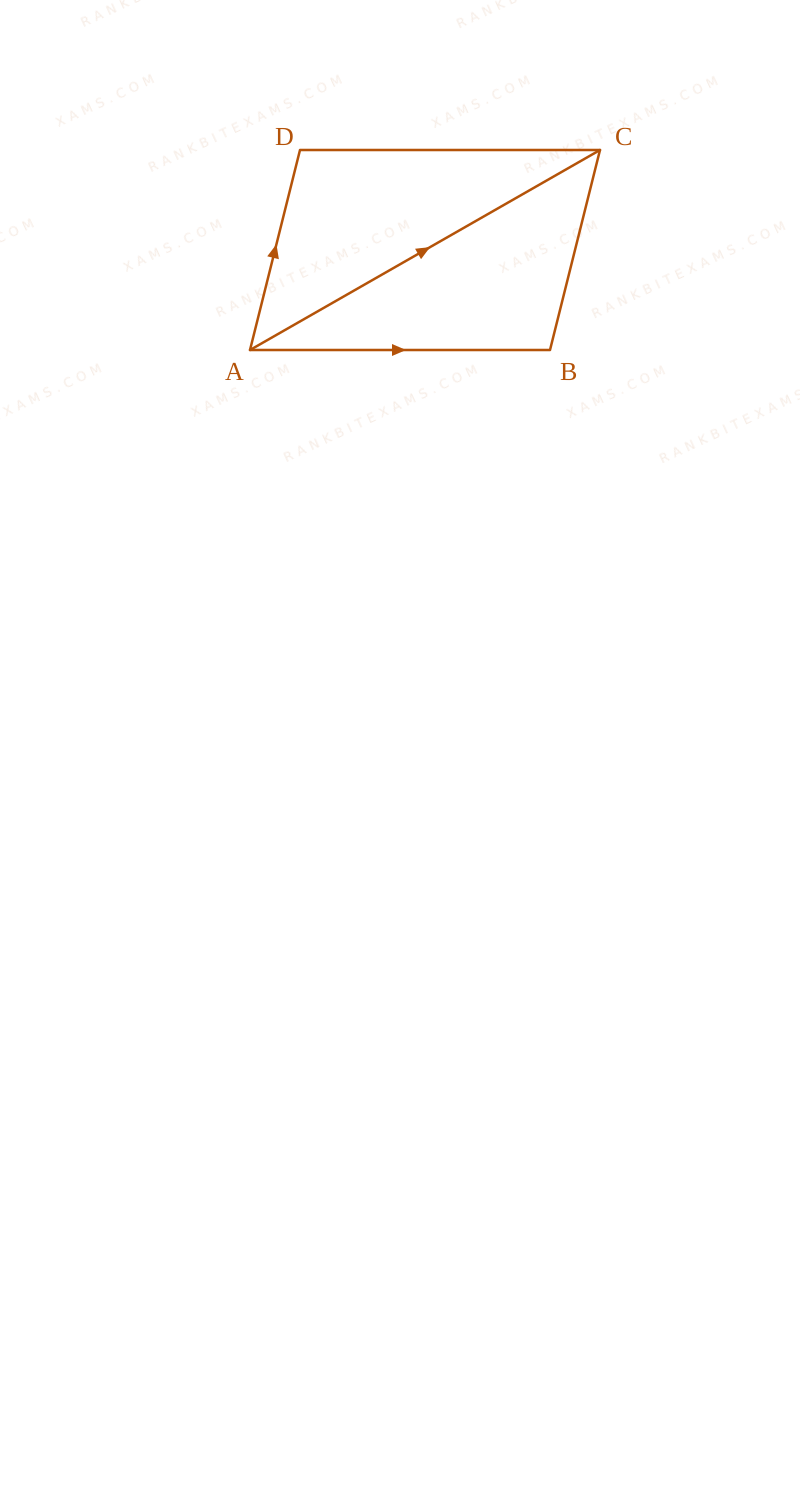
Let AB=2 i+4 j-5 k$\overrightarrow{AB}=2\hat{i}+4\hat{j}-5\hat{k}$ and AD= i+2 j+λ k, λin R$\overrightarrow{AD}=\hat{i}+2\hat{j}+\lambda \hat{k}, \lambda\in \mathbb{R}$. Let the projection of the vectorv= i+ j+ k$\vec{v}=\hat{i}+\hat{j}+\hat{k}$ on the diagonal AC$\overrightarrow{AC}$ of the parallelogram ABCD be of length one unit. If α,β$\alpha,\beta$, where α>β$\alpha>\beta$, be the roots of the equation λ²x²-6λ x+5=0$\lambda^{2}x^{2}-6\lambda x+5=0$, then 2α-β$2\alpha-\beta$ is equal to
A.1$1$
B.4$4$
C.3$3$
D.6$6$
Solution & Explanation
Related Formula
Projection of v on a = v · a| a|$$\text{Projection of } \vec{v} \text{ on } \vec{a} = \frac{\vec{v} \cdot \vec{a}}{|\vec{a}|}$$AC = AB + AD$$\overrightarrow{AC} = \overrightarrow{AB} + \overrightarrow{AD}$$
Core Logic
Using the parallelogram law of vector addition, the diagonal AC$\overrightarrow{AC}$ is given by:
Projection of A Vector diagram for Q1 - JEE Main 2026 Morning
Pattern Recognition
Projection questions in 3D geometry often couple a simple dot product identity with an unknown parameter. Squaring a linear equation derived from vector magnitudes often cancels the squared terms, making it easily solvable.
Chapter Mix
Class 12 Maths: Vector Algebra
Class 11 Maths: Quadratic Equations
Let a$\vec{a}$ and b$\vec{b}$ be two vectors such that | a| = 1, | b| = 4$|\vec{a}| = 1, |\vec{b}| = 4$ and a · b = 2$\vec{a} \cdot \vec{b} = 2$. If c = (2 a × b) - 3 b$\vec{c} = (2\vec{a} \times \vec{b}) - 3\vec{b}$ and the angle between b$\vec{b}$ and c$\vec{c}$ is α$\alpha$, then 192 ²α$192\sin^2\alpha$ is equal to
Numerical Answer.Answer: 48 to 48
Solution
Core Logic
b · c = b · ((2 a × b) - 3 b)$$\vec{b} \cdot \vec{c} = \vec{b} \cdot ((2\vec{a} \times \vec{b}) - 3\vec{b})$$|b||c| α = 2( b · ( a × b)) - 3|b|²$$|b||c|\cos\alpha = 2(\vec{b} \cdot (\vec{a} \times \vec{b})) - 3|b|^2$$
Since b · ( a × b) = 0$\vec{b} \cdot (\vec{a} \times \vec{b}) = 0$, we have |b||c| α = -3|b|²$|b||c|\cos\alpha = -3|b|^2$.
Practice past-year questions one chapter at a time. Pick an exam → subject → chapter and get every PYQ for that topic — pulled together from all past papers — with the chapter's key formulas alongside.