JEE Main · Chemistry → Steady

Chemical Kinetics appeared 43 times across 3 years — 5% of Chemistry. This question is from Arrhenius Equation.

Year 2026 2025 2024 Total
Questions 14 21 8 43

The temperature at which the rate constants of the given below two gaseous reactions become equal is ____ K. (Nearest integer). X arrow Y k₁ = 10⁶e(-30000)/(T) P arrow Q k₂ = 10⁴e(-24000)/(T) Given: ln 10 = 2.303

Numerical Answer Type:
Enter a numerical value Answer: 1303 to 1303 +4 marks

Solution & Explanation

Related Formula
k = A e-Eₐ/RT
Core Logic

Equate the two rate constants: k₁ = k₂

10⁶e(-30000)/(T) = 10⁴e(-24000)/(T)

Divide both sides by 10⁴:

10²e(-30000)/(T) = e(-24000)/(T)

Divide both sides by e(-30000)/(T):

100 = e(-24000)/(T)e(-30000)/(T) 100 = e(6000)/(T)
Step 1: Solve for T

Take the natural logarithm (ln) on both sides:

ln(100) = (6000)/(T) 2 ln(10) = (6000)/(T)

Substitute ln 10 = 2.303:

2 × 2.303 = (6000)/(T) 4.606 = (6000)/(T) T = (6000)/(4.606) = 1302.64 K
Step 2: Rounding

Nearest integer is 1303.

Pattern Recognition

Simple exponential equating. Group powers of 10 on one side and exponentials on the other, then apply natural log.

Chapter Mix

Class 12 Chemistry: Chemical Kinetics

Reference Study Guides

More Chemical Kinetics Previous-Year Questions — Page 3

Q66 jee_main_2026_24_january_morning Arrhenius Equation and Catalyst Effect
At 27°C in presence of a catalyst, activation energy of a reaction is lowered by 10 kJ mol⁻¹. The logarithm ratio of k(catalysed)k(uncatalysed) is (Consider that the frequency factor for both the reactions is same)
  • A. 17.41
  • B. 1.741
  • C. 3.482
  • D. 0.1741

Solution

Related Formula
k = A e-(Eₐ)/(RT)
Core Logic

Let the activation energy of the uncatalyzed reaction be Eₐ. Activation energy of the catalyzed reaction = Eₐ - 10 kJ mol⁻¹. kuncatalyzed = A e-(Eₐ)/(RT) kcatalyzed = A e-((Eₐ - 10000))/(RT)

Dividing the two rate constants: kcatalyzedkuncatalyzed = e(Δ Eₐ)/(RT) where Δ Eₐ = 10 kJ mol⁻¹ = 10000 J mol⁻¹.

Step 1: Calculate Logarithm Ratio

Taking natural logarithm on both sides:

ln ( kcatalyzedkuncatalyzed) = (Δ Eₐ)/(RT)

Converting to base 10 logarithm:

₁₀ ( kcatalyzedkuncatalyzed) = (Δ Eₐ)/(2.303 RT)

Substitute the values (R = 8.314 J K⁻¹ mol⁻¹, T = 300 K):

₁₀ ( kcatalyzedkuncatalyzed) = (10000)/(2.303 × 8.314 × 300) ₁₀ ( kcatalyzedkuncatalyzed) = (10000)/(5744.14) ≈ 1.741
Pattern Recognition

Remember that lowering activation energy by Δ Eₐ increases the rate by a factor of eΔ Eₐ / RT. Taking log base 10 simply scales this exponent by 1/2.303.

Chapter Mix

Class 12 Chemistry: Chemical Kinetics
Q72 jee_main_2026_24_january_evening First Order Reactions
The half-life of ⁶⁵Zn is 245 days. After x days, 75% of original activity remained. The value of x in days is ____. (Nearest integer) (Given : log 3 = 0.4771 and log 2 = 0.3010)
Numerical Answer. Answer: 102 to 102

Solution

Related Formula
t = (2.303)/(K) ((a₀)/(aₜ))

where K = ln 2t1/2

Core Logic

Given t1/2 = 245 days, so decay constant K = (ln 2)/(245). If 75% activity remained, the fraction remaining is aₜ / a₀ = 3/4 (or 75/100). So, (a₀)/(aₜ) = (4)/(3).

Step 1: Substitute Values
t = (1)/(K) ln((4)/(3)) t = (245)/(ln 2) ln((4)/(3))

Converting to base 10 logs:

t = 245 × ( (4/3))/( 2) t = 245 [ (2 2 - 3)/( 2) ]
Step 2: Arithmetic Evaluation
t = 245 [ (2(0.3010) - 0.4771)/(0.3010) ] t = 245 [ (0.6020 - 0.4771)/(0.3010) ] t = 245 [ (0.1249)/(0.3010) ] = 245 × 0.4149 t 101.66 days

Rounded to nearest integer = 102.

Pattern Recognition

All radioactive decays follow first-order kinetics. Don't waste time deriving formulas—plug aₜ = 0.75 a₀ straight into the standard integrated rate law.

Chapter Mix

Class 12 Chemistry: Chemical Kinetics Class 12 Physics: Nuclei

Q57 jee_main_2026_28_january_morning First Order Reaction Decomposition
An organic compound undergoes first order decomposition. The time taken for decomposition to ((1)/(8))th and ((1)/(10))th of its initial concentration are t1/8 and t1/10 respectively. What is the value of t1/8t1/10× 10? (2 = 0.3)
  • A. 9
  • B. 0.9
  • C. 3
  • D. 30

Solution

Related Formula
t = (1)/(k)ln((A₀)/(Aₜ))
Step 1: Formulate Time Ratios

For Aₜ = A₀/8:

t1/8 = (1)/(k)ln((A₀)/(A₀/8)) = (1)/(k)ln(8)

For Aₜ = A₀/10:

t1/10 = (1)/(k)ln((A₀)/(A₀/10)) = (1)/(k)ln(10)
Step 2: Find the Ratio
t1/8t1/10 = (ln 8)/(ln 10) = ( 8)/( 10) = (3 2)/(1) = 3(0.3) = 0.9

Therefore:

t1/8t1/10 × 10 = 0.9 × 10 = 9
Pattern Recognition

For first order kinetics, ratio of completion times is independent of k and strictly equals the ratio of logs of initial-to-final concentration fractions.

Chapter Mix

Class 12 Chemistry: Chemical Kinetics

Q72 jee_main_2026_28_january_evening Arrhenius Equation And Activation Energy
A arrow B (first reaction) C arrow D (second reaction) Consider the above two first-order reactions. The rate constant for first reaction at 500 K is double of the same at 300 K. At 500 K, 50% of the reaction becomes complete in 2 hour. The activation energy of the second reaction is half of that of first reaction. If the rate constant at 500 K of the second reaction becomes double of the rate constant of first reaction at the same temperature; then rate constant for the second reaction at 300 K is ____ × 10⁻¹ hour⁻¹ (nearest integer).
Numerical Answer. Answer: 5 to 5

Solution

Related Formula
ln( KT₂KT₁) = (Eₐ)/(R) [ (1)/(T₁) - (1)/(T₂) ] K = ln 2t1/2 (First Order)
Core Logic

For Reaction 1 (A K₁ B): (K₁)500K = 2(K₁)300K. ln(2) = Eₐ₁R [ (1)/(300) - (1)/(500) ] = Eₐ₁R [ (200)/(150000) ] = Eₐ₁R [ (2)/(1500) ] Eₐ₁ = (ln 2 × R × 1500)/(2)

Also for Reaction 1 at 500K, half-life is 2 hours, so: (K₁)500K = (ln 2)/(2) hr⁻¹

For Reaction 2 (C K₂ D): Given Eₐ₂ = Eₐ₁2 = (ln 2 × R × 1500)/(4) Given (K₂)500K = 2 × (K₁)500K = 2 × (ln 2)/(2) = ln 2

Applying Arrhenius equation for Reaction 2 from 300K to 500K: ln [ (K₂)500K(K₂)300K ] = Eₐ₂R [ (1)/(300) - (1)/(500) ] ln [ ln 2(K₂)300K ] = (((ln 2 × R × 1500)/(4)))/(R) × (2)/(1500) = (ln 2)/(2) = ln(√(2))

Step 1: Solve for K2 at 300K

Equating the arguments of the natural logs: ln 2(K₂)300K = √(2) (K₂)300K = ln 2√(2) = (0.693)/(1.414) = 0.49 hr⁻¹ (K₂)300K = 4.9 × 10⁻¹ hr⁻¹ ≈ 5 × 10⁻¹ hr⁻¹ (rounded to nearest integer).

Pattern Recognition

Sequential tracking of unknowns through Arrhenius. Eₐ ratios dictate log ratios between temperatures directly.

Chapter Mix

Class 12 Chemistry: Chemical Kinetics

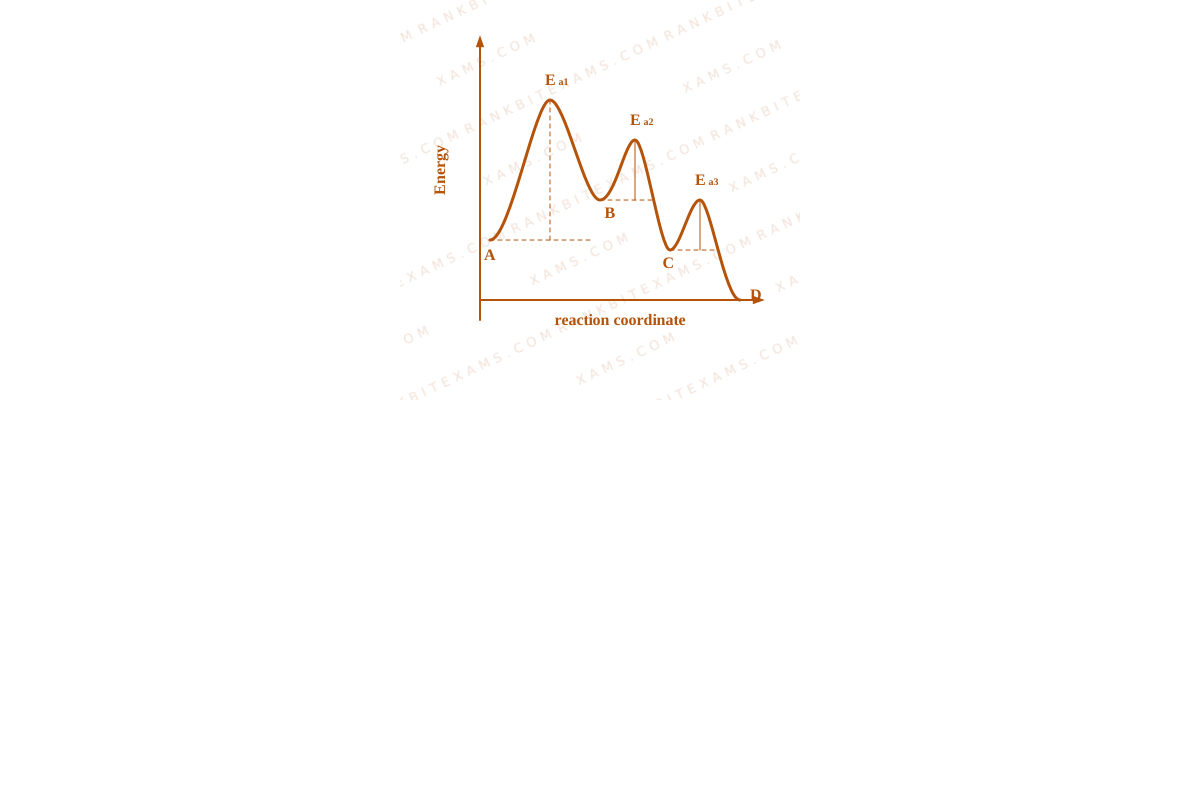
Q39 jee_main_2025_02_april_evening Reaction Mechanism and Energy Profiles
Reactant A converts to product D through the given mechanism (with the net evolution of heat): A arrow B slow; Δ H = +ve B arrow C fast; Δ H = -ve C arrow D fast; Δ H = -ve Which of the following represents the above reaction mechanism?
  • A. Graph (1)
  • B. Graph (2)
  • C. Graph (3)
  • D. Graph (4)

Solution

Related Formula
k = A e^-Eₐ/RT Rate ∝ 1Eₐ
Core Logic

Let us break down each step of the mechanism:

  • Step 1: A arrow B is slow.
  • Being the rate-determining step, it must have the highest activation energy barrier (Eₐ₁).
  • Since Δ H = +ve (endothermic), the energy level of intermediate state B must be higher than the reactant state A.
  • Step 2: B arrow C is fast.
  • It has a much lower activation energy barrier (Eₐ₂).
  • Since Δ H = -ve (exothermic), the energy level of intermediate C is lower than state B.
  • Step 3: C arrow D is fast.
  • It has a low activation energy barrier (Eₐ₃).
  • Since Δ H = -ve (exothermic), the energy level of final state D is lower than state C.
  • Net Reaction: Exothermic with "net evolution of heat".
  • The potential energy of the final product D is lower than the initial potential energy of reactant A.
Step 1: Check Potential Energy Profile

Evaluating the transition states and relative energy levels in Graph (1):

  • The first peak (transition state 1) is clearly the highest (Eₐ₁ > Eₐ₂, Eₐ₃) Step 1 is the slowest.
  • The intermediate B is higher in energy than A.
  • Intermediates C and product D are progressively lower in energy.
  • Product D has lower energy than reactant A (net exothermic).
  • Annotated reaction mechanism coordinate graph showing relative activation energies
    Annotated reaction mechanism coordinate graph showing relative activation energies

    This perfectly corresponds to Graph (1).

Pattern Recognition

Kinetics shortcut: Slow step = tallest peak. Exothermic step = drop in energy levels of products/intermediates. Endothermic step = climb in energy levels. Use these rules to visually scan energy profiles in under 5 seconds.

Chapter Mix

Class 12 Chemistry: Chemical Kinetics

More Chemical Kinetics Questions — jee_main_2026_22_january_morning

Practice all Chemical Kinetics previous-year questions →

Rankbit System
JEE Physics: Waves (+15.5%) | Electrostatics: Concentric Shells (-29.7%) | Modern Physics: Photoelectric Clones (+34.2%) | Mathematics: Definite Integrals (+18.1%) | Chemistry: Coordination Splitting (-11.4%) | JEE Physics: Waves (+15.5%) | Electrostatics: Concentric Shells (-29.7%) | Modern Physics: Photoelectric Clones (+34.2%) | Mathematics: Definite Integrals (+18.1%) | Chemistry: Coordination Splitting (-11.4%)