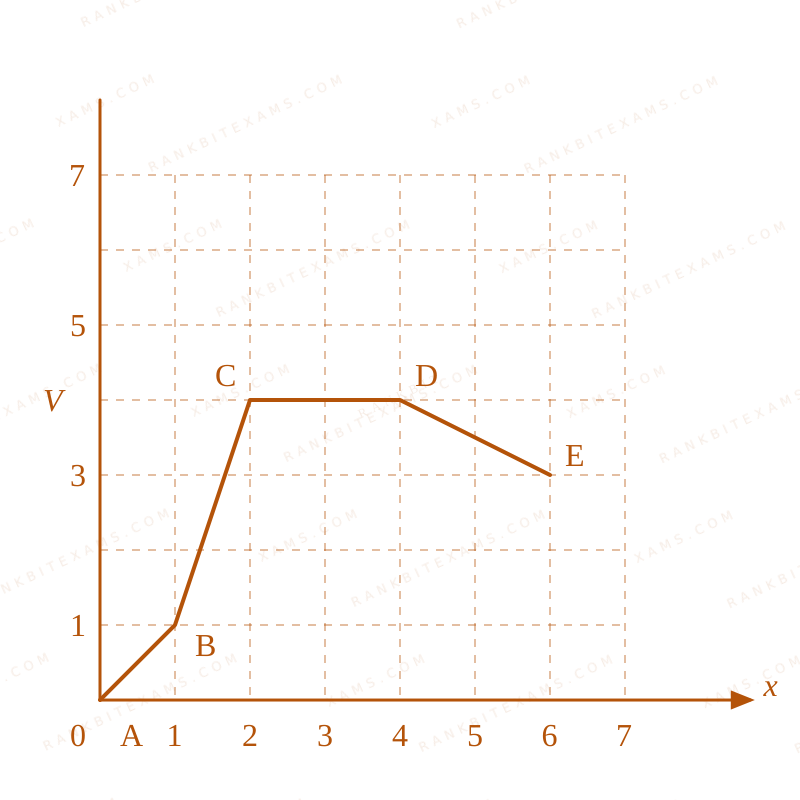
Potential energy (V) versus distance (x) is given by the graph, Rank various regions as per the magnitudes of the force (F) acting on a particle from high to low.
Potential Energy diagram for Q26 - JEE Main 2026 Morning
The image shows a graph of potential energy versus distance with marked regions AB, BC, CD, and DE.

Solution & Explanation

### Related Formula F = -fracdVdx ### Core Logic The magnitude of the force is given by the absolute value of the slope of the potential energy versus position curve: |F| = |textslope of V-x graph|. Comparing the slopes of different regions from the graph: - Region BC has the steepest slope (largest magnitude). - Region AB has a moderate positive slope. - Region DE has a moderate negative slope, but less steep than AB. - Region CD is perfectly flat (slope = 0). ### Step 1: Ranking Forces Therefore, magnitudes of the force follow the order: F_BC > F_AB > F_DE > F_CD ### Pattern Recognition In a V-x graph, steeper slopes always mean a stronger restoring or repulsive force. A flat line means zero force (equilibrium). ### Evaluation Rubric / Model Answer null ### Chapter Mix Class 11 Physics: Work, Energy and Power

More Work, Energy and Power Previous-Year Questions — Page 4

Q jee_main_2025_29_jan_morning Vertical Circular Motion
A body of mass 'm' connected to a massless and unstretchable string goes in a vertical circle of radius 'R' under gravity g. The other end of the string is fixed at the center of a circle. If velocity at top of circular path is n sqrtgR , where, n geq 1 , then ratio of kinetic energy of the body at bottom to that at top of the circle is
  • A. fracmathrmnmathrmn + 4
  • B. fracmathrmn + 4mathrmn
  • C. fracmathrmn^2mathrmn^2 + 4
  • D. fracmathrmn^2 + 4mathrmn^2

Solution

### Related Formula V_textBottom = sqrtV_textTop^2 + 4gR ### Core Logic Given velocity at the top position : V_textTop = sqrtn^2 gR By work-energy theorem, mechanical energy conservation between the top and bottom positions gives : V_textBottom = sqrtn^2 gR + 4gR Since KE = frac12m v^2, the ratio of kinetic energy at the bottom to that at the top is textRatio = fracV_textBottom^2V_textTop^2 = fracn^2 gR + 4gRn^2 gR = fracn^2 + 4n^2 ### Pattern Recognition Kinetic energy change in vertical circles always gains a fixed additive value of 2mg(2R) = 4mgR due to gravity work. ### Chapter Mix Class 11 Physics: Work, Energy and Power
Q46 jee_main_2024_01_february_morning Collisions
A simple pendulum of length 1mathrm~m has a wooden bob of mass 1mathrm~kg. It is struck by a bullet of mass 10^-2mathrm~kg moving with a speed of 2 times 10^2mathrm~ms^-1. The bullet gets embedded into the bob. The height to which the bob rises before swinging back is (use g = 10mathrm~m/s^2):
  • A. 0.30 m
  • B. 0.20 m
  • C. 0.35 m
  • D. 0.40 m

Solution

### Related Formula Conservation of Linear Momentum during embedded collision: mu = (M + m)V Conservation of Mechanical Energy during vertical rise: frac12(M+m)V^2 = (M+m)gh implies h = fracV^22g ### Core Logic Given data: m = 10^-2mathrm~kg, u = 2 times 10^2mathrm~ms^-1, M = 1mathrm~kg, g = 10mathrm~m/s^2. Apply momentum balance: 10^-2 times (2 times 10^2) = (1 + 0.01)V 2 = 1.01V implies V approx 2mathrm~ms^-1\ text(since 1.01 approx 1text) ### Step 1: Compute Maximum Rise Height Using the work-energy relation for the subsequent upward swing: h = fracV^22g = frac2^22 times 10 = frac420 = 0.20mathrm~m ### Pattern Recognition Perfectly inelastic collision approximation: because m ll M, we can simplify M+m approx M during velocity matching to complete the calculation rapidly. ### Evaluation Rubric / Model Answer null ### Chapter Mix Class 11 Physics: Work, Energy and Power Class 11 Physics: Laws of Motion
Q37 jee_main_2024_29_january_evening Conservation of Mechanical Energy
The bob of a pendulum was released from a horizontal position. The length of the pendulum is 10text m. If it dissipates 10\% of its initial energy against air resistance, the speed with which the bob arrives at the lowest point is: [Use g = 10text m s^-2]
  • A. 6sqrt5text m s^-1
  • B. 5sqrt6text m s^-1
  • C. 5sqrt5text m s^-1
  • D. 2sqrt5text m s^-1

Solution

### Related Formula Potential energy at the horizontal release point relative to the lowest point: U_i = mgell If 10\% of energy is dissipated, the remaining 90\% is converted entirely to kinetic energy at the lowest point: E_f = 0.90 times U_i = frac12mv^2 ### Core Logic Let the horizontal position be our reference for potential energy relative to the lowest point. * Initial potential energy: U_i = mgell * Energy remaining after 10\% loss: 0.90(mgell) Equating this to kinetic energy at the bottom: frac910 mgell = frac12 mv^2 ### Step 1: Calculate the Velocity We can cancel m from both sides: frac910 gell = frac12 v^2 Substitute ell = 10text m and g = 10text m s^-2: frac910 (10)(10) = frac12 v^2 90 = frac12 v^2 implies v^2 = 180 v = sqrt180 = sqrt36 times 5 = 6sqrt5text m s^-1
Pendulum trajectory diagram for Q37
### Pattern Recognition Whenever there is a fractional energy loss x, use the formula: v = sqrt2(1-x)gell. Substituting x = 0.1 gives v = sqrt1.8gell directly. ### Evaluation Rubric / Model Answer null ### Chapter Mix Class 11 Physics: Work, Energy and Power
Q42 jee_main_2024_29_january_evening Vertical Circular Motion
A bob of mass 'm' is suspended by a light string of length 'L'. It is imparted a minimum horizontal velocity at the lowest point A such that it just completes half circle reaching the top most position B. The ratio of kinetic energies frac(mathrmK.E.)_mathrmA(mathrmK.E.)_mathrmB is:
Vertical circular motion path of a pendulum bob for Q42 - JEE Main 2024 29 January Shift 2
The diagram displays a bob of mass m in vertical circular motion with velocity indicators at points A, B, and C.
  • A. 3:2
  • B. 5:1
  • C. 2:5
  • D. 1:5

Solution

### Related Formula For a body to just complete a vertical loop of radius L: * Speed at the lowest point A: v_A = sqrt5gL * Speed at the highest point B: v_B = sqrtgL ### Core Logic The kinetic energy at any point is given by: textK.E. = frac12mv^2 Thus: (textK.E.)_A = frac12m v_A^2 = frac12m(5gL) (textK.E.)_B = frac12m v_B^2 = frac12m(gL) ### Step 1: Calculate the Ratio Taking the ratio of the kinetic energies at A and B: frac(textK.E.)_A(textK.E.)_B = fracfrac12m(5gL)frac12m(gL) = frac51 = 5:1 ### Pattern Recognition Since textK.E. propto v^2, the ratio of kinetic energies is simply the ratio of the squares of the critical velocities at the bottom and top of the vertical loop: (sqrt5gL)^2 : (sqrtgL)^2 = 5:1. ### Evaluation Rubric / Model Answer null ### Chapter Mix Class 11 Physics: Work, Energy and Power
Q39 jee_main_2024_27_jan_morning Kinetic Energy and Momentum
Two bodies of mass 4text g and 25text g are moving with equal kinetic energies. The ratio of the magnitude of their linear momentum is:
  • A. 3:5
  • B. 5:4
  • C. 2:5
  • D. 4:5

Solution

### Related Formula K = fracP^22m implies P = sqrt2mK Where P is linear momentum, m is mass, and K is kinetic energy. ### Core Logic Given K_1 = K_2, the momentum ratio simplifies directly to the square root of their masses: fracP_1P_2 = sqrtfracm_1m_2 ### Step 1: Calculate the value Substitute m_1 = 4text g and m_2 = 25text g: fracP_1P_2 = sqrtfrac425 = frac25 ### Pattern Recognition For constant kinetic energy tracking profiles, momentum maps proportionally to sqrtm. ### Evaluation Rubric / Model Answer null ### Chapter Mix Class 11 Physics: Work, Energy and Power

More Work, Energy and Power Questions — jee_main_2026_21_jan_morning

Practice all Work, Energy and Power previous-year questions →

Rankbit System
JEE Physics: Waves (+15.5%) | Electrostatics: Concentric Shells (-29.7%) | Modern Physics: Photoelectric Clones (+34.2%) | Mathematics: Definite Integrals (+18.1%) | Chemistry: Coordination Splitting (-11.4%) | JEE Physics: Waves (+15.5%) | Electrostatics: Concentric Shells (-29.7%) | Modern Physics: Photoelectric Clones (+34.2%) | Mathematics: Definite Integrals (+18.1%) | Chemistry: Coordination Splitting (-11.4%)
YOUR FIRST PREP STEP STARTS HERE

We Map Every Repeating Question in Competitive Exams.

Say goodbye to generic mock test fatigue. RankBit uses smart analysis to group past exam questions into their foundational Repeating Question Types. Find chapter weightage, track repeating questions, and score higher with targeted practice.

Select Your Target Exam

Choose an exam track below to find formulas per chapter and patterns.

Syncing Exam Intelligence

Mapping formulas and patterns across all tracks…

PATH A — FULL LENGTH PRACTICE

Full Mock Test Hub

Simulate real NTA exam conditions with fully tracked mocks. Time yourself against past papers.

Now Live Open
PATH B — TARGETED PRACTICE

Topic-wise Practice Hub

Practice past-year questions one chapter at a time. Pick an exam → subject → chapter and get every PYQ for that topic — pulled together from all past papers — with the chapter's key formulas alongside.

Loading Questions... Browse Topics
Latest from the Blog
View all →

Loading articles...