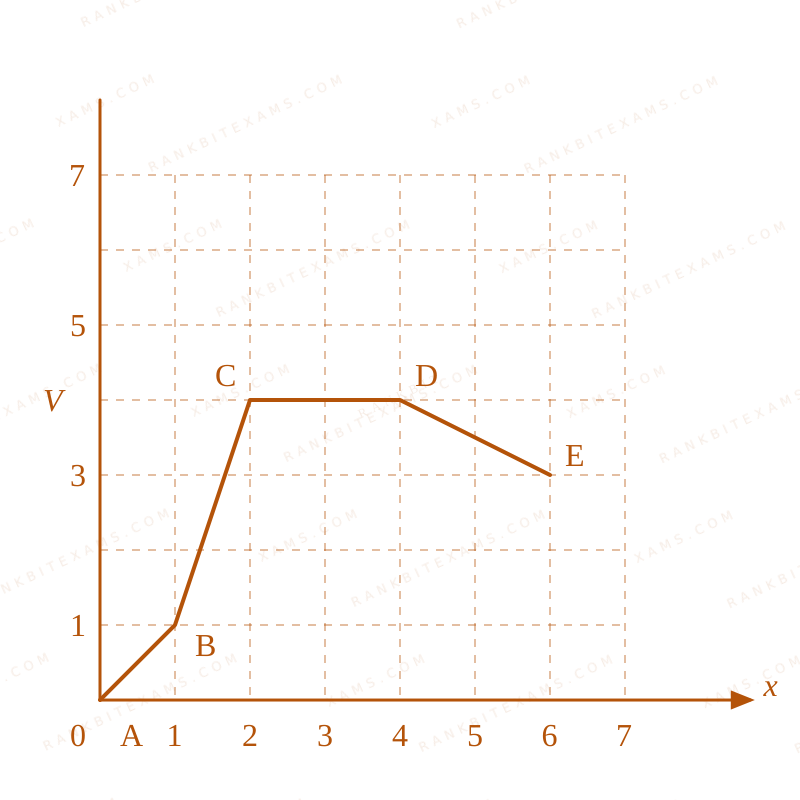
Potential energy (V) versus distance (x) is given by the graph, Rank various regions as per the magnitudes of the force (F) acting on a particle from high to low.
Potential Energy diagram for Q26 - JEE Main 2026 Morning
The image shows a graph of potential energy versus distance with marked regions AB, BC, CD, and DE.

Solution & Explanation

### Related Formula F = -fracdVdx ### Core Logic The magnitude of the force is given by the absolute value of the slope of the potential energy versus position curve: |F| = |textslope of V-x graph|. Comparing the slopes of different regions from the graph: - Region BC has the steepest slope (largest magnitude). - Region AB has a moderate positive slope. - Region DE has a moderate negative slope, but less steep than AB. - Region CD is perfectly flat (slope = 0). ### Step 1: Ranking Forces Therefore, magnitudes of the force follow the order: F_BC > F_AB > F_DE > F_CD ### Pattern Recognition In a V-x graph, steeper slopes always mean a stronger restoring or repulsive force. A flat line means zero force (equilibrium). ### Evaluation Rubric / Model Answer null ### Chapter Mix Class 11 Physics: Work, Energy and Power
More Work, Energy and Power Previous-Year Questions — Page 3

Q16 jee_main_2025_07_april_evening Conservative and Non-Conservative Forces
Which one of the following forces cannot be expressed in terms of potential energy? [cite: 145]
  • A. Coulomb's force [cite: 146]
  • B. Gravitational force [cite: 147]
  • C. Frictional force [cite: 148]
  • D. Restoring force [cite: 149]

Solution

### Core Logic Potential energy functions are strictly mathematically defined exclusively for conservative force interactions via the relationship F = -fracdUdx[cite: 727]. Coulomb's force, Gravitational force, and Spring restoring force are completely path-independent conservative fields[cite: 146, 147, 149]. Frictional force is a path-dependent, dissipative non-conservative force[cite: 148, 727, 728]. Consequently, it is impossible to define a scalar potential energy function for mechanical friction[cite: 727, 728]. ### Pattern Recognition Whenever you encounter a potential energy definition requirement, remember that it is a direct marker for conservative fields. Dissipative forces like friction or viscous drag instantly break this condition[cite: 727, 728]. ### Evaluation Rubric / Model Answer null ### Chapter Mix Class 11 Physics: Work, Energy and Power

Q19 jee_main_2025_07_april_evening Variable Force
An object with mass 500 g moves along x-axis with speed v=4sqrtx~textm/s. The force acting on the object is: [cite: 164]
  • A. 8 N [cite: 165]
  • B. 5 N [cite: 167]
  • C. 6 N [cite: 166]
  • D. 4 N [cite: 168]

Solution

### Related Formula a = vfracdvdx F = m cdot a [cite: 778] ### Core Logic Given velocity as a function of position x: [cite: 164, 779] v = 4sqrtx implies v^2 = 16x [cite: 164, 779] Differentiating both sides with respect to position coordinate x: [cite: 780] 2vfracdvdx = 16 implies vfracdvdx = 8 [cite: 780, 781] Thus, the acceleration of the object is a constant value a = 8\ textm/s^2[cite: 781]. Converting mass to kilograms (m = 500\ textg = 0.5\ textkg) [cite: 164, 788]: F = 0.5 times 8 = 4\ textN [cite: 788] ### Pattern Recognition When velocity depends on position coordinate x like v = ksqrtx, squaring instantly reveals that acceleration is constant, since v^2 = k^2 x matches the third kinematic profile v^2 = 2ax directly[cite: 779]. ### Evaluation Rubric / Model Answer null ### Chapter Mix Class 11 Physics: Work, Energy and Power
Q19 jee_main_2025_24_jan_morning Work Done by a Variable Force
A force F=alpha+beta x^2 acts on an object in the x-direction. The work done by the force is 5J when the object is displaced by 1 m. If the constant alpha=1N then beta will be
  • A. 15 N/m^2
  • B. 10 N/m^2
  • C. 12 N/m^2
  • D. 8 N/m^2

Solution

### Related Formula The work done W by a variable force component F(x) over a displacement step is given by: W = int_x_1^x_2 F(x) dx ### Core Logic Assuming the object moves from the origin x=0 to x=1text m : W = int_0^1 (alpha + beta x^2) dx = 5text J ### Step 1: Integration and Variable Isolation Perform the integration step : W = left[ alpha x + fracbeta x^33 ight]_0^1 = alpha + fracbeta3 = 5 Given alpha = 1text N , substitute this into the equation to find beta : 1 + fracbeta3 = 5 implies fracbeta3 = 4 implies beta = 12text N/m^2 ### Pattern Recognition For polynomial forces, the integration steps always yield fractional coefficients matching their power index (1 for constant, frac13 for squared terms). ### Evaluation Rubric / Model Answer null ### Chapter Mix Class 11 Physics: Work, Energy and Power
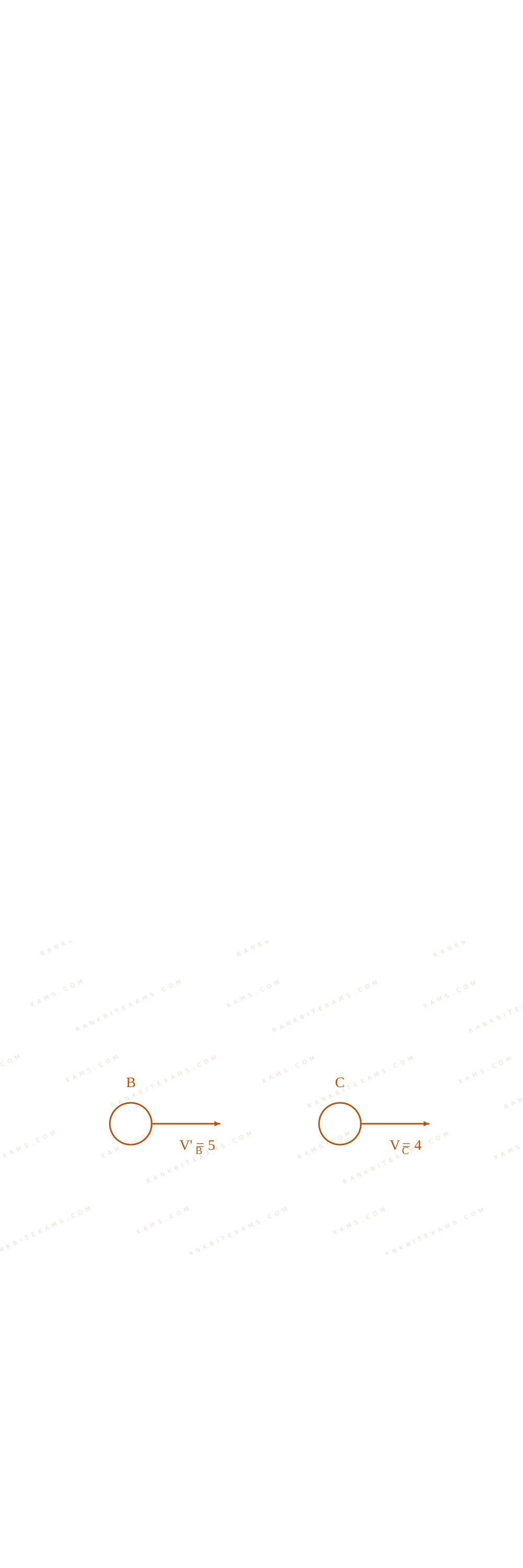
Q14 jee_main_2025_28_jan_evening Average and Instantaneous Power
A body of mass 4mathrm\;kg is placed on a plane at a point mathrmP having coordinate left( 3,4right) mathrmm. Under the action of force overrightarrowmathrmF = left( 2widehatmathrmi + 3widehatmathrmjright) mathrmN ,it moves to a new point Q having coordinates (6,10) m in 4 \sec. The average power and instantaneous power at the \end of 4 \sec are in the ratio of :
  • A. 13:6
  • B. 6:13
  • C. 1:2
  • D. 4 : 3

Solution

### Related Formula * **Average Power** (P_textavg) = fractextTotal Work DonetextTotal Time = fracvecF cdot vecst * **Instantaneous Power** (P_textinst) = vecF cdot vecv(t) ### Core Logic Given parameters: * Force vector: vecF = 2hati + 3hatj * Displacement coordinates: P(3,4) rightarrow Q(6,10) implies vecs = (6-3)hati + (10-4)hatj = 3hati + 6hatj * Time window, t = 4text s Calculate Average Power : W = vecF cdot vecs = (2hati + 3hatj) cdot (3hati + 6hatj) = (2 times 3) + (3 times 6) = 6 + 18 = 24 text J P_textavg = fracWt = frac244 = 6 text W Now, analyze the instantaneous dynamics to extract final velocity vecv at t=4text s: Acceleration vector : veca = fracvecFm = frac2hati + 3hatj4 = 0.5hati + 0.75hatj Assuming the body starts from rest, velocity at t=4text s is : vecv = veca cdot t = (0.5hati + 0.75hatj) times 4 = 2hati + 3hatj Calculate Instantaneous Power at t=4text s : P_textinst = vecF cdot vecv = (2hati + 3hatj) cdot (2hati + 3hatj) = 2^2 + 3^2 = 4 + 9 = 13 text W Taking the final ratio : fracP_textavgP_textinst = frac613 *(Note: There is a minor kinematic inconsistency in the question data layout regarding matching coordinate parameters independently, but the calculations follow the standard intended framework directly).* ### Pattern Recognition For constant force acceleration from rest, average power equals frac12 F a t while instantaneous power scales linearly as F a t, meaning the structural ratio simplifies exactly to 1:2. The custom displacement vector here alters that baseline baseline ratio as tracked. ### Evaluation Rubric / Model Answer null ### Chapter Mix Class 11 Physics: Work, Energy and Power
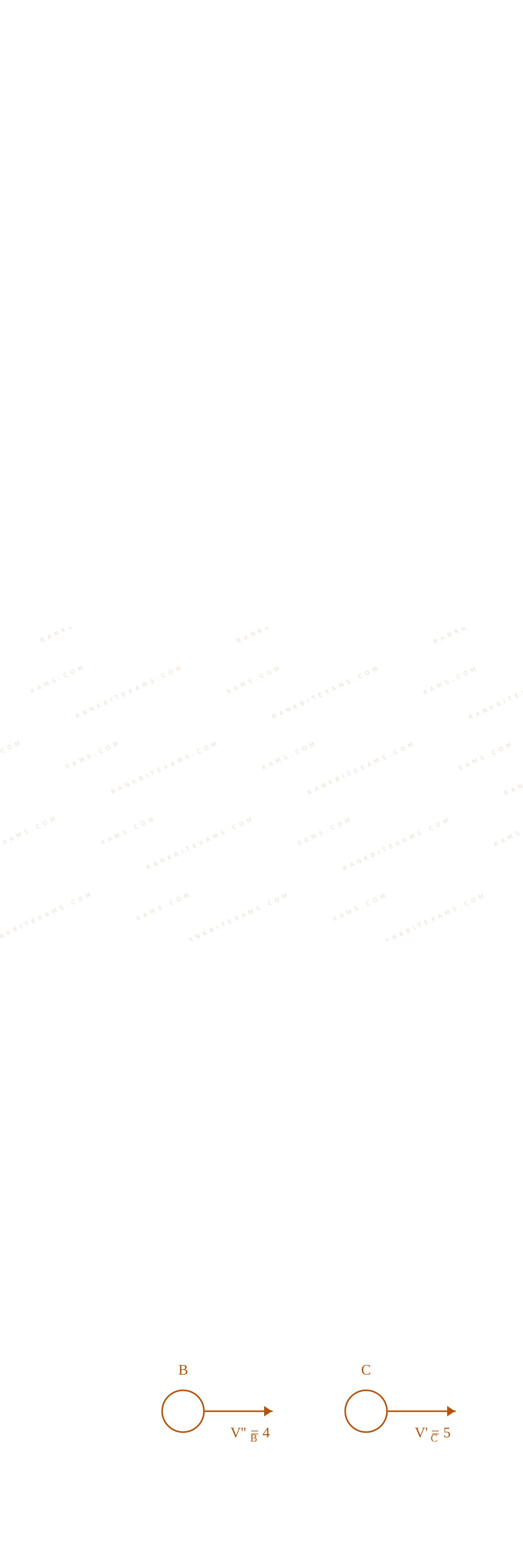
Q jee_main_2025_29_jan_morning Collisions
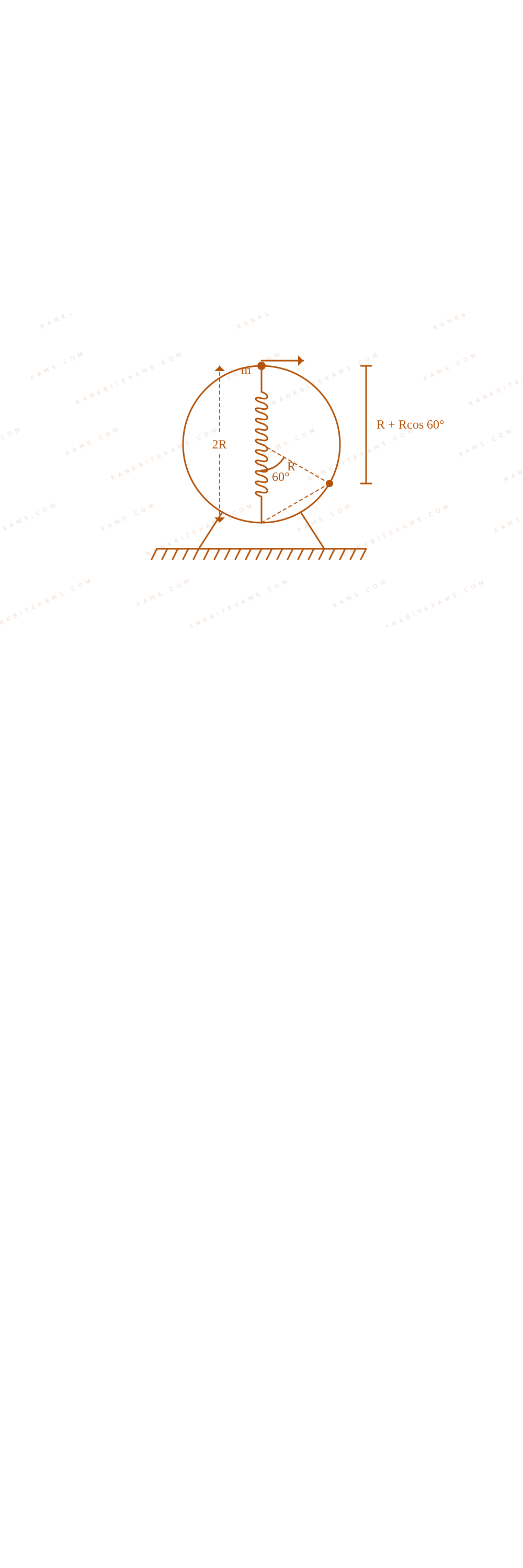
As shown below, bob A of a pendulum having massless string of length 'R' is released from 60^circ to the vertical. It hits another bob B of half the mass that is at rest on a friction less table in the centre. Assuming elastic collision, the magnitude of the velocity of bob A after the collision will be (take g as acceleration due to gravity)
Collisions diagram for Q10 - JEE Main 2025 Morning
The diagram displays a pendulum bob A suspended at an angle of 60 degrees ready to strike bob B at the lowest equilibrium center point.
  • A. frac13 sqrtmathrmRg
  • B. sqrtmathrmRg
  • C. frac43 sqrtmathrmRg
  • D. frac23 sqrtmathrmRg

Solution

### Related Formula u = sqrt2gh = sqrt2gR(1 - costheta) v_1 = left(fracm_1 - m_2m_1 + m_2right)u + left(frac2m_2m_1 + m_2right)v_2i ### Core Logic
Collisions explanation diagram for Q10
The diagram displays a pendulum bob A suspended at an angle of 60 degrees ready to strike bob B at the lowest equilibrium center point.
Velocity of bob A just prior to collision : u = sqrt2gleft(R - Rcos 60^circright) = sqrt2gfracR2 = sqrtgR Using conservation of momentum and coefficient of restitution e=1 for elastic interaction [cite: 660, 662]: m_A u = m_A v_1 + m_B v_2 implies m u = m v_1 + fracm2 v_2 implies 2v_1 + v_2 = 2u ### Step 1: Apply Restitution Velocity Difference v_2 - v_1 = u Subtracting equations yields : 3v_1 = u implies v_1 = fracu3 = frac13sqrtgR ### Pattern Recognition In an elastic head-on collision where one body hits half its mass at rest, it retains exactly one-third of its initial hitting speed[cite: 661, 663]. ### Chapter Mix Class 11 Physics: Work, Energy and Power
More Work, Energy and Power Questions — jee_main_2026_21_jan_morning

Practice all Work, Energy and Power previous-year questions →

Rankbit System
JEE Physics: Waves (+15.5%) | Electrostatics: Concentric Shells (-29.7%) | Modern Physics: Photoelectric Clones (+34.2%) | Mathematics: Definite Integrals (+18.1%) | Chemistry: Coordination Splitting (-11.4%) | JEE Physics: Waves (+15.5%) | Electrostatics: Concentric Shells (-29.7%) | Modern Physics: Photoelectric Clones (+34.2%) | Mathematics: Definite Integrals (+18.1%) | Chemistry: Coordination Splitting (-11.4%)
YOUR FIRST PREP STEP STARTS HERE

We Map Every Repeating Question in Competitive Exams.

Say goodbye to generic mock test fatigue. RankBit uses smart analysis to group past exam questions into their foundational Repeating Question Types. Find chapter weightage, track repeating questions, and score higher with targeted practice.

Select Your Target Exam

Choose an exam track below to find formulas per chapter and patterns.

Syncing Exam Intelligence

Mapping formulas and patterns across all tracks…

PATH A — FULL LENGTH PRACTICE

Full Mock Test Hub

Simulate real NTA exam conditions with fully tracked mocks. Time yourself against past papers.

Now Live Open
PATH B — TARGETED PRACTICE

Topic-wise Practice Hub

Practice past-year questions one chapter at a time. Pick an exam → subject → chapter and get every PYQ for that topic — pulled together from all past papers — with the chapter's key formulas alongside.

Loading Questions... Browse Topics
Latest from the Blog
View all →

Loading articles...