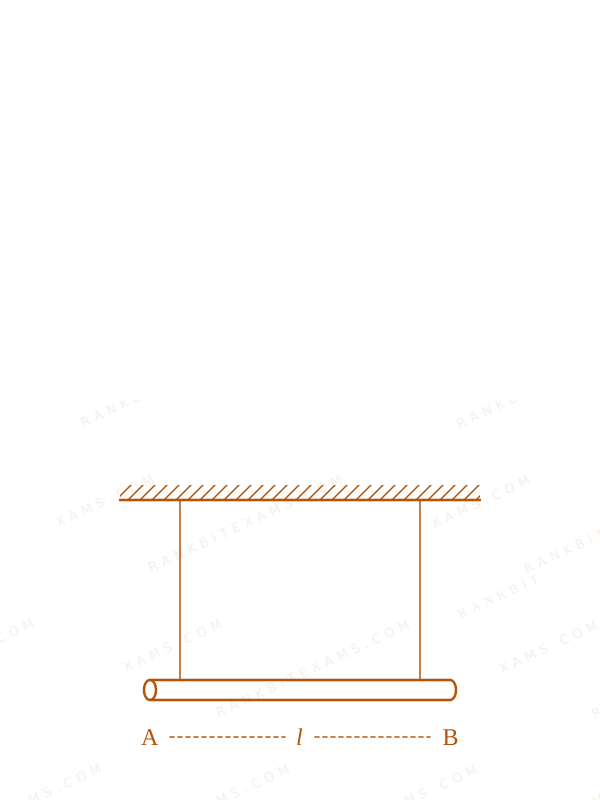
A uniform rod of mass m and length l suspended by means of two identical inextensible light strings as shown in figure. Tension in one string immediately after the other string is cut, is ____. (g acceleration due to gravity)
Rigid Body Dynamics diagram for Q39 - JEE Main 2026 Morning
A uniform rod suspended horizontally by two strings attached at its ends.

Solution & Explanation

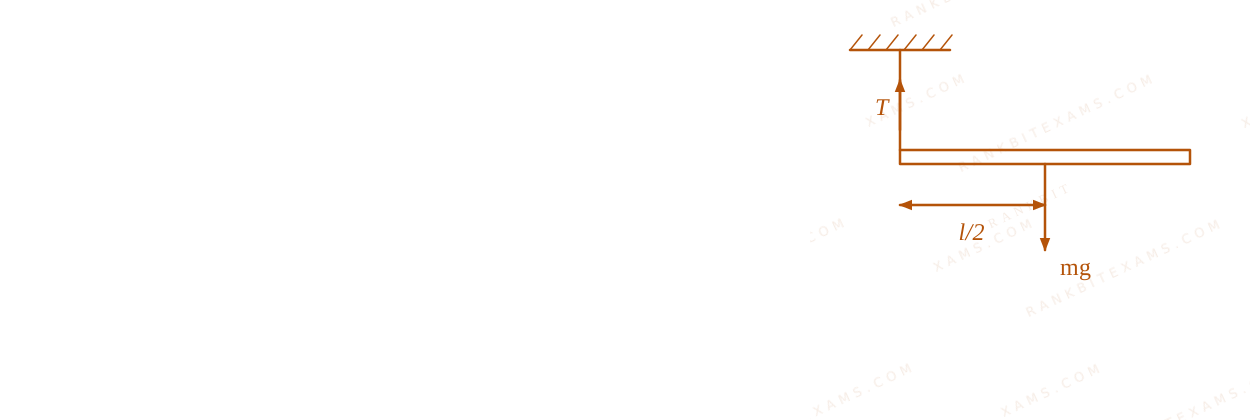
### Related Formula tau = Ialpha Sigma F_y = m a_CM, y a_CM, y = alpha fracl2 ### Core Logic Immediately after one string is cut, the rod starts rotating about the point where the remaining string is attached. Taking torque about the end where the string is attached (this point has instantaneous acceleration but initially zero vertical velocity): tau_textend = I_textend alpha Gravity provides the torque: tau = mg left(fracl2right). ### Step 1: Calculate Angular Acceleration Moment of inertia about the end is I = fracml^23. mg fracl2 = fracml^23 alpha alpha = frac3g2l
Rigid Body Dynamics solution diagram for Q39 - JEE Main 2026 Morning
A uniform rod suspended horizontally by two strings attached at its ends.
### Step 2: Calculate Force and Tension The acceleration of the center of mass (CM) is downwards: a_c = alpha fracl2 = left(frac3g2lright) left(fracl2right) = frac3g4 Applying Newton's second law for translational motion of the CM in vertical direction: mg - T = m a_c T = mg - m a_c = mg - m left(frac3g4right) = fracmg4 ### Pattern Recognition Classic 'cut string' rigid body problem. Always take torque about the pivot/hinge point to find alpha, then relate the center of mass linear acceleration a = r_cm alpha to find the unknown tension using F_textnet = ma. ### Evaluation Rubric / Model Answer null ### Chapter Mix Class 11 Physics: System of Particles and Rotational Motion

More System of Particles and Rotational Motion Previous-Year Questions — Page 8

Q48 jee_main_2024_30_jan_morning Angular Momentum of a Projectile
A particle of mass m projected with a velocity 'u' making an angle of 30^circ with the horizontal. The magnitude of angular momentum of the projectile about the point of projection when the particle is at its maximum height h is :
  • A. fracsqrt316 fracmu^3g
  • B. fracsqrt32 fracmu^2g
  • C. fracmu^3sqrt2g
  • D. textzero

Solution

### Related Formula L = m v_perp r_perp = m (u cos theta) H H_max = fracu^2 sin^2 theta2g ### Core Logic At maximum height, the vertical component of velocity is zero, so the only velocity is horizontal (u cos theta). The perpendicular distance from the line of action of this velocity to the origin is exactly the maximum height H. ### Step 1: Calculate Angular Momentum L = m cdot (u cos theta) cdot H Substitute H = fracu^2 sin^2 theta2g: L = m u cos theta left( fracu^2 sin^2 theta2g right) ### Step 2: Plug in Angles For theta = 30^circ: L = fracm u^32g cos(30^circ) sin^2(30^circ) L = fracm u^32g times fracsqrt32 times left(frac12right)^2 L = fracsqrt3 m u^316g ### Pattern Recognition Angular momentum of a projectile at apex about the launch point strictly uses the horizontal velocity component coupled with the maximum height as the lever arm: L = mv_x H. ### Evaluation Rubric / Model Answer null ### Chapter Mix Class 11 Physics: System of Particles and Rotational Motion Class 11 Physics: Kinematics
Q58 jee_main_2024_30_jan_morning Conservation of Angular Momentum
Consider a Disc of mass 5 mathrm~kg, radius 2 mathrm~m, rotating with angular velocity of 10 mathrm~rad/s about an axis perpendicular to the plane of rotation. An identical disc is kept gently over the rotating disc along the same axis. The energy dissipated so that both the discs continue to rotate together without slipping is ________ J.
Conservation of Angular Momentum diagram for Q58 - JEE Main 2024 Morning
A 5kg disc spinning at 10 rad/s before a second identical disc is added.
Numerical Answer. Answer: 250 to 250

Solution

### Related Formula I = fracMR^22 quad (textfor a solid disc) L = I omega E = frac12 I omega^2 ### Core Logic Since no external torque acts on the system along the axis of rotation, the angular momentum of the system is conserved. After coupling, the total moment of inertia doubles, slowing the common angular velocity. The kinetic energy lost goes into frictional heat between the discs. ### Step 1: Calculate Initial State Moment of inertia of one disc: I = fracMR^22 = frac5 times 2^22 = 10 mathrm~kg\,m^2 Initial angular momentum: L_i = I omega_i = 10 times 10 = 100 mathrm~kg\,m^2/s Initial kinetic energy: E_i = frac12 I omega_i^2 = frac12(10)(10)^2 = 500 mathrm~J ### Step 2: Conservation of Angular Momentum vecL_i = vecL_f 100 = 2I omega_f = 2(10) omega_f 100 = 20 omega_f Rightarrow omega_f = 5 mathrm~rad/s ### Step 3: Calculate Final Energy and Loss Final kinetic energy (for both discs): E_f = frac12 (2I) omega_f^2 = frac12 (20) (5)^2 = 10 times 25 = 250 mathrm~J Energy dissipated: Delta E = E_i - E_f = 500 - 250 = 250 mathrm~J ### Pattern Recognition When an identical object drops onto a spinning object (I_f = 2I_i), conservation of L dictates omega_f = omega_i / 2. Rotational KE (L^2 / 2I) is inversely proportional to I. Thus, doubling I halves the KE. The loss is exactly half the initial energy. ### Evaluation Rubric / Model Answer null ### Chapter Mix Class 11 Physics: System of Particles and Rotational Motion
Q55 jee_main_2024_31_jan_evening Angular Momentum
A body of mass 'm' is projected with a speed 'u' making an angle of 45^circ with the ground. The angular momentum of the body about the point of projection, at the highest point is expressed as fracsqrt2 m u^3X g. The value of 'X' is ________.
Numerical Answer. Answer: 8 to 8

Solution

### Related Formula H = fracu^2 sin^2 theta2g L = m v_x H_max (for highest point) ### Core Logic At the highest point in a projectile's trajectory, the velocity is entirely horizontal (v_x = u cos theta). The perpendicular distance from the point of projection to the line of motion is the maximum height H. ### Step 1: Calculate Velocity and Height Horizontal velocity: v_x = u cos theta Maximum height: H = fracu^2 sin^2 theta2g ### Step 2: Angular Momentum Calculation L = m times (u cos theta) times left(fracu^2 sin^2 theta2gright) For theta = 45^circ: cos(45^circ) = 1/sqrt2 sin^2(45^circ) = (1/sqrt2)^2 = 1/2 L = m times left(fracusqrt2right) times left(fracu^2 (1/2)2gright) L = m times fracusqrt2 times fracu^24g = fracm u^34sqrt2 g ### Step 3: Match Format We need the format to be fracsqrt2 m u^3X g. Multiply numerator and denominator by sqrt2: L = fracsqrt2 m u^34 times 2 times g = fracsqrt2 m u^38g Thus, X = 8. ### Pattern Recognition Angular momentum at the apex is always m(u costheta)(H_max). Be careful with algebraic rationalization at the end to match the given exact format. ### Evaluation Rubric / Model Answer null ### Chapter Mix Class 11 Physics: System of Particles and Rotational Motion Class 11 Physics: Motion in a Plane
Q58 jee_main_2024_31_jan_evening Moment of Inertia
Two identical spheres each of mass 2 text kg and radius 50 text cm are fixed at the ends of a light rod so that the separation between the centers is 150 text cm. Then, moment of inertia of the system about an axis perpendicular to the rod and passing through its middle point is fracx20 text kg m^2, where the value of x is
Numerical Answer. Answer: 53 to 53

Solution

### Related Formula I = I_cm + Md^2 For a solid sphere, I_cm = frac25MR^2. ### Core Logic Apply the Parallel Axis Theorem for each sphere. The total moment of inertia is twice the moment of inertia of a single sphere shifted from its center to the middle of the rod.
Moment of Inertia diagram for Q58 - JEE Main 2024 Evening
### Step 1: Establish Parameters Mass M = 2 text kg Radius R = 50 text cm = 0.5 text m = frac12 text m Distance between centers = 150 text cm = 1.5 text m. Distance from axis of rotation to the center of each sphere is d = frac1.52 = 0.75 text m = frac34 text m. ### Step 2: Calculate Inertia I_total = 2 times left[ frac25MR^2 + Md^2 right] I_total = 2 times left[ frac25(2)left(frac12right)^2 + (2)left(frac34right)^2 right] I_total = 2 times left[ frac45left(frac14right) + 2left(frac916right) right] I_total = 2 times left[ frac15 + frac98 right] I_total = 2 times left[ frac8 + 4540 right] I_total = 2 times frac5340 = frac5320 text kg m^2 ### Step 3: Extract x Comparing with fracx20 text kg m^2, we get: x = 53 ### Pattern Recognition Watch out for units. Convert cm to meters immediately. Use fractions (1/2 and 3/4) instead of decimals to rapidly solve the resulting squared terms without arithmetic errors. ### Evaluation Rubric / Model Answer null ### Chapter Mix Class 11 Physics: System of Particles and Rotational Motion
Q54 jee_main_2024_31_jan_morning Rolling Kinetic Energy
A solid circular disc of mass 50 mathrm~kg rolls along a horizontal floor so that its center of mass has a speed of 0.4 mathrm~m / mathrms. The absolute value of work done on the disc to stop it is ______ mathrmJ.
Numerical Answer. Answer: 6 to 6

Solution

### Related Formula W = Delta textKE K_textrolling = frac12 m v^2 left(1 + frack^2R^2right) ### Core Logic According to the Work-Energy Theorem, the total work done is equal to the change in kinetic energy. Since the disc comes to rest, final kinetic energy is zero. W = 0 - left(frac12 m v^2 + frac12 I omega^2right) ### Step 2: Calculation For a solid circular disc, I = frac12mR^2, thus frack^2R^2 = frac12. W = - frac12 m v^2 left(1 + frack^2R^2right) W = - frac12 times 50 times (0.4)^2 left(1 + frac12right) W = - 25 times 0.16 times 1.5 W = - 6mathrm\,J The absolute value of work done |W| = 6mathrm\,J. ### Evaluation Rubric / Model Answer null ### Chapter Mix Class 11 Physics: System Of Particles And Rotational Motion Class 11 Physics: Work, Energy And Power

More System of Particles and Rotational Motion Questions — jee_main_2026_21_jan_morning

Practice all System of Particles and Rotational Motion previous-year questions →

Rankbit System
JEE Physics: Waves (+15.5%) | Electrostatics: Concentric Shells (-29.7%) | Modern Physics: Photoelectric Clones (+34.2%) | Mathematics: Definite Integrals (+18.1%) | Chemistry: Coordination Splitting (-11.4%) | JEE Physics: Waves (+15.5%) | Electrostatics: Concentric Shells (-29.7%) | Modern Physics: Photoelectric Clones (+34.2%) | Mathematics: Definite Integrals (+18.1%) | Chemistry: Coordination Splitting (-11.4%)
YOUR FIRST PREP STEP STARTS HERE

We Map Every Repeating Question in Competitive Exams.

Say goodbye to generic mock test fatigue. RankBit uses smart analysis to group past exam questions into their foundational Repeating Question Types. Find chapter weightage, track repeating questions, and score higher with targeted practice.

Select Your Target Exam

Choose an exam track below to find formulas per chapter and patterns.

Syncing Exam Intelligence

Mapping formulas and patterns across all tracks…

PATH A — FULL LENGTH PRACTICE

Full Mock Test Hub

Simulate real NTA exam conditions with fully tracked mocks. Time yourself against past papers.

Now Live Open
PATH B — TARGETED PRACTICE

Topic-wise Practice Hub

Practice past-year questions one chapter at a time. Pick an exam → subject → chapter and get every PYQ for that topic — pulled together from all past papers — with the chapter's key formulas alongside.

Loading Questions... Browse Topics
Latest from the Blog
View all →

Loading articles...