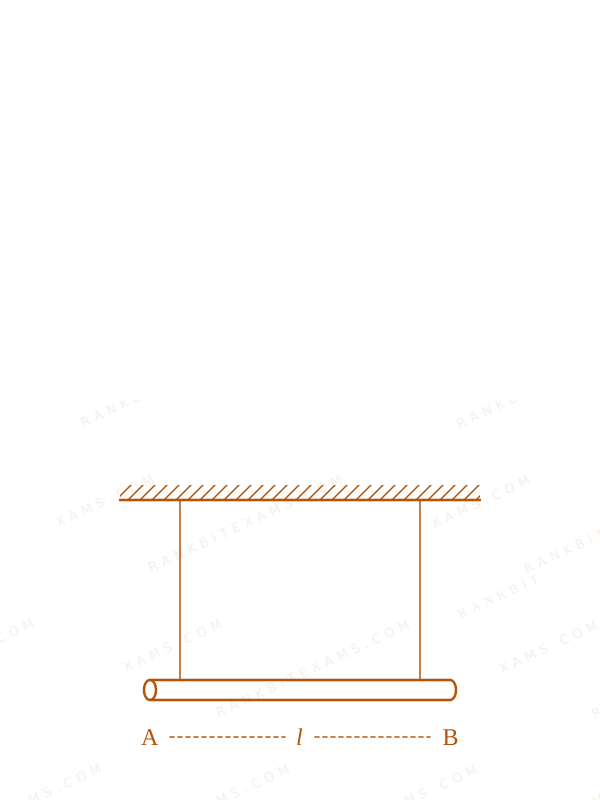
A uniform rod of mass m and length l suspended by means of two identical inextensible light strings as shown in figure. Tension in one string immediately after the other string is cut, is ____. (g acceleration due to gravity)
A uniform rod suspended horizontally by two strings attached at its ends.
A.mg/2$mg/2$
B.mg/4$mg/4$
C.mg/3$mg/3$
D.mg$mg$
Solution & Explanation
Related Formula
τ = Iα$\tau = I\alpha$
Σ Fy = m aCM, y$$\Sigma F_y = m a_{CM, y}$$aCM, y = α (l)/(2)$$a_{CM, y} = \alpha \frac{l}{2}$$
Core Logic
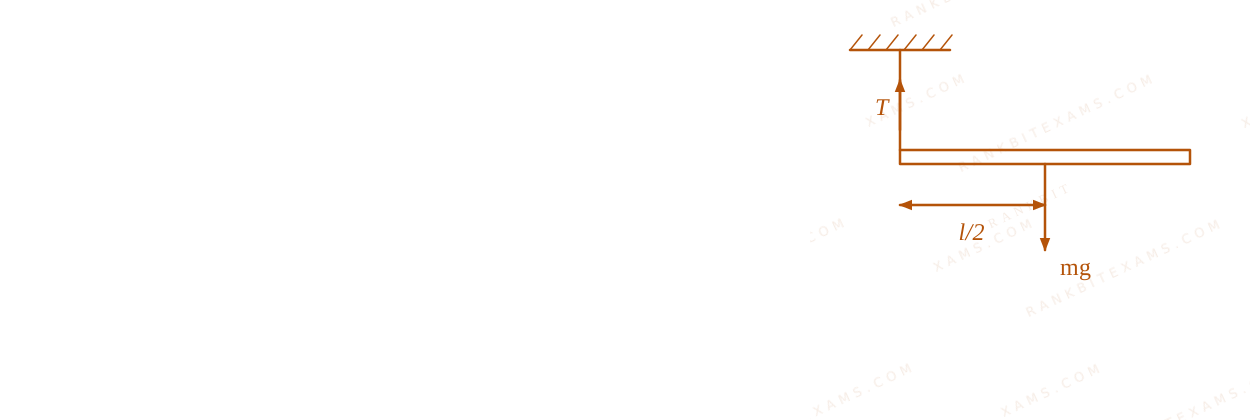
Immediately after one string is cut, the rod starts rotating about the point where the remaining string is attached.
Taking torque about the end where the string is attached (this point has instantaneous acceleration but initially zero vertical velocity):
Applying Newton's second law for translational motion of the CM in vertical direction:
mg - T = m ac$$mg - T = m a_{c}$$T = mg - m ac = mg - m ((3g)/(4)) = (mg)/(4)$$T = mg - m a_{c} = mg - m \left(\frac{3g}{4}\right) = \frac{mg}{4}$$
Pattern Recognition
Classic 'cut string' rigid body problem. Always take torque about the pivot/hinge point to find α$\alpha$, then relate the center of mass linear acceleration a = rcm α$a = r_{cm} \alpha$ to find the unknown tension using Fₙₑₜ = ma$F_{\text{net}} = ma$.
Chapter Mix
Class 11 Physics: System of Particles and Rotational Motion
Keywords:#rod suspended#two strings#tension cut
More System of Particles and Rotational Motion Previous-Year Questions — Page 4
Q49jee_main_2026_24_january_eveningMoment of Inertia of Continuous Bodies
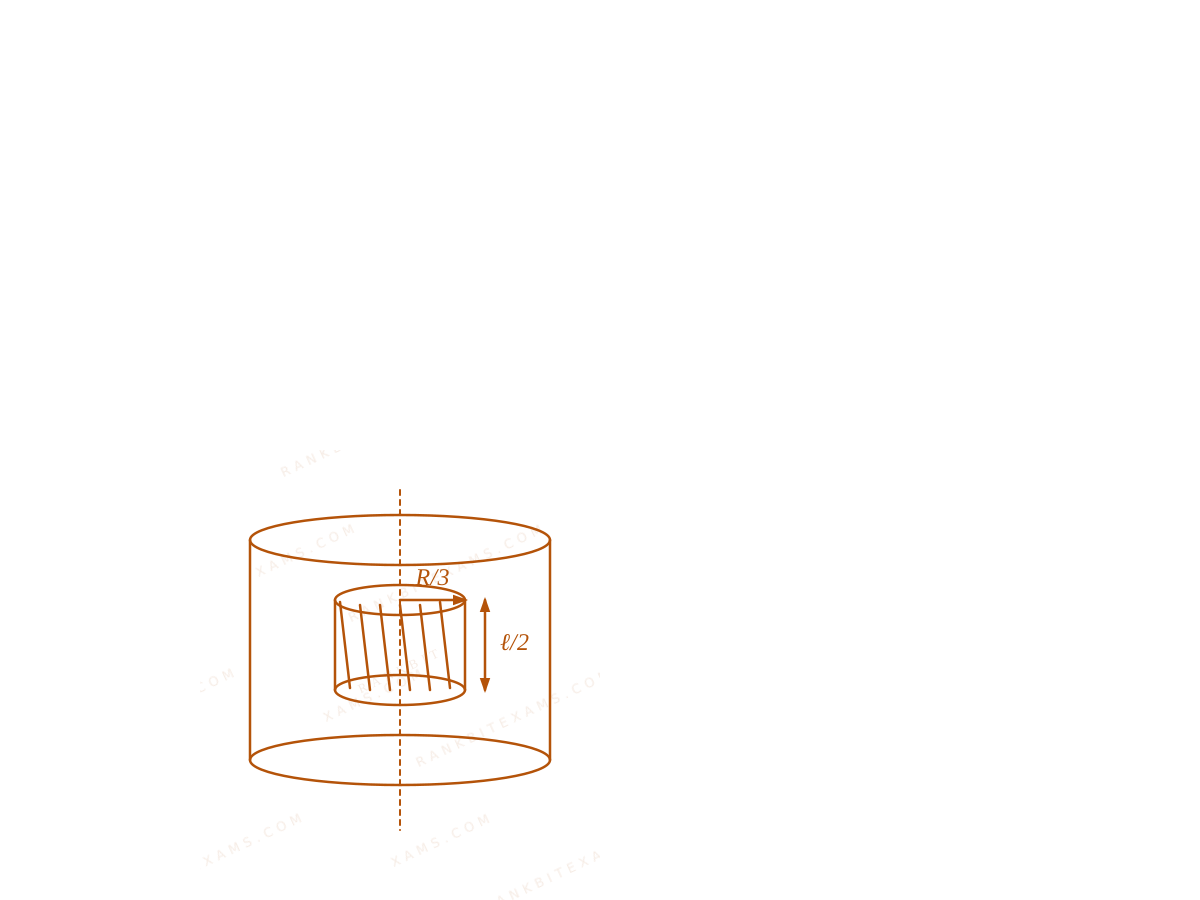
A uniform solid cylinder of length L and radius R has moment of inertia about its axis equal to I₁$I_{1}$ . A small co-centric cylinder of length L/2 and radius R/3 carved from this cylinder has moment of inertia about its axis equals to I₂$I_{2}$ . The ratio I₁/I₂$I_{1}/I_{2}$ is
Numerical Answer.Answer: 162 to 162
Solution
Related Formula
I = (1)/(2) M R²$$I = \frac{1}{2} M R^2$$M = ρ · V = ρ · π R² L$$M = \rho \cdot V = \rho \cdot \pi R^2 L$$
Core Logic
Moment of Inertia of Continuous Bodies diagram for Q49 - JEE Main 2026 Evening
I₂ = (1)/(2) m ((R)/(3))²$$I_2 = \frac{1}{2} m \left(\frac{R}{3}\right)^2$$I₂ = (1)/(2) ( (M)/(18) ) ( (R²)/(9) )$$I_2 = \frac{1}{2} \left( \frac{M}{18} \right) \left( \frac{R^2}{9} \right)$$I₂ = (1)/(324) M R²$$I_2 = \frac{1}{324} M R^2$$
Step 3: Finding the Ratio
(I₁)/(I₂) = ((1)/(2) M R²)/((1)/(324) M R²) = (324)/(2) = 162$$\frac{I_1}{I_2} = \frac{\frac{1}{2} M R^2}{\frac{1}{324} M R^2} = \frac{324}{2} = 162$$
Pattern Recognition
For similar geometries, mass scales as R² L$R^2 L$. Inertia scales as M R²$M R^2$ which ultimately means I ∝ R⁴ L$I \propto R^4 L$. Here R arrow R/3$R \rightarrow R/3$ (factor of 1/81$1/81$) and L arrow L/2$L \rightarrow L/2$ (factor of 1/2$1/2$), so I₂$I_2$ is 1/162$1/162$ of I₁$I_1$.
Chapter Mix
Class 11 Physics: System of Particles and Rotational Motion
Q29jee_main_2026_28_january_morningMoment of Inertia and Torque
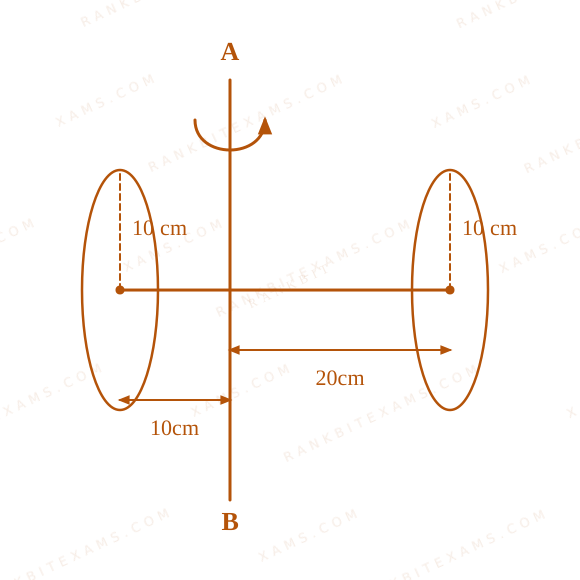
Two circular discs of radius each 10 cm are joined at their centres by a rod of length 30 cm and mass 600 gm as shown in figure.
Illustration showing two discs connected by a rod rotating about axis AB.
If the mass of each disc is 600 gm and applied torque between two discs is 43 × 10⁵ ~dyne· cm$43 \times 10^{5} \mathrm{~dyne\cdot cm}$, the angular acceleration of the discs about the given axis AB is ____ rad/s²$\mathrm{rad/s}^{2}$ .
A.22$22$
B.11$11$
C.100$100$
D.27$27$
Solution
Related Formula
τ = I α$\tau = I \alpha$
where τ$\tau$ is the torque, I$I$ is the moment of inertia about the axis of rotation, and α$\alpha$ is the angular acceleration.
Core Logic
First, calculate the total moment of inertia of the system (two discs + one rod) about axis AB using the parallel axis theorem. Let m = 600 ~gm$m = 600 \mathrm{~gm}$ and R = 10 ~cm$R = 10 \mathrm{~cm}$.
In compound systems, decompose into basic shapes (rod, disc). Determine the parallel distance to the required axis for each center of mass. Keep everything in CGS units since torque is given in dyne-cm.
Chapter Mix
Class 11 Physics: System of Particles and Rotational Motion
Q48jee_main_2026_28_january_morningRadius of Gyration
A solid sphere of radius 10 cm is rotating about an axis which is at a distance 15 cm from its centre. The radius of gyration about this axis is √(n)$\sqrt{n}$ cm. The value of n is ____
We are given k = √(n) ⇒ k² = n$k = \sqrt{n} \Rightarrow k^2 = n$.
n = 265$n = 265$
Pattern Recognition
Whenever radius of gyration is asked, divide out the mass immediately. k² = Icm-factor R² + d²$k^2 = I_{\text{cm-factor}} R^2 + d^2$.
Chapter Mix
Class 11 Physics: System of Particles and Rotational Motion
Q37jee_main_2026_28_january_eveningCross Product and Vector Reversal
When the position vector r=x i+y j+z k$\vec{r}=x\hat{i}+y\hat{j}+z\hat{k}$ changes sign as - r$-\vec{r}$ , which one of the following vector will not flip under sign change?
A.Linear momentum$\text{Linear momentum}$
B.Velocity$\text{Velocity}$
C.Acceleration$\text{Acceleration}$
D.Angular momentum$\text{Angular momentum}$
Solution
Related Formula
v = d rdt$$\vec{v} = \frac{d\vec{r}}{dt}$$p = m v$$\vec{p} = m\vec{v}$$a = d vdt$$\vec{a} = \frac{d\vec{v}}{dt}$$L = r × p$$\vec{L} = \vec{r} \times \vec{p}$$
Core Logic
Under a sign change of coordinates (parity transformation or spatial inversion) r arrow - r$\vec{r} \rightarrow -\vec{r}$.
Then, velocity v = d rdt arrow - v$\vec{v} = \frac{d\vec{r}}{dt} \rightarrow -\vec{v}$.
Linear momentum p = m v arrow - p$\vec{p} = m\vec{v} \rightarrow -\vec{p}$.
Acceleration a = d vdt arrow - a$\vec{a} = \frac{d\vec{v}}{dt} \rightarrow -\vec{a}$.
Angular momentum L = r × p$\vec{L} = \vec{r} \times \vec{p}$.
Under the transformation: L' = (- r) × (- p) = r × p = L$\vec{L}' = (-\vec{r}) \times (-\vec{p}) = \vec{r} \times \vec{p} = \vec{L}$.
Step 1: Final Conclusion
Since both position and momentum vectors change sign, their cross product (angular momentum) retains its original sign. It does not flip.
Pattern Recognition
Angular momentum is a pseudovector (or axial vector). True vectors (polar vectors) flip signs under spatial inversion, but pseudovectors (which are cross products of two polar vectors) do not.
Chapter Mix
Class 11 Physics: Systems of Particles and Rotational Motion
Q50jee_main_2026_28_january_eveningRotation about Fixed Axis
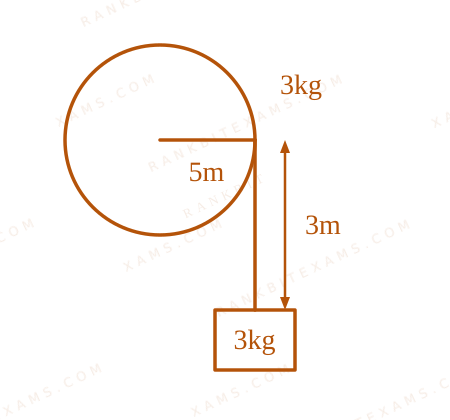
A fly wheel having mass 3 kg$3 \text{ kg}$ and radius 5 m$5 \text{ m}$ is free to rotate about a horizontal axis. A string having negligible mass is wound around the wheel and the loose end of the string is connected to a 3 kg$3 \text{ kg}$ mass. The mass is kept at rest initially and released. Kinetic energy of the wheel when the mass descends by 3 m$3 \text{ m}$ is ____ J. (g = 10 m/s²$g = 10 \text{ m/s}^{2}$ )
Solution for Rotation about Fixed Axis
By conservation of mechanical energy, the loss in gravitational potential energy of the descending mass equals the gain in kinetic energy of the block and the rotational kinetic energy of the flywheel.
mg h = (1)/(2) I ω² + (1)/(2) m v²$$mg h = \frac{1}{2} I \omega^2 + \frac{1}{2} m v^2$$
Step 1: Relate Velocity and Angular Velocity
Since the string does not slip, the linear velocity v$v$ of the mass is related to the angular velocity ω$\omega$ of the wheel by:
v = ω R ⇒ ω = (v)/(R)$$v = \omega R \Rightarrow \omega = \frac{v}{R}$$
Step 2: Energy Conservation
The flywheel is treated as a solid disc/cylinder (from the I = mR²/2$I = mR^2/2$ usage in the solution):
mg h = (1)/(2) ((M R²)/(2)) ω² + (1)/(2) m v²$$mg h = \frac{1}{2} \left(\frac{M R^2}{2}\right) \omega^2 + \frac{1}{2} m v^2$$
Given M = 3 kg$M = 3 \text{ kg}$ (wheel), m = 3 kg$m = 3 \text{ kg}$ (block), h = 3 m$h = 3 \text{ m}$.
Notice that the solution text specifies the flywheel mass as m$m$ and block mass also as m$m$, both being 3 kg$3\text{ kg}$. Let's follow the PDF exactly:
mg × 3 = (1)/(4) m v² + (1)/(2) m v²$$mg \times 3 = \frac{1}{4} m v^2 + \frac{1}{2} m v^2$$3mg = (3)/(4) m v²$$3mg = \frac{3}{4} m v^2$$v² = 4g = 4 × 10 = 40 (m/s)²$$v^2 = 4g = 4 \times 10 = 40 \text{ (m/s)}^2$$
Step 4: Calculate Kinetic Energy of Flywheel
K.E.wheel = (1)/(2) I ω² = (1)/(4) m v²$$K.E._{\text{wheel}} = \frac{1}{2} I \omega^2 = \frac{1}{4} m v^2$$K.E.wheel = (1)/(4) × 3 × 40 = 30 J$$K.E._{\text{wheel}} = \frac{1}{4} \times 3 \times 40 = 30 \text{ J}$$
Pattern Recognition
For a mass pulling a wheel of identical mass (disc), the total K.E.$K.E.$ is split between translational (1/2 mv²$1/2 mv^2$) and rotational (1/4 mv²$1/4 mv^2$). Rotational gets exactly 1/3$1/3$ of the total potential energy lost, 30 J$30\text{ J}$ out of 90 J$90\text{ J}$ total.
Chapter Mix
Class 11 Physics: Systems of Particles and Rotational Motion
Class 11 Physics: Work, Energy and Power
More System of Particles and Rotational Motion Questions — jee_main_2026_21_jan_morning
Practice past-year questions one chapter at a time. Pick an exam → subject → chapter and get every PYQ for that topic — pulled together from all past papers — with the chapter's key formulas alongside.