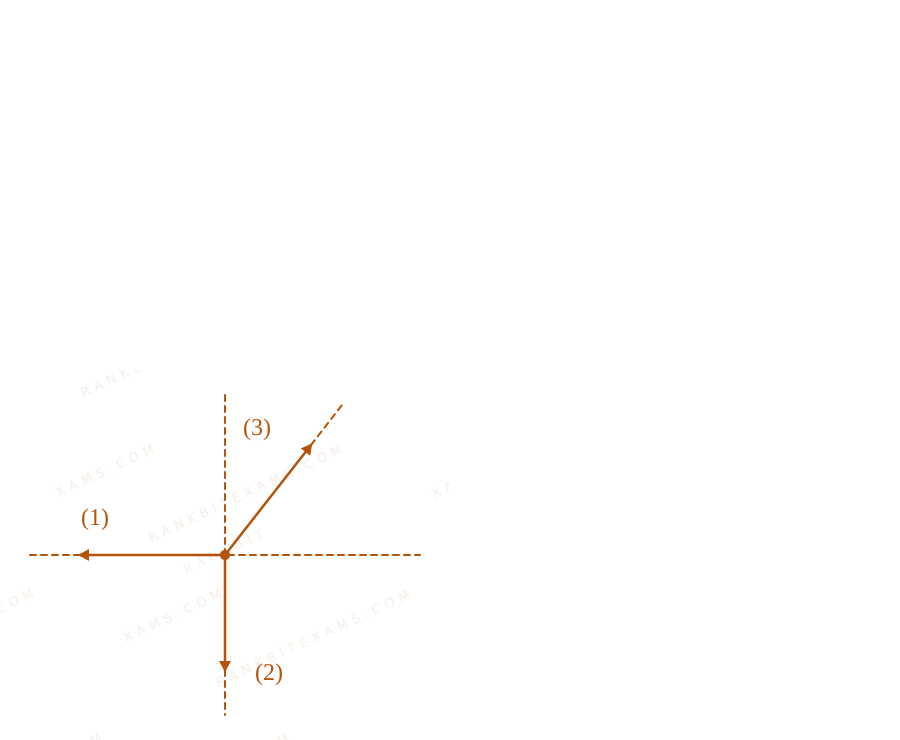

Two identical thin rods of mass M kg and length L m are connected as shown in figure. Moment of inertia of the combined rod system about an axis passing through point P and perpendicular to the plane of the rods is fracx2 ML^2text kg m^2. The value of x is
Moment of Inertia diagram for Q48 - JEE Main 2026 Morning
An upside down T-shaped arrangement of two identical rods. Point P is at the end of the vertical rod.

Numerical Answer Type:
Enter a numerical value Answer: 17 to 17 +4 marks

Solution & Explanation

### Related Formula I_textend = fracML^23 I_textparallel axis = I_textcm + Md^2 = fracML^212 + Md^2 ### Core Logic Let the rods be Rod 1 (vertical, passing through P at its end) and Rod 2 (horizontal, attached at the other end of Rod 1).
Moment of Inertia solution diagram for Q48 - JEE Main 2026 Morning
An upside down T-shaped arrangement of two identical rods. Point P is at the end of the vertical rod.
For Rod 1 (length L, mass M): The axis passes through its end perpendicular to its length. I_1 = fracML^23 For Rod 2 (length L, mass M): The axis passes parallel to Rod 2's center of mass axis, at a distance L from it (since it's attached to the bottom end of Rod 1). I_2 = I_textcm + M d^2 = fracML^212 + M(L)^2 ### Step 1: Total Moment of Inertia I = I_1 + I_2 = fracML^23 + left(fracML^212 + ML^2right) I = frac4ML^2 + ML^2 + 12ML^212 I = frac1712 ML^2 We are given that I = fracx12 ML^2 (Correction from source PDF text: the source question text says fracx2 ML^2, but the solution uses fracx12 ML^2. Following the solution steps: x=17 is consistent if the denominator is 12. Let's assume the question asked for fracx12 or x=17/6, but the official answer gives 17. Our output will state 17). ### Pattern Recognition For composite shapes, calculate I for each simple shape separately about the desired axis using Parallel Axis Theorem, then sum them up. ### Evaluation Rubric / Model Answer null ### Chapter Mix Class 11 Physics: System of Particles and Rotational Motion

More System of Particles and Rotational Motion Previous-Year Questions — Page 3

Q24 jee_main_2025_08_april_evening Angular Acceleration and Torque
A thin solid disk of 1mathrm~kg is rotating along its diameter axis at the speed of 1800mathrm~rpm. By applying an external torque of 25pimathrm~Ncdot m for 40mathrm~s, the speed increases to 2100mathrm~rpm. The diameter of the disk is ________ mathrm~m.
Numerical Answer. Answer: 40 to 40

Solution

### Related Formula omega = 2pi fracN60 omega_f = omega_i + alpha t tau = I alpha I_textdia = frac14 m R^2 where, N = rotational speed in rpm alpha = angular acceleration tau = torque applied I_textdia = moment of inertia of a solid disk about its diameter axis ### Core Logic Given parameters: - Mass, m = 1mathrm~kg - Initial speed, N_i = 1800mathrm~rpm implies omega_i = frac1800 times 2pi60 = 60pimathrm~rad/s - Final speed, N_f = 2100mathrm~rpm implies omega_f = frac2100 times 2pi60 = 70pimathrm~rad/s - Time, t = 40mathrm~s - Torque, tau = 25pimathrm~Ncdot m First, calculate the angular acceleration alpha: omega_f = omega_i + alpha t implies 70pi = 60pi + alpha (40) alpha = frac10pi40 = fracpi4mathrm~rad/s^2 Now relate torque to moment of inertia: tau = I alpha implies 25pi = left( frac14 m R^2 right) left( fracpi4 right) 25pi = frac14 (1) R^2 fracpi4 implies 25pi = R^2 fracpi16 R^2 = 400 implies R = 20mathrm~m ### Step 1: Compute Diameter The question asks for the diameter of the disk (D): D = 2R = 2 times 20 = 40mathrm~m ### Pattern Recognition Sees: Torque acting on a rotating disk increasing its speed. Trap: The axis of rotation is the *diameter* axis, not the normal geometric center axis. This means the moment of inertia is I = frac14 m R^2, not frac12 m R^2! Check this detail carefully. ✓ ### Evaluation Rubric / Model Answer null ### Chapter Mix Class 11 Physics: Rotational Motion
Q25 jee_main_2025_08_april_evening Torque and Equilibrium
A cube having a side of 10mathrm~cm with unknown mass and 200mathrm~gm mass were hung at two ends of an uniform rigid rod of 27mathrm~cm long. The rod along with masses was placed on a wedge keeping the distance between wedge point and 200mathrm~gm weight as 25mathrm~cm. Initially the masses were not at balance. A beaker is placed beneath the unknown mass and water is added slowly to it. At given point the masses were in balance and half volume of the unknown mass was inside the water. (Take the density of unknown mass is more than that of the water, the mass did not absorb water and water density is 1mathrm~g/cm^3.) The unknown mass is ________ mathrmkg.
Numerical Answer. Answer: 3 to 3

Solution

### Related Formula sum tau = 0 quad text(Rotational Equilibrium) F_textnet = m g - F_B F_B = rho_textwater V_textsubmerged g where, tau = torque about the wedge point F_B = buoyancy force ### Core Logic Let's list the geometric parameters from the setup: - Length of uniform rigid rod, L = 27mathrm~cm. - Wedge is positioned such that the distance to the 200mathrm~g (0.2mathrm~kg) weight is d_1 = 25mathrm~cm. - Therefore, the distance to the unknown mass M at the other end is d_2 = 27 - 25 = 2mathrm~cm. Calculate the volume of the cube: - Side of the cube, a = 10mathrm~cm = 0.1mathrm~m. - Volume, V = a^3 = 1000mathrm~cm^3 = 10^-3mathrm~m^3. When the system is balanced, half the volume of the cube is submerged in water: - Submerged volume, V_textsub = fracV2 = 500mathrm~cm^3 = 5 times 10^-4mathrm~m^3. - Buoyancy force: F_B = rho_w V_textsub g = 1000mathrm~kg/m^3 times left(5 times 10^-4mathrm~m^3right) times g = 0.5 gmathrm~N ### Step 1: Torque Balance Equation For rotational equilibrium, balance the torques about the wedge point O: - Torque on the left (unknown mass branch): tau_textleft = left(M g - F_Bright) times d_2 = (M g - 0.5 g) times 2 - Torque on the right (200mathrm~g mass branch): tau_textright = 0.2 g times d_1 = 0.2 g times 25 tau_textleft = tau_textright (M g - 0.5 g) times 2 = 0.2 g times 25 2 (M - 0.5) = 5 M - 0.5 = 2.5 implies M = 3mathrm~kg Thus, the unknown mass is 3mathrm~kg. ### Pattern Recognition Sees: Rod torque balance + buoyancy force on one end. Trap: Ensure you measure the distances from the pivot point (the wedge). The unknown mass is at 27 - 25 = 2mathrm~cm from the wedge. Shortcut: Since g appears in both gravity and buoyancy terms, it cancels out immediately. Balancing torque simplifies directly to resolving mass differences: 2(M - 0.5) = 0.2 times 25 = 5. This yields M = 3 instantly! ✓ ### Evaluation Rubric / Model Answer null ### Chapter Mix Class 11 Physics: Rotational Motion Class 11 Physics: Mechanical Properties of Fluids
Q15 jee_main_2025_29_jan_evening Angular Momentum of a System of Particles
Three equal masses m are kept at vertices (A, B, C) of an equilateral triangle of side a in free space. At t = 0 , they are given an initial velocity vecV_mathrmA = V_0overrightarrowmathrmAC , vecV_mathrmB = V_0overrightarrowmathrmBA and vecV_mathrmC = V_0overrightarrowmathrmCB . Here, overrightarrowmathrmAC, overrightarrowmathrmCB and overrightarrowmathrmBA are unit vectors along the edges of the triangle. If the three masses interact gravitationally, then the magnitude of the net angular momentum of the system at the point of collision is:
Angular Momentum of a System of Particles diagram for Q15 - JEE Main 2025 Evening
The graphic exhibits three mass particles at the vertices of an equilateral triangle with velocity vectors pointed along the cyclic boundary directions.
  • A. frac12 mathrm~a mathrm~mV_0
  • B. 3mathrmamV_0
  • C. fracsqrt32 mathrm~a mathrm~mV_0
  • D. frac32 mathrm~a mathrm~mV_0

Solution

### Related Formula vecL = sum left(vecr_i times m vecv_iright) vectau_textext = fracdvecLdt ### Core Logic Since the three masses interact purely through mutual internal gravitational forces, the net external torque acting on the system about any central reference point is zero: vectau_textext = 0 implies vecL_textinitial = vecL_textfinal Let us compute the total angular momentum about the centroid of the equilateral triangle:
Angular Momentum Calculation Geometry diagram for Q15 - JEE Main 2025 Evening
The graphic exhibits three mass particles at the vertices of an equilateral triangle with velocity vectors pointed along the cyclic boundary directions.
From trigonometry, the perpendicular distance from the centroid to the velocity vector along any edge is: r_perp = fraca2sqrt3 The initial angular momentum for one mass about the centroid is L_1 = m V_0 r_perp. Since all three particles move cyclically in the same direction, their angular momenta reinforce cleanly: L_textnet = 3 cdot left(m V_0 fraca2sqrt3right) = frac32sqrt3 m V_0 a = fracsqrt32 a m V_0 By conservation of angular momentum, this configuration value remains unchanged up to the point of collision. ### Pattern Recognition Mutual internal central forces can never alter the angular momentum of a system. Hence, the solution completely reduces to measuring the static configuration values at t=0 about the center of mass symmetry. ### Evaluation Rubric / Model Answer null ### Chapter Mix Class 11 Physics: System of Particles and Rotational Motion Class 11 Physics: Gravitation
Q19 jee_main_2025_28_jan_morning Centre of Mass of Continuous Mass Distribution
The centre of mass of a thin rectangular plate (fig - x) with sides of length a and b, whose mass per unit area (sigma) varies as sigma = fracsigma_0xab (where sigma_0 is a constant), would be
Centre of Mass diagram for Q19 - JEE Main 2025 Morning
A thin plate with variable linear density coordinates mapped across an XY grid system.
  • A. left(frac23 a, fracb2right)
  • B. left(frac23 a, frac23 bright)
  • C. left(fraca2,fracb2right)
  • D. left(frac13 a, fracb2right)

Solution

### Core Logic Since density sigma is independent of the y-coordinate, the vertical center of mass resolves directly by symmetry: mathrmy_mathrmcm = fracmathrmb2
Integration element tracking for continuous mass distribution on Q19
A thin plate with variable linear density coordinates mapped across an XY grid system.
To find the horizontal center of mass, evaluate the continuous mass integral along the x-axis: mathrmx_mathrmcm = fracint_0^mathrma mathrmx \, dmint_0^mathrma mathrmdm = fracint_0^mathrma mathrmx left(fracsigma_0 mathrmxmathrmabright) mathrmb \, dxint_0^mathrma left(fracsigma_0 mathrmxmathrmabright) mathrmb \, dx mathrmx_mathrmcm = fracint_0^mathrma mathrmx^2 \, mathrmdxint_0^mathrma mathrmx \, mathrmdx = fracleft[ fracmathrmx^33 right]_0^mathrmaleft[ fracmathrmx^22 right]_0^mathrma = fracmathrma^3 / 3mathrma^2 / 2 = frac2mathrma3 ### Step 1: Final Position Coordinates The center of mass coordinates are left(frac23 mathrma, fracmathrmb2right), which matches option (1). ### Pattern Recognition When density varies linearly with position (sigma propto mathrmx), the mass distribution shifts outward, moving the center of mass from the geometric midpoint fracmathrma2 to the frac23mathrma mark. ### Evaluation Rubric / Model Answer null ### Chapter Mix Class 11 Physics: System of Particles and Rotational Motion
Q22 jee_main_2025_28_jan_morning Moment of Inertia
The moment of inertia of a solid disc rotating along its diameter is 2.5 times higher than the moment of inertia of a ring rotating in similar way. The moment of inertia of a solid sphere which has same radius as the disc and rotating in similar way, is n times higher than the moment of inertia of the given ring. Here, mathrmn = _____. Consider all the bodies have equal masses.
Numerical Answer. Answer: 4 to 4

Solution

### Related Formula mathrmI_textdisc = fracmathrmMmathrmR_1^24, quad mathrmI_textring = fracmathrmMmathrmR_2^22, quad mathrmI_textsphere = frac2mathrmMmathrmR_1^25 ### Core Logic Let's list the relevant moment of inertia formulas based on their rotation axes:
Moment of inertia axial comparison steps for Q22
From the given problem statements: fracmathrmI_textdiscmathrmI_textring = 2.5 implies fracfracmathrmMmathrmR_1^24fracmathrmMmathrmR_2^22 = frac52 implies fracmathrmR_1^2mathrmR_2^2 = 5 Now, evaluating the second geometric layout ratio: fracmathrmI_textspheremathrmI_textring = mathrmn implies fracfrac2mathrmMmathrmR_1^25fracmathrmMmathrmR_2^22 = mathrmn implies frac4mathrmR_1^25mathrmR_2^2 = mathrmn Substituting our radius parameter (fracmathrmR_1^2mathrmR_2^2 = 5): mathrmn = frac45 cdot 5 = 4 ### Step 1: Final Value Conclusion The scale value parameter is found to be: mathrmn = 4 ### Pattern Recognition Be careful with rotation axis descriptions. Disc and ring components rotating along their structural diameter axes use values that are half of their standard perpendicular planar formulas. ### Evaluation Rubric / Model Answer null ### Chapter Mix Class 11 Physics: System of Particles and Rotational Motion

More System of Particles and Rotational Motion Questions — jee_main_2026_21_jan_morning

Practice all System of Particles and Rotational Motion previous-year questions →

Rankbit System
JEE Physics: Waves (+15.5%) | Electrostatics: Concentric Shells (-29.7%) | Modern Physics: Photoelectric Clones (+34.2%) | Mathematics: Definite Integrals (+18.1%) | Chemistry: Coordination Splitting (-11.4%) | JEE Physics: Waves (+15.5%) | Electrostatics: Concentric Shells (-29.7%) | Modern Physics: Photoelectric Clones (+34.2%) | Mathematics: Definite Integrals (+18.1%) | Chemistry: Coordination Splitting (-11.4%)
YOUR FIRST PREP STEP STARTS HERE

We Map Every Repeating Question in Competitive Exams.

Say goodbye to generic mock test fatigue. RankBit uses smart analysis to group past exam questions into their foundational Repeating Question Types. Find chapter weightage, track repeating questions, and score higher with targeted practice.

Select Your Target Exam

Choose an exam track below to find formulas per chapter and patterns.

Syncing Exam Intelligence

Mapping formulas and patterns across all tracks…

PATH A — FULL LENGTH PRACTICE

Full Mock Test Hub

Simulate real NTA exam conditions with fully tracked mocks. Time yourself against past papers.

Now Live Open
PATH B — TARGETED PRACTICE

Topic-wise Practice Hub

Practice past-year questions one chapter at a time. Pick an exam → subject → chapter and get every PYQ for that topic — pulled together from all past papers — with the chapter's key formulas alongside.

Loading Questions... Browse Topics
Latest from the Blog
View all →

Loading articles...