In a microscope the objective is having focal length f_0 = 2text cm and eye-piece is having focal length f_e = 4text cm. The tube length is 32 cm. The magnification produced by this microscope for normal adjustment is ____.

Numerical Answer Type:
Enter a numerical value Answer: 100 to 100 +4 marks

Solution & Explanation

### Related Formula m approx fracLf_0 times fracDf_e ### Core Logic For a compound microscope in normal adjustment (image formed at infinity), the magnifying power is given by the standard approximation: m simeq fracl Df_0 f_e where l is the tube length, D = 25text cm is the least distance of distinct vision. ### Step 1: Substitute Values Given values: l = 32text cm f_0 = 2text cm f_e = 4text cm D = 25text cm (standard assumption when not given) m = frac322 times frac254 m = 16 times frac254 = 4 times 25 = 100
Microscope solution diagram for Q50 - JEE Main 2026 Morning
### Pattern Recognition Compound microscope formulas: Normal adjustment to image at infty, m = (L/f_0)(D/f_e). Image at near point D, m = (L/f_0)(1 + D/f_e). Default to standard approximation when given tube length. ### Evaluation Rubric / Model Answer null ### Chapter Mix Class 12 Physics: Ray Optics and Optical Instruments
Reference Study Guides

More Ray Optics and Optical Instruments Previous-Year Questions — Page 9

Q34 jee_main_2024_29_jan_morning Spherical Mirrors
A convex mirror of radius of curvature 30 mathrm~cm forms an image that is half the size of the object. The object distance is:
  • A. -15 mathrm~cm
  • B. 45 mathrm~cm
  • C. -45 mathrm~cm
  • D. 15 mathrm~cm

Solution

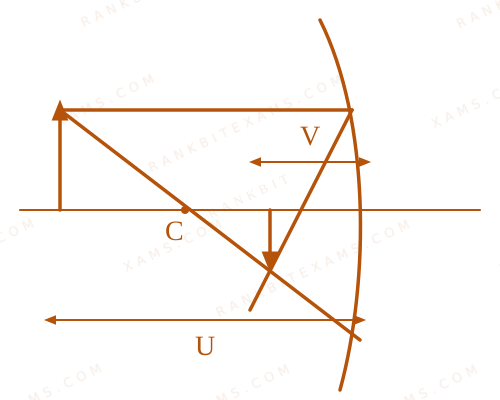
### Related Formula The magnification (m) of a spherical mirror is given by: m = fracff - u where, f = focal length (R/2) u = object distance ### Core Logic Given radius of curvature, R = 30 mathrm~cm. For a convex mirror: f = +fracR2 = +15 mathrm~cm Since a convex mirror always forms a virtual, erect, and diminished image of a real object, the magnification m must be positive: m = +frac12
Ray diagram for convex mirror showing image formation for Q34 - JEE Main 2024 Morning
### Step 1: Solve for Object Distance Using the magnification formula: +frac12 = frac1515 - u 15 - u = 30 implies u = -15 mathrm~cm Thus, the object distance is -15 mathrm~cm. ### Pattern Recognition Remember: Convex mirrors produce *only* virtual images for real objects, which means m is always positive and less than 1. If the question mentioned a concave mirror with a diminished image of half size, the image would be real, and m would be negative. ### Evaluation Rubric / Model Answer null ### Chapter Mix Class 12 Physics: Ray Optics and Optical Instruments
Q45 jee_main_2024_29_jan_morning Refraction at Spherical Surfaces and by Lenses
A biconvex lens of refractive index 1.5 has a focal length of 20 mathrm~cm in air. Its focal length when immersed in a liquid of refractive index 1.6 will be:
  • A. -16 mathrm~cm
  • B. -160 mathrm~cm
  • C. +160 mathrm~cm
  • D. +16 mathrm~cm

Solution

### Related Formula From the Lens Maker's Formula: frac1f = left( fracmu_textlensmu_textmedium - 1 right) left( frac1R_1 - frac1R_2 right) Taking the ratio of focal length in liquid medium (f_m) to focal length in air (f_a): fracf_mf_a = frac(mu_1 - 1) mu_mmu_1 - mu_m where, mu_1 = refractive index of the lens material = 1.5 mu_m = refractive index of the liquid medium = 1.6 f_a = focal length in air = 20 mathrm~cm ### Core Logic Substitute the parameters into the relative ratio template equation: fracf_m20 = frac(1.5 - 1) times 1.61.5 - 1.6 ### Step 1: Simplify and Compute $fracf_m20 = frac0.5 times 1.6-0.1 fracf_m20 = frac0.8-0.1 = -8 f_m = -8 times 20 = -160 mathrm~cm Therefore, the focal length in the liquid is -160 mathrm~cm. ### Pattern Recognition Notice that since the surrounding liquid medium has a higher refractive index than the lens material itself (mu_m gt mu_1), the sign of the focal length flips from positive to negative. The convex lens behaves as a diverging lens inside this specific liquid. ### Evaluation Rubric / Model Answer null ### Chapter Mix Class 12 Physics: Ray Optics and Optical Instruments
Q54 jee_main_2024_30_january_evening Lens Formula and Displacement
In an experiment to measure the focal length (f) of a convex lens, the magnitude of object distance (x) and the image distance (y) are measured with reference to the focal point of the lens. The y-x plot is shown in figure. The focal length of the lens is ________ mathrmcm.
Lens Formula and Displacement diagram for Q54 - JEE Main 2024 Evening
A graph showing y versus x with a curve passing through the point (20, 20).
Numerical Answer. Answer: 20 to 20

Solution

### Related Formula textNewton's Lens Formula: x_1 x_2 = f^2 where x_1 and x_2 are object and image distances from the focal points. ### Core Logic Since distances x and y are measured from the focal point (not the optical center), we use Newton's formula: x y = f^2. From the graph, a prominent point on the curve is (20, 20). ### Step 1: Calculate Focal Length 20 times 20 = f^2 f^2 = 400 implies f = 20 mathrm~cm Alternatively using standard lens formula: Object distance from optical center u = -(f + x) Image distance v = +(f + y) frac1v - frac1u = frac1f frac1f+y - frac1-(f+x) = frac1f If x = y = 20 mathrm~cm: frac1f+20 + frac1f+20 = frac1f frac2f+20 = frac1f 2f = f + 20 implies f = 20 mathrm~cm ### Pattern Recognition Whenever distances are specified relative to the focal point, Newton's formula (xy = f^2) instantly solves the problem. ### Evaluation Rubric / Model Answer null ### Chapter Mix Class 12 Physics: Ray Optics and Optical Instruments
Q55 jee_main_2024_30_jan_morning Lens Formula and Magnification
The distance between object and its two times magnified real image as produced by a convex lens is 45 mathrm~cm. The focal length of the lens used is \_ \_ \_ \_ \_ \_ mathrmcm
Numerical Answer. Answer: 10 to 10

Solution

### Related Formula m = fracvu frac1f = frac1v - frac1u ### Core Logic For a real image produced by a convex lens, the magnification m is negative. The distance between the object and the real image is the absolute sum of their distances from the lens: |v| + |u| = v - u = 45 mathrm~cm (since u is negative and v is positive). ### Step 1: Set Up Magnification and Distance fracvu = -2 v = -2u quad dots (i) Distance between object and image: v - u = 45 quad dots (ii) ### Step 2: Solve for Object and Image Distances Substitute (i) into (ii): (-2u) - u = 45 -3u = 45 Rightarrow u = -15 mathrm~cm Then, v = -2(-15) = +30 mathrm~cm. ### Step 3: Calculate Focal Length frac1f = frac1v - frac1u frac1f = frac130 - frac1-15 frac1f = frac130 + frac230 = frac330 = frac110 f = +10 mathrm~cm ### Pattern Recognition For a real image, total object-to-image distance D = v + |u|. Applying sign convention naturally resolves this to D = v - u. Two conditions (magnification + total distance) reliably solve for both u, v before hitting the lens equation. ### Evaluation Rubric / Model Answer null ### Chapter Mix Class 12 Physics: Ray Optics and Optical Instruments
Q52 jee_main_2024_31_jan_evening Refraction at Spherical Surfaces
Light from a point source in air falls on a convex curved surface of radius 20 text cm and refractive index 1.5. If the source is located at 100 text cm from the convex surface, the image will be formed at ______ cm from the object.
Numerical Answer. Answer: 200 to 200

Solution

### Related Formula fracmu_2v - fracmu_1u = fracmu_2 - mu_1R ### Core Logic For a convex refracting surface, the radius of curvature R is positive if the center of curvature lies in the denser medium. mu_1 = 1 text (air) mu_2 = 1.5 text (glass/medium) u = -100 text cm R = +20 text cm
Refraction at Spherical Surfaces diagram for Q52 - JEE Main 2024 Evening
### Step 1: Calculate Image Position frac1.5v - frac1-100 = frac1.5 - 120 frac1.5v + frac1100 = frac0.520 frac1.5v = frac140 - frac1100 frac1.5v = frac5 - 2200 = frac3200 v = frac1.5 times 2003 = 100 text cm ### Step 2: Distance from Object The image is formed at v = +100 text cm from the pole, which is on the other side of the surface. The object is at |u| = 100 text cm from the pole. Distance between object and image = |u| + v = 100 + 100 = 200 text cm. ### Pattern Recognition Always read the final line of optics questions carefully. The question asks for distance "from the object" not "from the surface/pole". This is a classic trap where students answer 100 instead of 200. ### Evaluation Rubric / Model Answer null ### Chapter Mix Class 12 Physics: Ray Optics and Optical Instruments

More Ray Optics and Optical Instruments Questions — jee_main_2026_21_jan_morning

Practice all Ray Optics and Optical Instruments previous-year questions →

Rankbit System
JEE Physics: Waves (+15.5%) | Electrostatics: Concentric Shells (-29.7%) | Modern Physics: Photoelectric Clones (+34.2%) | Mathematics: Definite Integrals (+18.1%) | Chemistry: Coordination Splitting (-11.4%) | JEE Physics: Waves (+15.5%) | Electrostatics: Concentric Shells (-29.7%) | Modern Physics: Photoelectric Clones (+34.2%) | Mathematics: Definite Integrals (+18.1%) | Chemistry: Coordination Splitting (-11.4%)
YOUR FIRST PREP STEP STARTS HERE

We Map Every Repeating Question in Competitive Exams.

Say goodbye to generic mock test fatigue. RankBit uses smart analysis to group past exam questions into their foundational Repeating Question Types. Find chapter weightage, track repeating questions, and score higher with targeted practice.

Select Your Target Exam

Choose an exam track below to find formulas per chapter and patterns.

Syncing Exam Intelligence

Mapping formulas and patterns across all tracks…

PATH A — FULL LENGTH PRACTICE

Full Mock Test Hub

Simulate real NTA exam conditions with fully tracked mocks. Time yourself against past papers.

Now Live Open
PATH B — TARGETED PRACTICE

Topic-wise Practice Hub

Practice past-year questions one chapter at a time. Pick an exam → subject → chapter and get every PYQ for that topic — pulled together from all past papers — with the chapter's key formulas alongside.

Loading Questions... Browse Topics
Latest from the Blog
View all →

Loading articles...