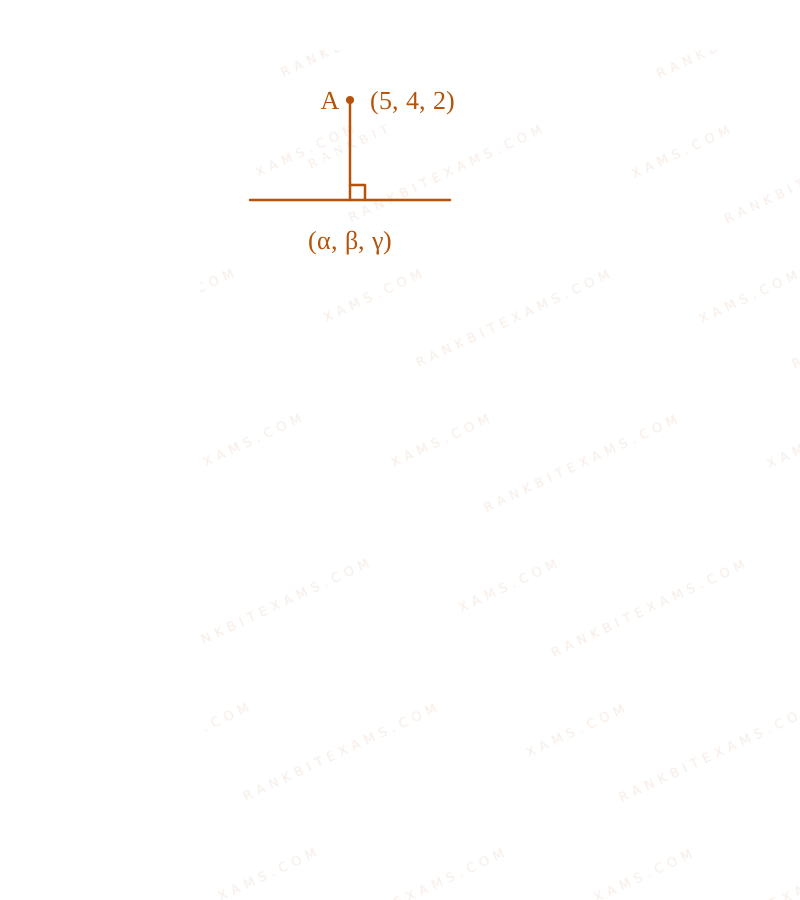
Let (alpha, beta, gamma) be the co-ordinates of the foot of the perpendicular drawn from the point (5, 4, 2) on the line vecr = (-hati + 3hatj + hatk) + lambda(2hati + 3hatj - hatk) . Then the length of the projection of the vector alphahati+betahatj+gammahatk on the vector 6hati+2hatj+3hatk is :

Solution & Explanation

### Related Formula textLength of projection of vecu text on vecw = frac|vecu cdot vecw||vecw| ### Core Logic Given point A(5, 4, 2) and line (L): vecr = (-hati + 3hatj + hatk) + lambda(2hati + 3hatj - hatk) Any general point P on this line has coordinates: (-1 + 2lambda, 3 + 3lambda, 1 - lambda) ### Step 1: Finding the foot of the perpendicular Vector vecAP = P - A = (-1 + 2lambda - 5)hati + (3 + 3lambda - 4)hatj + (1 - lambda - 2)hatk vecAP = (2lambda - 6)hati + (3lambda - 1)hatj + (-lambda - 1)hatk Since AP is perpendicular to line (L), the dot product of vecAP with the direction vector of the line (2hati + 3hatj - hatk) must be zero: vecAP cdot (2hati + 3hatj - hatk) = 0 2(2lambda - 6) + 3(3lambda - 1) - 1(-lambda - 1) = 0 4lambda - 12 + 9lambda - 3 + lambda + 1 = 0 14lambda - 14 = 0 Rightarrow lambda = 1
Foot of perpendicular 3D diagram for Q14 - JEE Main 2026 Morning
### Step 2: Coordinates of the foot Substitute lambda = 1 into general point P to get (alpha, beta, gamma): alpha = -1 + 2(1) = 1 beta = 3 + 3(1) = 6 gamma = 1 - 1 = 0 Foot of perpendicular is (1, 6, 0). ### Step 3: Calculate the projection Let vecu = alphahati + betahatj + gammahatk = hati + 6hatj + 0hatk Let vecw = 6hati + 2hatj + 3hatk textProjection = frac|vecu cdot vecw||vecw| = frac|1(6) + 6(2) + 0(3)|sqrt6^2 + 2^2 + 3^2 = frac6 + 12sqrt36 + 4 + 9 = frac18sqrt49 = frac187 ### Pattern Recognition Foot of perpendicular problems algorithm: 1) Frame general vector P(lambda). 2) Construct distance vector vecAP. 3) Dot product with direction vector vecd = 0. 4) Solve for lambda. ### Evaluation Rubric / Model Answer null ### Chapter Mix Class 12 Maths: Three Dimensional Geometry Class 12 Maths: Vector Algebra

Reference Study Guides

More Three Dimensional Geometry Previous-Year Questions — Page 10

Q28 jee_main_2024_31_jan_evening Distance of a point on a line
A line passes through A(4, -6, -2) and B(16, -2, 4). The point P(a, b, c) where a, b, c are non-negative integers, on the line AB lies at a distance of 21 units, from the point A. The distance between the points P(a, b, c) and Q(4, -12, 3) is equal to
Numerical Answer. Answer: 22 to 22

Solution

### Related Formula textDistance of point P text on line from A(x_1,y_1,z_1): P = (x_1 pm rd_x, y_1 pm rd_y, z_1 pm rd_z) textwhere (d_x,d_y,d_z) text are direction cosines and r text is distance. ### Core Logic Direction ratios of AB = (16-4, -2 - (-6), 4 - (-2)) = (12, 4, 6). Magnitude of this vector = sqrt144 + 16 + 36 = sqrt196 = 14. Direction cosines are left(frac1214, frac414, frac614right) = left(frac67, frac27, frac37right). Point P is at a distance of 21 units from A(4, -6, -2): P = left(4 pm 21left(frac67right), -6 pm 21left(frac27right), -2 pm 21left(frac37right)right) P = (4 pm 18, -6 pm 6, -2 pm 9) Since coordinates a,b,c of P are non-negative integers, we take the '+' sign: P = (4+18, -6+6, -2+9) = (22, 0, 7) Calculate distance from Q(4, -12, 3): PQ = sqrt(22 - 4)^2 + (0 - (-12))^2 + (7 - 3)^2 PQ = sqrt18^2 + 12^2 + 4^2 = sqrt324 + 144 + 16 = sqrt484 = 22 ### Evaluation Rubric / Model Answer null ### Chapter Mix Class 12 Maths: Three Dimensional Geometry
Q14 jee_main_2024_31_jan_morning Distance of a Point from a Line
The distance of the point Q(0, 2, -2) form the line passing through the point P(5, -4, 3) and perpendicular to the lines vecr = (-3hati + 2hatk) + lambda(2hati + 3hatj + 5hatk), lambda in mathbbR and vecr = (hati - 2hatj + hatk) + mu(-hati + 3hatj + 2hatk), mu in mathbbR
  • A. sqrt86
  • B. sqrt20
  • C. sqrt54
  • D. sqrt74

Solution

### Core Logic A vector in the direction of the required line is perpendicular to both given lines. We obtain it via cross product of their direction vectors: vecn = beginvmatrix hati & hatj & hatk \\ 2 & 3 & 5 \\ -1 & 3 & 2 endvmatrix = -9hati - 9hatj + 9hatk Taking the direction vector as hati + hatj - hatk. ### Step 1: Required Line Equation The line passes through P(5, -4, 3) with direction hati + hatj - hatk. Equation: vecr = (5hati - 4hatj + 3hatk) + alpha(hati + hatj - hatk). ### Step 2: Projection & Distance Any point on the line is M(5+alpha, -4+alpha, 3-alpha). We need distance from Q(0, 2, -2). Vector vecQM = (5+alpha)hati + (alpha-6)hatj + (5-alpha)hatk. Since vecQM is perpendicular to the line direction (hati + hatj - hatk): (5+alpha)(1) + (alpha-6)(1) + (5-alpha)(-1) = 0 5 + alpha + alpha - 6 - 5 + alpha = 0 implies 3alpha = 6 implies alpha = 2.
Distance of a Point from a Line diagram for Q14 - JEE Main 2024 Morning
### Step 3: Distance calculation Substitute alpha = 2 in vecQM: vecQM = 7hati - 4hatj + 3hatk. Distance |vecQM| = sqrt7^2 + (-4)^2 + 3^2 = sqrt49 + 16 + 9 = sqrt74. ### Evaluation Rubric / Model Answer null ### Chapter Mix Class 12 Maths: Three Dimensional Geometry Class 12 Maths: Vector Algebra
Q24 jee_main_2024_31_jan_morning Foot of Perpendicular and Angle
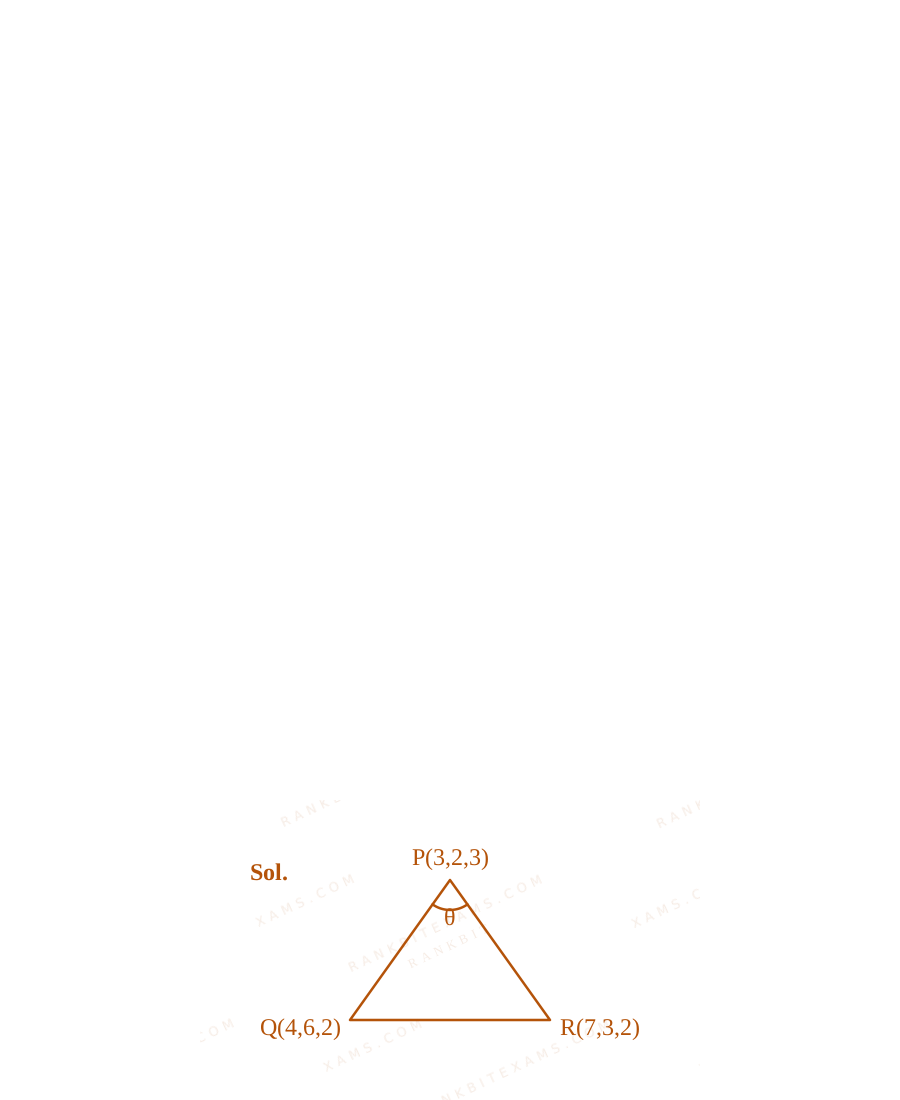
Let Q and R be the feet of perpendiculars from the point P(a, a, a) on the lines x = y, z = 1 and x = -y, z = -1 respectively. If angle QPR is a right angle, then 12a^2 is equal to
Numerical Answer. Answer: 12 to 12

Solution

### Core Logic Line 1: fracx1 = fracy1 = fracz-10 = r implies Q(r, r, 1). Line 2: fracx1 = fracy-1 = fracz+10 = k implies R(k, -k, -1). ### Step 1: Perpendicular Conditions Vector vecPQ = (r-a)hati + (r-a)hatj + (1-a)hatk. vecPQ cdot textDirection of Line 1 = 0 implies (r-a)(1) + (r-a)(1) + (1-a)(0) = 0. 2r - 2a = 0 implies r = a. Thus, vecPQ = 0hati + 0hatj + (1-a)hatk. Vector vecPR = (k-a)hati + (-k-a)hatj + (-1-a)hatk. vecPR cdot textDirection of Line 2 = 0 implies (k-a)(1) + (-k-a)(-1) + (-1-a)(0) = 0. k - a + k + a = 0 implies 2k = 0 implies k = 0. Thus, vecPR = -ahati - ahatj - (a+1)hatk. ### Step 2: Right Angle Condition Given angle QPR = 90^circ implies vecPQ cdot vecPR = 0. (0)(-a) + (0)(-a) + (1-a)(-(a+1)) = 0 -(1-a)(1+a) = 0 implies a^2 - 1 = 0 implies a^2 = 1 Therefore, 12a^2 = 12(1) = 12. ### Evaluation Rubric / Model Answer null ### Chapter Mix Class 12 Maths: Three Dimensional Geometry Class 12 Maths: Vector Algebra

More Three Dimensional Geometry Questions — jee_main_2026_21_jan_morning

Practice all Three Dimensional Geometry previous-year questions →

Rankbit System
JEE Physics: Waves (+15.5%) | Electrostatics: Concentric Shells (-29.7%) | Modern Physics: Photoelectric Clones (+34.2%) | Mathematics: Definite Integrals (+18.1%) | Chemistry: Coordination Splitting (-11.4%) | JEE Physics: Waves (+15.5%) | Electrostatics: Concentric Shells (-29.7%) | Modern Physics: Photoelectric Clones (+34.2%) | Mathematics: Definite Integrals (+18.1%) | Chemistry: Coordination Splitting (-11.4%)
YOUR FIRST PREP STEP STARTS HERE

We Map Every Repeating Question in Competitive Exams.

Say goodbye to generic mock test fatigue. RankBit uses smart analysis to group past exam questions into their foundational Repeating Question Types. Find chapter weightage, track repeating questions, and score higher with targeted practice.

Select Your Target Exam

Choose an exam track below to find formulas per chapter and patterns.

Syncing Exam Intelligence

Mapping formulas and patterns across all tracks…

PATH A — FULL LENGTH PRACTICE

Full Mock Test Hub

Simulate real NTA exam conditions with fully tracked mocks. Time yourself against past papers.

Now Live Open
PATH B — TARGETED PRACTICE

Topic-wise Practice Hub

Practice past-year questions one chapter at a time. Pick an exam → subject → chapter and get every PYQ for that topic — pulled together from all past papers — with the chapter's key formulas alongside.

Loading Questions... Browse Topics
Latest from the Blog
View all →

Loading articles...