JEE Main · Mathematics ↓ Falling

Straight Lines appeared 29 times across 3 years — 3.4% of Mathematics. This question is from Equilateral Triangle Between Parallel Lines.

Year 2026 2025 2024 Total
Questions 7 13 9 29

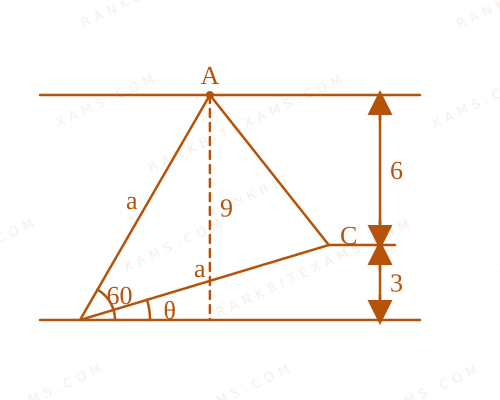
Let a point A lie between the parallel lines L₁ and L₂ such that its distances from L₁ and L₂ are 6 and 3 units, respectively. Then the area (in sq. units) of the equilateral triangle ABC, where the points B and C lie on the lines L₁ and L₂ respectively, is:

Solution & Explanation

Related Formula
Area of Equilateral Triangle = √(3)4 a²

Where a is the side length.

Core Logic

Let the side of the equilateral triangle be a. Let θ be the angle between the side AC and the parallel line L₂. Then, the angle between the side AB and the parallel line L₁ can be expressed via alternate geometry. Given distances from A to the lines form right-angled triangles.

Step 1: Set up geometric projections

Equilateral triangle between parallel lines diagram for Q4 - JEE Main 2026 Morning

From vertex C to line passing through A parallel to L₁, L₂, the perpendicular distance is 3. In the right triangle formed, we have:

θ = (3)/(a)

Similarly, point B lies on L₁. The perpendicular distance from A to L₁ is 6. However, combining the overall heights between the parallel lines, the total distance between L₁ and L₂ is 6 + 3 = 9. The projection of side BC (which connects L₁ and L₂) vertically is 9.

(60° + θ) = (9)/(a)
Step 2: Solve the trigonometric system

Expand (60° + θ):

√(3)2 θ + (1)/(2) θ = (9)/(a)

Substitute θ = (3)/(a) and θ = √(1 - ² θ) = √(1 - (9)/(a²)):

√(3)2 √(1 - (9)/(a²)) + (1)/(2) ((3)/(a)) = (9)/(a) √(3) √(1 - (9)/(a²)) + (3)/(a) = (18)/(a) √(3) √(1 - (9)/(a²)) = (15)/(a)

Squaring both sides:

3 (1 - (9)/(a²)) = (225)/(a²) 3 - (27)/(a²) = (225)/(a²) 3 = (252)/(a²) ⇒ a² = 84
Step 3: Calculate Area
Area of Δ ABC = √(3)4 a² = √(3)4 × 84 = 21√(3)
Pattern Recognition

When a rigid polygon (like an equilateral triangle or square) is wedged between parallel lines, set a base orientation angle θ for one edge and use rotational shifts (e.g., 60° + θ) to project heights. Expanding the sine addition formula instantly yields the side length.

Chapter Mix

Class 11 Maths: Straight Lines Class 11 Maths: Trigonometric Functions

Reference Study Guides

More Straight Lines Previous-Year Questions — Page 6

Q1 jee_main_2024_30_jan_morning Rotation of Axes and Lines
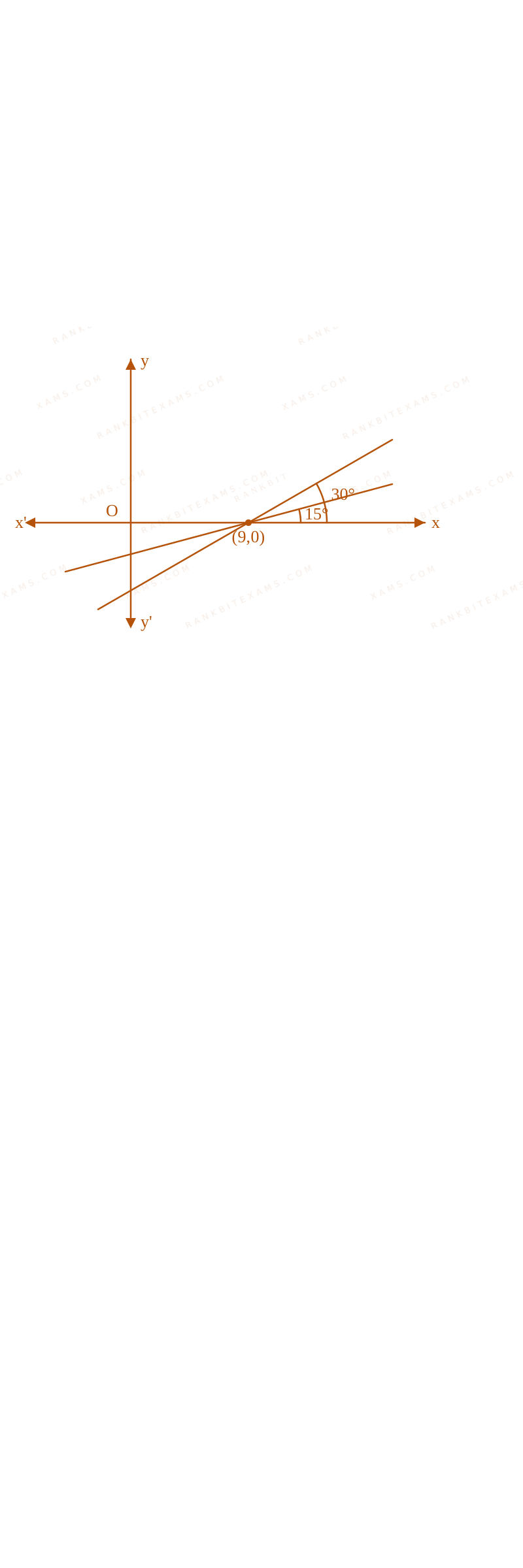
A line passing through the point A(9,0) makes an angle of 30° with the positive direction of x-axis. If this line is rotated about A through an angle of 15° in the clockwise direction, then its equation in the new position is
  • A. y√(3) - 2 + x = 9
  • B. x√(3) - 2 + y = 9
  • C. x√(3) + 2 + y = 9
  • D. y√(3) + 2 + x = 9

Solution

Related Formula
y - y₁ = (θ)(x - x₁)
Core Logic

Rotation of Axes and Lines diagram for Q1 - JEE Main 2024 Morning

The initial line makes an angle of 30° with the positive x-axis. It is rotated clockwise by 15° about the point A(9, 0). The new angle made by the line with the positive direction of the x-axis is 30° - 15° = 15°.

Step 1: Equation of the new line

The equation of the line passing through A(9, 0) with a slope of 15° is:

Eqⁿ: y - 0 = 15° (x - 9)

We know that 15° = 2 - √(3).

y = (2 - √(3)) (x - 9)
Step 2: Rearranging to match options

Dividing by (2 - √(3)):

y2 - √(3) = x - 9

Notice that 2 - √(3) = -(√(3) - 2). Thus:

-y√(3) - 2 = x - 9 y√(3) - 2 + x = 9
Pattern Recognition

A clockwise rotation decreases the angle of inclination. Calculate the new angle, find its tangent, and carefully algebraicize the denominator to match the given option forms.

Chapter Mix

Class 11 Maths: Straight Lines
Q2 jee_main_2024_31_jan_evening Centroid and Orthocentre
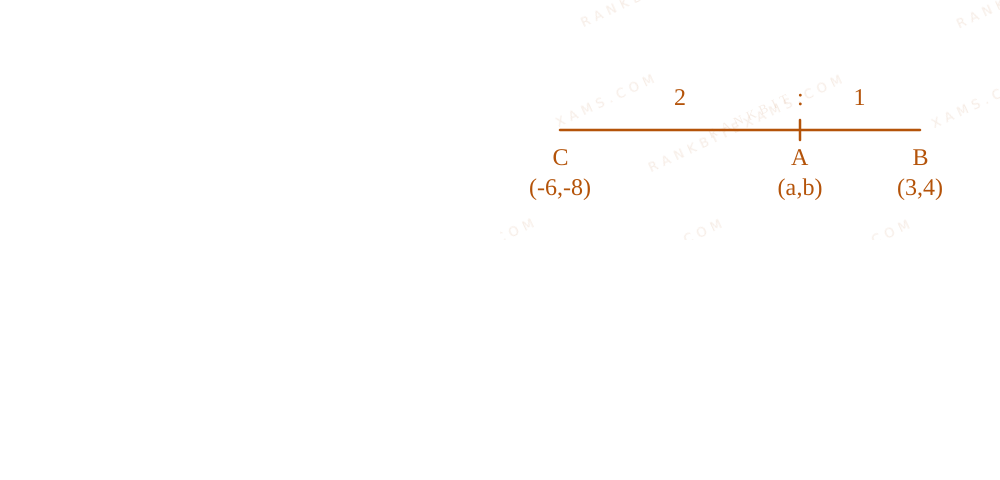
Let A (a, b), B(3, 4) and (-6, -8) respectively denote the centroid, circumcentre and orthocentre of a triangle. Then, the distance of the point P(2a + 3, 7b + 5) from the line 2x + 3y - 4 = 0 measured parallel to the line x - 2y - 1 = 0 is
  • A. 15 √(5)7
  • B. 17√(5)6
  • C. 17 √(5)7
  • D. √(5)17

Solution

Related Formula
Centroid divides the line joining Orthocentre and Circumcentre in 2:1

Distance in parametric form: x = x₁ + r θ, y = y₁ + r θ

Core Logic

Centroid and Orthocentre diagram for Q2 - JEE Main 2024 Evening

Let Orthocentre C(-6, -8) and Circumcentre B(3, 4). Centroid A(a, b) divides CB in 2:1.

a = (2(3) + 1(-6))/(2+1) = 0 b = (2(4) + 1(-8))/(2+1) = 0

So, P(2a+3, 7b+5) = (3, 5).

The line along which distance is measured is parallel to x - 2y - 1 = 0, giving slope m = θ = (1)/(2). Using parametric coordinates from P(3,5):

x = 3 + r θ, y = 5 + r θ

Substitute into the target line 2x + 3y - 4 = 0:

2(3 + r θ) + 3(5 + r θ) - 4 = 0 r(2 θ + 3 θ) = -17

From θ = 1/2, we get θ = 1√(5) and θ = 2√(5).

r(2( 2√(5)) + 3( 1√(5))) = -17 r( 7√(5)) = -17 |r| = 17√(5)7
Pattern Recognition

Standard Euler line property: O, G, C are collinear and G divides OC in 2:1. Use parametric equation to find intersection distance directly without finding the intersection point.

Chapter Mix

Class 11 Maths: Straight Lines
Q23 jee_main_2024_31_jan_evening Parallelogram Properties
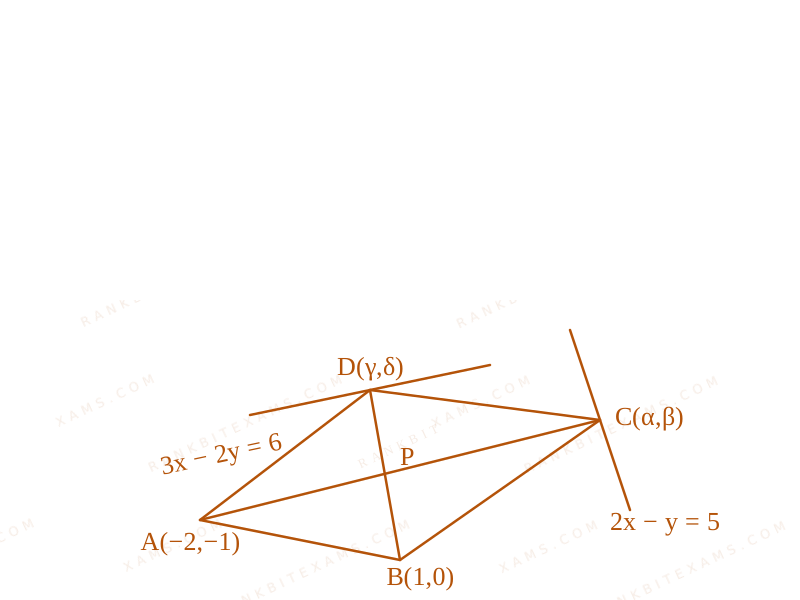
Let A(-2, -1), B(1, 0), C(α, β) and D(γ, δ) be the vertices of a parallelogram ABCD. If the point C lies on 2x - y = 5 and the point D lies on 3x - 2y = 6, then the value of |α + β + γ + δ| is equal to
Numerical Answer. Answer: 32 to 32

Solution

Related Formula
In a parallelogram, midpoints of diagonals coincide: ((xA+xC)/(2), (yA+yC)/(2)) = ((xB+xD)/(2), (yB+yD)/(2))
Core Logic

Parallelogram Properties diagram for Q23 - JEE Main 2024 Evening

Given diagonals AC and BD bisect each other:

α - 2 = γ + 1 α - γ = 3 (1) β - 1 = δ + 0 β - δ = 1 (2)

Point C(α, β) lies on 2x - y = 5 2α - β = 5 (3) Point D(γ, δ) lies on 3x - 2y = 6 3γ - 2δ = 6 (4)

From (1) and (2), substitute γ = α - 3 and δ = β - 1 into (4):

3(α - 3) - 2(β - 1) = 6 3α - 9 - 2β + 2 = 6 3α - 2β = 13 (5)

Solve (3) and (5): From (3), β = 2α - 5. Substitute in (5):

3α - 2(2α - 5) = 13 -α + 10 = 13 α = -3

So, β = 2(-3) - 5 = -11. From earlier substitutions:

γ = -3 - 3 = -6 δ = -11 - 1 = -12

Sum of variables:

|α + β + γ + δ| = |-3 - 11 - 6 - 12| = |-32| = 32
Chapter Mix

Class 11 Maths: Straight Lines
Q10 jee_main_2024_31_jan_morning Properties of Parallelogram
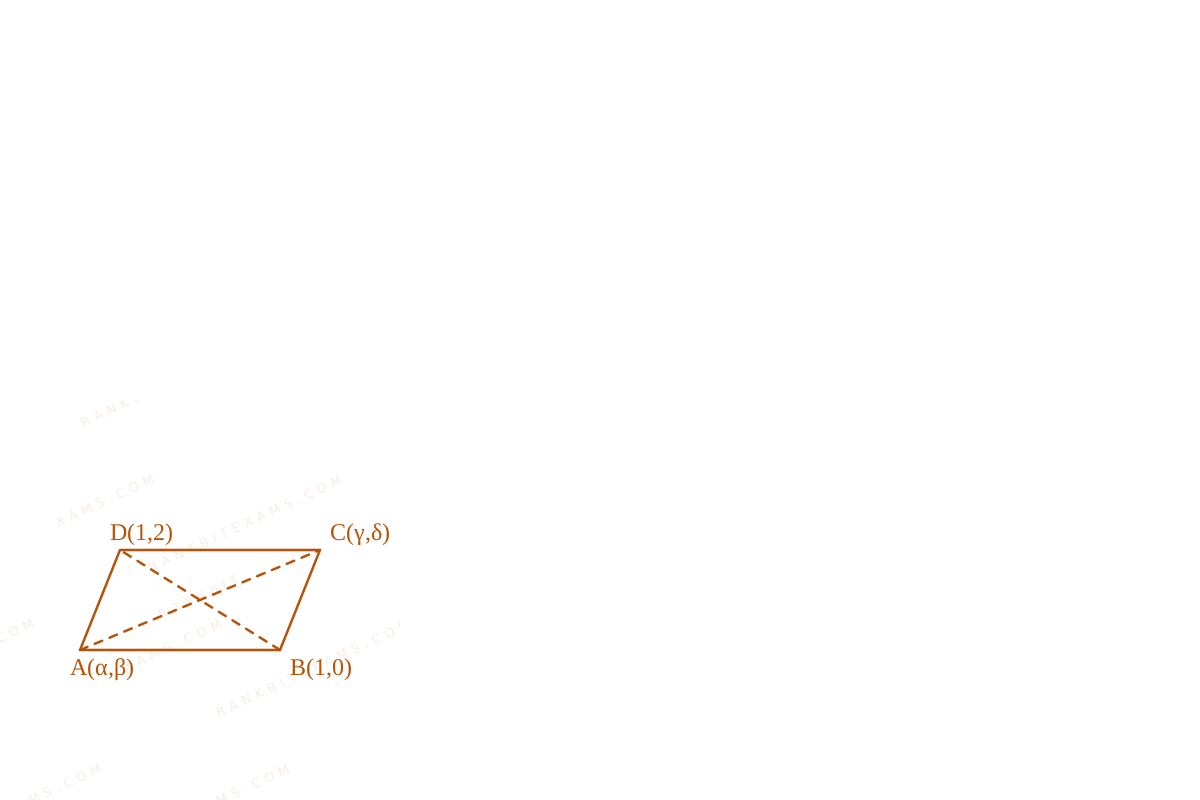
Let α, β, γ, δ in Z and let A (α, β), B (1, 0), C (γ, δ) and D (1, 2) be the vertices of a parallelogram ABCD. If AB = √(10) and the points A and C lie on the line 3y = 2x + 1, then 2(α + β + γ + δ) is equal to
  • A. 10
  • B. 5
  • C. 12
  • D. 8

Solution

Core Logic

Let E be the midpoint of the diagonals AC and BD. Since ABCD is a parallelogram, the diagonals bisect each other.

Properties of Parallelogram diagram for Q10 - JEE Main 2024 Morning
Midpoint E from BD: ( (1+1)/(2), (0+2)/(2) ) = (1, 1).

Step 1: Apply Midpoint on AC

Midpoint E from AC: ( (α+γ)/(2), (β+δ)/(2) ). Equating both:

(α+γ)/(2) = 1 α + γ = 2 (β+δ)/(2) = 1 β + δ = 2
Step 2: Final Value

The expression requires 2(α + β + γ + δ).

2(2 + 2) = 2(4) = 8

(Note: Additional conditions like AB = √(10) and the line equation are extraneous data not needed to find the sum).

Chapter Mix

Class 11 Maths: Straight Lines

More Straight Lines Questions — jee_main_2026_21_jan_morning

Practice all Straight Lines previous-year questions →

Rankbit System
JEE Physics: Waves (+15.5%) | Electrostatics: Concentric Shells (-29.7%) | Modern Physics: Photoelectric Clones (+34.2%) | Mathematics: Definite Integrals (+18.1%) | Chemistry: Coordination Splitting (-11.4%) | JEE Physics: Waves (+15.5%) | Electrostatics: Concentric Shells (-29.7%) | Modern Physics: Photoelectric Clones (+34.2%) | Mathematics: Definite Integrals (+18.1%) | Chemistry: Coordination Splitting (-11.4%)