The sum of all the roots of the equation (x-1)^2-5|x-1|+6=0 , is:

Solution & Explanation

### Related Formula X^2 = |X|^2 Quadratic factorization: t^2 - 5t + 6 = (t-2)(t-3) ### Core Logic Rewrite the equation taking |x - 1| = t, where t geq 0. Since (x-1)^2 = |x-1|^2, the equation becomes: t^2 - 5t + 6 = 0 ### Step 1: Solve for modulus (t - 2)(t - 3) = 0 Rightarrow t = 2, 3 Since both roots are positive, both provide valid solutions for the modulus. |x - 1| = 2 quad textand quad |x - 1| = 3 ### Step 2: Unpack x values From |x - 1| = 2: x - 1 = 2 Rightarrow x = 3 x - 1 = -2 Rightarrow x = -1 From |x - 1| = 3: x - 1 = 3 Rightarrow x = 4 x - 1 = -3 Rightarrow x = -2 The roots are 3, -1, 4, -2. ### Step 3: Sum of Roots textSum = 3 + (-1) + 4 + (-2) = 4 ### Pattern Recognition In symmetric modulus equations f(|x-a|) = 0, every valid root t generates twin solutions (a+t) and (a-t). The sum of each pair is perfectly 2a. If there are n distinct valid positive roots for t, the sum of all x-roots is exactly n times 2a. Here, n=2, a=1 Rightarrow 2 times 2(1) = 4. ### Evaluation Rubric / Model Answer null ### Chapter Mix Class 11 Maths: Quadratic Equations

Reference Study Guides

More Quadratic Equations Previous-Year Questions — Page 3

Q59 jee_main_2025_29_jan_morning Equations Reducible to Quadratic Forms
The number of solutions of the equation left(frac9x -frac9sqrtx +2right)left(frac2x -frac7sqrtx +3right) = 0 is:
  • A. 2
  • B. 4
  • C. 1
  • D. 3

Solution

### Related Formula textSubstitute variable to convert non-linear form: alpha = frac1sqrtx quad (x > 0) ### Core Logic Let frac1sqrtx = alpha. The equation reduces to a product of two quadratics: (9alpha^2 - 9alpha + 2)(2alpha^2 - 7alpha + 3) = 0 ### Step 1: Factorize the components First quadratic: 9alpha^2 - 9alpha + 2 = 0 implies (3alpha - 2)(3alpha - 1) = 0 implies alpha = frac23, frac13 Second quadratic: 2alpha^2 - 7alpha + 3 = 0 implies (2alpha - 1)(alpha - 3) = 0 implies alpha = frac12, 3 ### Step 2: Solve for x Since alpha = frac1sqrtx implies x = frac1alpha^2. For alpha = frac13 implies x = 9 For alpha = frac12 implies x = 4 For alpha = frac23 implies x = frac94 For alpha = 3 implies x = frac19 All 4 values are positive and valid. ### Pattern Recognition Always check constraints first (x > 0 due to sqrtx in denominator). Since all roots alpha > 0, every single algebraic root maps to a real distinct solution. ### Evaluation Rubric / Model Answer null ### Chapter Mix Class 11 Mathematics: Quadratic Equations
Q9 jee_main_2024_01_february_morning Equations Reducible to Quadratic Form
Let S=\xin R:(sqrt3+sqrt2)^x+(sqrt3-sqrt2)^x=10\. Then the number of elements in S is:
  • A. 4
  • B. 0
  • C. 2
  • D. 1

Solution

### Related Formula Conjugate Surd Identity: (sqrta + sqrtb)(sqrta - sqrtb) = a - b ### Core Logic Observe the base components of the exponents: (sqrt3 + sqrt2)(sqrt3 - sqrt2) = 3 - 2 = 1 Therefore, we can express one base as the reciprocal of the other: sqrt3 - sqrt2 = frac1sqrt3 + sqrt2 The equation becomes: (sqrt3 + sqrt2)^x + frac1(sqrt3 + sqrt2)^x = 10 ### Step 1: Formulate the Quadratic Equation Let (sqrt3 + sqrt2)^x = t. Then: t + frac1t = 10 implies t^2 - 10t + 1 = 0 Solving for t using the quadratic formula: t = frac10 pm sqrt(-10)^2 - 4(1)(1)2 = frac10 pm sqrt962 = 5 pm 2sqrt6 ### Step 2: Solve for x Notice that (5 pm 2sqrt6) can be written as square powers of the original base: (sqrt3 pm sqrt2)^2 = 3 + 2 pm 2sqrt6 = 5 pm 2sqrt6 Thus, we have: - For t = 5 + 2sqrt6 implies (sqrt3 + sqrt2)^x = (sqrt3 + sqrt2)^2 implies x = 2 - For t = 5 - 2sqrt6 implies (sqrt3 + sqrt2)^x = (sqrt3 - sqrt2)^2 = (sqrt3 + sqrt2)^-2 implies x = -2 Therefore, the distinct real solutions are x = 2 and x = -2. The number of elements in set S is 2. ### Pattern Recognition Sees: Rational conjugate bases added with inverse matching variables. Shortcut: Whenever you see an equation of the form A^x + B^x = C where AB = 1, the solution will always be symmetric (pm x_0). Checking x=2 explicitly gives (sqrt3+sqrt2)^2 + (sqrt3-sqrt2)^2 = (5+2sqrt6) + (5-2sqrt6) = 10, confirming pm 2 immediately. ### Evaluation Rubric / Model Answer null ### Chapter Mix Class 11 Mathematics: Quadratic Equations Class 9 Mathematics: Number Systems (Rationalization)
Q28 jee_main_2024_30_january_evening Modulus Equations
The number of real solutions of the equation xleft(x^2 + 3|x| + 5|x - 1| + 6|x - 2|right) = 0 is
Numerical Answer. Answer: 1 to 1

Solution

### Related Formula textZero Product Property: A cdot B = 0 implies A = 0 text or B = 0 ### Core Logic Given equation: xleft(x^2 + 3|x| + 5|x - 1| + 6|x - 2|right) = 0 This factors into two possibilities: 1) x = 0 2) x^2 + 3|x| + 5|x - 1| + 6|x - 2| = 0 ### Step 1: Evaluating the Modulus Term Look at the second factor: f(x) = x^2 + 3|x| + 5|x - 1| + 6|x - 2|. Notice that all terms inside are strictly non-negative: - x^2 ge 0 - 3|x| ge 0 - 5|x - 1| ge 0 - 6|x - 2| ge 0 For the sum to be 0, every single term must be simultaneously zero. x^2 = 0 implies x = 0 However, if x = 0, then 5|x-1| = 5(1) = 5 neq 0. Therefore, there is no real value of x that makes this entire second factor equal to zero. ### Step 2: Conclusion The only valid solution to the equation is x = 0 from the first factor. Thus, there is exactly 1 real solution. ### Pattern Recognition A sum of absolute values and squares set to 0 requires all individual components to hit 0 concurrently. If they have different zero-nodes (0, 1, 2), the sum can never be 0. ### Evaluation Rubric / Model Answer null ### Chapter Mix Class 11 Maths: Quadratic Equations
Q22 jee_main_2024_31_jan_evening Roots of Quadratic Equation
Let a, b, c be the length of three sides of a triangle satisfying the condition (a^2 + b^2)x^2 - 2b(a + c)x + (b^2 + c^2) = 0. If the set of all possible values of x is the interval (alpha, beta) then 12(alpha^2 + beta^2) is equal to
Numerical Answer. Answer: 36 to 36

Solution

### Core Logic Given equation: (a^2+b^2)x^2 - 2b(a+c)x + b^2+c^2 = 0. Expand and rearrange into perfect squares: (a^2x^2 - 2abx + b^2) + (b^2x^2 - 2bcx + c^2) = 0 (ax - b)^2 + (bx - c)^2 = 0 Since squares must be non-negative, each term is zero: ax - b = 0 implies x = fracba bx - c = 0 implies x = fraccb Thus, b = ax and c = bx = ax^2. Since a,b,c form a triangle, the triangle inequality holds: 1) a + b > c implies a + ax > ax^2 implies x^2 - x - 1 < 0 implies frac1-sqrt52 < x < frac1+sqrt52 2) a + c > b implies a + ax^2 > ax implies x^2 - x + 1 > 0 (Always true for real x) 3) b + c > a implies ax + ax^2 > a implies x^2 + x - 1 > 0 implies x > frac-1+sqrt52 or x < frac-1-sqrt52. Taking the intersection (and noting x > 0 since sides are positive): fracsqrt5-12 < x < fracsqrt5+12 So, alpha = fracsqrt5-12 and beta = fracsqrt5+12. Calculate 12(alpha^2 + beta^2): 12 left( frac6-2sqrt54 + frac6+2sqrt54 right) = 12 left( frac124 right) = 36 ### Evaluation Rubric / Model Answer null ### Chapter Mix Class 11 Maths: Complex Numbers and Quadratic Equations Class 11 Maths: Straight Lines
Q1 jee_main_2024_31_jan_morning Nature of Roots
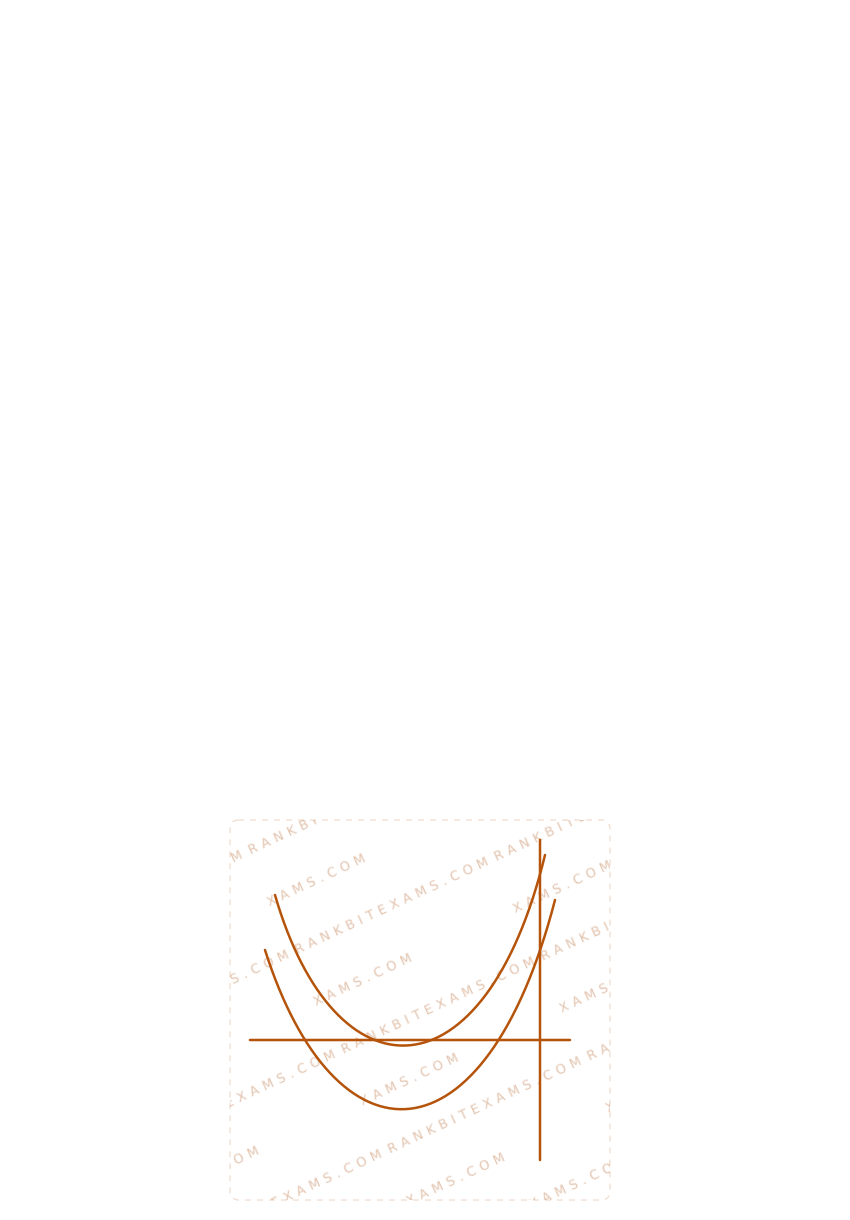
For 0 < c < b < a, let (a + b - 2c)x^2 + (b + c - 2a)x + (c + a - 2b) = 0 and alpha neq 1 be one of its root. Then, among the two statements (I) If alpha in (-1,0), then b cannot be the geometric mean of a and c (II) If alpha in (0,1), then b may be the geometric mean of a and c
  • A. textBoth (I) and (II) are true
  • B. textNeither (I) nor (II) is true
  • C. textOnly (II) is true
  • D. textOnly (I) is true

Solution

### Related Formula textSum of coefficients = 0 implies x = 1 text is a root. ### Core Logic Given f(x) = (a + b - 2c)x^2 + (b + c - 2a)x + (c + a - 2b) = 0. Substituting x = 1: f(1) = a + b - 2c + b + c - 2a + c + a - 2b = 0 Thus, one root is 1. Let the other root be alpha. ### Step 1: Find the other root Product of roots = fracc + a - 2ba + b - 2c. Since one root is 1, we have: alpha cdot 1 = fracc + a - 2ba + b - 2c alpha = fracc + a - 2ba + b - 2c ### Step 2: Analyze Statement (I) If -1 < alpha < 0: -1 < fracc + a - 2ba + b - 2c < 0 This implies b > fraca + c2 and b + c < 2a. Therefore, b cannot be the Geometric Mean of a and c. Statement (I) is true. ### Step 3: Analyze Statement (II) If 0 < alpha < 1: 0 < fracc + a - 2ba + b - 2c < 1 This gives b > c and b < fraca + c2. Therefore, b may be the Geometric Mean between a and c. Statement (II) is true. ### Pattern Recognition When coefficients in a quadratic equation are cyclic and sum to 0, one root is always 1. The other root is directly c/a. ### Evaluation Rubric / Model Answer null ### Chapter Mix Class 11 Maths: Quadratic Equations Class 11 Maths: Sequences and Series

More Quadratic Equations Questions — jee_main_2026_21_jan_morning

Practice all Quadratic Equations previous-year questions →

Rankbit System
JEE Physics: Waves (+15.5%) | Electrostatics: Concentric Shells (-29.7%) | Modern Physics: Photoelectric Clones (+34.2%) | Mathematics: Definite Integrals (+18.1%) | Chemistry: Coordination Splitting (-11.4%) | JEE Physics: Waves (+15.5%) | Electrostatics: Concentric Shells (-29.7%) | Modern Physics: Photoelectric Clones (+34.2%) | Mathematics: Definite Integrals (+18.1%) | Chemistry: Coordination Splitting (-11.4%)
YOUR FIRST PREP STEP STARTS HERE

We Map Every Repeating Question in Competitive Exams.

Say goodbye to generic mock test fatigue. RankBit uses smart analysis to group past exam questions into their foundational Repeating Question Types. Find chapter weightage, track repeating questions, and score higher with targeted practice.

Select Your Target Exam

Choose an exam track below to find formulas per chapter and patterns.

Syncing Exam Intelligence

Mapping formulas and patterns across all tracks…

PATH A — FULL LENGTH PRACTICE

Full Mock Test Hub

Simulate real NTA exam conditions with fully tracked mocks. Time yourself against past papers.

Now Live Open
PATH B — TARGETED PRACTICE

Topic-wise Practice Hub

Practice past-year questions one chapter at a time. Pick an exam → subject → chapter and get every PYQ for that topic — pulled together from all past papers — with the chapter's key formulas alongside.

Loading Questions... Browse Topics
Latest from the Blog
View all →

Loading articles...
