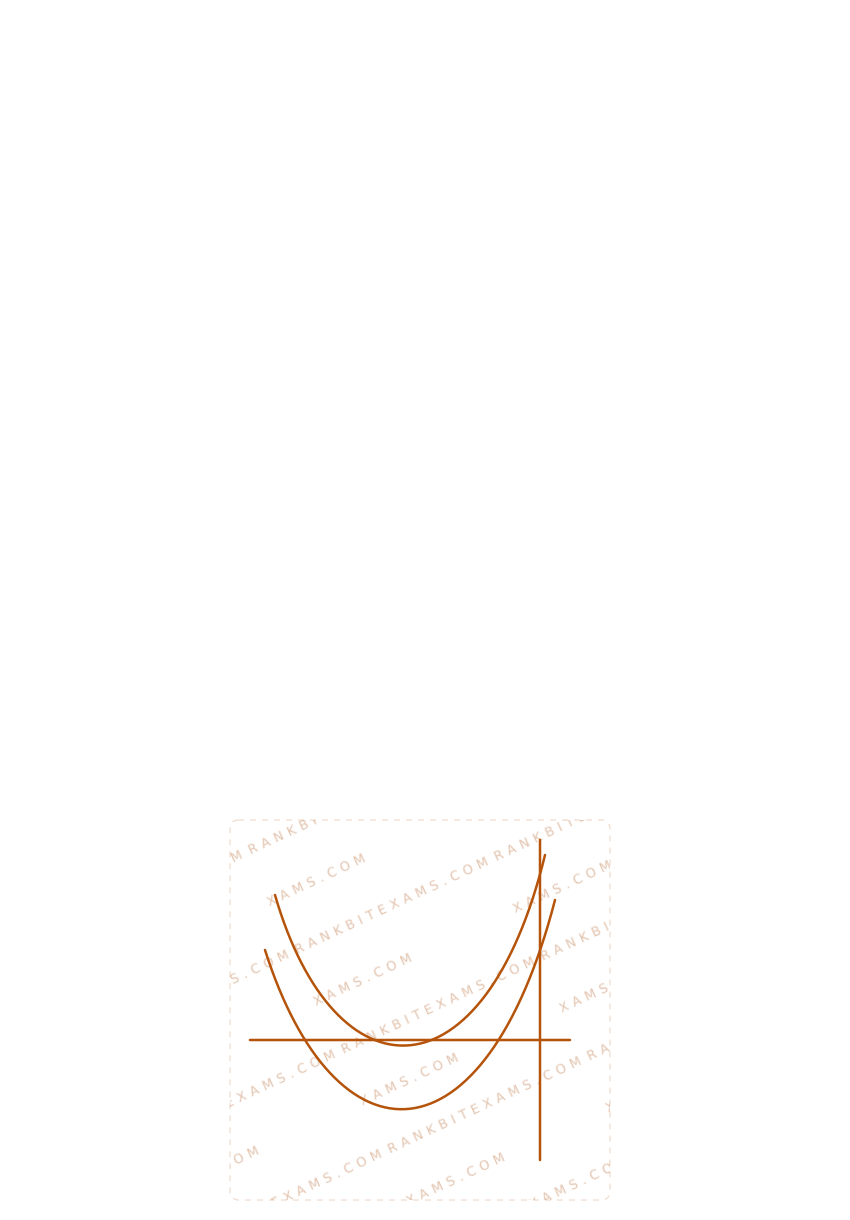
Related Formula
|y| = cases y, & y ≥ 0 -y, & y < 0 cases$$|y| = \begin{cases} y, & y \geq 0 \\ -y, & y < 0 \end{cases}$$
Core Logic
Break the domain into intervals based on the critical points of the absolute values, which are x = -4$x = -4$ and x = -2$x = -2$.
Intervals to test:
Case I: x < -4$x < -4$
Case II: -4 ≤ x < -2$-4 \leq x < -2$
Case III: x ≥ -2$x \geq -2$
Step 1: Analyzing Case I
For x < -4$x < -4$:
Both (x+4)$(x+4)$ and (x+2)$(x+2)$ are negative.
The equation becomes:
x(-(x + 4)) + 3(-(x + 2)) + 10 = 0$$x(-(x + 4)) + 3(-(x + 2)) + 10 = 0$$
-x² - 4x - 3x - 6 + 10 = 0$$-x^2 - 4x - 3x - 6 + 10 = 0$$
x² + 7x - 4 = 0$$x^2 + 7x - 4 = 0$$
Roots are x = -7 ± √(49 + 16)2 = -7 ± √(65)2$x = \frac{-7 \pm \sqrt{49 + 16}}{2} = \frac{-7 \pm \sqrt{65}}{2}$.
Check if they fall in the interval x < -4$x < -4$:
√(65) ≈ 8.06$\sqrt{65} \approx 8.06$
x₁ = (-7 + 8.06)/(2) ≈ 0.53$x_1 = \frac{-7 + 8.06}{2} \approx 0.53$ (Rejected, not <-4$<-4$)
x₂ = (-7 - 8.06)/(2) ≈ -7.53$x_2 = \frac{-7 - 8.06}{2} \approx -7.53$ (Accepted)
So, 1 valid solution here.
Step 2: Analyzing Case II
For -4 ≤ x < -2$-4 \leq x < -2$:
(x+4) ≥ 0$(x+4) \geq 0$ and (x+2) < 0$(x+2) < 0$.
The equation becomes:
x(x + 4) + 3(-(x + 2)) + 10 = 0$$x(x + 4) + 3(-(x + 2)) + 10 = 0$$
x² + 4x - 3x - 6 + 10 = 0$$x^2 + 4x - 3x - 6 + 10 = 0$$
x² + x + 4 = 0$x^2 + x + 4 = 0$
Discriminant D = 1² - 4(1)(4) = 1 - 16 = -15 < 0$D = 1^2 - 4(1)(4) = 1 - 16 = -15 < 0$.
No real roots in this interval.
Step 3: Analyzing Case III
For x ≥ -2$x \geq -2$:
Both (x+4)$(x+4)$ and (x+2)$(x+2)$ are positive.
The equation becomes:
x(x + 4) + 3(x + 2) + 10 = 0$$x(x + 4) + 3(x + 2) + 10 = 0$$
x² + 4x + 3x + 6 + 10 = 0$$x^2 + 4x + 3x + 6 + 10 = 0$$
x² + 7x + 16 = 0$$x^2 + 7x + 16 = 0$$
Discriminant D = 49 - 64 = -15 < 0$D = 49 - 64 = -15 < 0$.
No real roots in this interval.
Step 4: Final Count
Combining the results from all cases, there is exactly 1 distinct real solution.
Pattern Recognition
For sum-of-absolute-value equations, systematically partition the number line using the roots of the arguments. Discard roots generated by the quadratics that fall outside their respective assumed interval.
Chapter Mix
Class 11 Maths: Quadratic Equations