Permutations and Combinations appeared 40 times across 3 years — 4.6% of Mathematics.
This question is from Strictly Increasing Functions and Derangements.
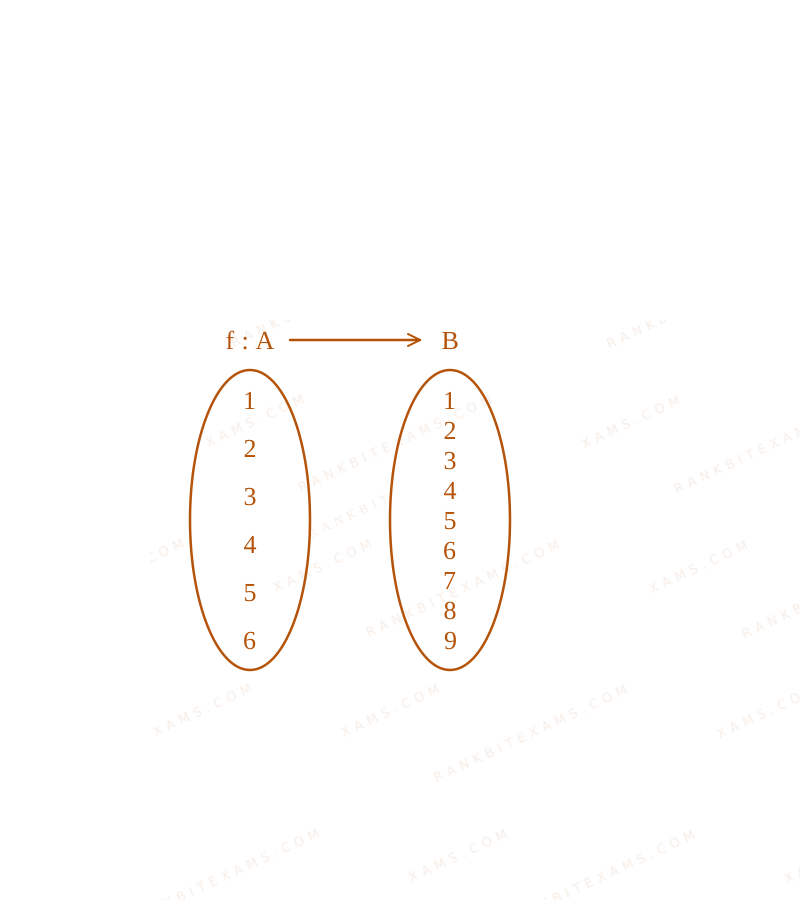
The number of strictly increasing functionsf$f$ from the set 1, 2, 3, 4, 5, 6$\{1, 2, 3, 4, 5, 6\}$ to the set 1, 2, 3, …, 9$\{1, 2, 3, \ldots, 9\}$ such that f(i) ≠ i$f(i) \neq i$ for 1 ≤ i ≤ 6$1 \leq i \leq 6$ , is equal to:
A.21
B.27
C.22
D.28
Solution & Explanation
Related Formula
For a strictly increasing function f: A → B$f: A \to B$ where |A| = m$|A| = m$ and |B| = n$|B| = n$, the number of functions without restrictions is nm$\binom{n}{m}$.
Core Logic
We need strictly increasing functionsf: 1,2,3,4,5,6 → 1,2, ,9$f: \{1,2,3,4,5,6\} \to \{1,2,\dots,9\}$ subject to f(i) ≠ i$f(i) \neq i$.
Since f$f$ is strictly increasing, f(i) ≥ i$f(i) \geq i$ must always hold because the target values are drawn from an equally spaced domain. If f(i) = i$f(i) = i$ for any i$i$, it forces a strict ladder down to 1. But we are given f(i) ≠ i$f(i) \neq i$. Thus, f(i) > i$f(i) > i$ for all 1 ≤ i ≤ 6$1 \leq i \leq 6$.
This implies f(1) ≥ 2$f(1) \geq 2$.
Function mapping sets diagram Q9 - JEE Main 2026 Morning
Step 1: Case Analysis on f(1)
Since f(1) > 1$f(1) > 1$, we evaluate possible starting points:
Case 1: f(1) = 2$f(1) = 2$
Remaining 5 values f(2)$f(2)$ to f(6)$f(6)$ must be strictly increasing and chosen from 3, 4, 5, 6, 7, 8, 9$\{3, 4, 5, 6, 7, 8, 9\}$ (7 available numbers). Since f(1)=2$f(1)=2$, f(i)>i$f(i)>i$ is naturally preserved for subsequent elements (e.g., f(2) ≥ 3 > 2$f(2) \ge 3 > 2$).
Number of ways = 75 = 21$= \binom{7}{5} = 21$.
Function mapping sets diagram Q9 - JEE Main 2026 Morning
Step 2: Subsequent Cases
Case 2: f(1) = 3$f(1) = 3$
Remaining 5 values chosen from 4, 5, 6, 7, 8, 9$\{4, 5, 6, 7, 8, 9\}$ (6 available numbers).
Number of ways = 65 = 6$= \binom{6}{5} = 6$.
Case 3: f(1) = 4$f(1) = 4$
Remaining 5 values chosen from 5, 6, 7, 8, 9$\{5, 6, 7, 8, 9\}$ (5 available numbers).
Number of ways = 55 = 1$= \binom{5}{5} = 1$.
Case 4: f(1) = 5$f(1) = 5$
Requires choosing 5 values from 6,7,8,9$\{6,7,8,9\}$, which is impossible.
Step 3: Total Sum
Total number of valid functions = 21 + 6 + 1 = 28$21 + 6 + 1 = 28$.
Pattern Recognition
For f(i) ≠ i$f(i) \neq i$ on strictly increasing integer arrays, f(x) - x > 0$f(x) - x > 0$. Using the substitution g(x) = f(x) - x$g(x) = f(x) - x$, you convert a constrained increasing function into a standard non-decreasing one, or simply pivot on f(1)$f(1)$ and sum the cascading binomials.
Chapter Mix
Class 11 Maths: Permutations and Combinations
Class 12 Maths: Functions
Keywords:#strictly increasing functions#JEE Main 2026 Morning Q9#Permutations and Combinations JEE Main 2026#Strictly Increasing Functions and Derangements JEE Main 2026
More Permutations and Combinations Previous-Year Questions — Page 4
Qjee_main_2025_02_april_morningPermutation of Multiset
The number of sequences of ten terms, whose terms are either 0 or 1 or 2, that contain exactly five 1s and exactly three 2s, is equal to:
A.360$360$
B.45$45$
C.2520$2520$
D.1820$1820$
Solution
Related Formula
The number of permutations of n$n$ objects where p$p$ are of one kind, q$q$ are of another kind, and r$r$ are of a third kind is:
The sequence has 10$10$ terms chosen from 0, 1, 2$\{0, 1, 2\}$. It contains exactly five 1$1$s and exactly three 2$2$s. This leaves exactly 10 - 5 - 3 = 2$10 - 5 - 3 = 2$ terms to be filled by 0$0$s.
Step 1: Arrangement Calculation
We need to arrange five 1$1$s, three 2$2$s, and two 0$0$s. The number of unique sequences is:
Note that sequences can start with 0$0$ since it asks for general sequences of ten terms rather than a standard non-zero multi-digit number representation.
Chapter Mix
Class 11 Mathematics: Permutations and Combinations
Line L₁$L_1$ of slope 2$2$ and line L₂$L_2$ of slope (1)/(2)$\frac{1}{2}$ intersect at the origin O$O$. In the first quadrant, P₁, P₂, , P₁₂$P_1, P_2, \dots, P_{12}$ are 12$12$ points on line L₁$L_1$ and Q₁, Q₂, , Q₉$Q_1, Q_2, \dots, Q_9$ are 9$9$ points on line L₂$L_2$. Then the total number of triangles, that can be formed having vertices at three of the 22$22$ points O, P₁, P₂, , P₁₂, Q₁, Q₂, , Q₉$O, P_1, P_2, \dots, P_{12}, Q_1, Q_2, \dots, Q_9$, is:
A.1080$1080$
B.1134$1134$
C.1026$1026$
D.1188$1188$
Solution
Related Formula
Number of ways to choose 3$3$ points out of N$N$ points is ^N C₃$^N C_3$.
If any points are collinear, choosing 3$3$ points from those collinear points will form a straight line instead of a triangle.
Core Logic
Total number of points = 1$1$ (origin O$O$) + 12$12$ (on L₁$L_1$) + 9$9$ (on L₂$L_2$) = 22$22$ points.
Triangles are formed by choosing any 3$3$ points except those that are collinear.
Step 1: Identifying Collinear Sets
The set of points lying on L₁$L_1$ includes O, P₁, , P₁₂$O, P_1, \dots, P_{12}$, which is 13$13$ collinear points.
Number of collinear combinations = ¹³ C₃$^{13} C_3$
The set of points lying on L₂$L_2$ includes O, Q₁, , Q₉$O, Q_1, \dots, Q_9$, which is 10$10$ collinear points.
Number of collinear combinations = ¹⁰ C₃$^{10} C_3$
Step 2: Triangle Calculation
Total Triangles = Total choices of 3 points - Collinear choices on L₁$L_1$ - Collinear choices on L₂$L_2$
Class 11 Mathematics: Permutations and Combinations
Q57jee_main_2025_07_april_morningPractical Problems on Combinations
From a group of 7 batsmen and 6 bowlers, 10 players are to be chosen for a team, which should include atleast 4 batsmen and atleast 4 bowlers. One batsmen and one bowler who are captain and vice-captain respectively of the team should be included. Then the total number of ways such a selection can be made, is
A.165$165$
B.155$155$
C.145$145$
D.135$135$
Solution
Related Formula
Number of ways to select r$r$ items from a pool of n$n$ distinct objects:
1 specific batsman (captain) and 1 specific bowler (vice-captain) are fixed (already selected).
Remaining selection required:
Total players left to choose = 10 - 2 = 8$10 - 2 = 8$ players.
Available remaining pool:
Batsmen available = 7 - 1 = 6$7 - 1 = 6$ batsmen.
Bowlers available = 6 - 1 = 5$6 - 1 = 5$ bowlers.
Adjusted structural constraints for the remaining 8 slots:
Needs at least 4 - 1 = 3$4 - 1 = 3$ more batsmen.
Needs at least 4 - 1 = 3$4 - 1 = 3$ more bowlers.
Step 1: Set Up Case Combinations
Let x$x$ be the number of additional batsmen and y$y$ be the number of additional bowlers selected, where x + y = 8$x + y = 8$ with x ≥ 3$x \ge 3$ and y ≥ 3$y \ge 3$.
Possible case matches:
Case 1: 5$5$ batsmen and 3$3$ bowlers (x=5, y=3$x=5, y=3$)
Case 2: 4$4$ batsmen and 4$4$ bowlers (x=4, y=4$x=4, y=4$)
Case 3: 3$3$ batsmen and 5$5$ bowlers (x=3, y=5$x=3, y=5$)
When specific roles (like captain/vice-captain) are strictly forced into the selection group, always remove them from both the operational choice pool size (n$n$) and the final destination requirement count (r$r$) before designing your target case distributions.
Chapter Mix
Class 11 Mathematics: Permutations and Combinations
Q75jee_main_2025_07_april_morningSubsets without Consecutive Elements
For n ≥ 2$n \geq 2$ , let Sₙ$S_{n}$ denote the set of all subsets of 1, 2, , n$\{1, 2, \dots, n\}$ with no two consecutive numbers. For example 1, 3, 5 in S₆$\{1, 3, 5\} \in \mathbf{S}_6$ , but 1, 2, 4 S₆$\{1, 2, 4\} \notin \mathbf{S}_6$ . Then n(S₅)$n(\mathbf{S}_5)$ is equal to
Numerical Answer.Answer: 13 to 13
Solution
Related Formula
The number of ways to choose r$r$ non-consecutive elements from a set of n$n$ items is given by the binomial formula:
Ways = n - r + 1Cᵣ$$\text{Ways} = {}^{n - r + 1}C_r$$
Core Logic
We need to find the total number of subsets for n = 5$n = 5$ items without consecutive values.
We break down the options based on the size of the subset (r$r$), ranging from an empty set (r=0$r=0$) up to the maximum possible non-consecutive size (r=3$r=3$).
Step 1: Compute Combinations for Each Size
Subsets containing no elements (r = 0$r = 0$):
Ways = 1 (The empty set )$$\text{Ways} = 1 \quad (\text{The empty set } \emptyset)$$
Subsets containing exactly 1 element (r = 1$r = 1$):
Shortcut: The total number of non-consecutive subsets for a set of size n$n$ follows the Fibonacci sequence pattern: Fₙ₊₂$F_{n+2}$. For n=5$n=5$, the value is the 7th Fibonacci number, which is exactly 13$13$.
Chapter Mix
Class 11 Mathematics: Permutations and Combinations
Q63jee_main_2025_08_april_eveningGeometry Problems in Combinatorics
There are 12 points in a plane, no three of which are in the same straight line, except 5 points which are collinear. Then the total number of triangles that can be formed with the vertices at any three of these 12 points is
To calculate valid un-collapsed geometric triangles, find total ways to select 3 distinct coordinate indicators from the set and remove choices restricted entirely within the inline row sequence.
Step 1: Compute Full Dynamic Combinations
Choosing 3 general elements from the array size of 12:
Points in a straight line cannot create spatial enclosing fields. Subtracting localized combinations from generalized permutations accounts for structural constraints.
Chapter Mix
Class 11 Mathematics: Permutations and Combinations
More Permutations and Combinations Questions — jee_main_2026_21_jan_morning
Practice past-year questions one chapter at a time. Pick an exam → subject → chapter and get every PYQ for that topic — pulled together from all past papers — with the chapter's key formulas alongside.