Let the foci of hyperbola coincide with the foci of the ellipse fracx^236 +fracy^216 = 1 . If the eccentricity of the hyperbola is 5, then the length of its latus rectum is:

Solution & Explanation

### Related Formula textEccentricity of ellipse e_1 = sqrt1 - fracb^2a^2 textFoci = (pm ae_1, 0) textLength of Latus Rectum of hyperbola = frac2b_hyp^2a_hyp ### Core Logic For the given ellipse fracx^236 + fracy^216 = 1: a^2 = 36 Rightarrow a = 6 b^2 = 16 e_1 = sqrt1 - frac1636 = sqrt1 - frac49 = fracsqrt53 Foci of the ellipse are at (pm ae_1, 0) = left(pm 6 cdot fracsqrt53, 0right) = (pm 2sqrt5, 0). ### Step 1: Establish Hyperbola Parameters Let the hyperbola be fracx^2p^2 - fracy^2q^2 = 1. Its foci coincide with the ellipse, so the foci of hyperbola are also (pm 2sqrt5, 0). Let e be the eccentricity of the hyperbola. We are given e = 5. Focus of hyperbola is pe = 2sqrt5. p(5) = 2sqrt5 Rightarrow p = frac2sqrt55 = frac2sqrt5 ### Step 2: Find the Conjugate Axis (q) For the hyperbola: e^2 = 1 + fracq^2p^2 25 = 1 + fracq^2left(frac2sqrt5right)^2 24 = fracq^24/5 Rightarrow 24 = frac5q^24 5q^2 = 96 Rightarrow q^2 = frac965 ### Step 3: Calculate Latus Rectum Length of Latus Rectum = frac2q^2p = frac2 left(frac965right)frac2sqrt5 = frac965 times sqrt5 = frac96sqrt5 ### Pattern Recognition Co-focal conics share the exact mathematical value of their focal length ae (or pe). Instantly extract c = ae from the first shape and map it directly to c = pe for the second. ### Evaluation Rubric / Model Answer null ### Chapter Mix Class 11 Maths: Conic Sections

Reference Study Guides

More Conic Sections Previous-Year Questions — Page 10

Q7 jee_main_2024_27_jan_morning Normal to a Parabola
If the shortest distance of the parabola y^2=4x from the centre of the circle x^2+y^2-4x-16y+64=0 is d, then d^2 is equal to:
  • A. 16
  • B. 24
  • C. 20
  • D. 36

Solution

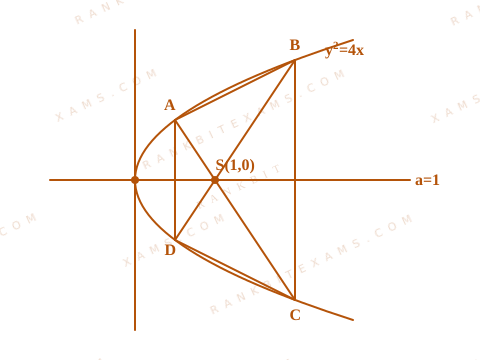
### Related Formula y = mx - 2am - am^3 quad text(Equation of normal to y^2 = 4ax) ### Core Logic First, extract the centre C of the circle x^2 + y^2 - 4x - 16y + 64 = 0: C equiv (2, 8) For the parabola y^2 = 4x, comparing with y^2 = 4ax, we get a = 1. The shortest distance between a point and a curve is measured along the normal to the curve passing through that point. We need the normal to the parabola that passes through the circle's centre (2, 8). ### Step 1: Applying Normal Condition Equation of normal in slope form (a=1): y = mx - 2m - m^3 Since it passes through (2, 8): 8 = m(2) - 2m - m^3 8 = -m^3 Rightarrow m^3 = -8 Rightarrow m = -2 ### Step 2: Finding Coordinate Point on Parabola The foot of the normal on the parabola is given by the coordinate P(am^2, -2am). Substitute a=1, m=-2: P equiv (1(-2)^2, -2(1)(-2)) P equiv (4, 4) ### Step 3: Calculating Shortest Distance The distance d is between the point P(4, 4) and the centre C(2, 8): d = sqrt(4-2)^2 + (4-8)^2 d = sqrt2^2 + (-4)^2 = sqrt4 + 16 = sqrt20 Thus, d^2 = 20. ### Pattern Recognition Shortest distance between a curve and a fixed point (like a circle's center) ALWAYS lies exactly along their common normal. Write the parameterized normal equation and force it through the coordinate to extract the slope root. ### Evaluation Rubric / Model Answer null ### Chapter Mix Class 11 Maths: Circles Class 11 Maths: Parabola
Q15 jee_main_2024_27_jan_morning Chord with a given middle point
The length of the chord of the ellipse fracx^225+fracy^216=1, whose mid point is left(1, frac25right) is equal to :
  • A. fracsqrt16915
  • B. fracsqrt20095
  • C. fracsqrt17415
  • D. fracsqrt15415

Solution

### Related Formula T = S_1 Equation of chord with a given midpoint (x_1, y_1) for an ellipse fracx^2a^2 + fracy^2b^2 = 1 is: fracx x_1a^2 + fracy y_1b^2 = fracx_1^2a^2 + fracy_1^2b^2 ### Core Logic Given the ellipse fracx^225 + fracy^216 = 1 and midpoint (x_1, y_1) = (1, frac25). Substitute these into the T = S_1 formula: fracx(1)25 + fracy(2/5)16 = frac1^225 + frac(2/5)^216 fracx25 + fracy40 = frac125 + frac4/2516 frac8x + 5y200 = frac125 + frac1100 frac8x + 5y200 = frac5100 = frac10200 This simplifies to the chord equation: 8x + 5y = 10 Rightarrow y = frac10 - 8x5 ### Step 1: Finding Points of Intersection Substitute the chord equation back into the ellipse equation to find intersection coordinates: fracx^225 + frac(frac10 - 8x5)^216 = 1 fracx^225 + frac(10 - 8x)^2400 = 1 Multiply the entire equation by 400: 16x^2 + (10 - 8x)^2 = 400 16x^2 + 100 - 160x + 64x^2 = 400 80x^2 - 160x - 300 = 0 Divide by 20: 4x^2 - 8x - 15 = 0 ### Step 2: Solving the Quadratic Solve for roots x_1 and x_2: x = frac-(-8) pm sqrt(-8)^2 - 4(4)(-15)2(4) x = frac8 pm sqrt64 + 2408 = frac8 pm sqrt3048 Difference of x-coordinates: |x_1 - x_2| = fracsqrt3044 ### Step 3: Calculating Chord Length Because the points lie on the line y = frac10 - 8x5, the difference in y-coordinates relates to the slope m = -frac85: |y_1 - y_2| = |-frac85| |x_1 - x_2| The distance D between the points is: D = sqrt(x_1 - x_2)^2 + (y_1 - y_2)^2 = |x_1 - x_2| sqrt1 + m^2 D = fracsqrt3044 sqrt1 + left(frac-85right)^2 D = fracsqrt3044 sqrt1 + frac6425 = fracsqrt3044 fracsqrt895 D = fracsqrt16 times 194 fracsqrt895 = frac4sqrt194 fracsqrt895 = fracsqrt16915 ### Pattern Recognition For intersecting lines and conics, you rarely need to explicitly find y_1 and y_2. Use the slope property: Distance = |x_1 - x_2| sqrt1+m^2 to bypass entirely the substitution of messy quadratic roots back into the linear equation. ### Evaluation Rubric / Model Answer null ### Chapter Mix Class 11 Maths: Ellipse Class 11 Maths: Straight Lines
Q25 jee_main_2024_29_jan_morning Intersection of Conics
If the points of intersection of two distinct conics x^2+y^2=4b and fracx^216+fracy^2b^2=1 lie on the curve y^2=3x^2 then 3sqrt3 times the area of the rectangle formed by the intersection points is
Numerical Answer. Answer: 432 to 432

Solution

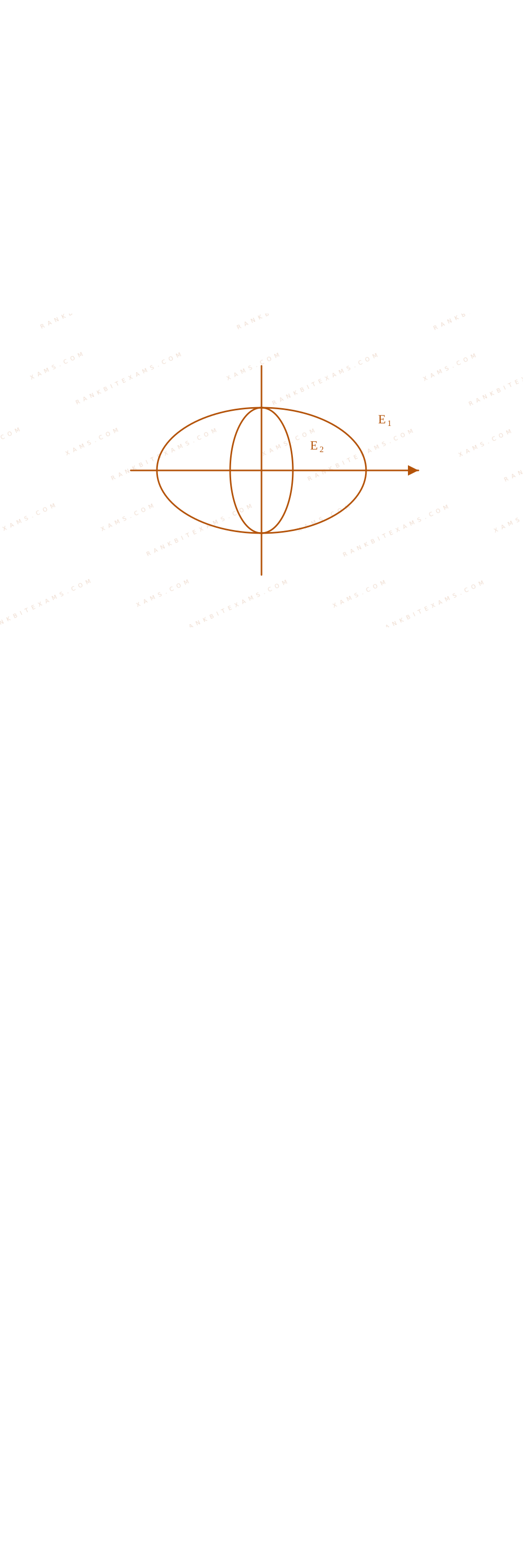
### Related Formula textArea of a rectangle bounded by x = pm x_1, y = pm y_1 text is (2x_1)(2y_1) = 4x_1y_1 ### Core Logic Since the points of intersection of the circle x^2+y^2=4b and the ellipse fracx^216+fracy^2b^2=1 satisfy the curve y^2 = 3x^2, we can substitute y^2 = 3x^2 into the circle equation to find these coordinates entirely in terms of b. Substitute y^2 = 3x^2 into x^2 + y^2 = 4b: x^2 + 3x^2 = 4b 4x^2 = 4b Rightarrow x^2 = b Since y^2 = 3x^2, substituting x^2=b gives: y^2 = 3b Now, these points (x^2=b, y^2=3b) must also lie perfectly on the ellipse. Substitute them into the ellipse equation: fracb16 + frac3bb^2 = 1 fracb16 + frac3b = 1 ### Step 1: Solve for Parameter b Multiply the equation by 16b: b^2 + 48 = 16b b^2 - 16b + 48 = 0 (b-4)(b-12) = 0 This gives two candidate values: b=4 and b=12. Check conditions: The problem specifically declares "two distinct conics". If b=4, the circle becomes x^2+y^2=16 and the ellipse becomes fracx^216+fracy^216=1 (which is identically x^2+y^2=16). The conics would coincide and not be distinct. Thus, reject b=4. We must use b=12. ### Step 2: Calculate Coordinates and Area With b=12, extract the point coordinates: x^2 = 12 Rightarrow x = pm 2sqrt3 y^2 = 36 Rightarrow y = pm 6 The four intersection points form a symmetrical rectangle in the cartesian plane with dimensions: Length = 2|x| = 2(2sqrt3) = 4sqrt3 Width = 2|y| = 2(6) = 12 Area of the rectangle = (4sqrt3) times 12 = 48sqrt3. ### Step 3: Evaluate Final Expression The question asks for 3sqrt3 times the area of the rectangle: 3sqrt3 times (48sqrt3) = 3 times 48 times 3 = 144 times 3 = 432 ### Pattern Recognition When intersection points of shapes are constrained to lie on a third curve (like y^2=kx^2), substitute the 3rd curve into the simplest conic first to lock x^2 and y^2 as scalars, then test those scalars strictly on the remaining complex conic. ### Evaluation Rubric / Model Answer null ### Chapter Mix Class 11 Mathematics: Conic Sections
Q3 jee_main_2024_30_january_evening Ellipse Properties
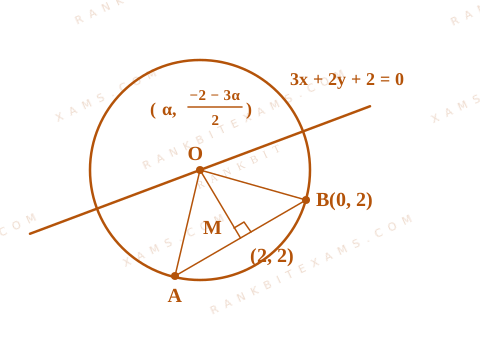
Let A(alpha, 0) and B(0, beta) be the points on the line 5x + 7y = 50 . Let the point P divide the line segment AB internally in the ratio 7:3 . Let 3x - 25 = 0 be a directrix of the ellipse E: fracx^2a^2 + fracy^2b^2 = 1 and the corresponding focus be S . If from S , the perpendicular on the x-axis passes through P , then the length of the latus rectum of E is equal to
  • A. frac253
  • B. frac329
  • C. frac259
  • D. frac325

Solution

### Related Formula textSection Formula: (x, y) = left(fracmx_2 + nx_1m+n, fracmy_2 + ny_1m+nright) textDirectrix of Ellipse: x = fracae textLength of Latus Rectum = frac2b^2a ### Core Logic First, find points A and B on 5x + 7y = 50. For A on x-axis: y = 0 Rightarrow 5x = 50 Rightarrow alpha = 10 Rightarrow A(10, 0) For B on y-axis: x = 0 Rightarrow 7y = 50 Rightarrow beta = frac507 Rightarrow Bleft(0, frac507right) ### Step 1: Finding Coordinates of P P divides AB in ratio 7:3. Using section formula: x_P = frac7(0) + 3(10)7 + 3 = frac3010 = 3 y_P = frac7left(frac507right) + 3(0)7 + 3 = frac5010 = 5 So, P = (3, 5). ### Step 2: Finding a and b for the Ellipse Directrix is 3x - 25 = 0 Rightarrow x = frac253. Thus, fracae = frac253.
Ellipse Properties diagram for Q3 - JEE Main 2024 Evening
Focus S has coordinates (ae, 0). A perpendicular from S to the x-axis is simply the vertical line x = ae. Since this line passes through P(3, 5), the x-coordinate of S must equal the x-coordinate of P. ae = 3 Now, solving for a: a = left(fracaeright) cdot e = frac253 cdot e Multiply the two equations: ae cdot fracae = 3 cdot frac253 Rightarrow a^2 = 25 Rightarrow a = 5. Also, ae = 3 Rightarrow 5e = 3 Rightarrow e = frac35. Calculate b^2: b^2 = a^2(1 - e^2) = 25left(1 - frac925right) = 25 cdot frac1625 = 16 Rightarrow b = 4 ### Step 3: Calculating Latus Rectum textLength of Latus Rectum = frac2b^2a = frac2(16)5 = frac325 ### Pattern Recognition Intersection of perpendicular from focus passing through a point purely locks the x-coordinate of the focus to the x-coordinate of that point. ### Evaluation Rubric / Model Answer null ### Chapter Mix Class 11 Maths: Straight Lines Class 11 Maths: Conic Sections
Q10 jee_main_2024_30_january_evening Hyperbola
Let P be a point on the hyperbola H: fracx^29 -fracy^24 = 1 in the first quadrant such that the area of triangle formed by P and the two foci of H is 2sqrt13 . Then, the square of the distance of P from the origin is
  • A. 18
  • B. 26
  • C. 22
  • D. 20

Solution

### Related Formula textEccentricity of Hyperbola: e^2 = 1 + fracb^2a^2 textFoci coordinates: (pm ae, 0) textArea of Triangle: frac12 times textbase times textheight ### Core Logic For the hyperbola fracx^29 - fracy^24 = 1, we have a^2 = 9 and b^2 = 4. e^2 = 1 + frac49 = frac139 Rightarrow e = fracsqrt133 The distance between the two foci S_1, S_2 is 2ae: 2ae = 2(3)left(fracsqrt133right) = 2sqrt13 ### Step 1: Using the Triangle Area
Hyperbola diagram for Q10 - JEE Main 2024 Evening
Let point P on the hyperbola be (alpha, beta) in the first quadrant (so alpha, beta gt 0). The base of the triangle is the segment between foci, length = 2sqrt13. The height of the triangle is the y-coordinate of P, which is beta. Area of Delta PS_1S_2 = frac12 times textbase times textheight 2sqrt13 = frac12 times (2sqrt13) times beta 2sqrt13 = sqrt13 cdot beta Rightarrow beta = 2 ### Step 2: Finding P's coordinates and Distance Since P lies on the hyperbola: fracalpha^29 - fracbeta^24 = 1 Substitute beta = 2: fracalpha^29 - frac44 = 1 fracalpha^29 - 1 = 1 Rightarrow fracalpha^29 = 2 Rightarrow alpha^2 = 18 We need the square of the distance of P from the origin, which is alpha^2 + beta^2: textDistance^2 = alpha^2 + beta^2 = 18 + 2^2 = 18 + 4 = 22 ### Pattern Recognition Area formed by a point on a conic and its foci uses the interfocal distance 2ae as a flat base on the x-axis, directly exposing the point's y-coordinate. ### Evaluation Rubric / Model Answer null ### Chapter Mix Class 11 Maths: Conic Sections

More Conic Sections Questions — jee_main_2026_21_jan_morning

Practice all Conic Sections previous-year questions →

Rankbit System
JEE Physics: Waves (+15.5%) | Electrostatics: Concentric Shells (-29.7%) | Modern Physics: Photoelectric Clones (+34.2%) | Mathematics: Definite Integrals (+18.1%) | Chemistry: Coordination Splitting (-11.4%) | JEE Physics: Waves (+15.5%) | Electrostatics: Concentric Shells (-29.7%) | Modern Physics: Photoelectric Clones (+34.2%) | Mathematics: Definite Integrals (+18.1%) | Chemistry: Coordination Splitting (-11.4%)
YOUR FIRST PREP STEP STARTS HERE

We Map Every Repeating Question in Competitive Exams.

Say goodbye to generic mock test fatigue. RankBit uses smart analysis to group past exam questions into their foundational Repeating Question Types. Find chapter weightage, track repeating questions, and score higher with targeted practice.

Select Your Target Exam

Choose an exam track below to find formulas per chapter and patterns.

Syncing Exam Intelligence

Mapping formulas and patterns across all tracks…

PATH A — FULL LENGTH PRACTICE

Full Mock Test Hub

Simulate real NTA exam conditions with fully tracked mocks. Time yourself against past papers.

Now Live Open
PATH B — TARGETED PRACTICE

Topic-wise Practice Hub

Practice past-year questions one chapter at a time. Pick an exam → subject → chapter and get every PYQ for that topic — pulled together from all past papers — with the chapter's key formulas alongside.

Loading Questions... Browse Topics
Latest from the Blog
View all →

Loading articles...