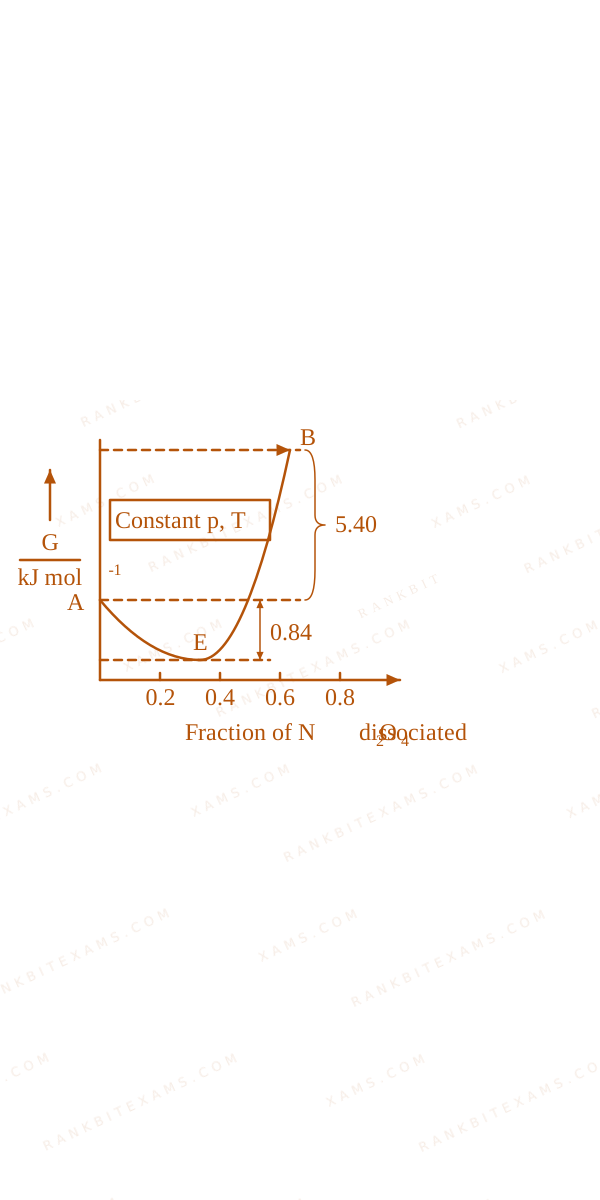
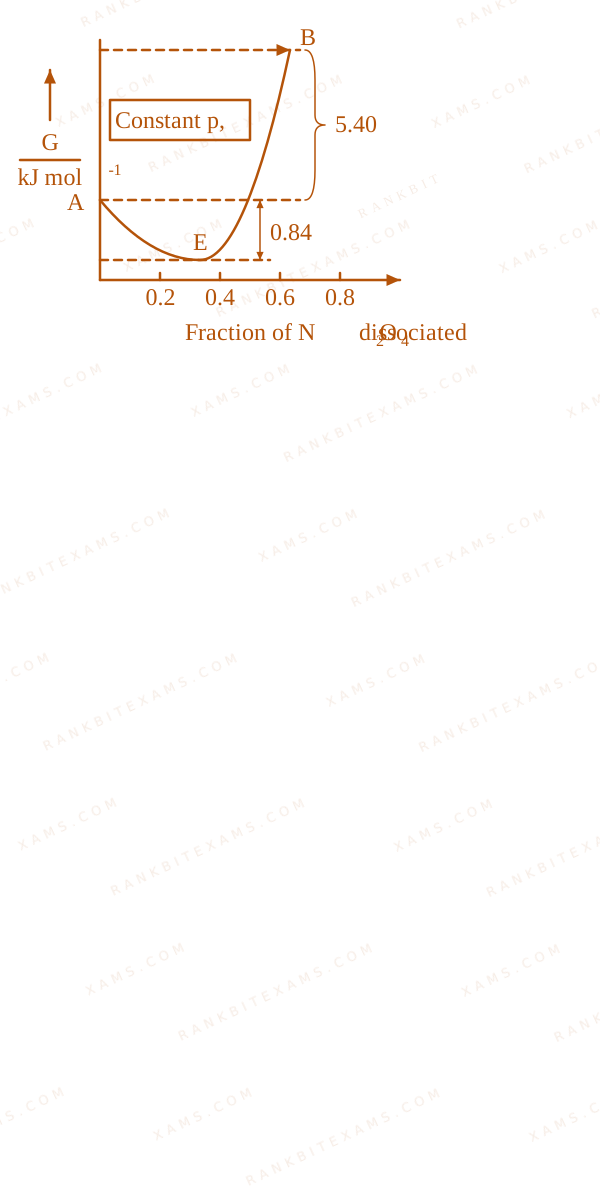
For the reaction, N_2O_4 rightleftharpoons 2NO_2, graph is plotted as shown below. Identify correct statements. A. Standard free energy change for the reaction is -5.40text kJ mol^-1. B. As Delta G^ominus in graph is positive, N_2O_4 will not dissociate into NO_2 at all. C. Reverse reaction will go to completion. D. When 1 mole of N_2O_4 changes into equilibrium mixture, value of Delta G = -0.84text kJ mol^-1. E. When 2 mole of NO_2 changes into equilibrium mixture, Delta G for equilibrium mixture is -6.24text kJ mol^-1.
Gibbs Free Energy and Equilibrium diagram for Q69 - JEE Main 2026 Morning
A plot of Gibbs free energy against the fraction of N2O4 dissociated.
Choose the correct answer from the options given below :

Solution & Explanation

### Core Logic Let's analyze the statements based on the given Gibbs free energy (G) vs. extent of reaction plot.
Gibbs Free Energy and Equilibrium diagram for Q69 - JEE Main 2026 Morning
A plot of Gibbs free energy against the fraction of N2O4 dissociated.
A. Standard free energy change (Delta_r G^circ) is the difference between standard free energies of pure products (point B) and pure reactants (point A): Delta_r G^circ = G_B^circ - G_A^circ. Since B is higher than A, Delta_r G^circ is positive, not -5.40text kJ mol^-1. Statement A is false. B. Even if Delta_r G^circ is positive, the minimum of the curve (equilibrium state E) lies between the pure reactant and product states. Therefore, partial dissociation occurs to reach equilibrium. It is false to say it will not dissociate at all. Statement B is false. C. The minimum E is not at fraction = 0 or 1, meaning an equilibrium mixture exists. Reverse reaction does not go to completion. Statement C is false. D. From 1 mole of pure reactant (point A) to the equilibrium mixture (point E), the drop in Gibbs energy is 0.84text kJ mol^-1. Thus Delta G = -0.84text kJ mol^-1 is correct. Statement D is true. E. The difference from pure products (point B, equivalent to 2 moles NO_2) to equilibrium (E) is the entire vertical distance. The drop from B to A is 5.40, and A to E is 0.84. So drop from B to E is - (5.40 + 0.84) = -6.24text kJ mol^-1. Statement E is true. ### Step 1: Final Conclusion Only statements D and E are correct. ### Pattern Recognition The free energy of mixing creates a minimum 'dip' (Equilibrium) below both pure reactants and pure products, preventing either forward or reverse reactions from going absolutely to 100% completion. ### Evaluation Rubric / Model Answer null ### Chapter Mix Class 11 Chemistry: Thermodynamics Class 11 Chemistry: Equilibrium
Reference Study Guides

More Thermodynamics Previous-Year Questions — Page 7

Q78 jee_main_2024_29_jan_morning Spontaneity and Gibbs Free Energy
  • A. Delta G text is negative for a spontaneous reaction
  • B. Delta G text is positive for a spontaneous reaction
  • C. Delta G text is zero for a reversible reaction
  • D. Delta G text is positive for a non-spontaneous reaction

Solution

### Core Logic According to the second law of thermodynamics, at constant temperature and pressure, the change in Gibbs free energy (Delta G) dictates the spontaneity of a process. - If Delta G lt 0 (negative), the process is spontaneous. - If Delta G gt 0 (positive), the process is non-spontaneous. - If Delta G = 0, the system is in equilibrium (reversible process). Therefore, the statement "Delta G is positive for a spontaneous reaction" is factually incorrect. ### Evaluation Rubric / Model Answer null ### Chapter Mix Class 11 Chemistry: Thermodynamics
Q83 jee_main_2024_30_january_evening Hess's Law of Constant Heat Summation
Two reactions are given below: 2mathrmFe_(s) + frac32mathrmO_2(g) rightarrow mathrmFe_2mathrmO_3(s), Delta mathrmH^circ = -822 mathrmkJ/mol mathrmC_(s) + frac12mathrmO_2(g) rightarrow mathrmCO_(g), Delta mathrmH^circ = -110 mathrmkJ/mol Then enthalpy change for following reaction 3mathrmC_(s) + mathrmFe_2mathrmO_3(s) rightarrow 2mathrmFe_(s) + 3mathrmCO_(g)
Numerical Answer. Answer: 492 to 492

Solution

### Related Formula According to Hess's Law, the net enthalpy change of a reaction is the sum of the enthalpy changes of the individual steps into which it can be divided. ### Core Logic Let the given reactions be: (1) 2mathrmFe_(s) + frac32mathrmO_2(g) rightarrow mathrmFe_2mathrmO_3(s), quad Delta H_1 = -822 \, mathrmkJ/mol (2) mathrmC_(s) + frac12mathrmO_2(g) rightarrow mathrmCO_(g), quad Delta H_2 = -110 \, mathrmkJ/mol Target Reaction (3): 3mathrmC_(s) + mathrmFe_2mathrmO_3(s) rightarrow 2mathrmFe_(s) + 3mathrmCO_(g), quad Delta H_3 = ? To construct the target reaction: - We need 3 mathrmCO_(g) on the product side, so we multiply reaction (2) by 3. - We need mathrmFe_2mathrmO_3(s) on the reactant side and 2 mathrmFe_(s) on the product side, so we reverse reaction (1). ### Step 1: Calculate Net Enthalpy Target Reaction (3) = 3 times (2) - (1) Delta H_3 = 3 times Delta H_2 - Delta H_1 Delta H_3 = 3(-110) - (-822) Delta H_3 = -330 + 822 = 492 \, mathrmkJ/mol ### Evaluation Rubric / Model Answer null ### Chapter Mix Class 11 Chemistry: Thermodynamics
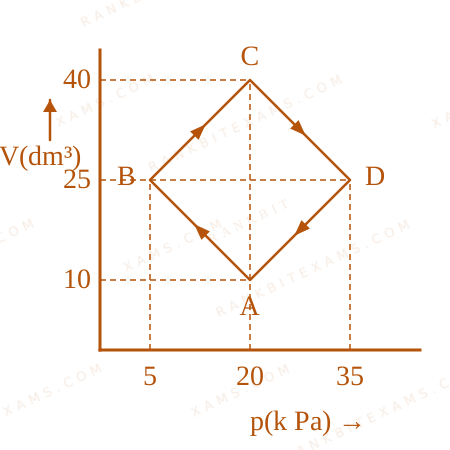
Q83 jee_main_2024_30_jan_morning Work Done in Cyclic Process
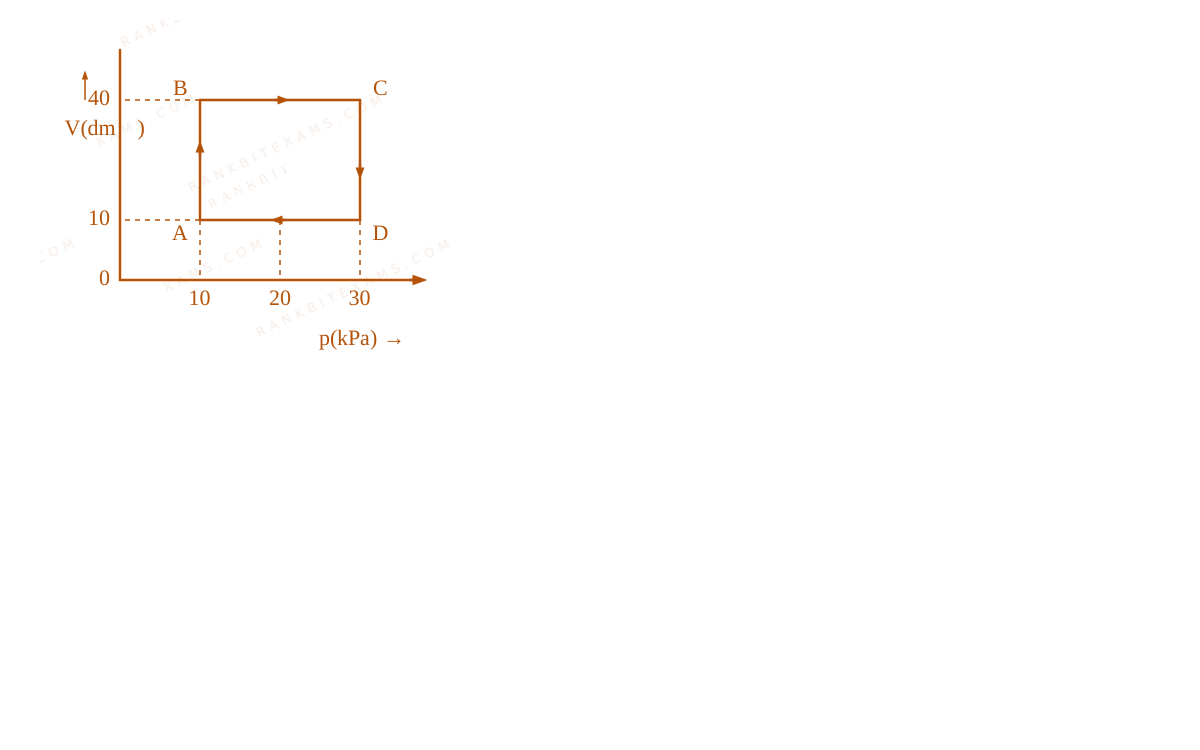
An ideal gas undergoes a cyclic transformation starting from the point A and coming back to the same point by tracing the path Arightarrow Brightarrow Crightarrow A as shown in the diagram. The total work done in the process is ________ J.
Work Done in Cyclic Process diagram for Q83 - JEE Main 2024 Morning
The image is a graph of Volume (dm3) vs Pressure (kPa) showing a triangular cyclic process starting from A(10,10) to B(10,30) to C(30,10) and back to A.
Numerical Answer. Answer: 200 to 200

Solution

### Related Formula W_textcyclic = textArea enclosed in P-V graph ### Core Logic The work done in a cyclic process is equal to the magnitude of the area enclosed by the cycle on a Pressure-Volume graph. Note that the provided graph is Volume (V) on the y-axis versus Pressure (P) on the x-axis. The path A rightarrow B rightarrow C rightarrow A is traced in a clockwise direction on the V-P graph. Clockwise on a V-P graph corresponds to anti-clockwise on a standard P-V graph, meaning net expansion work is done by the gas, making it positive conventionally (or negative depending on chemistry sign convention, but magnitude is asked for). ### Step 1: Calculating Area The enclosed region is a right-angled triangle. Base of triangle on P-axis = 30 - 10 = 20 text kPa Height of triangle on V-axis = 30 - 10 = 20 text dm^3 textArea = frac12 times textbase times textheight textArea = frac12 times 20 times 20 = 200 text kPacdottextdm^3 ### Step 2: Unit conversion 1 text kPa = 10^3 text Pa 1 text dm^3 = 1 text Litre = 10^-3 text m^3 W = 200 times 10^3 text Pa times 10^-3 text m^3 W = 200 text J ### Pattern Recognition 1 text kPa cdot 1 text L = 1 text Joule. This direct conversion saves time without converting explicitly to standard SI units (Pa and m^3). ### Evaluation Rubric / Model Answer null ### Chapter Mix Class 11 Chemistry: Thermodynamics

Q90 jee_main_2024_31_jan_evening Work Done in Isothermal Reversible Expansion
If 5text moles of an ideal gas expands from 10text L to a volume of 100text L at 300text K under isothermal and reversible condition then work w, is -xtext J. The value of x is ________ (Given R = 8.314text J K^-1textmol^-1)
Numerical Answer. Answer: 28720 to 28721

Solution

### Related Formula W = -2.303 \, nRT log left( fracV_2V_1 right) ### Core Logic For an isothermal and reversible expansion of an ideal gas, work is done by the system on the surroundings, hence it is negative by IUPAC convention. Given: n = 5text moles R = 8.314text J K^-1textmol^-1 T = 300text K V_1 = 10text L V_2 = 100text L ### Step 1: Calculating Work Done W = -2.303 times 5 times 8.314 times 300 times logleft( frac10010 right) W = -2.303 times 5 times 8.314 times 300 times log(10) W = -2.303 times 12471 times 1 W = -28720.713text J ### Step 2: Final Formatting The question asks for work w = -xtext J. So x = 28720.713, which rounds to 28721. ### Evaluation Rubric / Model Answer null ### Chapter Mix Class 11 Chemistry: Thermodynamics
Q88 jee_main_2024_31_jan_morning Gibbs Free Energy and Equilibrium
Consider the following reaction at 298 K. frac32O_2(g) rightleftharpoons O_3(g). quad K_p = 2.47 times 10^-29 Delta_rG^ominus for the reaction is ________ kJ. (Given R = 8.314 text J K^-1 mol^-1)
Numerical Answer. Answer: 163 to 164

Solution

### Related Formula Delta_rG^ominus = -RT ln K_p ### Step 1: Calculation Delta_rG^ominus = -8.314 times 10^-3 text kJ K^-1 mol^-1 times 298 text K times ln(2.47 times 10^-29) = -8.314 times 10^-3 times 298 times (-65.87) = 163.19 text kJ ### Step 2: Nearest Integer Rounding 163.19 to the nearest integer gives 163. ### Evaluation Rubric / Model Answer null ### Chapter Mix Class 11 Chemistry: Thermodynamics

More Thermodynamics Questions — jee_main_2026_21_jan_morning

Practice all Thermodynamics previous-year questions →

Rankbit System
JEE Physics: Waves (+15.5%) | Electrostatics: Concentric Shells (-29.7%) | Modern Physics: Photoelectric Clones (+34.2%) | Mathematics: Definite Integrals (+18.1%) | Chemistry: Coordination Splitting (-11.4%) | JEE Physics: Waves (+15.5%) | Electrostatics: Concentric Shells (-29.7%) | Modern Physics: Photoelectric Clones (+34.2%) | Mathematics: Definite Integrals (+18.1%) | Chemistry: Coordination Splitting (-11.4%)
YOUR FIRST PREP STEP STARTS HERE

We Map Every Repeating Question in Competitive Exams.

Say goodbye to generic mock test fatigue. RankBit uses smart analysis to group past exam questions into their foundational Repeating Question Types. Find chapter weightage, track repeating questions, and score higher with targeted practice.

Select Your Target Exam

Choose an exam track below to find formulas per chapter and patterns.

Syncing Exam Intelligence

Mapping formulas and patterns across all tracks…

PATH A — FULL LENGTH PRACTICE

Full Mock Test Hub

Simulate real NTA exam conditions with fully tracked mocks. Time yourself against past papers.

Now Live Open
PATH B — TARGETED PRACTICE

Topic-wise Practice Hub

Practice past-year questions one chapter at a time. Pick an exam → subject → chapter and get every PYQ for that topic — pulled together from all past papers — with the chapter's key formulas alongside.

Loading Questions... Browse Topics
Latest from the Blog
View all →

Loading articles...