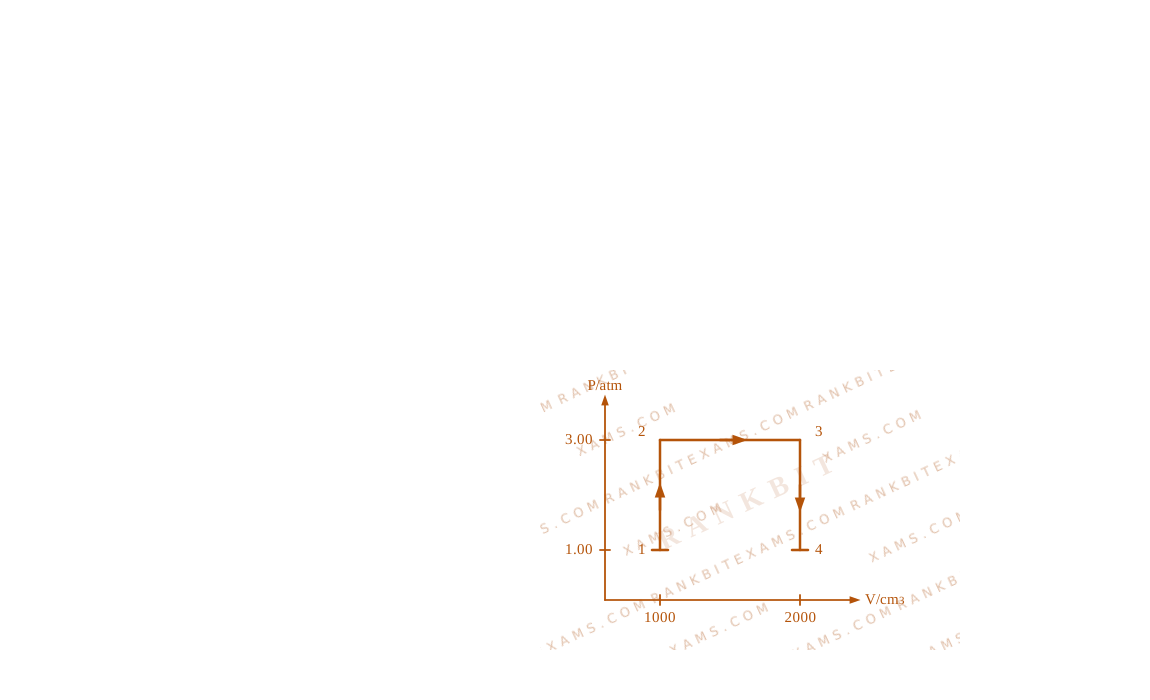
A perfect gas (0.1mathrm~mol) having barC_v=1.50mathrm~R (independent of temperature) undergoes the transformation from point 1 to point 4 as shown in the pressure-volume diagram below. If each step is reversible, the total work done (w) while going from point 1 to point 4 is (-) ________ J. (nearest integer)
P-V path diagram for Q47 - JEE Main 2025 Evening
P-V graph showing a thermodynamic process from point 1 to point 4 containing an isobaric step and isochoric steps.
[Given: R=0.082mathrm~L~atm~K^-1~mol^-1 = 8.314mathrm~J~K^-1~mol^-1]

Numerical Answer Type:
Enter a numerical value Answer: 304 to 304 +4 marks

Solution & Explanation

### Related Formula Thermodynamic work done (w) for each step: - Isochoric step (V = textconstant): w = 0 - Isobaric step (P = textconstant): w = -P Delta V ### Core Logic The process from point 1 to point 4 consists of three distinct segments: 1. Step 1 rightarrow 2: Isochoric cooling at constant volume V_1 = 1000mathrm~cm^3. Work done w_1rightarrow 2 = 0. 2. Step 2 rightarrow 3: Isobaric compression at constant pressure P = 3.00mathrm~atm from volume 2000mathrm~cm^3 to 1000mathrm~cm^3. 3. Step 3 rightarrow 4: Isochoric step at constant volume. Work done w_3rightarrow 4 = 0. ### Step 1: Calculate work done in the isobaric step (2 rightarrow 3) The volume changes from V_i = 2000mathrm~cm^3 = 2.0mathrm~L to V_f = 1000mathrm~cm^3 = 1.0mathrm~L: w_2rightarrow 3 = -P Delta V = -3.00mathrm~atm times (1.0mathrm~L - 2.0mathrm~L) = +3.00mathrm~Lcdot atm ### Step 2: Convert work to Joules and analyze direction Convert \mathrm{L\cdot atm} to Joules: w_2rightarrow 3 = 3.00 times 101.325mathrm~J = 303.975mathrm~J approx 304mathrm~J The question asks for the total work done as (-) ________ J, meaning work done *by* the system (expansion) is negative and work done *on* the system (compression) is positive. Since this is compression, work done on the gas is +304\mathrm{~J}, which is represented as -(-304)\mathrm{~J} in typical IUPAC convention where work of expansion is examined. The absolute magnitude of the work is 304\mathrm{~J}. ### Pattern Recognition During any cyclic or multi-step path on a P-V graph, work is done *only* when there is a change in volume (W = -\int P dV$). Any vertical line (constant volume) represents an isochoric step where work is exactly zero. The horizontal segment directly represents rectangular area under the path. ### Evaluation Rubric / Model Answer null ### Chapter Mix Class 11 Chemistry: Thermodynamics Class 11 Physics: Thermodynamics

Reference Study Guides

More Thermodynamics Previous-Year Questions

Q68 jee_main_2026_21_jan_morning Work Done in PV Graph
Which of the following graphs between pressure ‘P’ versus volume ‘V’ represent the maximum work done?
  • A. textOption 1
  • B. textOption 2
  • C. textOption 3
  • D. textOption 4

Solution

### Core Logic The magnitude of work done by or on a gas is given by the area under the P-V curve projected onto the volume axis. Graph 1: Cyclic process forming a triangle. Area is bounded, represents net work. Graph 2: Isochoric drop (vertical line at V=22.4L). Area = 0, so work done is zero. Graph 3: Expansion process forming a cycle. Area is enclosed in a convex shape. Graph 4: Direct expansion from V=22.4 to V=44.8 at pressure P=1 up to P=2 (a rectangle combined with a triangle). The total area under the upper curve from V=22.4 to V=44.8 covers the entire shaded region under the path down to the V-axis. Option (4) provides the largest total area under the curve extending down to the horizontal axis (maximum magnitude of work done). ### Evaluation Rubric / Model Answer null ### Chapter Mix Class 11 Chemistry: Thermodynamics
Q69 jee_main_2026_21_jan_morning Gibbs Free Energy and Equilibrium
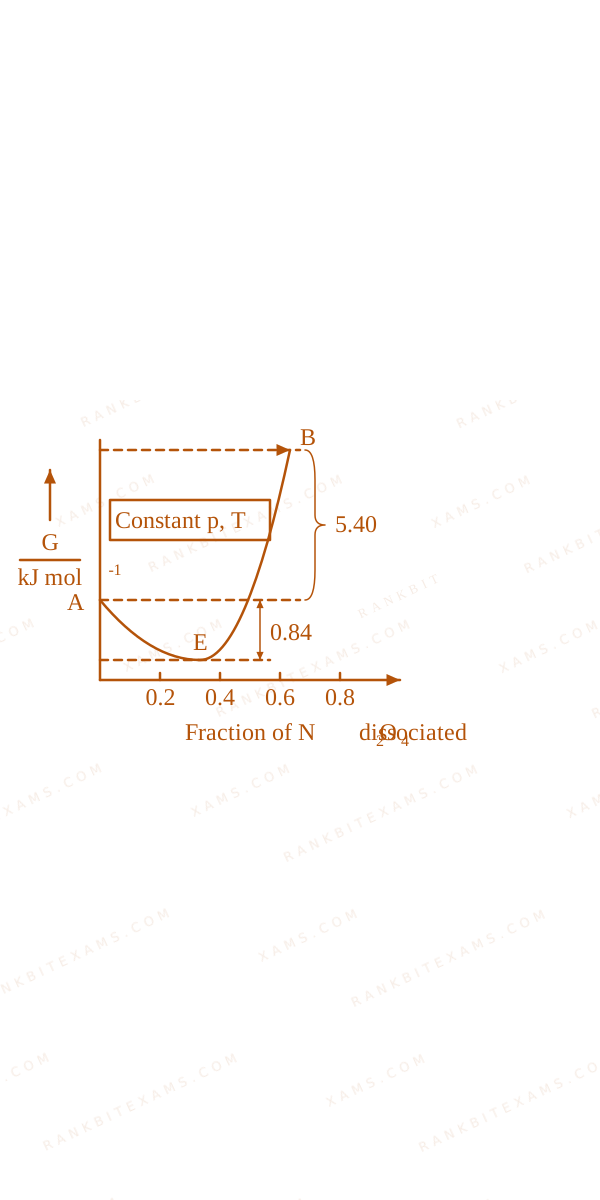
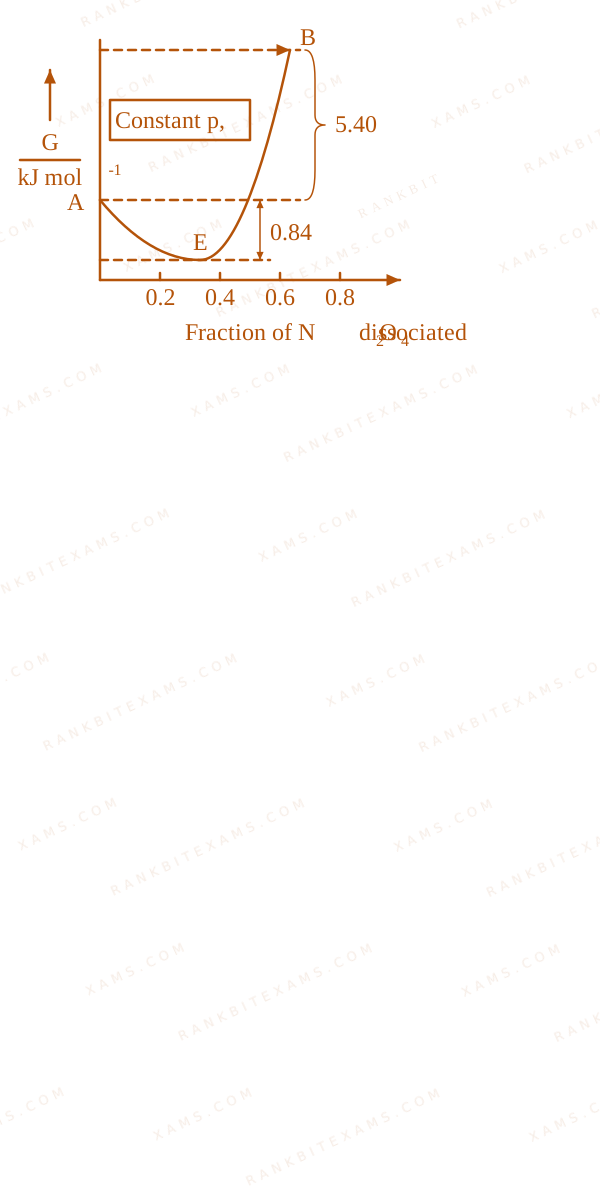
For the reaction, N_2O_4 rightleftharpoons 2NO_2, graph is plotted as shown below. Identify correct statements. A. Standard free energy change for the reaction is -5.40text kJ mol^-1. B. As Delta G^ominus in graph is positive, N_2O_4 will not dissociate into NO_2 at all. C. Reverse reaction will go to completion. D. When 1 mole of N_2O_4 changes into equilibrium mixture, value of Delta G = -0.84text kJ mol^-1. E. When 2 mole of NO_2 changes into equilibrium mixture, Delta G for equilibrium mixture is -6.24text kJ mol^-1.
Gibbs Free Energy and Equilibrium diagram for Q69 - JEE Main 2026 Morning
A plot of Gibbs free energy against the fraction of N2O4 dissociated.
Choose the correct answer from the options given below :
  • A. textD and E only
  • B. textC and E only
  • C. textA and D only
  • D. textB and C only

Solution

### Core Logic Let's analyze the statements based on the given Gibbs free energy (G) vs. extent of reaction plot.
Gibbs Free Energy and Equilibrium diagram for Q69 - JEE Main 2026 Morning
A plot of Gibbs free energy against the fraction of N2O4 dissociated.
A. Standard free energy change (Delta_r G^circ) is the difference between standard free energies of pure products (point B) and pure reactants (point A): Delta_r G^circ = G_B^circ - G_A^circ. Since B is higher than A, Delta_r G^circ is positive, not -5.40text kJ mol^-1. Statement A is false. B. Even if Delta_r G^circ is positive, the minimum of the curve (equilibrium state E) lies between the pure reactant and product states. Therefore, partial dissociation occurs to reach equilibrium. It is false to say it will not dissociate at all. Statement B is false. C. The minimum E is not at fraction = 0 or 1, meaning an equilibrium mixture exists. Reverse reaction does not go to completion. Statement C is false. D. From 1 mole of pure reactant (point A) to the equilibrium mixture (point E), the drop in Gibbs energy is 0.84text kJ mol^-1. Thus Delta G = -0.84text kJ mol^-1 is correct. Statement D is true. E. The difference from pure products (point B, equivalent to 2 moles NO_2) to equilibrium (E) is the entire vertical distance. The drop from B to A is 5.40, and A to E is 0.84. So drop from B to E is - (5.40 + 0.84) = -6.24text kJ mol^-1. Statement E is true. ### Step 1: Final Conclusion Only statements D and E are correct. ### Pattern Recognition The free energy of mixing creates a minimum 'dip' (Equilibrium) below both pure reactants and pure products, preventing either forward or reverse reactions from going absolutely to 100% completion. ### Evaluation Rubric / Model Answer null ### Chapter Mix Class 11 Chemistry: Thermodynamics Class 11 Chemistry: Equilibrium
Q73 jee_main_2026_21_jan_morning Gibbs Free Energy and Equilibrium Constant
Use the following data :
SubstancefracDelta_f H^ominus(500K)kJ mol^-1fracS^ominus(500K)J K^-1 mol^-1
AB(g)32222
A_2(g)6146
B_2(g)x280
One mole each of A_2(g) and B_2(g) are taken in a 1L closed flask and allowed to establish the equilibrium at 500K. A_2(g) + B_2(g) rightleftharpoons 2AB(g) The value of x (in textkJ mol^-1) is .... (Nearest integer) (Given: log K=2.2, R=8.314text J K^-1text mol^-1)
Numerical Answer. Answer: 70 to 70

Solution

### Related Formula Delta_r H^circ = sum Delta_f H^circ(textproducts) - sum Delta_f H^circ(textreactants) Delta_r S^circ = sum S^circ(textproducts) - sum S^circ(textreactants) Delta_r G^circ = Delta_r H^circ - TDelta_r S^circ Delta_r G^circ = -2.303 RT log K ### Core Logic For the reaction A_2(g) + B_2(g) rightleftharpoons 2AB(g): 1. Enthalpy change (Delta_r H^circ): Delta_r H^circ = [2 times Delta_f H^circ(AB)] - [Delta_f H^circ(A_2) + Delta_f H^circ(B_2)] Delta_r H^circ = (2 times 32) - (6 + x) = (64 - 6 - x) = (58 - x)text kJ mol^-1 2. Entropy change (Delta_r S^circ): Delta_r S^circ = [2 times S^circ(AB)] - [S^circ(A_2) + S^circ(B_2)] Delta_r S^circ = (2 times 222) - (146 + 280) = 444 - 426 = 18text J K^-1text mol^-1 3. Standard Gibbs Free Energy (Delta_r G^circ) via Equilibrium Constant: Delta_r G^circ = -2.303 times R times T log K Delta_r G^circ = -2.303 times 8.314 times 500 times 2.2 = -21063.8text J mol^-1 = -21.06text kJ mol^-1 4. Using Gibbs Equation: Delta_r G^circ = Delta_r H^circ - TDelta_r S^circ -21.06 = (58 - x) - 500 times left(frac181000right) -21.06 = 58 - x - 9 -21.06 = 49 - x x = 49 + 21.06 = 70.06text kJ mol^-1 Rounding off to nearest integer, x = 70. ### Evaluation Rubric / Model Answer null ### Chapter Mix Class 11 Chemistry: Thermodynamics Class 11 Chemistry: Equilibrium

Q38 jee_main_2025_02_april_evening Thermodynamic Work and Reversible Processes
Arrange the following in order of magnitude of work done by the system / on the system at constant temperature : (a) |mathrmw_mathrmreversible| for expansion in infinite stage. (b) |mathrmw_mathrmirreversible| for expansion in single stage. (c) |mathrmw_mathrmreversible| for compression in infinite stage. (d) |mathrmw_mathrmirreversible| for compression in single stage. Choose the correct answer from the options given below:
  • A. a > b > c > d
  • B. mathrmd > mathrmc = mathrma > mathrmb
  • C. c = a > d > b
  • D. a > c > b > d

Solution

### Related Formula w_textrev = -nRT lnleft(fracV_mathrmfV_mathrmiright) w_textirrev = -P_textext left(V_mathrmf - V_mathrmiright) ### Core Logic For isothermal reversible and irreversible steps: 1. **Reversible Path**: Since a reversible compression path retraces the exact coordinates of the reversible expansion path, the magnitudes of work are equal: |w_textrev, expansion| = |w_textrev, compression| implies a = c
P-V indicator diagrams comparing reversible and irreversible expansion/compression
2. **Isothermal Expansion**: Reversible work magnitude is the maximum possible work. Hence, for expansion: |w_textrev, expansion| > |w_textirrev, expansion| implies a > b
P-V indicator diagrams comparing reversible and irreversible expansion/compression
3. **Isothermal Compression**: Irreversible compression requires more work than reversible compression because of sudden pressure adjustments against the surroundings: |w_textirrev, compression| > |w_textrev, compression| implies d > c
P-V indicator diagrams comparing reversible and irreversible expansion/compression
### Step 1: Combine the inequalities Combining the results: - We have a = c - We have d > c - We have a > b This leads to the strict inequality sequence: d > c = a > b ### Pattern Recognition Thermodynamics Principle: Reversible expansion is the most efficient (gives maximum work magnitude), whereas reversible compression is the most efficient (requires minimum work magnitude). Single-stage irreversible compression is always the least efficient, demanding the absolute highest work input. ### Evaluation Rubric / Model Answer null ### Chapter Mix Class 11 Chemistry: Chemical Thermodynamics
Q jee_main_2025_02_april_morning Ideal Gas Free Expansion
Two vessels A and B are connected via stopcock. The vessel A is filled with a gas at a certain pressure. The entire assembly is immersed in water and is allowed to come to thermal equilibrium with water. After opening the stopcock the gas from vessel A expands into vessel B and no change in temperature is observed in the thermometer. Which of the following statement is true?
Ideal Gas Free Expansion experimental setup diagram for Q31
The diagram displays a water bath calorimeter surrounding two interconnected glass flasks via a valve setup to demonstrate thermal expansion behavior.
  • A. (1)\ mathrmdw neq 0
  • B. (2)\ mathrmdq neq 0
  • C. (3)\ mathrmdU neq 0
  • D. (4)\ textThe pressure in the vessel B before opening the stopcock is zero.

Solution

### Related Formula First Law of Thermodynamics expression: mathrmdU = dq + dw ### Core Logic The system parameters show an isothermal transformation layout with zero overall heat transfer step: * No change in temperature signifies mathrmdT = 0, hence internal energy change for an ideal gas satisfies: mathrmdU = nC_vmathrmdT = 0 * Since it expands freely into an empty chamber (vessel B), external pressure P_textext = 0, meaning work done is: mathrmdw = -P_textextmathrmdV = 0 * Combining these parameters in the First Law gives mathrmdq = 0. * This classic situation of "free expansion" implies vessel B was completely evacuated initially. ### Step 1: Statement Verification Therefore, the pressure inside vessel B before opening the stopcock was precisely zero. ### Pattern Recognition Isothermal + expansion against no opposing force = Free Expansion. For free expansion of an ideal gas, always remember: w = 0, q = 0, and Delta U = 0 simultaneously. ### Evaluation Rubric / Model Answer null ### Chapter Mix Class 11 Chemistry: Chemical Thermodynamics

More Thermodynamics Questions — jee_main_2025_03_april_evening

Practice all Thermodynamics previous-year questions →

Rankbit System
JEE Physics: Waves (+15.5%) | Electrostatics: Concentric Shells (-29.7%) | Modern Physics: Photoelectric Clones (+34.2%) | Mathematics: Definite Integrals (+18.1%) | Chemistry: Coordination Splitting (-11.4%) | JEE Physics: Waves (+15.5%) | Electrostatics: Concentric Shells (-29.7%) | Modern Physics: Photoelectric Clones (+34.2%) | Mathematics: Definite Integrals (+18.1%) | Chemistry: Coordination Splitting (-11.4%)