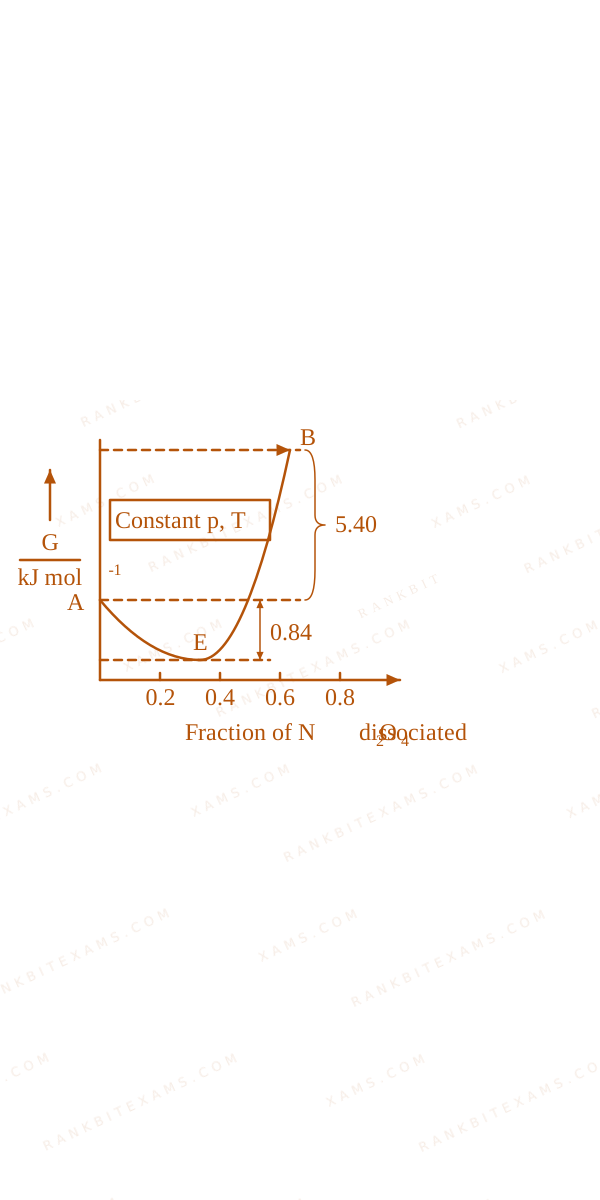
For the reaction, N₂O₄ leftharpoons 2NO₂$N_{2}O_{4} \rightleftharpoons 2NO_{2}$, graph is plotted as shown below. Identify correct statements.
A. Standard free energy change for the reaction is -5.40 kJ mol⁻¹$-5.40\text{ kJ mol}^{-1}$.
B. As Δ G$\Delta G^{\ominus}$ in graph is positive, N₂O₄$N_{2}O_{4}$ will not dissociate into NO₂$NO_{2}$ at all.
C. Reverse reaction will go to completion.
D. When 1 mole of N₂O₄$N_{2}O_{4}$ changes into equilibrium mixture, value of Δ G = -0.84 kJ mol⁻¹$\Delta G = -0.84\text{ kJ mol}^{-1}$.
E. When 2 mole of NO₂$NO_{2}$ changes into equilibrium mixture, Δ G$\Delta G$ for equilibrium mixture is -6.24 kJ mol⁻¹$-6.24\text{ kJ mol}^{-1}$.
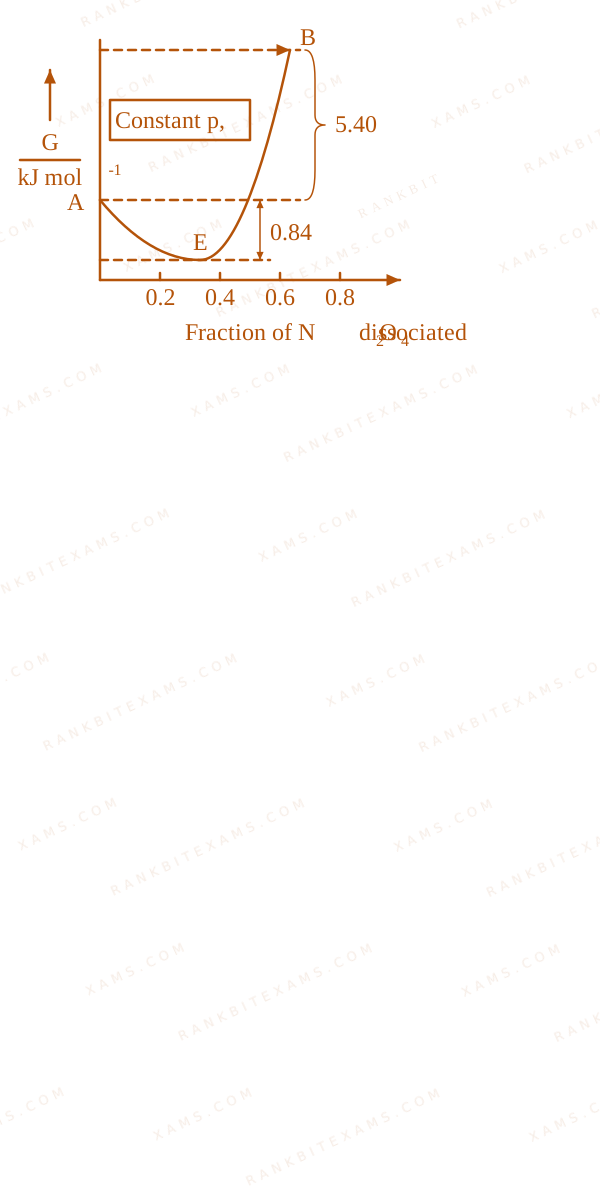
A plot of Gibbs free energy against the fraction of N2O4 dissociated.
Choose the correct answer from the options given below :
A.D and E only$\text{D and E only}$
B.C and E only$\text{C and E only}$
C.A and D only$\text{A and D only}$
D.B and C only$\text{B and C only}$
Solution & Explanation
Core Logic
Let's analyze the statements based on the given Gibbs free energy (G) vs. extent of reaction plot.
A plot of Gibbs free energy against the fraction of N2O4 dissociated.
A. Standard free energy change (Δᵣ G°$\Delta_r G^{\circ}$) is the difference between standard free energies of pure products (point B) and pure reactants (point A): Δᵣ G° = GB° - GA°$\Delta_r G^{\circ} = G_B^{\circ} - G_A^{\circ}$. Since B is higher than A, Δᵣ G°$\Delta_r G^{\circ}$ is positive, not -5.40 kJ mol⁻¹$-5.40\text{ kJ mol}^{-1}$. Statement A is false.
B. Even if Δᵣ G°$\Delta_r G^{\circ}$ is positive, the minimum of the curve (equilibrium state E) lies between the pure reactant and product states. Therefore, partial dissociation occurs to reach equilibrium. It is false to say it will not dissociate at all. Statement B is false.
C. The minimum E is not at fraction = 0 or 1, meaning an equilibrium mixture exists. Reverse reaction does not go to completion. Statement C is false.
D. From 1 mole of pure reactant (point A) to the equilibrium mixture (point E), the drop in Gibbs energy is 0.84 kJ mol⁻¹$0.84\text{ kJ mol}^{-1}$. Thus Δ G = -0.84 kJ mol⁻¹$\Delta G = -0.84\text{ kJ mol}^{-1}$ is correct. Statement D is true.
E. The difference from pure products (point B, equivalent to 2 moles NO₂$NO_2$) to equilibrium (E) is the entire vertical distance. The drop from B to A is 5.40$5.40$, and A to E is 0.84$0.84$. So drop from B to E is - (5.40 + 0.84) = -6.24 kJ mol⁻¹$- (5.40 + 0.84) = -6.24\text{ kJ mol}^{-1}$. Statement E is true.
Step 1: Final Conclusion
Only statements D and E are correct.
Pattern Recognition
The free energy of mixing creates a minimum 'dip' (Equilibrium) below both pure reactants and pure products, preventing either forward or reverse reactions from going absolutely to 100% completion.
Chapter Mix
Class 11 Chemistry: Thermodynamics
Class 11 Chemistry: Equilibrium
Keywords:#Gibbs free energy change#N2O4 dissociation#JEE Main 2026 Morning Q69#Thermodynamics JEE Main 2026#Gibbs free energy graph#Equilibrium
More Thermodynamics Previous-Year Questions — Page 6
Q27jee_main_2025_04_april_morningSpontaneity and Gibbs Energy
Let us consider a reversible reaction at temperature, T$T$.
In this reaction, both Δ H$\Delta H$ and Δ S$\Delta S$ were observed to have positive values. If the equilibrium temperature is Tₑ$T_e$, then the reaction becomes spontaneous at:
A.T = Tₑ$T = T_e$
B.Tₑ > T$T_e > T$
C.T > Tₑ$T > T_e$
D.Tₑ = 5T$T_e = 5T$
Solution
Related Formula
Δ G = Δ H - TΔ S$$\Delta G = \Delta H - T\Delta S$$
Core Logic
For a reaction to be spontaneous, the change in Gibbs free energy must be negative:
Δ G < 0 Δ H - TΔ S < 0$$\Delta G < 0 \implies \Delta H - T\Delta S < 0$$
Given that both Δ H > 0$\Delta H > 0$ and Δ S > 0$\Delta S > 0$:
Δ H < TΔ S T > (Δ H)/(Δ S)$$\Delta H < T\Delta S \implies T > \frac{\Delta H}{\Delta S}$$
At the equilibrium temperature Tₑ$T_e$, Δ G = 0$\Delta G = 0$, which gives:
Substituting this back into the inequality reveals that the reaction is spontaneous when:
T > Tₑ$T > T_e$
Pattern Recognition
When both Δ H$\Delta H$ and Δ S$\Delta S$ are positive, the reaction is entropy-driven and becomes spontaneous only at higher temperatures (T > Tₑ$T > T_e$).
Chapter Mix
Class 11 Chemistry: Chemical Thermodynamics
Q30jee_main_2025_04_april_morningIsothermal and Reversible Expansion
One mole of an ideal gas expands isothermally and reversibly from 10~dm³$10\mathrm{~dm}^3$ to 20~dm³$20\mathrm{~dm}^3$ at 300~K$300\mathrm{~K}$. Δ U$\Delta U$, q$q$ and work done in the process respectively are:
Given: R = 8.3 ~J~K⁻¹~mol⁻¹$R = 8.3\mathrm{~J~K^{-1}~mol^{-1}}$, ln 10 = 2.3$\ln 10 = 2.3$, 2 = 0.30$\log 2 = 0.30$, 3 = 0.48$\log 3 = 0.48$
Hence, Δ U = 0$\Delta U = 0$, q = 1.718~kJ$q = 1.718\mathrm{~kJ}$, w = -1.718~kJ$w = -1.718\mathrm{~kJ}$.
Pattern Recognition
Isothermal expansion of an ideal gas ALWAYS yields Δ U = 0$\Delta U = 0$. Work is negative (done by system) and heat exchange q$q$ matches work magnitude inversely.
Chapter Mix
Class 11 Chemistry: Chemical Thermodynamics
Q28jee_main_2025_07_april_eveningLattice Enthalpy and Born-Haber Cycle
The hydration energies of K^+$\text{K}^+$ and Cl^-$\text{Cl}^-$ are -x$-\text{x}$ and -y kJ/mol$-\text{y}\text{ kJ/mol}$ respectively. If lattice energy of KCl$\text{KCl}$ is -z kJ/mol$-\text{z}\text{ kJ/mol}$, then the heat of solution of KCl$\text{KCl}$ is:
According to Hess's Law, the dissolution process can be mapped as follows:
Lattice Enthalpy and Born-Haber Cycle diagram for Q28 - JEE Main 2025 Evening
Given parameters:
Lattice Energy of KCl$\text{KCl}$ breaking into gaseous ions = -(-z) = z kJ/mol$= -(-\text{z}) = \text{z}\text{ kJ/mol}$ (since lattice energy released on formation is given as -z$-\text{z}$).
Hydration energy of K^+ = -x kJ/mol$\text{K}^+ = -\text{x}\text{ kJ/mol}$
Hydration energy of Cl^- = -y kJ/mol$\text{Cl}^- = -\text{y}\text{ kJ/mol}$
Step 1: Computation
Substituting the values into the governing formulation:
Δ Hsol = z + (-x) + (-y)$$\Delta H_{\text{sol}} = \text{z} + (-\text{x}) + (-\text{y}) $$Δ Hsol = z - x - y = z - (x + y)$$\Delta H_{\text{sol}} = \text{z} - \text{x} - \text{y} = \text{z} - (\text{x} + \text{y}) $$
Pattern Recognition
To dissolve an ionic crystal, energy equal to the lattice energy must be supplied (endothermic step, +z$+\text{z}$), and hydration releases energy (exothermic steps, -x$-\text{x}$ and -y$-\text{y}$). Net heat of solution is simply the sum of these parts: z - x - y$\text{z} - \text{x} - \text{y}$.
Chapter Mix
Class 11 Chemistry: Chemical Thermodynamics
Class 11 Chemistry: Chemical Bonding and Molecular Structure
Q33jee_main_2025_07_april_eveningStandard Enthalpy of Formation
The correct statement amongst the following is:
A.The term 'standard state' implies that the temperature is 0°C$\text{The term 'standard state' implies that the temperature is } 0^{\circ}\text{C}$
B.The standard state of pure gas is the pure gas at a pressure of 1 and temperature 273 K$\text{The standard state of pure gas is the pure gas at a pressure of 1 \bar and temperature 273 K}$
C.ΔfH298θ is zero for O(g)$\Delta{\text{f}}\text{H}{298}^{\theta}\text{ is zero for O}(g)$
D.ΔfH500θ is zero for O2(g)$\Delta{\text{f}}\text{H}{500}^{\theta}\text{ is zero for O}2(g)$
Solution
Related Formula
ΔfHθ = 0 for an element in its reference/most stable standard state$$\Delta{\text{f}}H^{\theta} = 0 \quad \text{for an element in its reference/most stable standard state} $$
Core Logic
Standard state conditions prescribe a pressure of 1$1\text{ \bar}$. Temperature is not fixed by definition but is explicitly specified (often reference tables use 298.15 K$298.15\text{ K}$).
Oxygen naturally and stably exists as diatomic gas molecules (O₂(g)$\text{O}_2(g)$) at standard thresholds.
The enthalpy of formation of an element in its reference elemental state is identically zero at any reference temperature:
Conversely, atomic oxygen gas (O(g)$\text{O}(g)$) is not the reference phase, so its formation enthalpy is non-zero.
Step 1: Verification of Options
Statement (4) accurately aligns with thermodynamic core definitions, while statement (1) and (2) mistakenly conflate standard ambient reference states with STP conditions (273.15 K, 1 atm$273.15\text{ K}, 1\text{ atm}$).
Pattern Recognition
Standard state definitions checklist: Pressure = 1$= 1\text{ \bar}$. Temperature is variable/assigned independently. Elements in their most stable natural form take ΔfHθ = 0$\Delta{\text{f}}H^{\theta} = 0$ at all thermal profiles.
Chapter Mix
Class 11 Chemistry: Chemical Thermodynamics
Q31jee_main_2025_24_jan_eveningEnthalpy of Neutralization
Which of the following mixing of 1M base and 1M acid leads to the largest increase in temperature?
A. \text{30 mL HCl and 30 mL NaOH}
B. \text{30 mL } \mathrm{CH_{3}COOH} \text{ and 30 mL NaOH}
C. \text{50 mL HCl and 20 mL NaOH}
D. \text{45 mL } \mathrm{CH_{3}COOH} \text{ and 25 mL NaOH}
The temperature rise depends directly on the total heat released (Q$Q$) normalized by the total heat capacity of the resulting mixed volume (m · c$m \cdot c$). Let's evaluate the millimoles of H^+$\mathrm{H}^+$ and OH^-$\mathrm{OH}^-$ that react in each mixture:
Option 1:30 mL of 1M HCl + 30 mL of 1M NaOH$30\text{ mL of } 1\mathrm{M } \mathrm{HCl} + 30\text{ mL of } 1\mathrm{M } \mathrm{NaOH}$
Reactive millimoles = 30 mmol$\text{Reactive millimoles} = 30\text{ mmol}$. Both are strong electrolytes, releasing full neutralization energy (-57.3 kJ/mol$\sim -57.3\text{ kJ/mol}$).
Total volume = 60 mL$60\text{ mL}$.
Option 2:30 mL of 1M CH₃COOH + 30 mL of 1M NaOH$30\text{ mL of } 1\mathrm{M } \mathrm{CH_3COOH} + 30\text{ mL of } 1\mathrm{M } \mathrm{NaOH}$
Reactive millimoles = 30 mmol$\text{Reactive millimoles} = 30\text{ mmol}$. However, since acetic acid is a weak acid, part of the heat is consumed in its ionization. Thus, less total heat is evolved compared to Option 1.
Option 3:50 mL of 1M HCl + 20 mL of 1M NaOH$50\text{ mL of } 1\mathrm{M } \mathrm{HCl} + 20\text{ mL of } 1\mathrm{M } \mathrm{NaOH}$
Comparing Option 1 and Option 3, Option 1 releases significantly more heat (30 mmol$30\text{ mmol}$ vs 20 mmol$20\text{ mmol}$) into a smaller volume (60 mL$60\text{ mL}$ vs 70 mL$70\text{ mL}$), yielding the largest increase in temperature Δ T$\Delta T$.
Pattern Recognition
To maximize Δ T$\Delta T$, look for the option that maximizes the amount of reacting strong acid and strong base equivalents while keeping the total solution volume as small as possible.
Chapter Mix
Class 11 Chemistry: Thermodynamics
Class 11 Chemistry: Equilibrium
More Thermodynamics Questions — jee_main_2026_21_jan_morning
Practice past-year questions one chapter at a time. Pick an exam → subject → chapter and get every PYQ for that topic — pulled together from all past papers — with the chapter's key formulas alongside.
)
