In Carius method, 0.75 g of an organic compound gave 1.2 g of barium sulphate, find percentage of sulphur (molar mass 32text g mol^-1). Molar mass of barium sulphate is 233text g mol^-1.

Solution & Explanation

### Related Formula textPercentage of Sulphur = fractextMass of S text in BaSO_4textMolar mass of BaSO_4 times fractextMass of BaSO_4 text formedtextMass of organic compound times 100 ### Core Logic Molar mass of BaSO_4 = 233 g/mol. Mass of Sulfur (S) in 1 mole of BaSO_4 = 32 g. Mass of BaSO_4 formed = 1.2 g. Mass of organic compound = 0.75 g. \% mathrmS = frac32233 times frac1.20.75 times 100 \% mathrmS = frac32 times 1.2 times 100233 times 0.75 = frac3840174.75 approx 21.97\% ### Evaluation Rubric / Model Answer null ### Chapter Mix Class 11 Chemistry: Organic Chemistry - Some Basic Principles and Techniques

Reference Study Guides

More Organic Chemistry - Some Basic Principles and Techniques Previous-Year Questions — Page 6

Q43 jee_main_2025_28_jan_morning Acidity of Organic Compounds
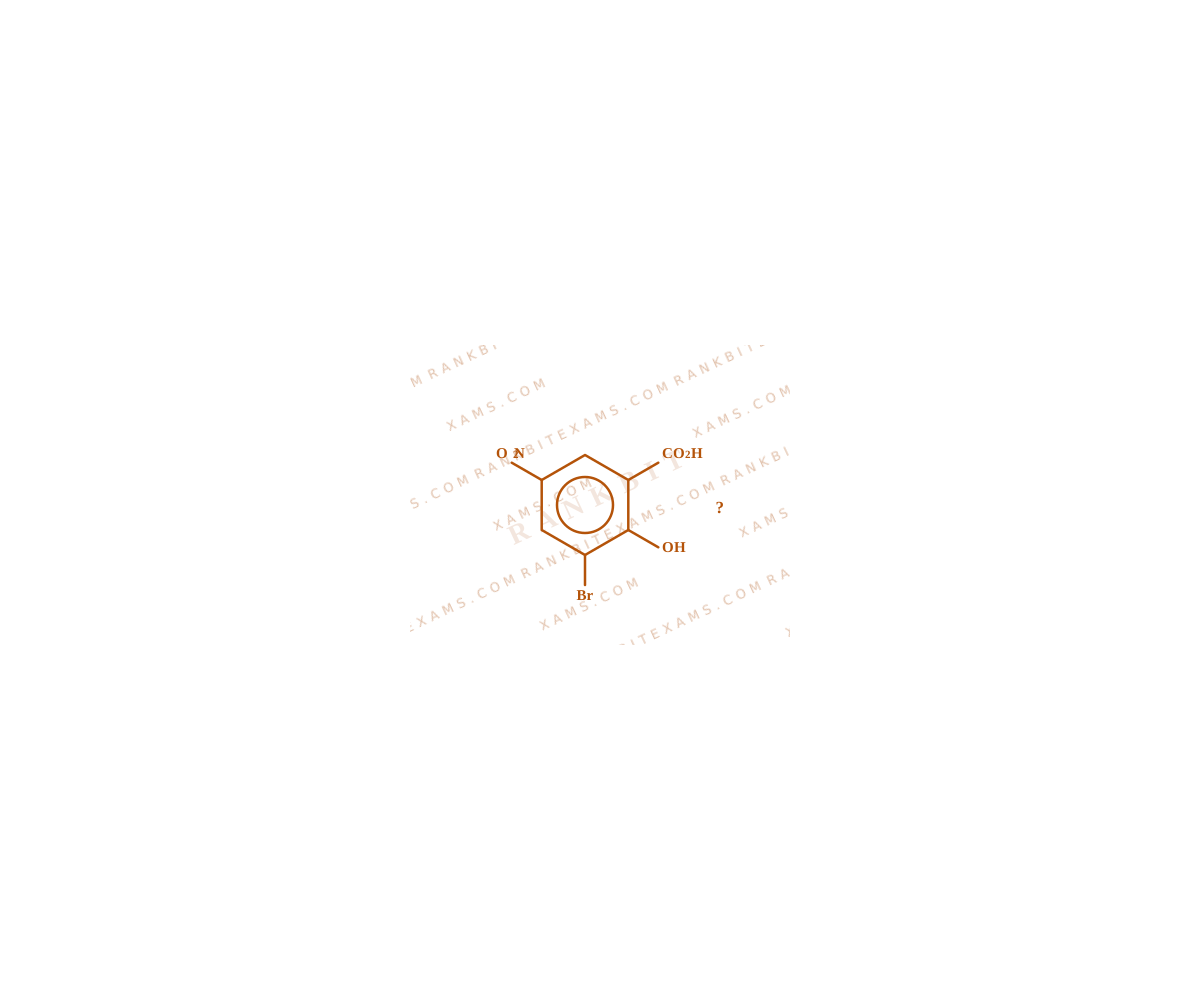
The compounds that produce mathrmCO_2 with aqueous mathrmNaHCO_3 solution are: A.
Acid structures profile for Q43 - JEE Main 2025 Morning
The prompt lists five structures labeled A through E evaluating structural acidities.
B.
Acid structures profile for Q43 - JEE Main 2025 Morning
The prompt lists five structures labeled A through E evaluating structural acidities.
C.
Acid structures profile for Q43 - JEE Main 2025 Morning
The prompt lists five structures labeled A through E evaluating structural acidities.
D.
Acid structures profile for Q43 - JEE Main 2025 Morning
The prompt lists five structures labeled A through E evaluating structural acidities.
E.
Acid structures profile for Q43 - JEE Main 2025 Morning
The prompt lists five structures labeled A through E evaluating structural acidities.
Choose the correct answer from the options given below:
  • A. textA and C only
  • B. textA, B and E only
  • C. textA, C and D only
  • D. textA and B only

Solution

### Core Logic Organic compounds react with sodium bicarbonate (mathrmNaHCO_3) to liberate mathrmCO_2 gas if they are stronger acids than carbonic acid (mathrmH_2mathrmCO_3). Evaluating the structures: - **A:** Benzoic acid, which is significantly more acidic than carbonic acid. - **C:** Picric acid (2,4,6-trinitrophenol). Due to three strong electron-withdrawing nitro groups, its acidity exceeds typical carboxylic acids and mathrmH_2mathrmCO_3. - **D:** Benzenesulfonic acid, a highly strong mineral-like organic acid. - **B & E:** Standard phenols or weakly substituted phenols, which are less acidic than carbonic acid and do not liberate mathrmCO_2. Therefore, structures A, C, and D give a positive test result. ### Pattern Recognition Sees: Sodium bicarbonate test for organic systems. Shortcut: Only carboxylic acids, sulfonic acids, and highly nitrated phenols like picric acid possess sufficient proton acidity to displace mathrmCO_2 from bicarbonate ions. ### Evaluation Rubric / Model Answer null ### Chapter Mix Class 11 Chemistry: Organic Chemistry - Some Basic Principles and Techniques
Q32 jee_main_2025_03_april_morning Structural Isomerism
Identify the correct statements from the following: A. textCH_3textCH_2textCOCH_2textCH_3 and textCH_3textCOCH_2textCH_2textCH_3 are metamers B. textCH_3textCH_2textCH_2textCN and textCH_3textCH_2textCH_2textNC are functional isomers C. 2-methylphenol and 3-methylphenol are position isomers D. textCH_3textCH_2textNH_2 and textCH_3textCH_2textCH_2textNH_2 are homologous Choose the correct answer from the options given below.
  • A. C & D only
  • B. B & C only
  • C. A & B only
  • D. A, B & C only

Solution

### Core Logic Let us check the statements step-by-step: * Statement A: Pentan-3-one and pentan-2-one have different alkyl groups attached on either side of the divalent polyfunctional carbonyl group (-textCO-). Hence, they are metamers.
Metamerism illustration for Q32 - JEE Main 2025 Morning
* **Statement B:** Cyanides (-textCN) and Isocyanides (-textNC) contain distinct functional groups, so they are functional isomers.
Metamerism illustration for Q32 - JEE Main 2025 Morning
* **Statement C:** Phenol structures containing a methyl substituent at positions 2 and 3 are structural position isomers. * **Statement D:** The given structures represent members of a homologous series because they differ sequentially by a -textCH_2- unit. ### Step 1: Verification Evaluating according to standard multi-choice options, statements A and B are perfectly validated. ### Pattern Recognition Shortcut: Metamers require variable alkyl distribution across a polyvalent heteroatom group. Functional isomers require changes like -textCN vs -textNC. ### Evaluation Rubric / Model Answer null ### Chapter Mix Class 11 Chemistry: Organic Chemistry - Some Basic Principles and Techniques
Q44 jee_main_2025_03_april_morning Acidic Strength of Organic Compounds
The least acidic compound, among the following is:
  • A. Compound (D)
  • B. Compound (A)
  • C. Compound (B)
  • D. Compound (C)

Solution

### Core Logic Let us check the conjugate bases formed upon losing a proton: * Compounds (A), (B), and (C) generate conjugate bases stabilized by resonance through the aromatic ring or strong electron-withdrawing groups. * Compound (D) represents an ethynyl group in a terminal alkyne structure (EtO_2C-Cequiv CH). Its conjugate base features a localized negative charge on an sp-hybridized carbon. Because there is no resonance stabilization present for this anion, it is significantly less stable than the conjugate bases of the other functional groups. ### Step 1: Conclusion Since a less stable conjugate base implies a weaker parent acid, the terminal alkyne compound (D) is the least acidic. ### Pattern Recognition Shortcut: A resonance-stabilized anion is always more stable than a localized one. Look for the alkyne carbon versus oxygen/aromatic-centered acids. ### Evaluation Rubric / Model Answer null ### Chapter Mix Class 11 Chemistry: Organic Chemistry - Some Basic Principles and Techniques
Q46 jee_main_2025_03_april_morning Quantitative Analysis - Dumas Method
During estimation of nitrogen by Dumas' method of compound X (0.42 g):
Skeletal structure profile of molecule X for Q46
The image shows the molecular skeletal architecture of compound X with structural parameters revealing a formula corresponding to a molecular mass of 86 g/mol.
mL of N2 gas will be liberated at STP. (nearest integer) (Given molar mass in g mol: C: 12, H: 1, N: 14)
Numerical Answer. Answer: 111 to 111

Solution

### Related Formula Using the Principle of Atom Conservation (POAC) for Nitrogen: n_textcompound times textatoms of N per molecule = 2 times n_N_2 ### Core Logic The molecular weight of the given heterocyclic amine organic structure X is calculated as 86text g/mol.
Stoichiometric parsing matrix step for Q46
The image shows the molecular skeletal architecture of compound X with structural parameters revealing a formula corresponding to a molecular mass of 86 g/mol.
Given mass of compound = 0.42text g: textMoles of compound X = frac0.4286 ### Step 1: Calculating STP Volume Using POAC on Nitrogen atoms: n_N_2 = frac0.4286 textVolume of N_2text at STP = n_N_2 times 22400text mL = frac0.4286 times 22400 approx 110.88text mL Rounding to the nearest integer gives 111text mL. ### Pattern Recognition Shortcut: Always identify the molecular formula from the skeletal grid first. Once M = 86 and total textN = 2 atoms are established, use the stoichiometric ratio directly. ### Evaluation Rubric / Model Answer null ### Chapter Mix Class 11 Chemistry: Organic Chemistry - Some Basic Principles and Techniques
Q47 jee_main_2025_03_april_morning Quantitative Analysis - Estimation of Carbon
0.5 g of an organic compound on combustion gave 1.46 g of CO_2 and 0.9 g of H_2O. The percentage of carbon in the compound is _____. (Nearest integer) [Given: Molar mass (in textg mol^-1) C: 12, H: 1, O: 16]
Numerical Answer. Answer: 80 to 80

Solution

### Related Formula The percentage of carbon via combustion details is found using: % text C = frac1244 times fractextMass of CO_2textMass of organic compound times 100 ### Core Logic Let us substitute the parameters: * Mass of organic compound = 0.5text g * Mass of CO_2 collected = 1.46text g ### Step 1: Numerical Calculation \% text C = frac1244 times frac1.460.5 times 100 % text C = frac12 times 1.4622 times 100 approx 79.63% Rounding to the nearest integer gives 80. ### Pattern Recognition Shortcut: frac1244 approx 0.2727. Multiply 0.2727 times 1.46 to find the carbon mass (0.398text g). Since 0.398text g out of 0.5text g is practically frac45, the value is \right around 80\%. ### Evaluation Rubric / Model Answer null ### Chapter Mix Class 11 Chemistry: Organic Chemistry - Some Basic Principles and Techniques

More Organic Chemistry - Some Basic Principles and Techniques Questions — jee_main_2026_21_jan_morning

Practice all Organic Chemistry - Some Basic Principles and Techniques previous-year questions →

Rankbit System
JEE Physics: Waves (+15.5%) | Electrostatics: Concentric Shells (-29.7%) | Modern Physics: Photoelectric Clones (+34.2%) | Mathematics: Definite Integrals (+18.1%) | Chemistry: Coordination Splitting (-11.4%) | JEE Physics: Waves (+15.5%) | Electrostatics: Concentric Shells (-29.7%) | Modern Physics: Photoelectric Clones (+34.2%) | Mathematics: Definite Integrals (+18.1%) | Chemistry: Coordination Splitting (-11.4%)
YOUR FIRST PREP STEP STARTS HERE

We Map Every Repeating Question in Competitive Exams.

Say goodbye to generic mock test fatigue. RankBit uses smart analysis to group past exam questions into their foundational Repeating Question Types. Find chapter weightage, track repeating questions, and score higher with targeted practice.

Select Your Target Exam

Choose an exam track below to find formulas per chapter and patterns.

Syncing Exam Intelligence

Mapping formulas and patterns across all tracks…

PATH A — FULL LENGTH PRACTICE

Full Mock Test Hub

Simulate real NTA exam conditions with fully tracked mocks. Time yourself against past papers.

Now Live Open
PATH B — TARGETED PRACTICE

Topic-wise Practice Hub

Practice past-year questions one chapter at a time. Pick an exam → subject → chapter and get every PYQ for that topic — pulled together from all past papers — with the chapter's key formulas alongside.

Loading Questions... Browse Topics
Latest from the Blog
View all →

Loading articles...