### Core Logic
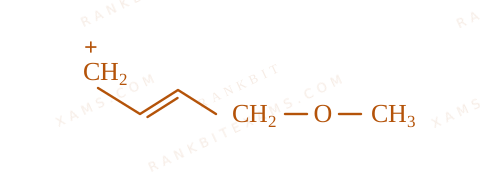
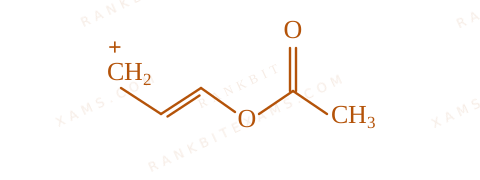
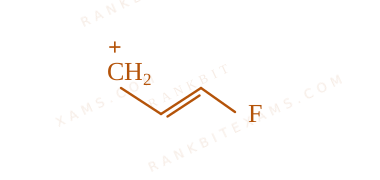
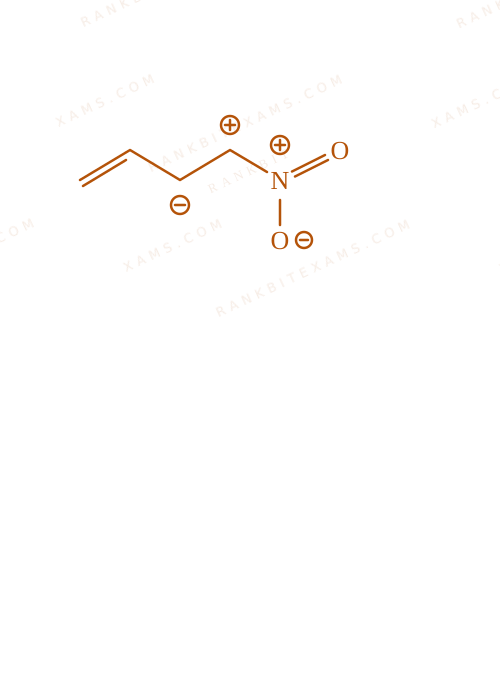
Carbocations are stabilized by structural factors such as the inductive effect (+I$+I$), mesomeric effect (+M$+M$), and hyperconjugation.
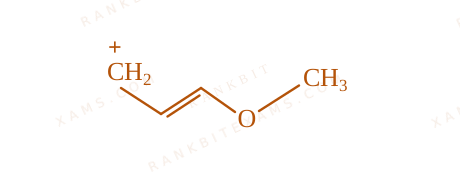
In Structure (2), the carbocation center is situated directly adjacent to a strong electronic donor methoxy group (-OCH_3$-OCH_3$). This configuration allows highly effective lone pair donation into the vacant p-orbital of the carbocation via the structural +M$+M$ mesomeric path, rendering it exceptionally stable.
### Pattern Recognition
An adjacent heteroatom with a lone pair (O, N$O, N$) triggers dynamic back-bonding stability (+M$+M$), which fundamentally outweighs basic hyperconjugation trends.
### Evaluation Rubric / Model Answer
null
### Chapter Mix
Class 11 Chemistry: Organic Chemistry - Some Basic Principles and Techniques
Keywords:#carbocations from the following is most stable#JEE Main 2025 Morning Q29#Organic Chemistry JEE Main 2025#Stability of Carbocations
More Organic Chemistry - Some Basic Principles and Techniques Previous-Year Questions

Q2025Hybridization in Organic Compounds
In 3, 3-dimethylhex-1-ene-4-yne, there are mathbfsp^3$\mathbf{sp}^3$, mathbfsp^2$\mathbf{sp}^2$ and mathbfsp$\mathbf{sp}$ hybridised carbon atoms respectively:
A.4, 2, 2$4, 2, 2$
B.3, 3, 2$3, 3, 2$
C.2, 4, 2$2, 4, 2$
D.2, 2, 4$2, 2, 4$
Solution
### Related Formula
textHybridization of Carbon = begincases mathrmsp^3 & 4~sigmatext-bonds \\ mathrmsp^2 & 3~sigmatext-bonds, 1~pitext-bond \\ mathrmsp & 2~sigmatext-bonds, 2~pitext-bonds endcases$\text{Hybridization of Carbon} = \begin{cases} \mathrm{sp^3} & 4~\sigma\text{-bonds} \\ \mathrm{sp^2} & 3~\sigma\text{-bonds}, 1~\pi\text{-bond} \\ \mathrm{sp} & 2~\sigma\text{-bonds}, 2~\pi\text{-bonds} \end{cases}$
### Core Logic
Let's first draw the structural formula of **3,3-dimethylhex-1-ene-4-yne**:
Hybridization in Organic Compoundsoverset6mathrmCmathrmH_3 - overset5mathrmC equiv overset4mathrmC - overset3mathrmC(mathrmCH_3)_2 - overset2mathrmCmathrmH = overset1mathrmCmathrmH_2$\overset{6}{\mathrm{C}}\mathrm{H}_3 - \overset{5}{\mathrm{C}} \equiv \overset{4}{\mathrm{C}} - \overset{3}{\mathrm{C}}(\mathrm{CH}_3)_2 - \overset{2}{\mathrm{C}}\mathrm{H} = \overset{1}{\mathrm{C}}\mathrm{H}_2$
### Step 1: Identify Hybridization of Each Carbon
We count the sigma (sigma$\sigma$) bonds or pi (pi$\pi$) bonds on each carbon:
- **mathrmC_1$\mathrm{C}_1$**: Involved in a double bond (mathrmCH_2 =$\mathrm{CH_2 =}$) implies mathrmsp^2$\implies \mathrm{sp^2}$
- **mathrmC_2$\mathrm{C}_2$**: Involved in a double bond (=mathrmCH-$=\mathrm{CH-}$) implies mathrmsp^2$\implies \mathrm{sp^2}$
- **mathrmC_3$\mathrm{C}_3$**: Single bonds only (bonded to mathrmC_2$\mathrm{C}_2$, mathrmC_4$\mathrm{C}_4$, and two methyl carbons) implies mathrmsp^3$\implies \mathrm{sp^3}$
- **Two methyl carbons** attached to mathrmC_3$\mathrm{C}_3$: Single bonds only implies 2 times mathrmsp^3$\implies 2 \times \mathrm{sp^3}$
- **mathrmC_4$\mathrm{C}_4$**: Involved in a triple bond (-mathrmC equiv$-\mathrm{C} \equiv$) implies mathrmsp$\implies \mathrm{sp}$
- **mathrmC_5$\mathrm{C}_5$**: Involved in a triple bond (equiv mathrmC-$\equiv \mathrm{C}-$) implies mathrmsp$\implies \mathrm{sp}$
- **mathrmC_6$\mathrm{C}_6$**: Single bonds only (-mathrmCH_3$-\mathrm{CH_3}$) implies mathrmsp^3$\implies \mathrm{sp^3}$
### Step 2: Calculate the Count
Summing the hybridization counts:
- mathrmsp^3$\mathrm{sp^3}$ carbons: mathrmC_3$\mathrm{C}_3$, mathrmC_6$\mathrm{C}_6$, and 2 times mathrmCH_3$2 \times \mathrm{CH_3}$ on mathrmC_3$\mathrm{C}_3$= 4$= 4$ carbon atoms
- mathrmsp^2$\mathrm{sp^2}$ carbons: mathrmC_1$\mathrm{C}_1$ and mathrmC_2$\mathrm{C}_2$= 2$= 2$ carbon atoms
- mathrmsp$\mathrm{sp}$ carbons: mathrmC_4$\mathrm{C}_4$ and mathrmC_5$\mathrm{C}_5$= 2$= 2$ carbon atoms
Thus, the number of mathrmsp^3$\mathrm{sp^3}$, mathrmsp^2$\mathrm{sp^2}$ and mathrmsp$\mathrm{sp}$ hybridized carbons is 4, 2, 2$4, 2, 2$ respectively.
### Pattern Recognition
Quick Tip: Always draw side substituents (like methyl groups) explicitly. A common mistake is to skip counting the methyl substituent carbons as mathrmsp^3$\mathrm{sp^3}$.
### Evaluation Rubric / Model Answer
null
### Chapter Mix
Class 11 Chemistry: Organic Chemistry - Some Basic Principles and Techniques
### Related Formula
textMethod Selection = fleft( Delta T_mathrmb, textdecomposition threshold, textvolatility with steam right)$\text{Method Selection} = f\left( \Delta T_{\mathrm{b}}, \text{decomposition threshold}, \text{volatility with steam} \right)$
### Core Logic
Let's align each purification technique to its designated mixtures based on NCERT guidelines:
- **(A) Simple distillation**: Used for liquids having a significant difference in their boiling points (>30~mathrmK$>30~\mathrm{K}$ or 30^circmathrmC$30^\circ\mathrm{C}$). Chloroform (b.p. 334~mathrmK$334~\mathrm{K}$) and aniline (b.p. 457~mathrmK$457~\mathrm{K}$) are separated easily using simple distillation rightarrow$\rightarrow$ **(III)**.
- **(B) Fractional distillation**: Used if boiling point differences of the components are very close (less than 25~mathrmK$25~\mathrm{K}$). Separation of petrochemical fractions such as diesel and petrol uses this technique rightarrow$\rightarrow$ **(I)**.
- **(C) Distillation under reduced pressure**: Used for liquids that tend to decompose at or below their normal boiling points. Glycerol is separated from spent-lye in soap manufacturing industry using this vacuum method to prevent glycerol decomposition rightarrow$\rightarrow$ **(IV)**.
- **(D) Steam distillation**: Applied to substances which are steam-volatile and completely immiscible in water. Aniline and water are separated using this technique rightarrow$\rightarrow$ **(II)**.
### Step 1: Conclusion
Thus, the correct match is:
**(A)-(III), (B)-(I), (C)-(IV), (D)-(II)**
This corresponds perfectly to option (4).
### Pattern Recognition
Glycerol from spent-lye is a highly tested practical chemistry concept. Remember that vacuum distillation lowers the boiling point, permitting evaporation without decomposition.
### Evaluation Rubric / Model Answer
null
### Chapter Mix
Class 11 Chemistry: Organic Chemistry - Some Basic Principles and Techniques
Q2025Quantitative Estimation (Dumas Method)
In Dumas' method for estimation of nitrogen, 0.5 gram of an organic compound gave 60~mathrmmL$60~\mathrm{mL}$ of nitrogen collected at 300mathrmK$300\mathrm{K}$ temperature and 715~mathrmmmHg$715~\mathrm{mmHg}$ pressure. The percentage composition of nitrogen in the compound (Aqueous tension at 300mathrmK = 15~mathrmmmHg$300\mathrm{K} = 15~\mathrm{mmHg}$) is
A. 1.257
B. 20.87
C. 18.67
D. 12.57
Solution
### Related Formula
p_mathrmN_2 = p_texttotal - p_textaq$p_{\mathrm{N_2}} = p_{\text{total}} - p_{\text{aq}}$n_mathrmN_2 = fracp_mathrmN_2 VR T$n_{\mathrm{N_2}} = \frac{p_{\mathrm{N_2}} V}{R T}$\% mathrmN = fractextMass of nitrogentextMass of organic compound times 100$\% \mathrm{N} = \frac{\text{Mass of nitrogen}}{\text{Mass of organic compound}} \times 100$
### Core Logic
Dumas' method estimates nitrogen by collecting dry nitrogen gas (N_2$N_2$). We must subtract the aqueous tension (vapor pressure of water) to find the pressure exerted solely by the dry nitrogen gas.
### Step 1: Calculate Pressure of Dry Nitrogen
p_mathrmN_2 = 715~mathrmmmHg - 15~mathrmmmHg = 700~mathrmmmHg$p_{\mathrm{N_2}} = 715~\mathrm{mmHg} - 15~\mathrm{mmHg} = 700~\mathrm{mmHg}$
Converting pressure to atmospheres:
p_mathrmN_2 = frac700760~mathrmatm$p_{\mathrm{N_2}} = \frac{700}{760}~\mathrm{atm}$
### Step 2: Calculate Moles of Nitrogen Gas
Using the ideal gas law with R = 0.0821~mathrmL~atm~mol^-1~K^-1$R = 0.0821~\mathrm{L~atm~mol^{-1}~K^{-1}}$, T = 300~mathrmK$T = 300~\mathrm{K}$, and V = 60~mathrmmL = 60 times 10^-3~mathrmL$V = 60~\mathrm{mL} = 60 \times 10^{-3}~\mathrm{L}$:
n_mathrmN_2 = fracleft(frac700760right) times 60 times 10^-30.0821 times 300$n_{\mathrm{N_2}} = \frac{\left(\frac{700}{760}\right) \times 60 \times 10^{-3}}{0.0821 \times 300}$n_mathrmN_2 = frac0.92105 times 0.06024.63 approx 2.244 times 10^-3~mathrmmol$n_{\mathrm{N_2}} = \frac{0.92105 \times 0.060}{24.63} \approx 2.244 \times 10^{-3}~\mathrm{mol}$
### Step 3: Calculate Mass and Percentage of Nitrogen
The molar mass of mathrmN_2$\mathrm{N_2}$ is 28~mathrmg~mol^-1$28~\mathrm{g~mol^{-1}}$:
textMass of mathrmN_2 = n_mathrmN_2 times 28 = 2.244 times 10^-3 times 28 approx 0.06283~mathrmg$\text{Mass of } \mathrm{N_2} = n_{\mathrm{N_2}} \times 28 = 2.244 \times 10^{-3} \times 28 \approx 0.06283~\mathrm{g}$
Now find the percentage in 0.5~mathrmg$0.5~\mathrm{g}$ of organic compound:
\% mathrmN = frac0.06283~mathrmg0.5~mathrmg times 100 = 12.566\% approx 12.57\%$\% \mathrm{N} = \frac{0.06283~\mathrm{g}}{0.5~\mathrm{g}} \times 100 = 12.566\% \approx 12.57\%$
### Pattern Recognition
Watch out! Always subtract the aqueous tension from the wet gas pressure first to find the dry gas pressure. Forgetting this step is the most common source of error in Dumas calculations.
### Evaluation Rubric / Model Answer
null
### Chapter Mix
Class 11 Chemistry: Organic Chemistry - Some Basic Principles and Techniques
Q2025Aromaticity and Huckel's Rule
Designate whether each of the following compounds is aromatic or not aromatic:
The diagram displays eight different cyclic conjugated hydrocarbon compounds labeled (a) through (h) to evaluate for aromatic character.
Choose the correct answer from the options given below:
A.text(1) e, g aromatic and a, b, c, d, f, h not aromatic$\text{(1) e, g aromatic and a, b, c, d, f, h not aromatic}$
B.text(2) b, e, f, g aromatic and a, c, d, h not aromatic$\text{(2) b, e, f, g aromatic and a, c, d, h not aromatic}$
C.text(3) a, b, c, d aromatic and e, f, g, h not aromatic$\text{(3) a, b, c, d aromatic and e, f, g, h not aromatic}$
D.text(4) a, c, d, e, h aromatic and b, f, g not aromatic$\text{(4) a, c, d, e, h aromatic and b, f, g not aromatic}$
Solution
### Related Formula
According to Huckel's Rule, a planar, monocyclic, completely conjugated system is aromatic if it contains:
(4n + 2)pi quad textelectrons (where n = 0, 1, 2, dots)$(4n + 2)\pi \quad \text{electrons (where } n = 0, 1, 2, \dots)$The diagram displays eight different cyclic conjugated hydrocarbon compounds labeled (a) through (h) to evaluate for aromatic character.The diagram displays eight different cyclic conjugated hydrocarbon compounds labeled (a) through (h) to evaluate for aromatic character.
### Step 1: Classification
Hence, compounds a, c, d, e, and h follow Huckel's rule and are aromatic, whereas b, f, and g are not aromatic.
### Pattern Recognition
Quick check for aromaticity: Count the pairs of localized/delocalized pi$\pi$ electrons moving through the continuous loop. Odd number of pairs (1, 3, 5...) means aromatic (2pi, 6pi, 10pi$2\pi, 6\pi, 10\pi$). Even pairs mean anti-aromatic/non-aromatic.
### Evaluation Rubric / Model Answer
null
### Chapter Mix
Class 11 Chemistry: Organic Chemistry - Some Basic Principles and Techniques
Class 11 Chemistry: Hydrocarbons
Q2025Free Radical Stability
Consider the following compound (X)
beginarrayc mathrm I \\ mathrm H - mathrm C equiv mathrm C - mathrm C H _ 2 - mathrm C H - mathrm C H _ 3 \\ mathrm I \\ mathrm C H _ 3 endarray$\begin{array}{c} \mathrm {I} \\ \mathrm {H} - \mathrm {C} \equiv \mathrm {C} - \mathrm {C H} _ {2} - \mathrm {C H} - \mathrm {C H} _ {3} \\ \mathrm {I} \\ \mathrm {C H} _ {3} \end{array}$
The most stable and least stable carbon radicals, respectively, produced by homolytic cleavage of corresponding mathrmC - H$\mathrm{C - H}$ bond are :
A.(1)\ textII, IV$(1)\ \text{II, IV}$
B.(2)\ textIII, II$(2)\ \text{III, II}$
C.(3)\ textI, IV$(3)\ \text{I, IV}$
D.(4)\ textII, I$(4)\ \text{II, I}$
Solution
### Related Formula
Free radical stability structural hierarchy sequence:
textResonance Stabilized (Propargyl/Allyl) > 3^circ > 2^circ > 1^circ > textVinylic/Alkyne Center$\text{Resonance Stabilized (Propargyl/Allyl)} > 3^\circ > 2^\circ > 1^\circ > \text{Vinylic/Alkyne Center}$
### Core Logic
Let's analyze individual cleavage points across the carbon backbone skeleton:
* **Position II** yields a propargyl intermediate radical directly adjacent to the alkyne bond. This allows strong resonance stabilization across the pi$\pi$ system, making it the most stable radical position.
* **Position I** places the radical directly on an mathrmsp$\mathrm{sp}$-hybridized carbon center. The high electronegativity of mathrmsp$\mathrm{sp}$ orbitals tightly holds the unpaired electron, making homolytic cleavage extremely difficult and rendering this intermediate the least stable radical position.
Free Radical Stability
### Step 1: Verdict
Therefore, the most stable and least stable positions are II and I, respectively.
### Pattern Recognition
Radicals located on mathrmsp$\mathrm{sp}$ carbons (vinylic/alkynic) are highly unstable due to poor orbital overlap, while positions next to triple bonds (propargylic) are exceptionally stable due to active resonance delocalization.
### Evaluation Rubric / Model Answer
null
### Chapter Mix
Class 11 Chemistry: Organic Chemistry - Some Basic Principles and Techniques
More Organic Chemistry - Some Basic Principles and Techniques Questions — jee_main_2025_24_jan_morning
We Map Every Repeating Question in Competitive Exams.
Say goodbye to generic mock test fatigue. RankBit uses smart analysis to group past exam questions into their foundational Repeating Question Types. Find chapter weightage, track repeating questions, and score higher with targeted practice.
Select Your Target Exam
Choose an exam track below to find formulas per chapter and patterns.
Syncing Exam Intelligence
Mapping formulas and patterns across all tracks…
PATH A — FULL LENGTH PRACTICE
Full Mock Test Hub
Simulate real NTA exam conditions with fully tracked mocks. Time yourself against past papers.
Under Development
PATH B — TARGETED PRACTICE
Topic-wise Practice Hub
Practice past-year questions one chapter at a time. Pick an exam → subject → chapter and get every PYQ for that topic — pulled together from all past papers — with the chapter's key formulas alongside.